
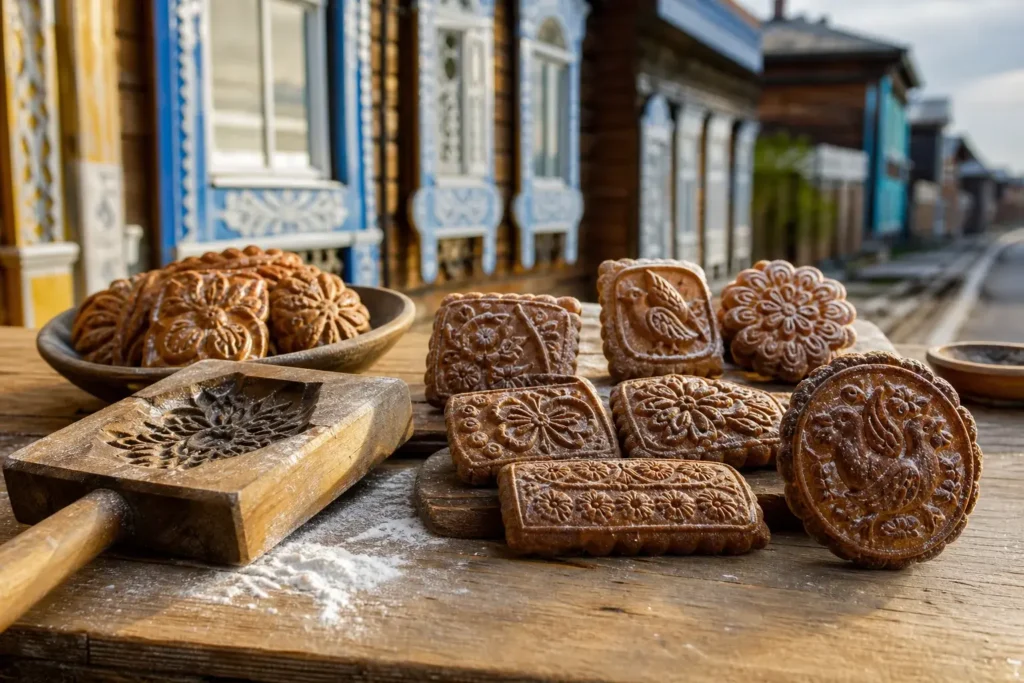
Gorodets gingerbread is one of Russia’s most celebrated regional sweets. If you’re curious about how to make Gorodets gingerbread, you’ll be recreating a tradition that has shaped this small Volga town for centuries. These thick, decorative honey cakes are stamped with intricate patterns carved into wooden molds—the hallmark of Gorodets craftsmanship.
This guide walks you through making them at home. You’ll need basic pantry ingredients and patience for the dough to rest. The result is a soft, fragrant cookie that captures the sweet history of this craft town.
Quick answer: Mix honey, flour, and spices to form a stiff dough. Refrigerate for at least 2 hours. Roll out, press into a floured wooden mold or cut into rounds, then bake for 10–15 minutes at 180–200°C until pale gold. Traditionally glazed while warm. Total time: 3–4 hours including resting.
At a Glance
| Type | Desserts & sweets |
|---|---|
| Local name | Городецкий пряник |
| Origin | Grain barges wintering in Gorodets cove brought Old Believers who saw opportunity in gingerbread production. By the second half of the 18th century, 75 producers made up to 128 tonnes annually. Nineteenth-century production peaked at 163 tonnes, with some pieces weighing 16–25 kilograms. These gingerbreads, sold at regional fairs, became famous throughout Russia and reached even Turkey. |
| Servings | 2–4 people (makes 8–12 pieces) |
| Total time | 3–4 hours including resting |
| Difficulty | Medium |
History and Story of Gorodets Gingerbread, Nizhny Novgorod
Pryaniki appeared in Russia in the 9th century and were called honey bread, made from rye flour, berry juice, and honey. Traders later brought spices from the Middle East and India, which were incorporated into the recipe. From the 17th to 19th centuries, pryanik baking became a major commercial activity, with the most popular varieties produced in Moscow, Arkhangelsk, Vologda, Vyazma, Gorodets, Tula, and Tver. Gorodets was an important center for both gingerbread production and woodworking. Masters carved wooden molds from hard woods such as maple, walnut, pear, and birch to supply other cities.
Ingredients
- 250 ml honey
- 400 ml wheat flour
- 100 g butter
- 1 egg
- 1/2 teaspoon ground cinnamon
- 1/4 teaspoon ground cardamom
- 1/4 teaspoon ground cloves
- 1/4 teaspoon baking soda
How Gorodets Gingerbread, Nizhny Novgorod Is Made
Step 1: Combine honey and spices
Gently warm the honey in a saucepan over low heat for 1–2 minutes, being careful not to boil it. Add the ground cinnamon, cardamom, cloves, and a pinch of salt. Stir well. Turn off the heat and let the mixture cool for about 5 minutes.
Tip: Do not overheat the honey or the spices will lose their flavor.
Step 2: Start the dough
In a large bowl, beat the egg and then add the softened butter. Cream together well. Gradually add the honey-spice mixture while stirring. Add the baking soda and mix until the soda is fully dissolved and the batter is smooth.
Tip: The baking soda reacts with the honey; you'll see slight foaming, which is normal.
Step 3: Add flour and form dough
Sift the flour and gradually add it to the mixture, stirring constantly until a stiff dough forms. The dough should come together but remain slightly sticky. Knead briefly with your hands if needed to bring it together into a ball.
Tip: Do not overmix; you want a crumbly, dense texture that holds together.
Step 4: Rest the dough
Wrap the dough in plastic or parchment paper and refrigerate for at least 2 hours. This resting period allows the honey and spices to infuse into the dough and makes it easier to shape. Longer rest (overnight) deepens the flavor.
Tip: Gorodets masters traditionally aged dough for days or even longer; a minimum of 2 hours is practical for home cooking.
Step 5: Shape the cookies
Remove dough from the fridge and work with a small portion at a time (keep the rest wrapped). If using a wooden mold, dust it lightly with flour, press a piece of dough into it, and release onto a baking sheet. If carving or using cutters, roll the dough to about 1 cm thick and cut into rounds or shapes.
Tip: Keep your work surface and mold lightly floured to prevent sticking. The mold imprints should be clear and defined.
Step 6: Bake the gingerbread
Preheat the oven to 180–200°C. Place the shaped dough pieces on a parchment-lined baking sheet with at least 2 cm between them. Bake for 10–15 minutes until the edges are pale gold and the surface is firm but still slightly soft to the touch. The cookies should not brown deeply.
Tip: Overbaking will make them hard; they should be slightly chewy when warm and firmer as they cool.
Step 7: Glaze while warm (optional)
While the cookies are still warm, you can brush them with a thin glaze made from powdered sugar mixed with a small amount of water or lemon juice to a spreadable consistency. Place glazed cookies on a rack to cool and the glaze will harden into a light coating.
Tip: Traditional Gorodets gingerbread is often left plain, but a simple glaze adds authenticity.
Variants
- Stamped cookies pressed into carved wooden molds (the traditional Gorodets method)
- Cut cookies shaped with metal cutters into rounds or figures
- Hand-molded cookies formed entirely by hand
- Glazed cookies coated with confectioner's sugar glaze
- Cookies filled with jam between two layers
- Decorated cookies with nuts or candied fruit pressed into the dough
Common Mistakes to Avoid
- Using flour that is too warm or not sifting it before adding, which can make the dough lumpy and uneven.
- Adding too much flour, which dries out the dough and creates a tough, crumbly cookie instead of the characteristic soft crumb.
- Skipping the refrigeration step. Properly rested dough holds the mold pattern better and bakes more evenly.
- Baking at too high a temperature or for too long, which causes the cookies to harden too much and lose their tender interior.
- Pressing too hard when using a wooden mold, which can crack the dough or distort the pattern.
- Not letting the dough come to room temperature slightly before shaping, which makes it difficult to work with.
How to Order and Eat It
Pryaniki are usually made in the form of small thick flat cakes coated with pastry glaze. Gorodets gingerbread is eaten as a standalone sweet treat, often with tea or coffee. The dense, chewy interior and crisp edges are characteristic. The stamped patterns are meant to be admired before eating. Historically, these cookies kept for months and were treasured gifts; today they remain popular souvenirs from the town.
To order: Пряник городецкий [Pryanik gorodetskiy]
Diet and Allergens
- Typically contains gluten
- Contains eggs
- Contains butter
Russia Vibes Tips
- Use floral or heather honey if available for a more authentic depth of flavor. The honey quality directly affects the taste, so avoid very mild honey.
- If you don't have a wooden mold, you can carve simple patterns into a wooden spoon handle or use traditional cookie cutters to approximate the style. The pattern matters less than respecting the traditional dense, spiced dough.
- Store baked gingerbread in an airtight container at room temperature. These cookies are famous for staying fresh for weeks, even months, thanks to the honey content and dense crumb.
- For the most authentic result, let the dough rest overnight or for at least 8 hours. This aging allows the honey and spices to fully develop, creating the characteristic complex flavor.
- Do not refrigerate the baked cookies; cold temperatures can make them hard. Keep them at room temperature in a sealed tin or jar.
Explore Nearby Gorodets Gingerbread, Nizhny Novgorod
Browse more: All Food & Drink · All Food & Drink in Nizhny Novgorod · All Nizhny Novgorod · All Other
FAQ
Is Gorodets gingerbread different from Tula gingerbread?
Both are stamped Russian gingerbreads from major production centers, but they have distinct traditions. Tula gingerbread is the most famous and often has chocolate filling or elaborate decoration. Gorodets gingerbread is typically unfilled, smaller in size historically, and emphasizes the carved wooden-mold pattern as the main decoration.
Does the recipe contain ginger?
Not necessarily. The name pryanik comes from the Russian word for spices, not ginger specifically. Ginger is optional, unlike honey, which is traditional. Cardamom, cinnamon, cloves, and nutmeg are more typical in authentic recipes.
Can I make these without honey?
Sugar is often used as a substitution for honey in industrial production and modern home-cooking. You can substitute honey with an equal amount of brown sugar or molasses, though the flavor will be slightly different and less complex.
How long does the dough need to rest?
A minimum of 2 hours refrigeration is practical. Traditional recipes call for several days of aging, which deepens the flavor and creates the characteristic dense, crumbly texture. Overnight resting (8–12 hours) is a good compromise.
Can I use a regular cookie cutter instead of a wooden mold?
Yes. While the carved wooden mold creates the authentic stamped pattern that defines Gorodets gingerbread, round or decorative cutters work well. The key is the spiced honey dough and proper baking; the pattern is secondary.
Why do these cookies keep so long?
The high honey and sugar content acts as a natural preservative. Combined with the dense crumb structure, Gorodets gingerbread can remain fresh at room temperature for weeks or even months if stored properly in an airtight container.
Can I make this dough in a food processor?
You can mix the wet ingredients and spices in a processor, but add the flour by hand at the end and knead briefly by hand. The manual kneading develops the texture properly and gives you better control over the dough consistency.
What glaze is traditional?
Prianiki had different flavors and were sometimes decorated with dedications or the name of a city. A simple glaze of powdered sugar and water or lemon juice is common. Warm cookies are brushed lightly while still pliable, creating a delicate coating that hardens as they cool.
Russia Vibes is a one-person project. A coffee keeps it going
How we research and update our guides
About this guide: AI assistance and accuracy
This guide is created with the help of AI and is based on official sources where available. Mistakes can still happen. Opening hours, prices, rules and other details are given to the best of our knowledge as of the date shown and can change without notice. It offers general recommendations only, not professional, legal or travel advice. Please confirm important details with the official source before you travel; you are responsible for your own plans and decisions.

Take this guide with you
Get a free PDF of this guide to print or read offline: key facts, tips and a map link on a few clean pages.
Report an issue on this page
Paying for your trip: please read
International sanctions affect payments between Russia and many other countries. In practice, cards issued in the EU, the UK, the US and several other countries often do not work in Russia, Russian cards usually do not work abroad, and some booking platforms, airlines and payment providers limit or suspend their services for Russia. The situation changes frequently.
We do not give legal or financial advice, and this site does not encourage anyone to break or circumvent sanctions. Whatever you plan, you are responsible for following the laws and regulations that apply to you, including those of your country of residence and citizenship.
Many travelers still organise their stay lawfully. It is worth asking your bank or payment provider what is currently permitted, contacting hotels, tour operators and carriers directly about the payment methods they accept, and checking which services are open to customers from your country. Clarify payment, cancellation and refund terms before you commit to a booking, and keep your plans flexible.
Partner links on this site may not be available in every country, and prices, availability and rules in our guides can differ from what you see when you book.