
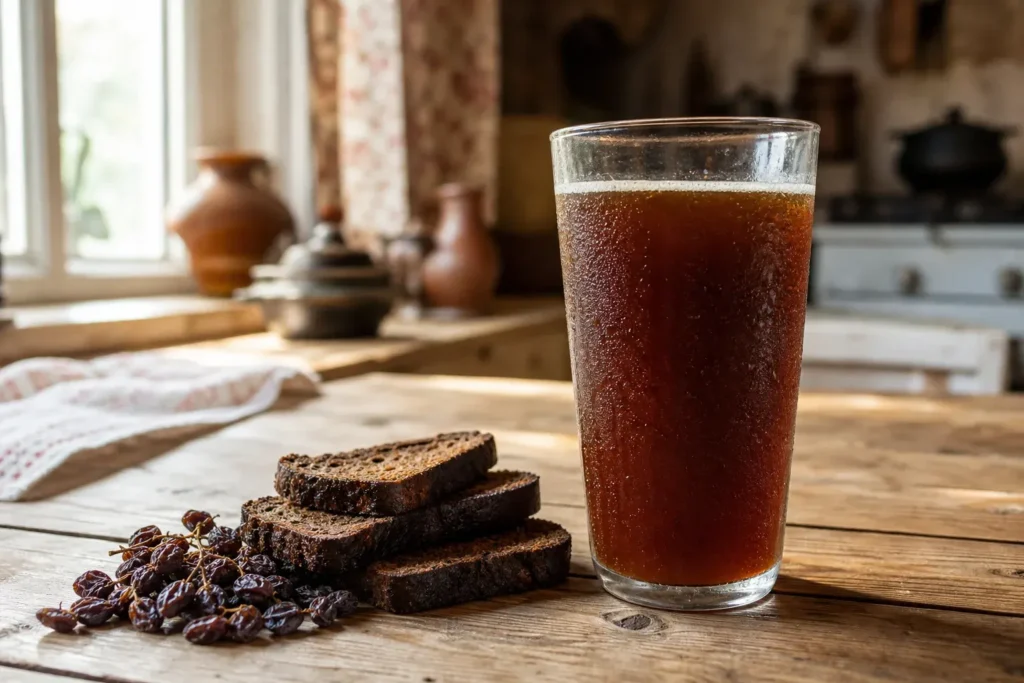
Kvass is one of Russia’s oldest drinks, documented since 988 AD. This naturally fermented beverage made from dark rye bread has sustained Russian life for over a millennium—from medieval fields to modern tables. If you want to understand how Russians traditionally quenched thirst and created a drink that works as both refreshment and ingredient in soups, how to make traditional kvass recipe reveals the simple method.
This guide shows you how to make authentic kvass at home. You’ll need just four basic ingredients and about three days of fermentation. The result is a lightly sour, malty, naturally carbonated drink with minimal alcohol content—something you can serve cold and share with anyone, from children to guests.
Quick answer: Toast dark rye bread until deeply browned, steep it in hot water with sugar and raisins for several hours, then ferment with yeast at room temperature for 2–3 days. The drink develops natural carbonation and a balanced sweet-sour taste. Total active time is about one hour, with most time spent waiting for fermentation.Traditional kvass costs almost nothing to make at home using inexpensive rye bread and basic pantry ingredients—typically a budget option compared to buying commercial versions.
At a Glance
| Type | Drinks |
|---|---|
| Local name | Квас |
| Origin | Russia and Eastern Europe, documented since 988 AD |
| Servings | Makes 2.5–3 litres, serves 4–6 |
| Total time | 48–72 hours, mostly fermentation |
| Difficulty | Easy |
History and Story of Kvass, Saint Petersburg
The drink was documented in 988 AD when Grand Prince Vladimir of Kiev distributed kvass to celebrate the Christianisation of Kievan Rus, making it one of the oldest recorded beverages in European history. The recipe remained unchanged across social classes—the fundamental drink of toasted rye bread fermented in water with a sweetener was universal in a way wine and imported beverages never were.Rye grew across the Russian steppe where wheat could not be relied upon, and stale or surplus rye bread, which every household had in abundance, was the raw material. The fermentation happened naturally from wild yeast on the bread and in the air, requiring no specialist equipment or knowledge.In the 16th century, kvass was listed in the Domostroy among mandatory home supplies, next to salted meat and sauerkraut. The wealthy made various kinds of kvass using rye bread or pears, raisins, cherries, bilberries and lingonberries. Soviet-era industrialization changed kvass production, but the drink remained central to Russian daily life.
Ingredients
- 400–500 g dark rye bread, preferably dense sourdough type
- 2.5–3 litres water
- 50–100 g sugar or honey
- 30 g unwashed raisins (contain natural yeast)
- ¼ teaspoon instant yeast (optional, but improves reliability)
- Large glass jar or food-grade bucket
- Cheesecloth or fine strainer
- Bottles suitable for carbonation
How Kvass, Saint Petersburg Is Made
Step 1: Prepare and toast the bread
Slice or tear dark rye bread into chunks roughly the size of croutons. Arrange on a baking sheet and toast in a 180–200°C oven for 20–30 minutes until very dark brown, completely dry and hard. The bread should look deeply caramelized but not burnt; this step extracts the malty sugars that give kvass its character.
Tip: Use traditional dense rye bread (Borodinsky or similar), not light supermarket rye. The darker and denser the bread, the deeper and more complex the final flavour.
Step 2: Steep the bread in hot water
Place the toasted bread pieces in a large glass jar or food-grade bucket. Bring 2.5 litres of water to a boil and pour it over the bread. Stir briefly, then let it soak for 4–8 hours (or even overnight) at room temperature. This extraction draws out the malted flavours into the water. Strain the liquid through cheesecloth into a clean container, pressing gently on the bread to extract all the liquid.
Tip: If using longer extraction (overnight), cover loosely to allow air circulation but keep dust out. The longer soak creates a deeper flavour.
Step 3: Add sugar and yeast
Pour the strained liquid into a clean fermentation vessel. Dissolve 50–100 g of sugar (or honey, which is more traditional) into the warm liquid. Once cooled to room temperature, sprinkle ¼ teaspoon of instant yeast over the surface and stir well. Add a small handful of unwashed raisins—they carry natural yeast that aids fermentation and add subtle fruit notes.
Tip: Do not use chlorinated tap water if possible; filtered or boiled water works better. Honey produces more authentic flavour than white sugar.
Step 4: Ferment at room temperature
Cover the jar with clean cheesecloth (not a tight lid, which can trap too much pressure). Place it in a warm, dim corner of your kitchen away from direct sunlight. Fermentation begins within 6–12 hours—you'll see bubbling and foaming. Leave undisturbed for 2–3 days, tasting after 48 hours. When the liquid becomes pleasantly sour and slightly sweet, fermentation is complete.
Tip: Room temperature (18–24°C) is ideal. Warmer speeds fermentation; cooler slows it. The sweet-sour balance is personal—stop sooner if you prefer it sweeter, longer for more sourness.
Step 5: Strain and bottle
Carefully strain the kvass through fine cheesecloth into clean bottles, leaving behind the settled solids and raisins (discard these or save for compost). If you want extra carbonation, add 2–3 raisins to each bottle before sealing. Bottles designed for carbonated drinks work best; do not use ordinary jars with regular lids.
Tip: Save a few raisins from fermentation to add to each bottle; they help create natural fizz during secondary fermentation.
Step 6: Secondary fermentation (optional carbonation)
Seal the bottles tightly and leave at room temperature for 12–24 hours. Gentle pressure will build inside as residual yeast continues to work and create carbon dioxide. You may hear a soft crackle when opening—this is normal. After this secondary fermentation, move bottles to the refrigerator. Cold stops fermentation and preserves the drink.
Tip: Check bottle pressure occasionally. If bottles feel rock-hard, they have sufficient carbonation; refrigerate immediately to prevent over-pressurization.
Variants
- Fruit kvass: Add dried or fresh berries (cherries, lingonberries, cranberries, bilberries) during fermentation for a more brightly flavoured, complex drink
- Mint kvass: Add fresh or dried mint sprigs during fermentation for a cooling, herbal quality, especially popular in summer
- Honey kvass: Use raw honey instead of sugar as the sweetener for a more traditional, delicate flavour
- Beet kvass: Ferment sliced raw beets in salted water instead of bread—this creates a different drink entirely, used as a health tonic
- Spiced kvass: Add a pinch of caraway seeds, coriander or hops during fermentation (hops also improve shelf life)
- Lemon kvass: Include fresh lemon slices (seeds removed) for a refreshing citrus note
Common Mistakes to Avoid
- Using light, soft rye bread instead of dark, dense, sourdough bread. Light bread yields pale, weak-flavoured kvass without the malty depth. Look specifically for dense, dark rye loaves.
- Covering the fermentation jar with an airtight lid from the start. This traps carbon dioxide and can cause excessive pressure. Always use cheesecloth, a clean towel, or a loose cover during primary fermentation.
- Fermenting in a cold kitchen (below 16°C). Fermentation slows dramatically or stalls. Room temperature (18–24°C) is essential for reliable results.
- Adding chlorinated tap water directly. Chlorine can inhibit natural fermentation. Use filtered or boiled-then-cooled water if your tap water is heavily treated.
- Skipping the raisins or using washed raisins. Unwashed raisins carry wild yeast essential for natural fermentation. Commercial yeast can substitute, but raisins are traditional and more reliable for beginners.
- Bottling before fermentation is complete (while still very sweet). This causes excessive pressure build-up. Always taste first and bottle only when the balance feels right.
- Storing in warm conditions after bottling. Always refrigerate after secondary fermentation to slow yeast activity and preserve the drink.
How to Order and Eat It
Kvass is served ice-cold, usually in small glasses. Pour from the bottle directly into a glass; if it has settled, the drink may be slightly cloudy, which is normal and authentic.Traditionally, kvass is drunk on its own as a refreshing beverage, especially on warm days. It was also said to be handy when a sour flavour had to be added to soups and vinaigrettes—many Russians use it as an ingredient in cold summer soups like okroshka rather than just as a standalone drink.A small glass of kvass is often served with a meal as a palate-cleansing accompaniment. The mild acidity aids digestion, and the minimal alcohol content makes it suitable for all ages.
To order: Квас пожалуйста [Kvas pozhaluysta]
Diet and Allergens
- Contains gluten (rye bread)
- Contains minimal alcohol: 0.5–2.6% depending on fermentation
Russia Vibes Tips
- If you cannot find dark rye bread in your location, you can create a substitute by toasting regular rye bread much longer than usual until it is deeply browned and hard, or by mixing rye flour with a small amount of molasses or malt extract before toasting. The goal is maximum caramelization to mimic the complexity of commercial dark rye.
- The balance between sweet and sour is completely personal. Taste kvass after 48 hours and every 6 hours after that. Some prefer it mostly sweet with just a hint of sour; others like it noticeably tangy. Fermentation time is your control—stop when it tastes right to you.
- Kvass ferments faster in warm weather (above 22°C) and slower in cool weather. In summer, watch carefully after 24 hours; in winter, allow closer to 72 hours. A thermometer on your fermentation jar helps you plan accordingly.
- Save the spent bread solids from straining. Many people reuse them to make a second, weaker batch of kvass (the 'second run'). The flavour will be gentler but still authentic. Alternatively, compost the solids—they are not edible.
- Homemade kvass keeps in the refrigerator for about a week. The carbonation gradually diminishes, and the drink becomes less fizzy and more sour over time. This is normal. Drink within 7–10 days; if the bottle develops an off smell or mould appears, discard it immediately.
- If fermentation seems very slow (no bubbles after 24 hours and room is cool), add a pinch more yeast or move the jar to a warmer spot. Traditional kvass can ferment on raisins alone, but in cool kitchens or with very old bread, a tiny bit of commercial yeast ensures success.
Explore Nearby Kvass, Saint Petersburg
Related guides
 Iset River Embankment & Plotinka Walk: Yekaterinburg’s Historic Heart
Main image: AI-generated illustration. It may not show the place exactly as it looks.
 Local Food & Market Walk, Yekaterinburg: Central Market, Pelmeni and Street Eats
Main image: AI-generated illustration. It may not show the place exactly as it looks.
Browse more: All Food & Drink · All Food & Drink in Saint Petersburg · All Other · All Saint Petersburg
FAQ
Is homemade kvass safe to drink?
Yes. The fermentation process creates acidity and yeast activity that preserve the drink safely. Traditional kvass undergoes double fermentation—both alcoholic and lactic, which creates a naturally protective environment. Always use clean equipment, sealed bottles, and refrigerate after fermentation. If anything smells vinegary-off or shows mould, discard it.
Does kvass contain alcohol?
Kvass contains a small amount of alcohol between 0.7% and 2.6%, depending on the recipe and raw materials. In Russia, commercial kvass is not considered an alcoholic beverage and is sold without restrictions to anyone including children. Homemade kvass may reach slightly higher alcohol levels depending on fermentation length and temperature.
Can I make kvass without yeast?
Yes. Fermentation happens naturally from wild yeast on the bread and in the air. Unwashed raisins carry sufficient wild yeast to start fermentation reliably. Commercial yeast speeds the process and guarantees success, but is not strictly required if you use raisins and allow extra time (up to 5 days).
What's the difference between kvass and beet kvass?
Beet kvass is a different drink: beets fermented in salted water. While both are traditional fermented Russian drinks, they have entirely different bases, flavours and uses. Beet kvass is often consumed as a health tonic in small amounts, whereas bread kvass is a refreshing everyday beverage.
Why is my kvass not getting fizzy?
Carbonation requires fermentation time and sealed bottles. During primary fermentation (first 2–3 days), keep the jar covered loosely with cheesecloth, not sealed. Only after straining into sealed bottles does pressure build and fizz develop—allow 12–24 hours of secondary fermentation at room temperature before refrigerating. Cold stops carbonation, so don't refrigerate too early.
Can I use regular white bread or wheat bread instead of rye?
Do not use wheat bread or light rye. Dark rye provides the malty, complex flavour that defines kvass. White bread produces a pale, weak result that tastes more like slightly fermented sugar water. The type of bread is central to authentic kvass—this is not negotiable.
How do I store finished kvass?
Always store in the refrigerator after fermentation is complete. Sealed bottles preserve carbonation and slowing yeast activity stops further fermentation. Kvass keeps for about a week in cold storage. It will gradually become less fizzy and more sour over time, which is natural. Discard if it develops an off-smell or visible mould.
Is homemade kvass different from commercial kvass?
From the 1960s and 70s, kvass began to be produced in bottles—and from that point it had little right to carry the name. That drink was not a product of fermentation but was made from kvass wort, sugar, lemon acid, and milk acid, all mixed and carbonated, called 'blended kvass'. Homemade kvass made from bread fermentation is the authentic product; many commercial versions are approximations.
Russia Vibes is a one-person project. A coffee keeps it going
How we research and update our guides
About this guide: AI assistance and accuracy
This guide is created with the help of AI and is based on official sources where available. Mistakes can still happen. Opening hours, prices, rules and other details are given to the best of our knowledge as of the date shown and can change without notice. It offers general recommendations only, not professional, legal or travel advice. Please confirm important details with the official source before you travel; you are responsible for your own plans and decisions.

Take this guide with you
Get a free PDF of this guide to print or read offline: key facts, tips and a map link on a few clean pages.
Report an issue on this page
Paying for your trip: please read
International sanctions affect payments between Russia and many other countries. In practice, cards issued in the EU, the UK, the US and several other countries often do not work in Russia, Russian cards usually do not work abroad, and some booking platforms, airlines and payment providers limit or suspend their services for Russia. The situation changes frequently.
We do not give legal or financial advice, and this site does not encourage anyone to break or circumvent sanctions. Whatever you plan, you are responsible for following the laws and regulations that apply to you, including those of your country of residence and citizenship.
Many travelers still organise their stay lawfully. It is worth asking your bank or payment provider what is currently permitted, contacting hotels, tour operators and carriers directly about the payment methods they accept, and checking which services are open to customers from your country. Clarify payment, cancellation and refund terms before you commit to a booking, and keep your plans flexible.
Partner links on this site may not be available in every country, and prices, availability and rules in our guides can differ from what you see when you book.