
Last updated
The Volga-Don Canal stands as one of the most ambitious hydraulic engineering projects of the 20th century. Built between 1948 and 1952, this 101-kilometer waterway connects the Volga River near Volgograd with the Don River near Kalach-on-Don, fulfilling a dream that engineers had pursued for nearly four centuries.
The canal descends 88 metres from the Volga and rises 44 metres to the Don, managed by 13 locks that allow ships of up to 141 metres long and 16.8 metres wide to traverse the elevation changes. Walking the embankment or taking a boat tour lets you see massive cargo vessels rise and fall through the impressive lock gates, their mechanisms hidden within monumental arch structures designed by architect Leonid Polyakov.
Quick Facts
| Russian name | Волго-Донской судоходный канал имени В. И. Ленина |
|---|---|
| Distance from the nearest major city | about 1,200 km |
| Travel time from the nearest major city | 12–14 hours by train or flight to Volgograd, then local transport |
| Built / opened | 1952 |
| Architect(s) | Leonid Polyakov (architectural ensemble); Sergey Zhuk (hydraulic engineer, Hydroproject Institute) |
| Address | Krasnoarmeysk, Volgograd Oblast OpenStreetMap · Google Maps |
| Admission | free |
| Best time to visit | May to September for canal navigation and warm weather. Peak summer (July–August) brings heat over 35°C, excellent light for photography, and maximum ship traffic (busiest mornings, 7–10 a.m.). June and September offer cooler temperatures and fewer crowds. Winter (November–March) closes the canal; ice, snow, and reduced visibility make the memorial and embankment less inviting but offer solitude. Spring flood (April–May) can muddy the embankment. Autumn (September–October) provides clear skies and wildlife migration. |
| Recommended duration | 2–3 hours |
| Last updated | October 18, 2026 |
What Is (and Isn't) Part of a Visit to Volga-Don Canal, Volgograd?
| Part | Status | Notes |
|---|---|---|
| The canal locks and water route (101 km total) | Included in the standard ticket | Free to view from the embankment at the Volga end; part of any organised boat tour. |
| The Lenin Monument and triumphal arch gateway | Included in the standard ticket | Free to view, accessible 24 hours, located at the Volga entrance near Krasnoarmeysk. |
| Canal Museum | Separate ticket or institution | Separate admission (small fee, approximately ₽); hours not widely published; ask locally or book via tour operator. |
| Boat tours and river cruises | Separate ticket or institution | Organised half-day or multi-day cruises depart from Volgograd; require advance booking through tour operators; prices ₽₽–₽₽₽₽ depending on length and amenities. |
| Mamayev Kurgan (WWII Memorial) and Volgograd city centre | Outside / not part of it | Located across the Volga river in central Volgograd, about 15–20 km from the canal Volga entrance; a separate destination requiring its own trip. |
| Viewing from vehicles while driving the canal road | Included in the standard ticket | A paved road parallels the canal for much of its length; free to drive and stop at viewpoints, though access to some lock areas is restricted. |
How to Get from the nearest major city to Volga-Don Canal, Volgograd
| Option | Duration | Price | Notes |
|---|---|---|---|
| Train from Moscow to Volgograd, then organised day tour | 14–16 hours total (12–14 hours train + 2 hours tour) | ₽₽ | Volgograd has daily rail connections to Moscow (10–12 hours). From Volgograd central station, book a guided tour through a hotel concierge or tour operator; tours typically depart 8–9 a.m. and return by 12–2 p.m. Best for a single-day excursion from Moscow. |
| Flight to Volgograd, then day tour | 5–7 hours total (2–3 hours flight + 2 hours tour) | ₽₽₽ | Daily flights connect Moscow and Volgograd (Gumrak Airport). Tour departures same as above. Preferable if time is limited; allows same-day morning arrival and afternoon canal visit. |
| Multi-day river cruise through the canal | 3–7 days | ₽₽₽ | Organised cruises depart from Volgograd, Moscow, or Saint Petersburg in summer (May–September). Passage through all 13 locks, crossing the Tsimlyansk Reservoir, and ending at Kalach-on-Don or Rostov. Includes accommodation and meals aboard. |
| Self-drive from Volgograd to embankment viewpoint | 1–2 hours from central Volgograd | ₽ | Rent a car and drive south to the Krasnoarmeysk lock complex (about 20 km). Free viewing of the monument and embankment. No guided experience, but allows flexible timing and multiple visits. |
₽ budget · ₽₽ moderate · ₽₽₽ upscale · ₽₽₽₽ splurge. Price levels are estimates compared with typical prices for visitors.
Why Visit Volga-Don Canal, Volgograd?
Visitors come to witness an engineering achievement that rivals the Suez and Panama canals in complexity, yet was completed in just 4.5 years—an astonishing feat. The canal transformed Volgograd’s geography and strategic importance immediately after World War II, and the monuments and triumphal arches lining its banks tell that story. You can walk the scenic embankment, watch ships navigate the locks, and understand how one waterway connects your current location to five different seas.
The experience combines industrial history, hydraulic engineering, and the dramatic landscape of the Volga steppe. Organised boat tours offer the rare experience of passing through the locks yourself, climbing and descending alongside freight vessels.
Highlights of Volga-Don Canal, Volgograd
First Lock Complex and Lenin Monument
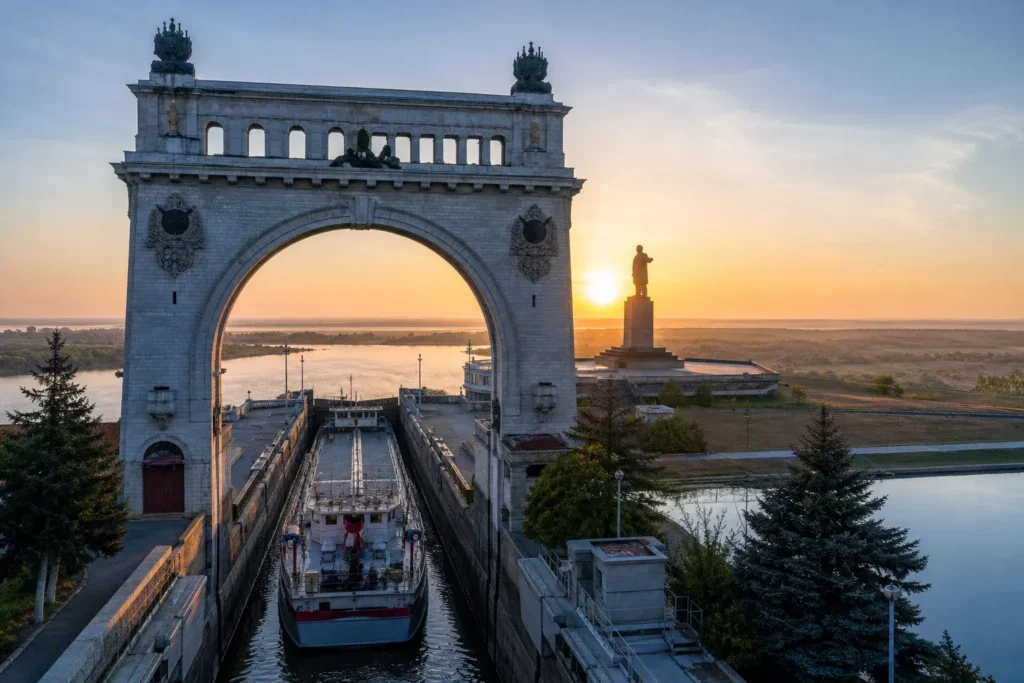
At the Volga entrance south of Volgograd stands the symbolic heart of the canal—a massive stone triumphal arch framing the first lock, with a 26-metre granite Lenin monument rising from its pedestal. Built in 1973 by sculptor Yevgeny Vuchetich and architect Benjamin Demin, the statue stands on a pedestal that originally held a Stalin monument erected at the 1952 opening. The arch itself is functional: the lock operating mechanisms and hydraulic cables run hidden inside its structure. This is where ships first begin their 88-metre descent toward the Volga.
Tip: Arrive early morning to see the memorial lit by rising sun and to catch ship transits between 7–10 a.m., when traffic is heaviest.
The Locks in Action
The canal features 13 locks spaced along its 101-kilometre route—nine on the Volga slope climbing 88 metres, and four on the Don slope descending 44 metres. Three gateway passages at the beginning of the Volga-Don canal are located within the borders of Volgograd city; the "steep climb" starts seven kilometres away from the third gateway, and at a stretch of nine kilometres gateways allow ships through, each next step rising until eventually reaching a point 50 metres above the first gateway. Watching a cargo vessel 120+ metres long rise or fall through a lock takes about 15 minutes and reveals the engineering principle: water fills or drains from the lock chamber, lifting or lowering the ship without engines or additional power.
Tip: Organised tours time their passage to transit during business hours (typically 6 a.m.–8 p.m., though schedules vary by season). The locks are busiest May–October when navigation peaks.
Triumphal Arch Gateways
Both ends of the canal are crowned with triumphal arches; the arches play an important role as the mechanisms for opening the gateways and cables are hidden inside. These are not mere monuments but load-bearing structures that conceal the hydraulic systems controlling the lock gates. All the facilities of the Volga-Don Canal represent a single architectural ensemble built according to the project of a group of authors under the direction of architect Leonid Polyakov. The arches are Art Deco-inspired, with clean lines and monumental proportions typical of Stalinist-era infrastructure.
Tip: The Volga-end arch is accessible and photographable from the embankment; walk up close to appreciate the scale and see the lock gates opening and closing beneath it.
The 88-Metre Descent
From Volgograd the vessels must first climb 88 metres; there are 13 locks along the route, which drops 88 metres to the Volga and 44 metres to the Don. This dramatic elevation difference between the two rivers was the primary engineering challenge. The canal overcomes it through a series of cascading locks that lift vessels like steps on a staircase. The two principal engineering problems solved in the Volga-Don construction were the difference in elevation of the two rivers, 44 metres, and the lack of an adequate system of feeder streams between the Volga and the Don. Three pumping stations maintain water levels throughout the system.
Tip: The grade is steepest in the first 9 kilometres; if short on time, focus on the Volga entrance locks and monument.
The Embankment and Walking Route
The Volga side of the canal lies in the suburbs of Volgograd and shows the first lock and its gates dominated by a beautiful arch. A scenic embankment walk connects several viewpoints at the Volga end, with benches overlooking the lock chambers. Visitors can enjoy the beautiful embankment in Volgograd with Lenin's statue. The embankment is landscaped with grass and trees, offering cooling shade during hot summer months. Fishing is common here, and locals use the area for evening walks.
Tip: Walk the embankment mid-morning or late afternoon to avoid midday heat (40°C+ in summer). The Lenin monument casts excellent photography shadows in early morning.
Canal Museum
The canal museum reveals exciting facts about the building, history and work of the canal and navigation. Located near the first lock, the museum exhibits construction photographs, engineering diagrams, and objects related to the canal's history. The museum is small (typically 1–2 hours to explore) but provides essential context for understanding what you see outside. Official opening hours and admission details are not widely published online, so ask at local tour operators.
Tip: Ask your hotel or a tour operator for current museum hours and whether an English-speaking guide is available; advance booking via tour agencies may be necessary.
The Tsimlyansk Reservoir Section
The huge Tsimlian reservoir lies along the canal route. Between the steep Volga locks and the Don descent, the canal crosses this broad, shallow reservoir created by a dam. To ensure adequate quantities and levels of water in the canal, there are three pumping stations (Karpovsky, Marinovsky, Varvarovskoy) that pump water back to the canal from the Tsimlyanskoye reservoir. In summer the reservoir warms enough for swimming, and the flat landscape and distant shores create a different atmosphere from the lock complexes.
Tip: River cruises spend most of a day crossing the reservoir; it offers a meditative contrast to the engineered drama of the locks. Wildlife (waterfowl, cormorants) is visible here in migration seasons.
Historical Context: The Monument to Closure
It is called the "Connection of the Fronts" and is installed on the site where the GDK closed the encirclement ring around the 6th German Army near Stalingrad. The canal's location was not chosen randomly—it crosses the narrowest land bridge between the Volga and Don, the exact geography of the Battle of Stalingrad (August 1942 – February 1943). People continued work on the project immediately after the Battle of Stalingrad in 1943. The canal was built across this hard-won ground as the city itself was being rebuilt, making it a monument to Soviet recovery.
Tip: Pair your canal visit with Mamayev Kurgan, Volgograd's WWII memorial, located on the opposite (west) bank of the Volga. Both sites are essential to understanding Volgograd's post-war identity.
Atmosphere
The canal embankment in summer is a place of industrial beauty and human leisure. Massive cargo vessels glide silently up or down through the locks, their bulk made dreamlike by the scale of the waterway. The monumental arch gates frame each lock like stage sets. Water churns as a 10,000-tonne ship rises in its chamber; the silence afterward is eerie. The air carries the smell of diesel fuel, wet stone, and steppe grass.
By day, the embankment is busy with fishermen lining the water, families walking, and occasional tour groups. Vendors sell ice cream and drinks near the Lenin monument. At night, the arch and statue are floodlit, and the locks’ machinery hums with maintenance. Spring and autumn bring waterfowl migration across the steppe and clearer light. Winter closes the canal to navigation, though ice and snow transform the landscape into an austere scene.
History of Volga-Don Canal, Volgograd
The idea of cutting a channel between the Volga and the Don is centuries old. In 1569 the Ottoman Turks began digging a canal in the hope of moving warships toward the Caspian, but the effort collapsed. In 1696 Peter the Great commissioned his own attempt, recognising the commercial and military value of a Volga-Don link, yet the technical demands of the era proved too great and the project was abandoned. Several later Russian engineers drew up plans, but none was completed.
Sergey Zhuk’s Hydroproject Institute began a design prior to the Second World War, which interrupted the process. The project of the construction was created in the middle of the 1930s but was not realised because of the Great Patriotic War; people continued work on the project immediately after the Battle of Stalingrad in 1943. The construction of the canal began in February 1948.
The canal was built within 4.5 years and is a unique period in world history. Tens of thousands of Soviet Gulag prisoners and war prisoners built this canal; about one hundred and sixty thousand Soviet prisoners passed through and laboured. Despite the well-established opinion that prisoners of the camps and prisoners of war built the canal, this is not entirely true—those and others were 100 thousand people, and there were 700 thousand free-labourers. In terms of complexity, the Suez Canal had seen comparable construction work, but it took more than thirty years for Suez to be built, and the Panama Canal took more than twenty years, while the Volga-Don was finished in an astonishing 4.5 years.
On 1 June 1952 the first ship navigated the newly built canal named after Vladimir Lenin. In 1952 the water of the Volga and the Don rivers merged and Volgograd became a port of five seas. In 1952, the Stalin Monument was erected on the pedestal for the opening of the Volga-Don Canal. The monument to Stalin was demolished in 1962 as part of the policy of de-Stalinisation; the 26-metre monument to Lenin was erected on an empty pedestal in 1973. All the facilities of the Volga-Don Canal represent a single architectural ensemble built according to the project of a group of authors under the direction of architect Leonid Polyakov.
Tickets and Booking for Volga-Don Canal, Volgograd
| Ticket | Price | Includes |
|---|---|---|
| Embankment access and viewing | Free | Access to the Volga-end embankment, Lenin monument, and triumphal arch; viewing of the first three locks from the shore; access to park benches and scenic walk areas. |
| Canal Museum | ₽ | Entry to the small museum of canal history, construction photographs, engineering exhibits, and navigation artefacts. Duration approximately 1–2 hours. |
| Half-day organised tour (embankment and museum) | ₽₽ | Guided walk, entrance to the museum, explanation of the locks and historical context. Typically 3–4 hours, includes pickup and drop-off from central Volgograd. |
| Day boat tour (partial canal) | ₽₽₽ | Passage through several locks on a small passenger vessel, close-up view of lock mechanisms in operation, onboard commentary, return to Volgograd. Typically 6–8 hours including travel time. |
| Multi-day river cruise (full canal transit) | ₽₽₽₽ | Accommodation aboard ship, all meals, passage through all 13 locks, Tsimlyansk Reservoir crossing, guided commentary, stops at riverside towns. Duration 3–7 days depending on itinerary. |
₽ budget · ₽₽ moderate · ₽₽₽ upscale · ₽₽₽₽ splurge. Price levels are estimates compared with typical prices for visitors.
Free viewing of the canal embankment, Lenin monument, and locks is available 24 hours at the Volga entrance south of Volgograd. No booking required.
For organised tours, boat cruises, and museum entry, contact tour operators in Volgograd; many hotels include tour desk services. Booking is essential 2–7 days in advance for summer season (May–September) and should specify whether you wish a half-day embankment tour or a multi-day cruise. Tours operate May–September; winter closure (November–March) halts all navigation. Museum hours are not published online; confirm with your tour operator or hotel concierge. Prices listed are approximate and subject to change; verify with the booking source. Note that fares and concessions for Russian citizens, students, and pensioners differ significantly from international rates. For all current ticket categories, tour schedules and prices, contact tour operators listed by Volgograd Convention and Visitors Bureau or check hotel tourism desks.
Plan and Book
Suggested itineraries Volga-Don Canal, Volgograd
2 hours (on-site only)
Arrive at the Volga-end embankment in early morning. Walk to the Lenin monument and triumphal arch for photographs with good light. Spend 20 minutes watching the first lock chamber (if a ship is transiting, timing will align). Walk the embankment north to view fishing areas and Volga panorama. Rest on a bench overlooking the lock gates. Depart by 10 a.m. Best for visitors with minimal time or as a stop between other Volgograd destinations.
4 hours (with museum)
Same as above (2 hours embankment walk and monument) plus 1.5–2 hours in the canal museum. Arrive by 8 a.m. to allow entry during morning hours. Museum provides necessary historical context before and after embankment viewing. Lunch in nearby Krasnoarmeysk town (casual cafes, no fine dining). Total trip time 5–6 hours including transport from central Volgograd.
Half-day (6–7 hours)
Book a guided half-day tour from Volgograd (typically 8–9 a.m. departure). Includes embankment walk, monument explanation, museum entry, and expert commentary on engineering. Lunch break included. Return to hotel by 2–3 p.m. Ideal for most visitors and includes logistics.
Full day (8–10 hours)
Book a day boat tour if available; passengers board a small cruise vessel that transits several locks between Krasnoarmeysk and the reservoir. Watch the lock-chamber filling and descent in real time. Experience the scale of the engineering from the water. Includes lunch aboard or in a riverside town. Alternative: rent a car and drive the canal road south to the second lock complex (40 km) and Don-side viewpoints; self-guided exploring of multiple lock sites. Return by evening.
How to Get to Volga-Don Canal, Volgograd
From central Volgograd to the Volga-end embankment:
- By taxi or ride-hailing app: 15–20 km south to Krasnoarmeysk; 20–30 minutes depending on traffic; ₽₽ fare.
- By car rental: Self-drive via the M6 highway south toward Astrakhan; exit signs for Krasnoarmeysk or ‘Volga-Don Canal’.
- By marshrutka (shared minibus): Operate from Volgograd central market area; less frequent and timing is unreliable; ask hotel staff for current routes.
- By organised tour: Hotel concierge arranges pickup from your accommodation and drop-off at the embankment; included transport in the tour package.
Public transport directly to the canal is limited. Most visitors use taxi or join an organised tour. Once at the embankment, all sites are walkable; the monument is visible from the car park, and the embankment is a 5–10 minute walk downhill.
Accessibility
The Lenin monument and embankment are accessible via a gently sloping paved area (no steps from the main viewpoint). The monument itself sits on a wide plaza with seating. Wheelchair access to the embankment is uneven in places due to paving age; a companion is recommended for those with limited mobility. The canal museum is small and may have narrow doors; confirm wheelchair access with the tour operator beforehand. The first lock viewing area has a waist-high stone barrier; photography from this point is good but standing is required. Lifts and accessible toilets are not published as available at the embankment; use facilities in central Krasnoarmeysk town (10 minutes by taxi).
Food Nearby
The Volga-end embankment has no on-site restaurants; bring water and snacks. Krasnoarmeysk town (10 minutes south by taxi or car) has basic cafes serving Russian fare (soups, grilled meat, bread). No fine dining exists near the canal. Volgograd city centre, 15–20 km north, offers wider choice. Most visitors eat before departing Volgograd or pack picnics to enjoy on the embankment benches.
What to Bring
Sun protection (hat, sunscreen, sunglasses) essential May–September; temperatures reach 35–40°C in July–August. Light, breathable clothing; the embankment offers limited shade. Sturdy walking shoes for uneven paving. A light jacket for early morning or evening. Camera with zoom lens for photographing ships and distant lock gates. Binoculars for birdwatching (waterfowl common along the water). Water bottle (refill at Krasnoarmeysk). Insect repellent in summer (mosquitoes near water). No bag restrictions at the embankment; no security checkpoint.
Best Views and Photo Spots of Volga-Don Canal, Volgograd
Lenin Monument and triumphal arch gateway, full frontal view from the plaza
The 26-metre granite Lenin figure stands against a stone arch framing the first lock chamber behind it. The monument is lit by morning sun, casting long shadows. Ships passing through the lock beneath add scale. The Volga and steppe grassland spread to the north.
Best time: Early morning (6–7 a.m.) for warm light and monument shadows; mid-June to mid-July for nearly no shadows (high sun).
Lock chamber viewed from embankment stone barrier, side angle
The rectangular lock chamber occupies the frame, with lock gates barely visible in their recesses. A cargo ship filling the chamber (if transiting) provides human scale. Water level rising or falling inside the chamber is visible.
Best time: Any time a ship is transiting; typically 7–10 a.m. or 3–5 p.m. in summer. Overhead sun (mid-day) reduces water reflection; late afternoon improves reflections.
Embankment walk north toward the Volga, with monument receding in the background
Wide-angle view of the monument distant on the skyline, embankment grass and benches in the foreground, Volga river and tree-lined far shore in the distance, steppe horizon beyond. Gives scale and context.
Best time: Late afternoon (5–6 p.m.) for backlighting and soft shadows; June for long daylight and minimal glare.
Close-up detail of the arch structure, showing stone carved decoration and scale
The arch's blocky Art Deco lines, coursed stone masonry, and the sheer height become apparent from directly beneath or beside it. If a lock mechanism is visible (behind bars or through openings), machinery detail appears.
Best time: Early morning or late afternoon to avoid harsh overhead shadows on the stone. Cloudy days flatten detail; clear days with oblique light show carving best.
Bench-seat viewpoint overlooking the lock and monument, with Volga and steppe in the frame
The entire lock complex in a single composition: monument, arch, lock chamber, and the Volga beyond. Sitting figures in the foreground (if present) add human context. Sky and light play across the water.
Best time: Golden hour (late afternoon, 5–7 p.m.); sunrise if arriving early. Wind-free mornings best for water reflections.
Photography Rules
Photography is free and unrestricted at the public embankment. Tripods are permitted but may draw attention; ask the ticket office if booking a tour. Drones are not officially regulated at this public site, but flying near infrastructure (locks, bridges, power lines) may attract authorities; check locally before launching. Flash is unnecessary in daylight and prohibited indoors at the museum if one exists. Best light is sunrise (6–7 a.m., golden light on the monument) and late afternoon (5–7 p.m., backlighting on the locks and Volga).
Family Suitability
The canal embankment is suitable for families with children and strollers. The paved surface is accessible for pushchairs, though some unevenness requires care. Benches provide rest points. Young children (3–8 years) enjoy watching ships and climbing on grass; the monument and locks are dramatic without being frightening. Older children (9+) appreciate the engineering and historical context if explained. No playgrounds or family facilities exist on-site; supervise children near the water barrier. The walk is unshaded in summer (hot for toddlers); bring sun protection and water. A museum visit adds 1–2 hours but requires patience for non-reading children. River cruises accept children but require them to stay close to railings; not ideal for very young or restless children. Best approach: short embankment walk (1–2 hours) for families, with an optional tour for context.
Russia Vibes Tips
- Arrive before 10 a.m. to catch morning ship traffic through the locks and to have the embankment to yourself before midday crowds and intense heat. Photographers should aim for 6–7 a.m. for monument shadows and golden light.
- The first three locks at the Volga end are the most accessible and dramatic; if short on time, focus here rather than attempting to drive 40+ km to the Don side. Most tours also concentrate on this section.
- Bring sunscreen and a hat even on cloudy days; the steppe reflects intense sun, and the embankment offers only scattered shade trees. Dehydration is common in summer; carry more water than you think necessary.
- Do not assume museum hours are posted online or that entry is straightforward; contact a tour operator or your hotel 1–2 days before visiting to confirm museum opening and to book entry if required.
- If taking a multi-day river cruise, book 4–6 weeks in advance during peak summer (July–August); cruises fill quickly and schedules are limited to the navigation season (May–September).
- Pair your canal visit with a day trip to Mamayev Kurgan (Volgograd's WWII memorial) across the Volga to understand the geographic and historical significance of the canal's location. Both are essential to grasping post-war Volgograd's identity.
Explore Nearby Volga-Don Canal, Volgograd
Browse more: All Day Trips · All Day Trips in Volgograd · All Landmarks · All Volgograd
FAQ: Volga-Don Canal, Volgograd
Is admission to the canal free?
Yes. The embankment, Lenin monument, and viewing areas are free and open 24 hours. Boat tours, river cruises, and the museum carry separate fees; these require advance booking through tour operators.
Can I see ships passing through the locks?
Yes, especially in summer (May–September). Ship traffic is heaviest 7–10 a.m. and 3–5 p.m. Each lock transit takes about 15 minutes. Winter closure (November–March) stops all navigation. An organized day boat tour lets you pass through the locks yourself aboard a small cruise vessel.
How do I get to the canal from Volgograd city centre?
The Volga-end embankment is 15–20 km south of central Volgograd. Taxi or ride-hailing app (₽₽, 20–30 minutes) is easiest. Alternatively, book an organized tour from your hotel (includes transport). Public transport is unreliable; ask your hotel concierge for current routes.
What is the Lenin monument, and why is it there?
A 26-metre granite statue erected in 1973 by sculptor Yevgeny Vuchetich, it replaced a Stalin monument demolished in 1962. It symbolizes Soviet engineering achievement and links the canal to the post-WWII reconstruction of Volgograd. The monument stands on the pedestal at the Volga entrance.
How long does it take to visit the canal?
A short embankment walk and monument view: 1–2 hours. Adding the museum: 3–4 hours total. A half-day organized tour: 6–7 hours including transport. A full-day boat tour or multi-day cruise offers deeper engagement with the locks and waterway.
When is the best time to visit?
May to September for warm weather and open navigation. June and September offer cooler temperatures than peak summer (July–August). July–August bring intense heat (35–40°C) but maximum ship traffic and excellent light for photography. Winter (November–March) closes the canal to ships; ice and snow transform the landscape but draw few visitors.
Are the triumphal arches part of the lock gates, or just monuments?
The arches are functional structures; the lock operating mechanisms, hydraulic cables, and gate control systems are hidden inside the stone arch itself. They are both monuments and load-bearing infrastructure essential to the canal's operation.
Can I visit the Don-end of the canal (near Kalach-on-Don)?
Yes, but it requires a multi-day river cruise or a long car journey (about 100 km from the Volga end via the canal road). Most day visitors focus on the Volga-end embankment and first three locks near Volgograd, as they are the most accessible and visually impressive.
Russia Vibes is a one-person project. A coffee keeps it going
How we research and update our guides
About this guide: AI assistance and accuracy
This guide is created with the help of AI and is based on official sources where available. Mistakes can still happen. Opening hours, prices, rules and other details are given to the best of our knowledge as of the date shown and can change without notice. It offers general recommendations only, not professional, legal or travel advice. Please confirm important details with the official source before you travel; you are responsible for your own plans and decisions.
International sanctions affect payments between Russia and many other countries. In practice, cards issued in the EU, the UK, the US and several other countries often do not work in Russia, Russian cards usually do not work abroad, and some booking platforms, airlines and payment providers limit or suspend their services for Russia. The situation changes frequently. We do not give legal or financial advice, and this site does not encourage anyone to break or circumvent sanctions. Whatever you plan, you are responsible for following the laws and regulations that apply to you, including those of your country of residence and citizenship. Many travelers still organise their stay lawfully. It is worth asking your bank or payment provider what is currently permitted, contacting hotels, tour operators and carriers directly about the payment methods they accept, and checking which services are open to customers from your country. Clarify payment, cancellation and refund terms before you commit to a booking, and keep your plans flexible. Partner links on this site may not be available in every country, and prices, availability and rules in our guides can differ from what you see when you book.Paying for your trip: please read
Report an issue on this page

Take this guide with you
Get a free PDF of this guide to print or read offline: key facts, tips and a map link on a few clean pages.