
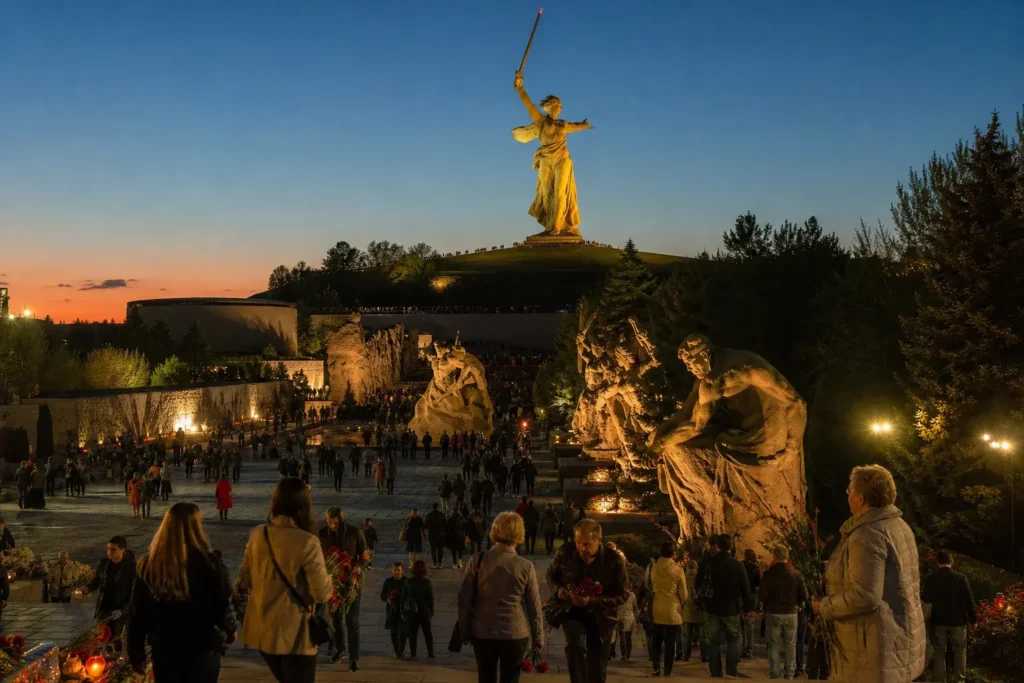
Victory Day has been observed annually on May 9 since 1945 and is one of the most revered and widely celebrated public holidays in Russia. It commemorates the Soviet Union‘s victory over Nazi Germany in 1945 and honours the approximately 27 million Soviet citizens who died during the Great Patriotic War.
Volgograd holds extraordinary significance for Victory Day. One of the decisive battles of World War II took place there from August 1942 to February 1943, when German armies at the limit of their advance attempted to capture Stalingrad. After bitter fighting during which the city was reduced to rubble, the German salient was cut off by Soviet forces, and an army group of some 300,000 men was annihilated. The battle saw nearly 99 percent of the city destroyed, earning Volgograd the prestigious Hero City status in 1945.
Quick Facts
| Russian name | День Победы |
|---|---|
| Type | Holiday / observance |
| When | Every year on May 9 |
| Next occurrence | May 9 (same date every year) |
| Typical duration | One day |
| Public holiday | Yes, a non-working day in Russia |
| District | Volgograd |
| Best time to visit | May 9 is the primary date for Victory Day celebrations. The day itself offers the most intensive ceremonies and largest gatherings. May 7–9 brings extended programming. Avoid arriving on May 9 evening if looking for quiet reflection, as crowds peak then. Early morning visits to memorials offer a more contemplative atmosphere before public ceremonies begin. Weather in early May is mild to warm in Volgograd. |
| Last updated | October 18, 2026 |
Dates, programs and prices change from year to year. Always check the official website for the current edition.
Why Visit Victory Day, Volgograd?
Volgograd on Victory Day offers a uniquely profound commemoration deeply rooted in historical reality. The program covers key memorial sites including Mamayev Kurgan, Fallen Fighters Square and the 62nd Army Embankment. From May 7–9, the action “Light of the Great Victory” is held on Mamayev Kurgan. The event traditionally includes lighting design of the memorial complex and evening commemorative displays highlighting the significance of the historical site.
On May 8, a wreath-laying ceremony takes place at the Eternal Flame at the Mass Grave of the defenders of Krasny Tsaritsyn and soldiers of the 62nd and 64th armies who died defending Stalingrad. The ceremonies and gatherings draw survivors, veterans, and citizens honouring those who died in one of history’s most consequential battles.
How Victory Day, Volgograd Is Celebrated
Throughout Russia, Victory Day brings parades, fireworks, and concerts held across the country. Since 2011, the Immortal Regiment March has become a defining observance. Citizens take to the streets silently every year carrying pictures of loved ones lost to war, a gesture that resonated with Russians everywhere.
In Volgograd specifically, the St. George Ribbon city patriotic action takes place during May, covering public spaces and aimed at popularizing the symbols of Victory. Families gather around a festive table to honour surviving witnesses of World War II and remember those who passed away. The day carries the weight of memory: Volgograd residents and visitors pay tribute to the city’s extraordinary sacrifice and the turning point the battle represented in the war.
What It Means for Your Visit
Victory Day is a public holiday in Russia, a fixed-date holiday observed on 9 May every year. This means most government offices, banks, and schools are closed. Many shops may have limited hours, though restaurants and cafes may remain open.
In Volgograd, expect large crowds at memorial sites, particularly Mamayev Kurgan and Fallen Fighters Square. Flower-laying ceremonies may cause temporary closures of surrounding streets. The Volgograd Region approves a comprehensive set of events dedicated to the anniversary, including flower-laying ceremonies, opening of memorial sites and city actions. Book accommodation in advance if visiting around May 9. Public transport typically operates, though with potential delays due to crowds. Check current event schedules with local tourism information, as specific programs vary by year.
Atmosphere
Victory Day in Volgograd carries an atmosphere distinct from celebrations elsewhere in Russia. The city’s identity is inseparable from its wartime history; every memorial, street and riverbank carries the imprint of the battle. On May 9, this solemn weight intensifies. Veterans, survivors and families gather at Mamayev Kurgan and other sites of remembrance, speaking softly amid crowds, many carrying flowers and photographs.
The evenings transform with illuminations on the memorial complex, creating a contemplative rather than purely celebratory mood. The Immortal Regiment marches fill squares with silent processions of portraits—grandfathers, aunts, cousins lost in the war. Fireworks eventually light the sky, but they are understood here not as entertainment but as a final salute to the fallen. In Volgograd, Victory Day feels less like triumph and more like sacred remembrance.
History of Victory Day, Volgograd
Since the Russian Federation formed in 1991, it has officially recognized 9 May as a non-working holiday, even if it falls on a weekend. However, the modern form of the celebration emerged later. The first military parade took place on May 9, 1965, marking 20 years since the victory over Nazi Germany. This is also when Victory Day became a public holiday in Russia and in 15 Republics of the Soviet Union.
In 1965, a World War II soldier, Leonid Brezhnev, rose to the rank of party secretary. Brezhnev leveraged general sentiment around the Great Patriotic War to rally support for his leadership. Russian Victory Day became a public holiday, with military parades and grand celebrations becoming the norm and continuing in present-day Russia.
Germany’s unconditional surrender was signed on May 8, 1945, at 23:01 Central European Time. Due to the two-hour time difference, it was already 01:01 on May 9 in Moscow when the surrender took effect. Joseph Stalin declared May 9 Victory Day, a day of both jubilant celebration and profound mourning.
For Volgograd, Victory Day holds additional meaning rooted in the Battle of Stalingrad. One of the decisive battles of World War II took place there from August 1942 to February 1943. The defeat of the Germans at Stalingrad is regarded by many historians as the turning point of World War II. The city’s heroic defense began in 1942 and ended a year later with the defeat of fascist forces and the almost complete destruction of the city, which was transformed to rubble. More than one million Russians and 200,000 Germans died.
In 2011, three journalists took it upon themselves to remind everyone by quietly walking through the streets with portraits of family members who died in the war. The gesture resonated with Russians everywhere, and it soon became the Immortal Regiment March. This grassroots movement has transformed Victory Day observance across Russia, including in Volgograd, where personal memory and national remembrance now intertwine.
Tickets and Booking for Victory Day, Volgograd
Victory Day is a free public observance. Entry to memorial sites such as Mamayev Kurgan and Fallen Fighters Square is generally free, though some museums may charge admission and have their own opening hours and policies. Ceremonies and commemorative events are public and free to attend. Check the official Volgograd region administration website or local tourism authorities for the current year’s program, timing of wreath-laying ceremonies, and any special events or restrictions, as programs vary annually.
Get Tickets for Victory Day, Volgograd
How to Get to Victory Day, Volgograd
Volgograd is best reached by air or train from Moscow or other major Russian cities. From Volgograd Central Railway Station or International Airport, take a taxi or local bus to reach central memorial sites. Mamayev Kurgan is in the northern part of the city; Fallen Fighters Square and the Eternal Flame are centrally located near the Volga embankment. Public marshrutkas (minibuses) and buses connect these sites. Walking between some central memorials is possible, though distances are substantial. For visitors unfamiliar with the city, a local taxi or hired guide may ease navigation to multiple sites on Victory Day, when crowds are heaviest.
Accessibility
Mamayev Kurgan features stairs and sloped pathways; wheelchair access is limited in some areas. The memorial museum may have varying accessibility depending on the specific section. Fallen Fighters Square and the Eternal Flame area are largely at street level and more accessible. Verify current accessibility conditions with specific venues or the Volgograd tourism office before visiting, as conditions and available services may change.
Food Nearby
Volgograd has restaurants, cafes and street food vendors near central memorial sites. The Volga embankment area has restaurants with river views. Many establishments may have reduced hours or be closed on Victory Day itself, so plan meals in advance. Local cuisine includes traditional Russian dishes. Convenience stores and small shops exist throughout the city center.
What to Bring
Flowers and wreaths are traditional; vendors near memorial sites sell them. Comfortable walking shoes are essential, especially for Mamayev Kurgan, which involves climbing. Dress warmly or lightly depending on the weather forecast—early May in Volgograd can be mild to warm. Bring water and sunscreen. A small bag is useful for carrying flowers and personal items; bag checks may occur at larger memorials.
Photography Rules
Photography is generally permitted at outdoor memorials and public spaces. Flash is typically discouraged indoors in museums. Drones and commercial filming require special permission. Be respectful during ceremonies; some moments call for quiet observation rather than active photography. Check with individual venues for their specific rules.
Family Suitability
Victory Day ceremonies are family-appropriate and welcoming to all ages. Children attend wreath-laying ceremonies, marches and outdoor commemorations. Mamayev Kurgan involves considerable walking and climbing, which may challenge young children or those with limited mobility. Strollers are possible on some paths but difficult on stairs. Many families find the solemn atmosphere, long processions and ceremonies engaging for teenagers and adults; younger children may find the length and emotional tone less suited to their attention span.
Russia Vibes Tips
- Arrive very early in the morning at Mamayev Kurgan if you wish to avoid the largest crowds. By late morning on May 9, thousands have gathered.
- Wear comfortable shoes with good grip; the stairs at Mamayev Kurgan are steep and numerous, and crowds make them more challenging.
- Bring flowers from outside Volgograd if possible, or purchase them the day before, as vendors near memorials may run out or charge premium prices on May 9 itself.
- Plan to attend the evening "Light of the Great Victory" illumination events (May 7–9) on Mamayev Kurgan for a different perspective; they are less crowded than daytime ceremonies.
- If visiting as a foreigner, position yourself respectfully during the Immortal Regiment marches—step aside and allow the silent processions to pass without interruption.
Explore Nearby Victory Day, Volgograd
Related guides
 Basilico, Volgograd: Italian Pasta, Pizza and Wine
Main image: AI-generated illustration. It may not show the place exactly as it looks.
 Volgograd-Baku Friendship Park: Free Riverside Greenspace with Cultural MonumentsOpen 24 hours
Main image: AI-generated illustration. It may not show the place exactly as it looks.
Browse more: More in Volgograd · All Events & Holidays · All Events & Holidays in Volgograd · All Holidays · All Volgograd
FAQ: Victory Day, Volgograd
Is Victory Day a public holiday in Russia?
Yes. Russia has officially recognized 9 May since 1991 and considers it a non-working holiday even if it falls on a weekend. Most businesses, offices and schools close.
Why is May 9 Victory Day and not May 8?
Germany's unconditional surrender was signed on May 8, 1945, at 23:01 Central European Time. Due to the two-hour time difference, it was already 01:01 on May 9 in Moscow when the surrender took effect.
What makes Volgograd significant for Victory Day?
One of the decisive battles of World War II took place in Volgograd from August 1942 to February 1943. After bitter fighting during which the city was reduced to rubble, the German salient was cut off by Soviet forces, and an army group of some 300,000 men was annihilated.
What is the Immortal Regiment March?
In 2011, three journalists started quietly walking through the streets with portraits of family members who died in the war. The gesture resonated with Russians everywhere, and it soon became the Immortal Regiment March. Citizens have since taken to the streets silently every year carrying pictures of loved ones lost to war.
Are the main memorial sites free to visit?
Entry to outdoor memorial sites like Mamayev Kurgan and Fallen Fighters Square is generally free. Associated museums may charge admission; check individual venues for current pricing and hours.
Should I book accommodation in advance for May 9?
Yes. Volgograd is historically significant for World War II, drawing visitors nationally and internationally on Victory Day. Hotels fill quickly; book well in advance for stays around May 9.
What time should ceremonies begin on May 9?
Wreath-laying ceremonies typically occur in the morning (around 10:00 a.m.). Check the Volgograd region official website closer to the date for the specific program and timing for that year.
Are there large crowds on May 9?
Yes, significantly. Victory Day is one of the most revered and widely celebrated public holidays in Russia, with parades, fireworks, and concerts held across the country. In Volgograd, the historic significance draws particularly large gatherings. Expect crowded memorials and slow movement between sites.
Russia Vibes is a one-person project. A coffee keeps it going
Last updated: October 18, 2026.
How we research and update our guides
About this guide: AI assistance and accuracy
This guide is created with the help of AI and is based on official sources where available. Mistakes can still happen. Opening hours, prices, rules and other details are given to the best of our knowledge as of the date shown and can change without notice. It offers general recommendations only, not professional, legal or travel advice. Please confirm important details with the official source before you travel; you are responsible for your own plans and decisions.
International sanctions affect payments between Russia and many other countries. In practice, cards issued in the EU, the UK, the US and several other countries often do not work in Russia, Russian cards usually do not work abroad, and some booking platforms, airlines and payment providers limit or suspend their services for Russia. The situation changes frequently. We do not give legal or financial advice, and this site does not encourage anyone to break or circumvent sanctions. Whatever you plan, you are responsible for following the laws and regulations that apply to you, including those of your country of residence and citizenship. Many travelers still organise their stay lawfully. It is worth asking your bank or payment provider what is currently permitted, contacting hotels, tour operators and carriers directly about the payment methods they accept, and checking which services are open to customers from your country. Clarify payment, cancellation and refund terms before you commit to a booking, and keep your plans flexible. Partner links on this site may not be available in every country, and prices, availability and rules in our guides can differ from what you see when you book.Paying for your trip: please read
Report an issue on this page

Take this guide with you
Get a free PDF of this guide to print or read offline: key facts, tips and a map link on a few clean pages.