
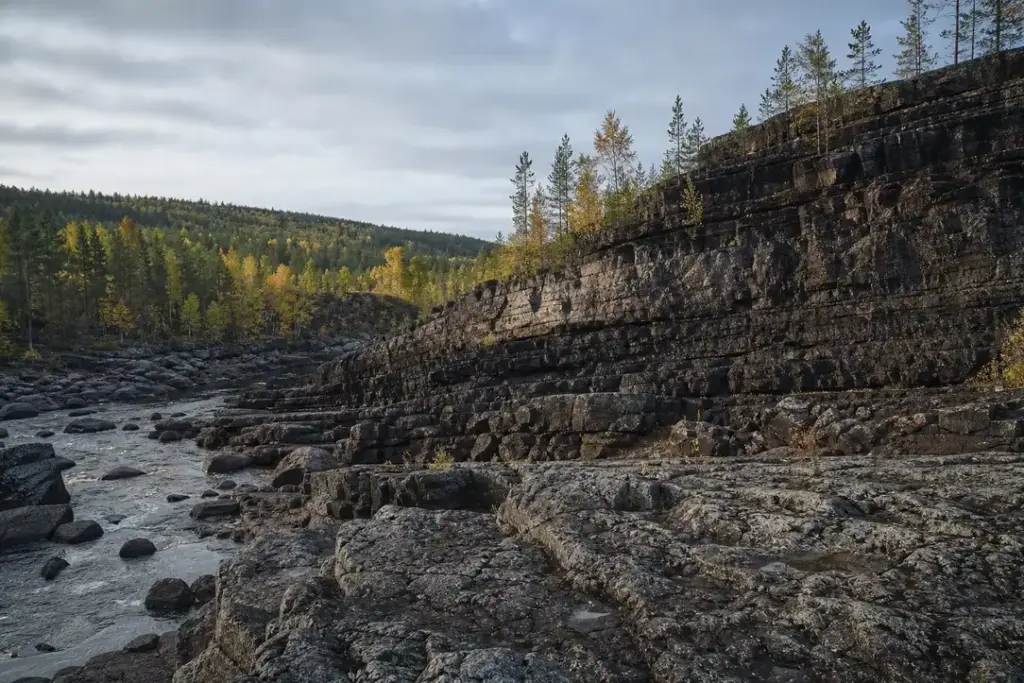
Girvas paleovolcano is an ancient extinct volcano located near the village of Girvas in Kondopozhsky District, roughly 1.5 hours by car from Petrozavodsk. This geological monument dates back 2–3 billion years, making it one of the oldest known volcanic sites on Earth. The site preserves fragments of the original magma vents, solidified lava flows, and crater traces in the riverbed of the Suna River.
Today visitors walk on exposed volcanic rocks and observe the layered structure of ancient lava that flowed across central Karelia during the Paleoproterozoic era. The paleovolcano was officially identified by geologists in 1967, after hydroelectric development in the 1930s drained sections of the riverbed, exposing the buried volcano.
Quick Facts
| Russian name | Палеовулкан Гирвас |
|---|---|
| Address | Girvasskoye rural settlement, Kondopozhsky District, Karelia, Russia Google MapsApple MapsYandex Maps2GIS |
| District | Kondopozhsky |
| Admission | Free |
| Best time to visit | Late spring (May) offers the best balance of accessibility and scenic interest. Summer and early autumn (June–September) provide stable weather and comfortable walking conditions with longer daylight hours. April–early May is ideal if you specifically want to see the Girvas waterfall, but expect wet rocks and crowded conditions if a major water release occurs. Winter is difficult due to snow, ice and frozen terrain, though the site remains accessible to those prepared for cold conditions. |
What Is (and Isn't) Part of a Visit to Girvas Paleovolcano, Karelia?
| Part | Status | Notes |
|---|---|---|
| Exposed paleovolcano formations (lava flows, crater traces, feeder channels) | Included in the standard ticket | Open to visitors at all times; walk directly on the rocks. |
| Girvas Waterfall | Included in the standard ticket | Visible only April–May during high water release from the hydroelectric station; small stream or dry riverbed the rest of the year. |
| Suna River valley and forest surroundings | Outside / not part of it | Part of the landscape but not part of the geological site itself. |
| Paleozerskaya Hydroelectric Power Station | Outside / not part of it | Located nearby; a separate modern industrial facility, not part of the paleovolcano visit. |
| Guided geological tours | Separate ticket or institution | Available through local tour operators; contact Petrozavodsk tourism for current options. |
Why Visit Girvas Paleovolcano, Karelia?
Girvas offers a rare opportunity to see a geological record spanning billions of years. Unlike younger mountain ranges or recent volcanic sites, the paleovolcano shows Earth’s ancient geology directly underfoot. The site preserves visible magma feeder channels, thermal spring deposits, and the distinctive pahoehoe lava flow patterns that geologists use to reconstruct how the volcano erupted.
The setting combines scientific significance with natural beauty: the rocky terrain sits within Karelian forest, and in spring the site can host a powerful waterfall when the nearby Paleozerskaya hydroelectric station releases water. This makes it suitable for both geology enthusiasts and general visitors exploring Karelia’s natural heritage.
Highlights of Girvas Paleovolcano, Karelia
Solidified Lava Flows
The site contains more than 20 solidified lava flows up to 32 metres thick, each formed during separate eruptions spanning millions of years. Walk across the rocky surfaces and observe how the molten rock cooled in place, leaving visible flow patterns and ridges.
Tip: The different lava flows are stacked vertically; look for the distinct layers and color variations to understand the timeline of eruptions.
Magma Feeder Channels
Visitors can observe several explosion tubes—magma supply channels—and touch them with their hands. These vertical conduits are where molten rock once rose from deep underground toward the surface, and they are unusually well preserved here.
Tip: The feeder channels are darker rock in sharp contrast to surrounding formations; ask a guide to point them out if visiting as part of a tour.
Ancient Crater Traces
Girvas is considered the best-preserved Paleoproterozoic paleovolcano on the territory of Fennoscandia. The crater zone remains visible, though much smaller than it was billions of years ago due to erosion and subsidence.
Tip: The crater area is subtle from ground level; geological knowledge helps interpret what you are seeing. Guided tours often provide clearer context.
Thermal Spring Deposits
A fragment of a once-hot thermal spring is accessible to visitors, showing the hydrothermal activity that followed the main eruptions. This deposit illustrates the geological aftermath of volcanism.
Tip: The thermal deposits are chemically altered rock; their unusual appearance and different mineral content make them distinct from fresh lava flows.
Girvas Waterfall (Seasonal)
A waterfall about 300 metres long flows over the paleovolcano only during high water in April–May, when the nearby Suna hydroelectric station releases excess water. During other seasons the riverbed carries only a thin stream or is dry.
Tip: If you visit in spring to see the waterfall, expect crowds and difficult footing on wet rocks. Plan a visit for May if possible, when water flows but conditions are more stable than early April.
Suna River Valley Setting
The extinct volcano is located in the riverbed of the Suna River, which continues to flow through the ancient rocks today. The river valley frames the geological formations and provides context for understanding post-volcanic erosion.
Tip: The rocks are slippery when wet or after rain; wear sturdy footwear with good grip even during dry seasons.
Atmosphere
Girvas feels like stepping into deep time. The site is quiet, forested, and isolated from tourist crowds compared to more famous Karelia attractions. The riverbed consists entirely of dark volcanic rock—a stark contrast to the surrounding birch and pine forest. In summer, ferns and moss grow in crevices between the rocks, softening the otherwise stark geology.
On clear days the site is windswept and exposed. The Suna River flows gently or dramatically depending on the season and hydroelectric operations. In spring during high water, the roar of the waterfall creates an atmosphere of power. At other times the place is peaceful and introspective. Few visitors arrive on any given day outside of organized tours, making it possible to experience long periods of solitude with 2-billion-year-old rock.
History of Girvas Paleovolcano, Karelia
The Girvas volcano was active more than 3 billion years ago, with the last eruption occurring about 2 billion years ago. Eruptions in the period 2.1–1.97 billion years ago were of catastrophic proportions, as evidenced by powerful strata of pyroclastic rocks.
The stratovolcano had a height of approximately 700 metres, though geologists emphasize this is a partial reconstruction; the original volcano may have been significantly larger. Lava flows poured out over thousands of square kilometres; the entire territory of central Karelia was covered with a thick layer of plateau basalts.
The location where the crater and traces of lava fields are situated was under the riverbed of the Suna River until the beginning of the 20th century. Now the volcano is a rocky slope. Water flowed down it, forming two beautiful waterfalls of Karelia: Poor-threshold and Girvas, with a height of 15 metres.
In 1933, the Paleozerskaya hydroelectric power station was built on the site of the Girvas waterfall. The neighbouring riverbed, where there was a waterfall Poor-threshold, was blocked by a dam. The riverbed was drained and scientists were able to study the rock, so the location of the ancient volcano Girvas was discovered. Scientists from Petrozavodsk officially identified the paleovolcano in 1967.
Legends and Myths about Girvas Paleovolcano, Karelia
The Moose of Girvas
Legend – historically unreliable. The toponym is based on the Finnish and Karelian word 'hirvas'—moose. According to a local legend, once a beautiful and noble moose, running away from hunters, turned into a rock, giving rise to one of the most beautiful waterfalls in Karelia.
Tickets and Booking for Girvas Paleovolcano, Karelia
Entry to the Girvas paleovolcano is free; there is no admission charge and no booking required. The site is open year-round and accessible directly from the roadside.
Getting there: The site is located along the Kola Highway between Kondopoga and Medvezhegorsk, approximately 1.5 hours by car from Petrozavodsk. From the highway, a short walking trail leads down to the riverbed where the paleovolcano is exposed.
Parking and access: Informal parking is available near the site. The terrain is rocky and uneven; sturdy footwear is essential. In spring, rocks are wet and slippery.
Guided tours: Girvas is often visited as part of organized tours from Petrozavodsk that combine it with other sites such as Kivach Waterfall, Sampo Mountain, and Marcial Waters. Tours typically last 8–10 hours for the full Golden Ring of Karelia itinerary. Check with Petrozavodsk tourism offices or tour operators for current availability and schedules.
Suggested itineraries Girvas Paleovolcano, Karelia
1 hour
Walk the main exposed lava flows and observe the crater traces. Focus on the different rock layers and the contrast between weathered and fresh volcanic surfaces. Suitable for visitors with limited time or mobility concerns.
1.5–2 hours
Explore the full site, including the magma feeder channels, thermal spring deposits, and the main lava flow areas. Walk the Suna riverbed in both directions to understand the scale and distribution of volcanic material. Best for those interested in geology.
Half day (3–4 hours with driving)
Include Girvas as part of a Golden Ring of Karelia tour. Combine with Marcial Waters (Peter the Great's historic resort), Sampo Mountain, and Kivach Waterfall. Allows time for the paleovolcano site plus lunch and a second major attraction.
Spring day trip (April–May)
Visit Girvas specifically to see the seasonal waterfall during high water, then explore the paleovolcano rocks. Combine with nearby Marcial Waters or a riverside picnic. Total 4–5 hours from Petrozavodsk.
How to Get to Girvas Paleovolcano, Karelia
By car from Petrozavodsk: Drive north on the Kola Highway (M18/P-21) toward Medvezhegorsk for approximately 90–100 km. The site is between Kondopoga and Medvezhegorsk, near the village of Girvas. Follow signs for the paleovolcano or ask locally. Journey time is roughly 1.5 hours from the city centre.
From the road: Turn off the Kola Highway and follow local directions to a small parking area. A marked or informal footpath leads down to the riverbed through the forest. The walk to the main formations takes 5–15 minutes depending on exactly where you park.
By organized tour: Arrange a guided tour through tourism offices in Petrozavodsk or hotels in the area. Most tours combine Girvas with Marcial Waters, Sampo Mountain, and Kivach Waterfall as a full-day Golden Ring of Karelia itinerary. Tours depart in the morning and return in the evening.
Public transport: No direct bus service to the paleovolcano exists. You must either rent a car, join a tour, or hire a taxi from Petrozavodsk.
Accessibility
The site consists of rough, uneven rock terrain with significant elevation changes between different lava flow levels. There are no paved paths, handrails, or facilities. Wheelchair access is not possible. The rocks are slippery when wet. Those with mobility limitations or balance concerns should assess their fitness before attempting the walk. Children should be supervised closely due to the rocky terrain and proximity to the river.
Food Nearby
No restaurants or shops are located at the site itself. The nearest services are in Girvas village (approximately 5–10 km) or Kondopoga and Medvezhegorsk. Pack snacks and water if visiting independently. Organized tours often include meal stops in Medvezhegorsk or nearby facilities.
What to Bring
Sturdy hiking boots with good grip are essential—rocks are slippery even in dry conditions and extremely dangerous when wet. Bring water, especially in summer. A light jacket or windbreaker, as the exposed rocky terrain offers no shelter. In spring, waterproof clothing is advisable. Sunscreen and insect repellent are useful in warm months. A geological field guide or smartphone camera can enhance the experience if you are interested in rock types and formations.
Best Views and Photo Spots of Girvas Paleovolcano, Karelia
Main lava flow overlook
Wide view of the stacked lava layers and the broader river valley. Shows the scale of the volcanic deposit and provides context for the scale and extent of the site.
Best time: Morning light from the east side; overcast days reduce harsh shadows on the complex rock surfaces.
Suna River from the paleovolcano
The river flowing through the volcanic rock, emphasizing how modern erosion has exposed the ancient formations. Depending on water level, this shows the contrast between the clear riverbed and dark volcanic stone.
Best time: Any time, but spring high water (April–May) creates dramatic flow and possible waterfall views.
Close detail of lava texture and pahoehoe patterns
Macro view of the frozen lava surface showing the distinctive rope-like patterns of Hawaiian pahoehoe lava. Demonstrates the texture and cooling behavior of the original eruption.
Best time: Bright, clear days when shadows emphasize surface detail; avoid backlighting that obscures texture.
Feeder channel from above
The darker vertical magma conduit against surrounding lighter lava, showing the pathway magma took to reach the surface. Illustrates the internal plumbing of the ancient volcano.
Best time: Overcast light or morning sun to reduce glare; position to show depth and color contrast.
Photography Rules
Photography is permitted and encouraged. The site offers dramatic rocky textures and layered formations that photograph well in overcast light or early morning. In spring with the waterfall, dramatic landscape shots are possible. The rocky terrain and forest create interesting foreground and background options. Avoid drones without explicit permission from local authorities. Tripods are practical on stable rock surfaces but may be difficult to position safely on uneven ground.
Family Suitability
Girvas is suitable for older children and families comfortable with rough terrain. The site has no guardrails, paved paths, or facilities, making it unsuitable for very young children, strollers, or those with limited mobility. Children must be closely supervised due to slippery rocks and proximity to water. The site is educational for school-age children interested in geology or natural history. The visit is physically demanding and requires good balance. Families with young children should consider visiting as part of an organized tour where a guide can manage timing and safety. Best suited for children aged 8 and older with outdoor hiking experience.
Russia Vibes Tips
- Visit in May if you want to see the waterfall. The Paleozerskaya hydroelectric station typically releases water for a few days to a week in late April or early May, creating the dramatic Girvas waterfall. Call ahead to Petrozavodsk tourism to confirm timing before planning your trip.
- Wear rocks-specific footwear, not general hiking boots. The volcanic rock is rougher and sharper than typical mountain stone, and boot soles can wear quickly. Good grip matters more than cushioning. Many locals recommend hiking shoes with aggressive tread.
- Visit on a weekday or outside July–August to avoid crowds, especially if visiting as an independent traveler. Tour groups often arrive midday, particularly June–September and during Russian holidays.
- Do not attempt the site alone in poor weather, especially rain. Rocks become treacherous when wet, and visibility is reduced in mist. The exposed location offers no shelter, and the river can rise quickly.
- Bring a simple geology reference or download a guide before arrival. The paleovolcano is not self-explanatory; understanding lava flows, feeder channels, and crater structures greatly enhances the visit. Organized tours provide this context.
Explore Nearby Girvas Paleovolcano, Karelia
Related guides
 Best Things to Do in Summer, Karelia: Eight Essential Activities
Main image: AI-generated illustration. It may not show the place exactly as it looks.
 Kivach Waterfall: Hours, Access and What to SeeOpen daily 08:00–21:00
Main image: AI-generated illustration. It may not show the place exactly as it looks.
 Kivach Nature Reserve: Waterfall, Taiga and Russian Literary HistoryOpen daily 07:00–23:00
Main image: AI-generated illustration. It may not show the place exactly as it looks.
Browse more: More in Kondopozhsky · All Karelia · All Landmarks · All Sightseeing · All Sightseeing in Karelia
FAQ: Girvas Paleovolcano, Karelia
Is the paleovolcano free to visit?
Yes, entry is completely free. There are no tickets, gates, or admission fees. The site is open access year-round.
When can I see the Girvas waterfall?
Water from the Suna River is diverted for the needs of the Suna hydroelectric power station, but in spring when the volume of water is excessive, it flows directly through the paleovolcano, creating a waterfall. This occurs for a few days to a week in late April or early May.
How old is the Girvas volcano?
About 2 billion years have passed since the last eruption. The volcano was active more than 3 billion years ago, making it one of Earth's oldest known volcanic structures.
Can I visit without a guide?
Yes, the site is freely accessible without a guide. The exposed formations are visible and you can walk the area independently. However, a guide or geological background significantly improves understanding of what you are seeing.
What do I actually see at Girvas?
You see dark volcanic rock formations including solidified lava flows stacked vertically, magma feeder channels, crater traces, and thermal spring deposits. The site is not a dramatic landform like a mountain; it appears as rocky terrain in a river valley. Understanding the geology helps appreciate the significance.
How long should I spend there?
Allow 1–2 hours. A quick visit of 30–45 minutes lets you see the main formations. 1.5–2 hours gives time to explore the full site, walk both directions along the riverbed, and observe details like lava texture and feeder channels.
Is there parking and are there facilities?
Parking exists near the site but is informal; no dedicated parking lot or facilities (restrooms, shops, restaurants) are available. Pack water and snacks. The nearest services are in Girvas village or nearby towns.
Can I combine Girvas with other attractions?
Yes. Girvas is often visited as part of the Golden Ring of Karelia tour including Marcial Waters, Sampo Mountain, and Kivach Waterfall. This makes a full-day outing from Petrozavodsk. Organized tours typically combine these sites.
Russia Vibes is a one-person project. A coffee keeps it going
Looking for more on this? Kolomenskoye Museum-Reserve: Half-Day Itinerary: Church, Palace, Park (Moscow Vibes)

Take this guide with you
Get a free PDF of this guide to print or read offline: key facts, tips and a map link on a few clean pages.
Report an issue on this page
Paying for your trip: please read
Payments and bookings between Russia and many other countries are currently restricted. In practice, cards issued in the EU, the UK, the US and several other countries often cannot be used in Russia, Russian cards usually cannot be used abroad, and some booking platforms, airlines and payment providers limit or pause their services for Russia. The situation changes frequently.
We do not give legal or financial advice, and this site does not encourage anyone to break any rule that applies to them. Whatever you plan, you are responsible for following the laws and regulations that apply to you, including those of your country of residence and citizenship.
Many travelers still organise their stay without problems. It is worth asking your bank or payment provider what is currently possible, contacting hotels, tour operators and carriers directly about the payment methods they accept, and checking which services are open to customers from your country. Clarify payment, cancellation and refund terms before you commit to a booking, and keep your plans flexible.
Partner links on this site may not be available in every country, and prices, availability and rules in our guides can differ from what you see when you book.
How we research and update our guides
About this guide: AI assistance and accuracy
This guide is created with the help of AI and is based on official sources where available. Mistakes can still happen. Opening hours, prices, rules and other details are given to the best of our knowledge as of the date shown and can change without notice. It offers general recommendations only, not professional, legal or travel advice. Please confirm important details with the official source before you travel; you are responsible for your own plans and decisions.
* Affiliate link: as an Amazon Associate we earn from qualifying purchases at no extra cost to you.