
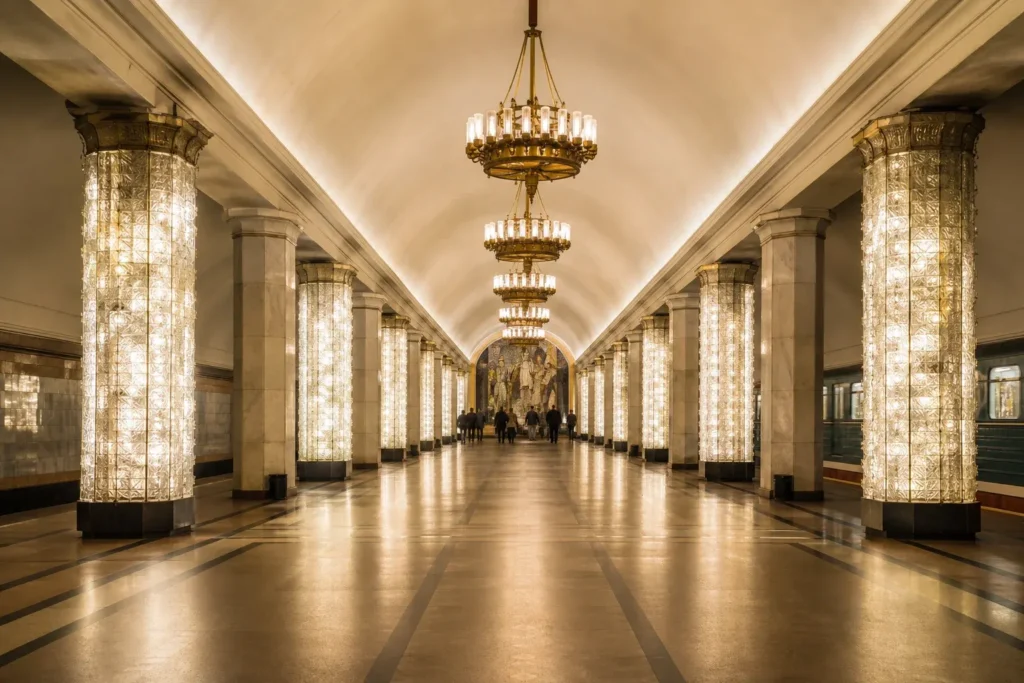
Avtovo Metro Station is one of the seven stations that opened with the first Leningrad metro line on 15 November 1955, and it is the one most visitors come to photograph. It sits in the Kirovsky District in the south-west of Saint Petersburg, at the southern end of the original line, behind a neoclassical vestibule with a dome.
Below it is a long, high hall lined with two rows of columns, some of them faced with glass that glows like crystal. It is a normal commuter station, so you share it with people on their way to work, but a short stop here shows how the metro was built as a monument to the city and its wartime memory. This guide explains what to look for, how to get there and how to pay.
Quick Facts
| Russian name | Автово |
|---|---|
| Built / opened | 1955 |
| Architect(s) | Yevgeny Levinson and Andrey Gruschke (engineer S. M. Epstein) |
| Address | Санкт-Петербург, проспект Стачек, станция метро «Автово» OpenStreetMap · Google Maps |
| District | Kirovsky District |
| Interchanges | Avtovo (Line 1, the station vestibule, a domed building on the east side of Prospekt Stachek) Kirovsky Zavod (Line 1, previous stop towards the centre) Leninsky Prospekt (Line 1, next stop towards Prospekt Veteranov) |
| Opening hours | The metro runs daily from early morning until around midnight, and the exact opening and closing times of the station can vary with the day and with works on the line (as of October 2026 – check the official site of the Saint Petersburg Metro). |
| Best time to visit | The station is indoors, so it works in any season. For a calmer look at the hall, choose midday or a weekend rather than the weekday morning and evening rush. Photographers may prefer quieter hours, when fewer passengers cross the frame. |
| Last updated | October 16, 2026 |
Why Visit Avtovo Metro Station, Saint Petersburg?
Avtovo shows the early Soviet idea of the metro as an underground palace better than most stations. The colonnade of glass and marble columns, the bronze chandeliers and the military ornament were designed as a memorial to the siege and the victory, and they have been restored to the 1955 look.
It is also one of the few places where a visit costs only a ride. The station is a shallow one built in an open trench, so you walk down a staircase rather than ride a long escalator, and the whole hall is visible at once. Allow half an hour, or less if you only want the main view.
Highlights of Avtovo Metro Station, Saint Petersburg
The glass columns
The hall is built as a three-vaulted colonnade. Sixteen of the columns are faced with glass made at the Lomonosov factory, and under the lights they look like crystal, which gave the station its nickname of the crystal palace. The original plan called for glass on every column, but the factory could not produce enough in time.
Look for the glass columns along the platform; their glow changes as trains arrive and as the lighting reflects.
Tip: Stand at the platform edge and look along the row, not straight at a single column, to see the glow.
The white marble columns
The remaining columns, thirty-two in all, are faced with white marble. This was meant as a temporary solution when the glass could not be finished, but it was never replaced, and today the mix of marble and glass is part of the station's character.
Together the two rows frame the central hall like a nave and lead the eye to the mosaic at the far end.
Tip: Compare a marble column with a glass one: the texture and the way each catches the light is completely different.
Bronze chandeliers and wall lights
The hall is lit by bronze chandeliers hung along its length, with matching wall lights, in the style of a ceremonial interior. They give the hall a warm, golden tone that contrasts with the cool glass and white stone.
They were part of the 1955 design and are among the elements brought back in the long restoration that ended in 2012.
Tip: Look up as you walk the platform; the chandeliers are easiest to see from the middle of the hall.
Laurel garlands and golden swords on the wall grilles
The track walls carry decorative grilles with laurel garlands, golden swords and other symbols of military courage. They are the clearest sign that Avtovo was conceived as a monument as well as a transport stop, tied to the memory of the war and the siege.
The grilles also serve as ventilation, which is why they look like ornament more than machinery.
Tip: The details are easiest to read from the platform rather than the middle, so step towards the wall.
The Victory mosaic
At the end of the hall, a mosaic panel titled Victory closes the view along the colonnade. It is the visual end point of the station and reinforces its theme of remembrance and triumph.
It works best seen from the far end of the platform, looking back along the columns toward the vestibule side, or from the middle looking at it head-on.
Tip: Photograph the mosaic from a distance so the columns frame it.
The domed neoclassical vestibule
On the surface the station is a large neoclassical building with a dome, standing on the east side of Prospekt Stachek. It looks like a small palace rather than a metro entrance, and it sets the tone for the hall below.
Visitors often rush through it, but it is worth a moment outside, especially at dusk when the building is lit.
Tip: Take the exterior photo before you go in, since the entrance is the best view of the building.
A shallow station with no escalators
Avtovo is the shallow station of the first line, about twelve metres down and built in an open trench. It has no escalators, so you reach the platform by stairs. That makes it unusually easy to see the whole hall as you descend, and the platform feels close to the street.
The layout is also why the station can show off such a large, open interior.
Tip: Allow a minute at the top of the stairs to take in the view as it opens up.
A listed monument restored to its 1955 look
The station has been entered in the register of cultural heritage objects of regional significance, and a long restoration, finished in 2012, brought it back to its original appearance. What you see is therefore close to what the first passengers saw.
The heritage status also means the interior is protected from casual alterations.
Tip: If you can, visit outside rush hour when the hall is calm and the details are easier to see.
Atmosphere
Down on the platform, the hall is long, high and almost symmetrical. Two rows of pale columns run the length of the station, glass ones glowing next to white marble, and the bronze chandeliers give the light a warm tone. Trains arrive with a rush of air and a metallic rumble, and then the hall settles back into a murmur of footsteps.
Most people here are commuters: workers from the Kirov Plant district, students, parents with shopping. Photographers and visitors stop to look up, and the regulars politely step around them. In the early morning and evening peaks it is busy; at midday it is calm, and the grand scale of the hall is easier to appreciate.
History of Avtovo Metro Station, Saint Petersburg
The Leningrad metro opened on 15 November 1955 with a first line from Ploshchad Vosstaniya to Avtovo, seven stations and about eleven kilometres. The city had begun planning an underground railway before the war, and the postwar line was built as a showpiece, with each station given its own monumental design.
Avtovo was the southern terminus. Trial trains ran from it on 8 October 1955, and on opening day the first train arrived here from Ploshchad Vosstaniya. The architects were Yevgeny Levinson and Andrey Gruschke, working with the engineer S. M. Epstein. Unlike the other stations of the first line, which were built deep, Avtovo is a shallow station of about twelve metres, built in an open trench, which is why it has no escalators.
The design is a three-vaulted colonnade. Levinson and Gruschke planned for all the columns to be faced with glass, which was a new idea in metro decoration, and glass was made at the Lomonosov factory. The factory could not deliver enough in time, so sixteen columns received glass and the rest were finished in white marble. The marble was meant to be temporary, but it has never been replaced.
The decoration was conceived as a memorial. Bronze chandeliers, wall lights and grilles with laurel garlands and golden swords carry the theme of military courage, and a mosaic titled Victory closes the hall. The southern outskirts of the city were close to the front line during the siege, and the station was meant to honour the defenders and the victory. Above ground, the station is entered through a neoclassical vestibule with a dome.
For more than two decades Avtovo was the end of the line. The first line was extended south in 1977, when Leninsky Prospekt and Prospekt Veteranov opened, and Avtovo became a through station. The station kept its name from the historic district, which has Finnish roots.
In the early 2000s a restoration programme began to return the hall to its original appearance, and it was completed in 2012. In December 2011 the station was entered in the register of cultural heritage objects of regional significance.
Today it remains an ordinary working station of Line 1 and one of the best known in Saint Petersburg.
Tickets and Booking for Avtovo Metro Station, Saint Petersburg
Avtovo needs no ticket of its own: you pay for a ride on the Saint Petersburg Metro and can look around the hall while you wait for a train. The fare is a flat one regardless of distance (₽).
- Contactless bank card: accepted at turnstiles marked for bank-card payment, but whether a card issued outside Russia works varies, and the sanctions rules of your own country may restrict the use of Russian payment services, so check this yourself before you travel.
- Podorozhnik card: a reusable transport card sold at metro ticket offices, and usually the simplest option for visitors who plan several rides.
- Unified Petersburger card: for residents.
Rates for Russian citizens and concession categories differ from the standard fare. Weekday morning and evening rush hours are the busiest times at the turnstiles. The official website of the Saint Petersburg Metro lists current fares, payment methods and categories.
Plan and Book
How to Get to Avtovo Metro Station, Saint Petersburg
By metro: take Line 1 (the red Kirovsko-Vyborgskaya line) towards Prospekt Veteranov. Avtovo is two stops after Narvskaya, and there is no need to change trains. From Ploshchad Vosstaniya in the centre the stations are Vladimirskaya, Pushkinskaya, Tekhnologichesky Institut, Baltiyskaya, Narvskaya, Kirovsky Zavod and then Avtovo.
On arrival: the station is entered through a domed vestibule on the east side of Prospekt Stachek. From the vestibule a staircase leads down to the platform hall; there are no escalators.
By taxi or bus: ask for Prospekt Stachek, metro station Avtovo (проспект Стачек, метро «Автово»). Many city bus and tram routes stop around the station, but the metro is the simplest way from the centre.
Accessibility
Avtovo has no escalators; the platform is reached by stairs from the vestibule. Whether a lift or other step-free route is available was not verified for this article, so check the accessibility information on the official website of the Saint Petersburg Metro and consider asking the staff before you travel.
Food Nearby
There are no verified cafes inside the station. Shops and cafes can be found around the vestibule and along Prospekt Stachek, and a wider choice lies towards the centre.
What to Bring
A payment card or a Podorozhnik card, and a camera or phone ready before you go down. Bags may be checked at the entrance.
Best Views and Photo Spots of Avtovo Metro Station, Saint Petersburg
Middle of the platform, looking along the colonnade
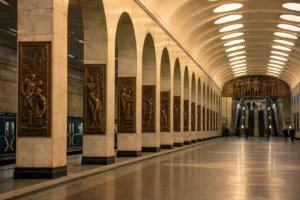
Two rows of columns and chandeliers converge towards the end of the hall, showing the symmetry of the design.
Best time: Off-peak hours, when fewer people stand in the frame.
Close-up of a glass column
The glass facing catches the light and glows, with the marble columns beside it for contrast.
Best time: Between trains, when reflections are calmer.
The Victory mosaic at the end of the hall
The mosaic closes the view along the colonnade and is framed by columns on both sides.
Best time: Quiet midday, from a distance.
The domed vestibule from Prospekt Stachek
The neoclassical building with its dome stands out from the surrounding street.
Best time: Dusk, when the building is lit.
Photography Rules
Casual photography on the platform is generally tolerated, but professional filming and tripods typically need permission from the metro. Do not block passengers or the platform edge, and avoid photographing staff or other passengers.
Family Suitability
Easy for families because the stop is short and the hall is striking. There are no escalators, so strollers and small children need the stairs, and the platform edge is busy at rush hour. Children usually enjoy the glowing columns, and a visit takes only a few minutes.
Russia Vibes Tips
- Take photos on the way down as well as on the platform; the staircase gives a view of the hall opening up that you do not get at the bottom.
- Travel with the flow: the busiest direction in the morning is towards the centre, so a midday ride is quieter.
- Combine Avtovo with Narvskaya, two stops towards the centre, which is another stop on the first line worth seeing.
- Look at the wall grilles, not just the columns; the golden swords and laurel garlands are easy to miss.
- Do not stand on the yellow line near the platform edge for photos; stand back and use the width of the hall.
- Spend a minute outside to see the vestibule, which looks like a palace and sets up the interior.
Explore Nearby Avtovo Metro Station, Saint Petersburg
Related guides
 Putilovskaya Metro Station, Saint Petersburg: Line 6 Terminus
Main image: AI-generated illustration. It may not show the place exactly as it looks.
 Kirovsky Zavod Metro Station, Saint Petersburg: Industrial Hall
Main image: AI-generated illustration. It may not show the place exactly as it looks.
 Kirovsky Zavod Metro Station, Saint Petersburg: Industrial Hall
Main image: AI-generated illustration. It may not show the place exactly as it looks.
 Narvskaya Metro Station, Saint Petersburg: Soviet Labour Theme
Main image: AI-generated illustration. It may not show the place exactly as it looks.
Browse more: More in Kirovsky District · All Metro Stations · All Metro Stations in Saint Petersburg · All Other Hubs · All Saint Petersburg
FAQ: Avtovo Metro Station, Saint Petersburg
Do I need a ticket to see Avtovo station?
You need to pay for a metro ride to enter the platform area. There is no separate sightseeing ticket, and the hall can be seen as part of a normal journey. See the fares section for payment options.
Is Avtovo the deepest station in Saint Petersburg?
No, the opposite: it is a shallow station, about twelve metres down, built in an open trench, which is why it has no escalators and why the hall can be so open and high.
Why are only some columns made of glass?
The architects planned glass for all of them, but the factory could not produce enough in time. Sixteen columns were finished in glass and the rest in white marble, which was meant to be temporary but stayed.
How do I get there from the centre?
Take Line 1 towards Prospekt Veteranov. Avtovo is the second stop after Narvskaya and needs no change. See the getting there section for the stations in order.
Is it worth a special trip?
Yes if you like architecture or Soviet history, and it combines well with Narvskaya and the Narva Triumphal Gate area. If your time is short, choose a station in the centre, but Avtovo is the most famous.
When did it open?
On 15 November 1955, with the first line of the Leningrad metro. It was the southern terminus for more than twenty years, until the line was extended south in 1977.
Can I take photos?
Casual photography is generally tolerated, but tripods and professional filming need permission. See the photography section for the details and the etiquette on the platform.
Is the station protected?
Yes. It is entered in the register of cultural heritage objects of regional significance, and it was restored to its original look in a long project that ended in 2012.
Russia Vibes is a one-person project. A coffee keeps it going
Last updated: October 16, 2026. Found an error or something out of date? Report it and we will check and fix it.
How we research and update our guides
About this guide: AI assistance and accuracy
This guide is created with the help of AI and is based on official sources where available. Mistakes can still happen. Opening hours, prices, rules and other details are given to the best of our knowledge as of the date shown and can change without notice. It offers general recommendations only, not professional, legal or travel advice. Please confirm important details with the official source before you travel; you are responsible for your own plans and decisions.
International sanctions affect payments between Russia and many other countries. In practice, cards issued in the EU, the UK, the US and several other countries often do not work in Russia, Russian cards usually do not work abroad, and some booking platforms, airlines and payment providers limit or suspend their services for Russia. The situation changes frequently. We do not give legal or financial advice, and this site does not encourage anyone to break or circumvent sanctions. Whatever you plan, you are responsible for following the laws and regulations that apply to you, including those of your country of residence and citizenship. Many travelers still organise their stay lawfully. It is worth asking your bank or payment provider what is currently permitted, contacting hotels, tour operators and carriers directly about the payment methods they accept, and checking which services are open to customers from your country. Clarify payment, cancellation and refund terms before you commit to a booking, and keep your plans flexible. Partner links on this site may not be available in every country, and prices, availability and rules in our guides can differ from what you see when you book.Paying for your trip: please read

Take this guide with you
Get a free PDF of this guide to print or read offline: key facts, tips and a map link on a few clean pages.