
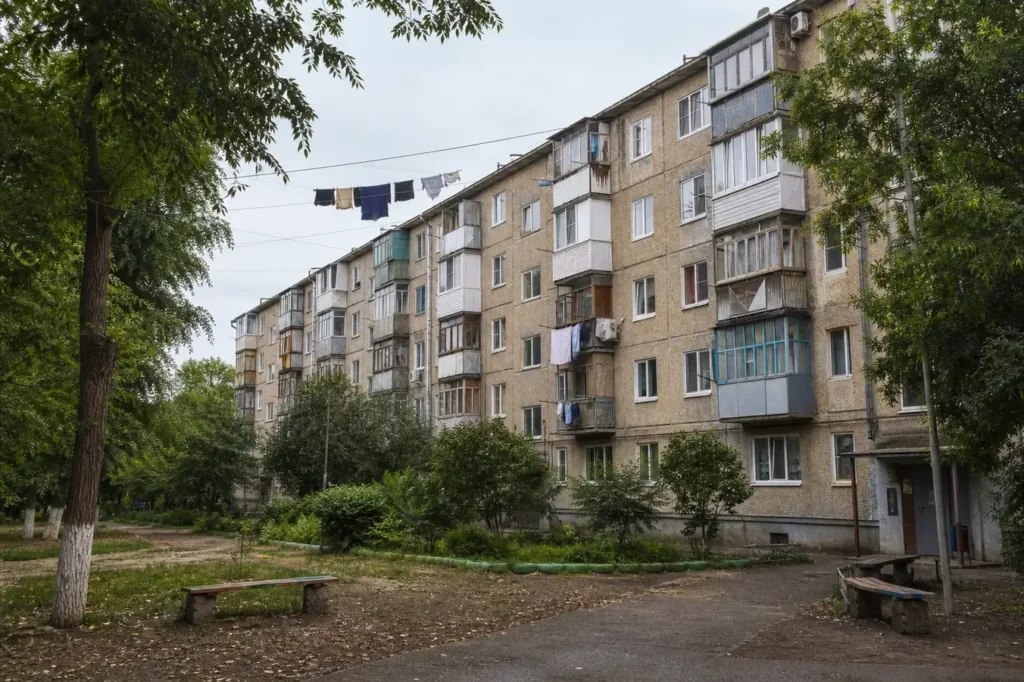
Traktorozavodsky District is a city district in Volgograd established in June 1936 and named after the Volgograd Tractor Factory. Today it spans 54 square kilometres with a population of around 134,000, making it one of Volgograd’s largest residential areas.
The district is marked by Soviet-era apartment blocks interspersed with quieter green spaces and monuments. For visitors, it offers a window into working-class Volgograd life, away from the city center, and provides access to remnants of the industrial past that shaped the region.
Quick Facts
| Russian name | Тракторозаводский район |
|---|---|
| Address | Волгоград, Волгоградская область OpenStreetMap · Google Maps |
| District | Traktorozavodsky |
| Metro | Traktornyy Zavod (VGTZ) (ST, ST-2, Northern terminus of Metrotram) Spartanovka (ST, Within district) |
| Best time to visit | Spring (May) and early autumn (September–October) offer the most pleasant weather for walking. May is significant for Victory Day (May 9), when the district hosts commemorative events at war monuments, especially Dzerzhinsky Square.Weekday mornings and early afternoons are quietest; avoid rush hours (07:00–09:00, 17:00–19:00) if you seek a peaceful atmosphere. Summer can be hot but is the peak season for visiting; winter is cold but quiet, offering a genuine Soviet neighborhood experience. |
| Recommended duration | 2–3 hours |
| Last updated | October 18, 2026 |
What Is (and Isn't) Part of a Visit to Traktorozavodsky District, Volgograd?
| Part | Status | Notes |
|---|---|---|
| Traktorozavodsky District residential area | Included in the standard ticket | The entire neighborhood, streets, parks and public spaces are freely accessible to visitors. |
| Volgograd Tractor Factory (VGTZ) | Not open to visitors | The factory site is not open for public tours; only the exterior gates and Metrotram station are visible. |
| Park of Memory (Pamyati Park) | Included in the standard ticket | Free public park on Menzhinskogo Street with war memorials. |
| Dzerzhinsky Square | Included in the standard ticket | Free public square with World War II monuments, central to the district. |
| Metrotram stations and rides | Separate ticket or institution | Light rail fares are separate; Traktornyy Zavod station is the northern terminus. |
| Nearby Central District attractions | Outside / not part of it | Major museums and the Mamayev Kurgan memorial are in different districts; the Metrotram connects to them southbound. |
Why Visit Traktorozavodsky District, Volgograd?
The Volgograd Tractor Factory, one of the first industrial sites built according to Soviet rapid industrialization plans in the late 1920s, began operations in 1930. During World War II, the factory retooled to produce T-34 tanks and became world-famous during the Battle of Stalingrad for the fierce combats fought there.
Visiting the district means understanding how ordinary Volgograd functioned beyond the Mamayev Kurgan memorial complex. You’ll see Dzerzhinsky Square with its war monuments, walk streets named after Soviet heroes, and observe how a factory town rebuilt itself after near-total destruction.
How Traktorozavodsky District, Volgograd Is Laid Out
The district spreads northward from the Volga River, centered around the now-largely-defunct Volgograd Tractor Factory. The Metrotram (light rail) runs through its heart, with the northern terminus at Traktornyy Zavod (VGTZ) station. From there, the line heads south through Spartanovka before connecting to central Volgograd.
Main streets radiate outward from the factory area: Degtyarev Street leads through residential zones; Menzhinskogo Street passes Pamyati Park (Park of Memory). The district’s layout follows typical Soviet urban planning—industrial core surrounded by residential blocks, with parks and memorials scattered throughout.
Highlights of Traktorozavodsky District, Volgograd
Volgograd Tractor Factory Remains
The Volgograd Tractor Factory, called the Stalingrad Tractor Plant until 1961, began operations in 1930. Much of it is now derelict or has been demolished, with the plant continuing to operate on a small scale. All that remains of the VgTZ works is a series of walk-through plants and two monuments in the square. The Metrotram terminates at Traktornyy Zavod station, closest to the factory gates.
Tip: The factory site itself is not open for tours, but the Metrotram ride to its terminus offers views of the sprawling industrial complex and the distinctive brick smokestacks.
Dzerzhinsky Square Memorial
A monument to the Defenders of the Great Patriotic War stands on Dzerzhinsky Square in Traktorozavodsky district. The factory was named after Felix Dzerzhinsky, founder of the Soviet secret police, and a statue of him still stands in front of its main portal, though his name was dropped from the plant's designation in 1961. This square remains the emotional center of the district.
Tip: Visit early morning or late afternoon for best light if photographing the monuments. The square is most active during May 9 (Victory Day).
Park of Memory
A granite memorial dedicated to soldiers who fought in Afghanistan is located in Traktorozavodsky area, in the Park of Memory. The park sits on Menzhinskogo Street and serves as a local gathering place with several monuments to Soviet-era servicemen and defenders.
Tip: The park is quieter on weekday mornings, offering a reflective atmosphere away from the bustle of central Volgograd.
Metrotram Line ST and ST-2
The Volgograd Metrotram is a light rail line with 22 stations along the Volga River, running from the northern suburbs to the city center over a route of 17.3 kilometres. A subway section in the south has five underground stations and an elevated station; the route opened in two stages in 1984 and 2011, with the northern terminus at Traktornyy Zavod station.
Tip: The above-ground sections offer good views of the Volga; the underground section near the center is more crowded during rush hours.
Soviet Residential Architecture
The district is a living textbook of Soviet urban planning. Five- to nine-story panel and brick apartment blocks dominate, many built in the 1950s–1980s after the city's reconstruction. Look for the characteristic design: narrow balconies, staggered floor heights, communal courtyards with benches and playgrounds.
Tip: Photography enthusiasts should explore side streets early in the day; the low sun angle picks out textures in the aging facades.
Volgograd State Technical University
The Traktorozavodsky building of the Volgograd State Technical University stands on Degtyarev Street. This campus branch reflects the district's industrial heritage and continues to attract engineering students.
Tip: The university grounds are open during business hours; the campus courtyard offers a quiet spot to rest.
Atmosphere
Traktorozavodsky District feels like post-Soviet working-class Russia. Broad, tree-lined streets are quiet except during rush hours when the Metrotram carries commuters. The soundscape mixes birdsong with distant rumble from passing trams and the occasional factory noise.
Apartment courtyards are communal spaces where older residents sit on benches, children play, and clotheslines crisscross overhead. Markets and small shops cluster along Degtyarev and other main streets. The air carries a mixed scent of Soviet-era concrete, trees, and occasionally industrial dust.
Weekday mornings and early afternoons are quietest; evenings see families returning home. The district attracts few tourists, so you’ll encounter genuine neighborhood life—the Russia many guidebooks skip over.
History of Traktorozavodsky District, Volgograd
The district was established in June 1936, taking its name from the newly built tractor factory. The factory was built as one of the first industrial sites under Soviet rapid industrialization plans adopted in the late 1920s, with construction carried out with assistance from Western countries, primarily the United States, and was introduced into operation in 1930.
Production of tractors began in 1930, with the plant producing both regular wheeled and tracked versions; by the outbreak of World War II, a quarter of a million regular tractors and 40,000 tracked versions had been made.
During World War II the plant switched to production of tanks, most famously the successful T-34 model, of which 250 units left the plant every month. As the German Wehrmacht reached Stalingrad in summer 1942, the tractor plant was the first target and the first part of Volgograd the Germans took, reaching the Volga banks; during fierce fighting the plant was largely destroyed, with the last shots fired in early February 1943 even days after the German 6th Army commander capitulated, with Wehrmacht soldiers still holding out at the factory until surrender.
After the battle, the plant was cleared of shells and debris and provisionally reconstructed within months, starting with tank repairs before full-scale production resumed. Until 1961, the plant was called the Stalingrad Tractor Plant named for F. Dzerzhinsky.
The district expanded rapidly in the 1950s–1970s as the factory and related industries grew. The plant continues to operate on a small scale, but much of it is now derelict or has been demolished, shifting the district’s character from industrial hub to predominantly residential neighborhood.
Legends and Myths about Traktorozavodsky District, Volgograd
The T-34s of Traktor
Legend – historically unreliable. During World War II, the factory produced 250 T-34 tanks monthly; as German forces approached Stalingrad in summer 1942, the tractor plant was their first military target. Local legend holds that tanks were driven straight from the assembly line to the front lines—some accounts claim they went directly into battle with fresh paint still wet and workers waving from the hatches. This captures the desperate urgency of the Soviet response.
The Red Factory That Never Fell
Legend – historically unreliable. Soviet propaganda celebrated the factory's survival and reconstruction as proof of Soviet determination. Despite near-total destruction during the Battle of Stalingrad and being a primary German objective, the factory was operational again within months. Local residents retell this as evidence that no capitalist power could defeat Soviet will.
Tickets and Booking for Traktorozavodsky District, Volgograd
Traktorozavodsky District is a neighborhood and requires no tickets to visit. All streets, parks and public spaces are freely accessible. If you take the Metrotram light rail to reach or explore the district, purchase a separate ticket at the station or use a Volna transport card available at metro booths and some kiosks.
The Metrotram terminus at Traktornyy Zavod (VGTZ) station is the main entry point for visitors arriving by light rail from central Volgograd. Walking and local buses also serve the district.
Suggested itineraries Traktorozavodsky District, Volgograd
2 hours
Start at Traktornyy Zavod Metrotram station and walk through the factory perimeter area (do not enter). Head to Dzerzhinsky Square to see the war monuments, then stroll along Menzhinskogo Street to Park of Memory. Return via Degtyarev Street, observing Soviet apartment architecture.
3 hours
Begin as above but add a visit to a local market or café near the Metrotram stations for authentic neighborhood atmosphere. Extend your walk to explore residential courtyards and side streets. Visit the Volgograd State Technical University campus if open. End with a sunset view from a district vantage point toward the Volga.
Half day
Combine the 3-hour walk with a Metrotram ride along the full length of the line (ST route) to see both the district and the underground central sections, understanding the city's geography. Return to the district for dinner at a local restaurant, experiencing daily neighborhood life away from tourist zones.
How to Get to Traktorozavodsky District, Volgograd
By Metrotram: The ST and ST-2 light rail lines terminate at Traktornyy Zavod (VGTZ) station in the northern part of the district. From central Volgograd (Ploshchad Chekistov), the journey takes approximately 25–30 minutes. Trains run from approximately 05:48 to 22:42 daily.
By bus or marshrutka: Multiple local bus routes serve the district, connecting to the railway station and other parts of the city.
Walking: The district is best explored on foot from the Metrotram stations, particularly Traktornyy Zavod for the factory and Spartanovka for other neighborhoods.
Accessibility
The Metrotram stations have step-free access and elevators at some stops, though not all underground stations are wheelchair-accessible. The subway section has five underground stations and one elevated station; surface-level stations are easier to access.Sidewalks are generally passable but may be uneven in places. Parks are flat and accessible. Older apartment buildings lack elevators; avoid entering courtyards if mobility is limited. Modern cafés and shops near the Metrotram have standard accessibility features.
Food Nearby
The district lacks tourist-focused restaurants but offers authentic neighborhood options. Small cafés and stolovaya (canteen-style) restaurants cluster near the Metrotram stations and along Degtyarev Street, serving traditional Russian soups, pelmeni, and grilled meat. Local markets sell fresh produce and prepared foods. Bakeries, pizza shops and fast food chains operate in shopping areas near main streets.No high-end dining; the food is working-class and honest. Best for lunch between 12:00–14:00 when canteens are busy with local workers.
What to Bring
Comfortable walking shoes are essential—expect 2–3 km of paved streets with occasional uneven sidewalks. Bring water and sun protection (hat, sunscreen) in summer; the district has few shaded areas outside parks. In winter, warm clothing and insulated footwear are vital due to ice and snow.A phone with an offline map is useful as street signs use Cyrillic only. Small bags are fine; no security screening unlike major attractions.
Best Views and Photo Spots of Traktorozavodsky District, Volgograd
Dzerzhinsky Square, facing the monuments
The statue of Felix Dzerzhinsky and World War II memorials framed by apartment blocks. The square's Soviet-era aesthetic is strongest at dawn or late afternoon.
Best time: Early morning (07:00–09:00) for soft light and fewer people; May 9 evening for festive crowds.
Traktornyy Zavod Metrotram station exterior
The station's distinctive modernist design and views of the sprawling factory complex and smokestacks beyond. The industrial landscape is dramatic in winter against snow.
Best time: Overcast days reduce harsh shadows on the industrial structures; late afternoon light catches the brick facades.
Park of Memory, looking toward tree-lined paths
Memorials set among mature trees and grass, representative of Soviet memorial design. Foreground memorials frame the tree canopy.
Best time: Spring (May–June) when trees are full; morning light from the east.
Residential courtyards along side streets
Typical Soviet apartment blocks (5–9 stories) surrounding shared courtyards with benches and clotheslines. Captures everyday neighborhood life.
Best time: Weekday late afternoon (16:00–18:00) when residents are active; use respectful distance and ask permission before photographing people.
Photography Rules
Photography is unrestricted in public areas. No drones or tripods are permitted in parks or near government buildings. The factory perimeter is visible from public streets; do not attempt to photograph from inside the gates or trespass. Flash photography is not needed outdoors and may annoy residents indoors.
Family Suitability
The district is family-friendly for walks but offers limited attractions for young children. Park of Memory is suitable for all ages; the Metrotram ride itself is an attraction for kids interested in Soviet engineering. Apartment block courtyards are safe but not formally arranged for play.Older children and teenagers studying Soviet history will find the monuments and factory remnants educational. Strollers are acceptable on sidewalks, though some are uneven. The district lacks dedicated playgrounds on main routes, so plan accordingly if traveling with young children.
Russia Vibes Tips
- The Metrotram is not a metro line—it's a rapid tram that shares street-level track with regular trams in much of the district. Only the southern section downtown is underground. Understanding this prevents confusion about stations and frequency.
- Dzerzhinsky Square is most vibrant on Victory Day (May 9). If visiting then, arrive early to see ceremonies without crowds, or stay late for evening commemorations.
- Don't try to enter the factory grounds; the perimeter is fenced and not open to public tours despite its historical significance. Photography from the street and station is the only access.
- Carry cash. While some cafés accept cards, many small stolovayas and street vendors operate cash-only. ATMs are present but not every restaurant has card readers.
- Ask at your hotel or the railway station for a simple map. Street names use Cyrillic and Russian-speaking locals are helpful, but signage is minimal compared to central tourist zones.
- Visit on a weekday if possible. Weekends draw local shoppers to markets and the district feels less like 'real life.' Weekday mornings show authentic neighborhood rhythm.
Explore Nearby Traktorozavodsky District, Volgograd
Browse more: More in Traktorozavodsky · All Neighborhood in Russia · All Neighborhoods · All Neighborhoods in Volgograd · All Volgograd
FAQ: Traktorozavodsky District, Volgograd
Can I visit the inside of the Volgograd Tractor Factory?
No. The factory is not open to public tours. The site is partially operational and privately owned. You can view the exterior from the Metrotram station and nearby streets, photograph the gates and smokestacks from public areas, and read plaques on Dzerzhinsky Square.
Is there a museum dedicated to the factory's history?
There is no dedicated factory museum on-site. The State Museum of Political History of Russia in central Volgograd has exhibits on industrial Stalingrad. The district's monuments tell the World War II story, but factory production history is not formally displayed locally.
How do I reach the district from central Volgograd?
Take the Metrotram (light rail) line ST or ST-2 northbound from Ploshchad Chekistov toward Traktornyy Zavod terminus. The journey takes 25–30 minutes. Purchase a ticket at the station before boarding.
What is the difference between the factory's old and current names?
Until 1961, it was called the Stalingrad Tractor Plant named after Felix Dzerzhinsky. After Khrushchev's de-Stalinization campaign, the city and factory were renamed Volgograd Tractor Plant, though Dzerzhinsky's name remained in the official designation longer.
Are there restaurants worth visiting in Traktorozavodsky?
The district lacks tourist restaurants. Instead, there are authentic stolovayas (Soviet-style canteens) and small cafés serving traditional Russian food. For more variety, take the Metrotram to central Volgograd. The experience here is neighborhood dining, not destination dining.
How long should I spend in the district?
Plan 2–3 hours for a walking tour including Dzerzhinsky Square, Park of Memory, and residential streets. Longer stays offer deeper immersion in neighborhood life but limited new attractions. Most visit as part of a larger Volgograd itinerary.
Is the district safe for solo visitors?
Yes. Traktorozavodsky is a regular residential neighborhood, not a tourist zone, so petty crime is low and violent crime is rare. Standard city precautions apply. Avoid dark and empty areas late at night. Solo visitors are welcome and often encounter friendly locals.
What should I know about Soviet war monuments?
Monuments are treated with respect by locals; they mark losses in World War II and the Soviet-Afghan War. Photography is permitted, but approach with solemnity. Do not sit or lean on monuments. May 9 (Victory Day) is the most solemn time, with ceremonies and wreaths.
Russia Vibes is a one-person project. A coffee keeps it going
Last updated: October 18, 2026.
How we research and update our guides
About this guide: AI assistance and accuracy
This guide is created with the help of AI and is based on official sources where available. Mistakes can still happen. Opening hours, prices, rules and other details are given to the best of our knowledge as of the date shown and can change without notice. It offers general recommendations only, not professional, legal or travel advice. Please confirm important details with the official source before you travel; you are responsible for your own plans and decisions.
International sanctions affect payments between Russia and many other countries. In practice, cards issued in the EU, the UK, the US and several other countries often do not work in Russia, Russian cards usually do not work abroad, and some booking platforms, airlines and payment providers limit or suspend their services for Russia. The situation changes frequently. We do not give legal or financial advice, and this site does not encourage anyone to break or circumvent sanctions. Whatever you plan, you are responsible for following the laws and regulations that apply to you, including those of your country of residence and citizenship. Many travelers still organise their stay lawfully. It is worth asking your bank or payment provider what is currently permitted, contacting hotels, tour operators and carriers directly about the payment methods they accept, and checking which services are open to customers from your country. Clarify payment, cancellation and refund terms before you commit to a booking, and keep your plans flexible. Partner links on this site may not be available in every country, and prices, availability and rules in our guides can differ from what you see when you book.Paying for your trip: please read
Report an issue on this page

Take this guide with you
Get a free PDF of this guide to print or read offline: key facts, tips and a map link on a few clean pages.