
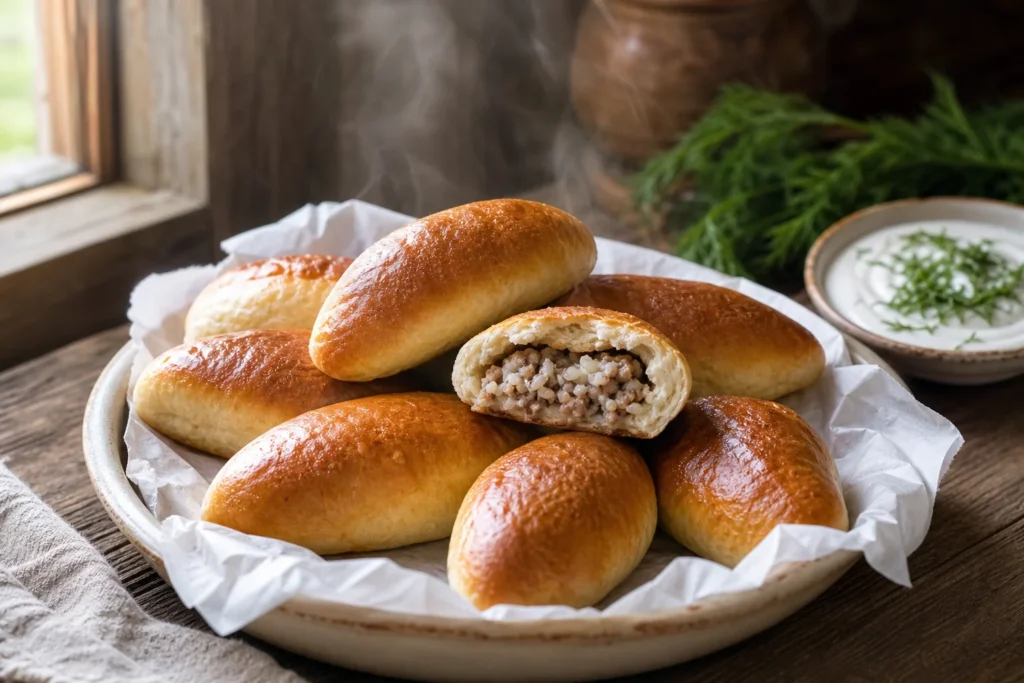
Pirozhki are small Russian filled pastries that can be baked or fried. Known in Russian as пирожки, they appear in home cooking, bakeries and casual food settings throughout the country, including Volgograd. Their fillings range from potatoes, cabbage and mushrooms to meat, rice, eggs and sweet ingredients.
This guide shows how to make soft baked pirozhki using a simple yeast dough and a potato-and-onion filling. You will learn how to prepare the filling, shape the pastries, seal them properly and bake them until golden. The result is a practical introduction to a familiar part of Russian everyday food culture.
Quick answer: Prepare a soft yeast dough, cook a potato-and-onion filling, divide and shape the pastries, allow a second rise and bake until golden. Allow approximately 2–3 hours.
At a Glance
| Type | Street food & snacks |
|---|---|
| Local name | Пирожки |
| Origin | Traditional Russian cuisine; common throughout Russia, including Volgograd |
| Servings | Approximately 10–12 medium pirozhki, serving 3–4 |
| Total time | Approximately 2–3 hours including dough rising and baking |
| Difficulty | Medium |
History and Story of Pirozhki, Volgograd
Pirozhki belong to the extensive Russian tradition of filled pies and baked dough dishes. The name is related to pirog, the Russian word for a pie. Pirozhki are generally smaller, individual pastries rather than large pies cut into portions.
Russian pies have a long history in domestic cooking and ceremonial food traditions. Historical fillings included vegetables, grains, mushrooms, fish and meat, reflecting the ingredients available to different households and regions.
Small filled pastries developed into a convenient way to combine bread dough with a ready-to-eat filling. Their portability made them suitable for meals away from the home as well as for serving with soups and tea.
There is no single traditional pirozhki recipe. Some use yeast dough, while other versions employ different doughs. They may be baked in an oven or fried in oil. The form also varies: oval, rounded and elongated pastries are all possible.
Savory fillings include mashed potatoes with onion, braised cabbage, minced meat, mushrooms and rice with egg. Sweet versions can contain fruit, berries or other sweet ingredients.
In Volgograd, pirozhki are part of the wider Russian food tradition rather than an exclusively local invention. Visitors can recognize them by their individually portioned form and the filling enclosed within the dough.
The baked potato version in this guide offers a straightforward introduction to the dish. It uses familiar ingredients and a yeast dough that can also accommodate other fully cooked fillings. Learning the method makes it easier to understand the variations encountered in Russian bakeries and home cooking.
Ingredients
- 400 g plain wheat flour
- 220 ml lukewarm milk
- 7 g instant dry yeast
- 25 g sugar
- 5 g fine salt
- 40 g unsalted butter, melted
- 1 medium egg for the dough
- 400 g potatoes, peeled
- 120 g onion, finely chopped
- 20 ml vegetable oil
- 2 g black pepper
- 3 g salt for the filling
- 1 medium egg for glazing
How Pirozhki, Volgograd Is Made
Step 1: Prepare the yeast dough
Combine the flour, instant yeast, sugar and salt in a large bowl. Add the lukewarm milk, one egg and melted butter. Mix until a soft dough forms, then knead for approximately 8–10 minutes until smoother and more elastic. The dough should feel supple and slightly tacky rather than stiff or dry.
Tip: Add only a little extra flour if absolutely necessary. Excess flour makes the baked pastries heavy.
Step 2: Allow the dough to rise
Place the dough in a lightly oiled bowl and cover it. Leave it in a comfortably warm place until noticeably expanded, usually around 60–90 minutes. The exact time depends on room temperature and yeast activity. Avoid exposing the dough to excessive heat or allowing its surface to dry.
Tip: Judge the dough by its expansion rather than following the clock alone.
Step 3: Cook the potato filling
Boil the peeled potatoes in lightly salted water until tender, then drain thoroughly and mash. Meanwhile, cook the chopped onion in vegetable oil until softened and lightly golden. Combine the onion with the potatoes, black pepper and filling salt. Mix well and allow the filling to cool before assembling the pastries.
Tip: A relatively dry potato filling is easier to seal inside the dough than a loose, wet mixture.
Step 4: Divide and shape
Turn the risen dough onto a lightly floured surface and divide it into approximately 10–12 portions. Flatten each piece into a small oval or round. Place a spoonful of cooled filling in the centre, leaving sufficient dough around the edges for sealing. Bring the edges together and pinch firmly.
Tip: Avoid overfilling. The dough needs enough space to expand without splitting.
Step 5: Proof the filled pastries
Arrange the sealed pirozhki on a baking tray lined with baking paper, leaving gaps between them. Place the seam underneath and cover loosely. Allow them to rise again for approximately 20–30 minutes. Beat the remaining egg and brush it lightly over the surfaces to produce a golden finish.
Tip: Keep the egg wash away from excessive pooling around the bottoms.
Step 6: Bake until golden
Preheat the oven to 190°C conventional heat. Bake the pirozhki for approximately 18–25 minutes, depending on their size, until the surfaces are golden and the dough is fully cooked. Remove them from the oven and allow them to rest briefly before serving. The filling will remain hot for some time.
Tip: If the tops brown too quickly, reduce the oven temperature slightly rather than removing underbaked pastries.
Variants
- Potato and onion pirozhki: Soft mashed potato filling combined with cooked onion.
- Cabbage pirozhki: Filled with braised cabbage, sometimes accompanied by egg.
- Meat pirozhki: Use seasoned, fully cooked minced meat or another prepared meat filling.
- Mushroom pirozhki: Filled with cooked mushrooms and onion.
- Rice and egg pirozhki: A familiar savoury combination with chopped boiled egg.
- Sweet pirozhki: Made with fruit, berries or other sweet fillings.
- Fried pirozhki: Cooked in oil rather than baked, producing a different outer texture.
Common Mistakes to Avoid
- Using a filling that is still hot, which makes shaping and sealing more difficult.
- Adding too much flour and producing dense pastry.
- Overfilling each piece so the seams split during baking.
- Failing to seal the dough firmly around the filling.
- Skipping the second rise and producing a tight, heavy texture.
- Confusing pirozhki with large Russian pies or with pelmeni dumplings.
- Assuming all Russian pirozhki contain meat.
How to Order and Eat It
Pirozhki are generally eaten warm, although some fillings are also enjoyable at room temperature. Their small size makes them practical to eat by hand, without a knife and fork.
They may be served individually as a snack, alongside soup or as part of a larger meal. Savoury potato or cabbage versions work particularly well with broth-based dishes. Sweet pirozhki are often suitable with tea.
In a bakery, ask what filling is inside before ordering, especially if you avoid certain meats or ingredients. The same pastry shape can contain very different fillings.
Freshly baked pirozhki may look cool enough to handle while the filling remains extremely hot. Break one open carefully before taking a large bite.
To order: Можно, пожалуйста, пирожок с картошкой? (Mozhno, pozhaluysta, pirozhok s kartoshkoy?)
Diet and Allergens
- Contains wheat gluten
- Contains milk
- Contains egg
- Vegetarian with the specified potato filling
- No pork in this recipe
- No alcohol added
- Meat, mushroom and other fillings may have different dietary properties
Russia Vibes Tips
- Learn the filling words картошка for potato, капуста for cabbage and мясо for meat when reading bakery labels.
- If visiting a bakery, ask what has been freshly baked rather than choosing solely by appearance.
- For a homemade batch, keep the filling fairly dry so the seam remains closed.
- Make all portions similar in size to help them bake evenly.
- Serve savoury pirozhki with a simple soup when you want a more substantial meal.
- Reheat leftover baked pastries gently in an oven to restore their outer texture.
Explore Nearby Pirozhki, Volgograd
Browse more: All Food & Drink · All Other
FAQ
What are Russian pirozhki?
Pirozhki are individual Russian filled pastries, usually made with dough wrapped around a savoury or sweet filling. They may be baked or fried. Common fillings include potatoes, cabbage, mushrooms, meat, rice and fruit. They differ from larger pies because each pastry forms a separate portion.
Are pirozhki baked or fried?
Both methods are traditional. Baked pirozhki usually have a bread-like exterior, while fried versions develop a more pronounced oily crust. The recipe here uses an oven and a soft yeast dough. The preferred method depends on the filling, regional practice and individual cooking tradition.
What is the difference between pirozhki and pelmeni?
Pirozhki are filled pastries made with dough that is generally baked or fried. Pelmeni are smaller dumplings commonly filled with minced meat and cooked in boiling water. The texture, preparation and serving methods differ significantly, even though both enclose a filling inside dough.
Can I prepare the filling in advance?
Yes. Cooked potato, cabbage or mushroom fillings can be prepared in advance and refrigerated in a covered food-safe container. They should be cooled before being placed inside the dough. Avoid using a watery filling, because excess moisture can interfere with sealing and baking.
Why do my pirozhki open during baking?
The usual causes include overfilling, poorly pinched seams or filling moisture. Stretching the dough too thin can also contribute. Leave a border around the filling, press the edges together securely and arrange the pastries with their seams facing downward before the second rise.
Can pirozhki be made without meat?
Yes. Potato, cabbage, mushroom and other vegetable fillings are widely used. The recipe in this guide contains no meat, although its dough includes milk, butter and eggs. Visitors should still ask about the ingredients of bakery products because individual recipes differ.
Are pirozhki usually eaten for breakfast or lunch?
Pirozhki can be eaten at different times of day. They may be a quick bakery snack, part of a lunch or an accompaniment to tea. Savoury versions fit well beside soup, while sweet versions are suitable as a small dessert or afternoon snack.
Can I freeze homemade pirozhki?
Fully baked pirozhki can be cooled, packed appropriately and frozen. Their texture is usually better when reheated in an oven rather than left to become damp after thawing. Cool and store them promptly, and reheat thoroughly, particularly when using fillings containing meat or eggs.
Russia Vibes is a one-person project. A coffee keeps it going
How we research and update our guides
About this guide: AI assistance and accuracy
This guide is created with the help of AI and is based on official sources where available. Mistakes can still happen. Opening hours, prices, rules and other details are given to the best of our knowledge as of the date shown and can change without notice. It offers general recommendations only, not professional, legal or travel advice. Please confirm important details with the official source before you travel; you are responsible for your own plans and decisions.

Take this guide with you
Get a free PDF of this guide to print or read offline: key facts, tips and a map link on a few clean pages.
Report an issue on this page
Paying for your trip: please read
International sanctions affect payments between Russia and many other countries. In practice, cards issued in the EU, the UK, the US and several other countries often do not work in Russia, Russian cards usually do not work abroad, and some booking platforms, airlines and payment providers limit or suspend their services for Russia. The situation changes frequently.
We do not give legal or financial advice, and this site does not encourage anyone to break or circumvent sanctions. Whatever you plan, you are responsible for following the laws and regulations that apply to you, including those of your country of residence and citizenship.
Many travelers still organise their stay lawfully. It is worth asking your bank or payment provider what is currently permitted, contacting hotels, tour operators and carriers directly about the payment methods they accept, and checking which services are open to customers from your country. Clarify payment, cancellation and refund terms before you commit to a booking, and keep your plans flexible.
Partner links on this site may not be available in every country, and prices, availability and rules in our guides can differ from what you see when you book.