
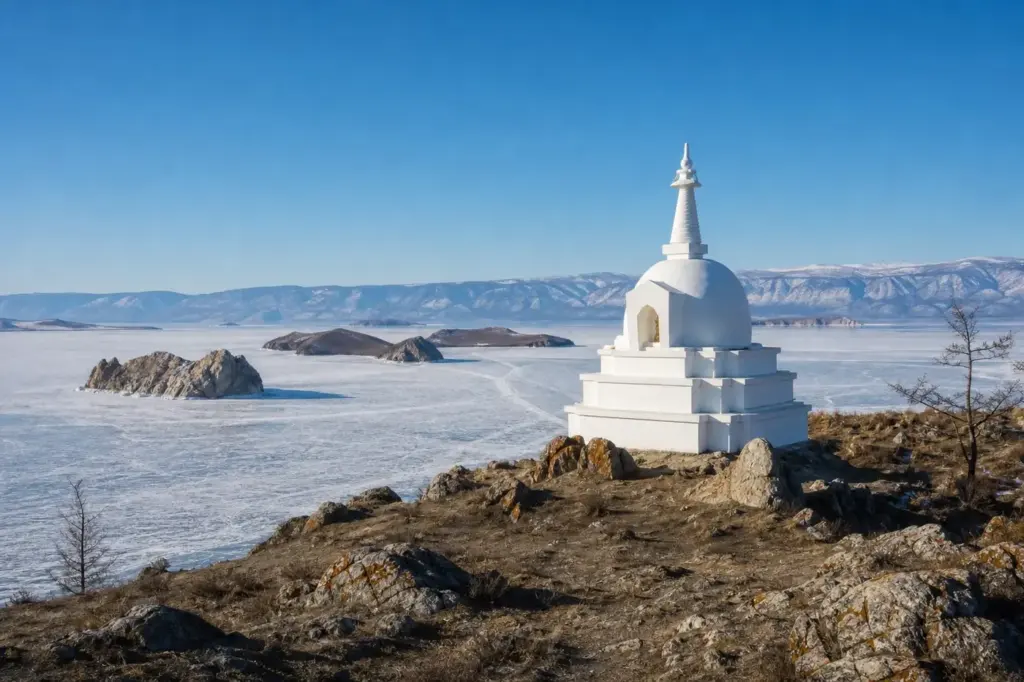
Ogoy Island is the largest island within the Maloe More strait of Lake Baikal, measuring 2.9 km long and 0.6 km wide. Located between Olkhon Island to the west and the mainland to the east, this uninhabited rocky island rises to 512 metres at its highest point, where the Buddhist Stupa of Enlightenment stands as its most distinctive landmark. The stupa was completed in 2005 at the initiative of the Moscow Buddhist Center.
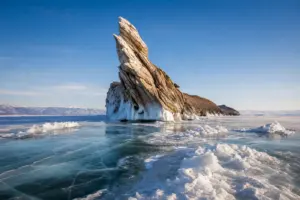
Most visitors reach Ogoy Island as a day excursion by boat from Khuzhir settlement on Olkhon Island. The crossing typically takes 30–45 minutes each way. In winter, when Lake Baikal freezes, the island becomes accessible by vehicle across the ice, offering a completely different experience with frozen landscapes and ice formations at nearby capes.
Current access notice: As of October 2026: Winter ice access (typically January–March) depends on ice thickness and safety conditions; confirm with tour operators before travel. Summer boat service operates June–September; schedule and frequency vary by season and weather.
Quick Facts
| Russian name | остров Огой |
|---|---|
| Built / opened | 2005 |
| Architect(s) | Moscow Buddhist Center |
| Address | Maloye More Strait, Olkhonsky District, Irkutsk Oblast, Russia Google MapsApple MapsYandex Maps2GIS |
| Admission | free; boat tours from Khuzhir or Listvyanka ₽₽ |
| Best time to visit | Summer season (June–September) offers reliable boat access, calm weather for safe crossings, and warmer temperatures. July–August see peak tourist traffic. Winter (January–March) provides a unique frozen-lake experience with ice grottoes and otherworldly landscapes, but requires confirmed ice conditions. Spring (April–May) and autumn (September–October) may have limited or no boat service due to ice melt or reformation. Early morning departures offer better light and calmer water in summer. |
What Is (and Isn't) Part of a Visit to Ogoy Island, Lake Baikal?
| Part | Status | Notes |
|---|---|---|
| Stupa of Enlightenment | Included in the standard ticket | The white Buddhist stupa at the island's summit is the main attraction and is freely accessible to all visitors who reach the island. |
| Island hiking and shore exploration | Included in the standard ticket | Visitors may walk around the island, visit rocky capes, and explore accessible shoreline as part of their visit. |
| Boat transport to/from the island | Separate ticket or institution | Tours must be booked and paid separately; boats depart from Khuzhir on Olkhon Island or from Listvyanka mainland. |
| Guided tour services | Separate ticket or institution | Organized excursions with guides are available as separate paid tours and are not required; independent travel is possible by private boat. |
| Winter ice transport | Separate ticket or institution | In winter, vehicle crossing on frozen lake is organized as a separate service from summer boat operations. |
| Olkhon Island | Outside / not part of it | The nearby larger island of Olkhon Island is a separate destination with its own attractions (Cape Khoboy, Shamanka Rock, Khuzhir settlement); access to Olkhon requires a separate ferry and is not included in an Ogoy visit. |
Why Visit Ogoy Island, Lake Baikal?
The Stupa of Enlightenment dominates the skyline and is visible from across the Maloe More. It commands views over the entire lake and surrounding islands. Local tradition holds that walking clockwise around the stupa three times in silence while thinking positive thoughts is spiritually significant.
The island’s barren, windswept terrain provides stark, dramatic scenery typical of this remote part of Baikal. Rocky shores, low vegetation, and nesting seabirds create an atmosphere of isolation. The crossing itself is memorable—navigating through dozens of rocky islands and then landing on the remote shore feels like stepping away from the inhabited world.
Highlights of Ogoy Island, Lake Baikal
Stupa of Enlightenment
Built in 2005 at the initiative of the Moscow Buddhist Center, this white Buddhist stupa sits at the island's highest point and is dedicated to Dakini Tröma Nagmo in the Tibetan Buddhist tradition. The structure is visible from across the Maloe More strait and dominates the landscape. The walk to the summit is steep but short, rewarding visitors with 360-degree views of Lake Baikal. Local practice suggests walking clockwise around the stupa three times for spiritual benefit.
Tip: Bring windproof clothing—the exposed hilltop is extremely windy. Time your arrival for morning light to photograph the stupa against the lake backdrop.
Cape Dragon (Khorin Irgi)
The island's southern cape attracts visitors for its dramatic rock formations and frozen ice grottoes in winter. The caves and ice formations create striking photo opportunities. In summer, the rocky shore provides vantage points across the lake. The cape is typically included in boat tour routes around the island.
Tip: If visiting in winter, bring a headlamp for exploring the ice caves safely.
Northern Rocky Shore
The island's windward northern coastline features jagged boulders and dramatic cliffs that rise sharply from the water. This side receives heavy wave action even on calm days, creating ever-changing conditions. The rocky terrain is difficult to traverse but photogenic.
Tip: Do not attempt to walk the full shoreline; it is unstable and hazardous. Stay on marked routes.
Lake Baikal Views from the Island
From any high point on Ogoy, the endless expanse of Lake Baikal dominates the horizon. In summer, the crystalline water reflects the sky. In winter, the frozen lake stretches to the horizon, and on very clear days, mountains on the far shore become visible. The Maloe More strait surrounding the island is dotted with smaller rocky islets that add to the dramatic seascape.
Tip: Polarizing filters significantly enhance sky and water contrast in photographs.
Vegetation and Wildlife
Ogoy is sparsely vegetated with grasses and low-growing shrubs; the island is uninhabited by humans. The barren landscape contrasts sharply with forested regions of Baikal. Ground squirrels, pikas, and snakes inhabit the rocky terrain, though they are rarely seen by visitors. The island is a nesting ground for larks and herring gulls, making bird migration periods particularly active.
Tip: Spring and early summer are best for observing birds, particularly during nesting season.
The Maloe More Strait
The strait separating Ogoy from Olkhon Island and the mainland is approximately 5–16 km wide at its narrowest point. During summer boat crossings, visitors pass through a landscape studded with dozens of smaller rocky islands and see the open water of Lake Baikal. In winter, the frozen strait becomes a highway for vehicle transport, and the ice landscape appears otherworldly.
Tip: The boat crossing itself is a highlight; sit on deck to photograph the surrounding islands and changing shorelines.
Atmosphere
Ogoy Island has a stark, spiritual quality. The windswept hilltop where the stupa stands feels exposed and contemplative. On calm summer days, the island is quiet except for water lapping against rocks and bird calls. Visitors arrive in small groups, typically 5–15 people per boat, maintaining a sense of remoteness despite the tourist traffic. In winter, the silence is profound—only the crunch of boots on ice and wind sound.
The island feels geographically and culturally isolated. Its position in the middle of Lake Baikal, combined with its rocky barrenness, creates an otherworldly atmosphere. Visitors speak in lowered voices. The Buddhist stupa reinforces this sense of spiritual significance. At sunset, the light turns golden and the shadows from the stupa stretch across the hilltop, creating a meditative mood.
History of Ogoy Island, Lake Baikal
Ogoy Island has been uninhabited throughout recorded history. Its name comes from the Buryat word ‘uhaggui’ meaning ‘waterless’, referring to the absence of fresh water sources. The island appears in Buryat spiritual traditions as a sacred place, though systematic documentation of its religious significance is limited.
In 2005, the Moscow Buddhist Center initiated construction of the Stupa of Enlightenment at the island’s highest point. The stupa was dedicated to Dakini Tröma Nagmo, a figure in Tibetan Buddhist practice. The construction represented a significant spiritual investment by the Buddhist community and marked a turning point in the island’s relationship with visitors. Prior to 2005, the island was rarely visited except by adventurous travellers and researchers.
The stupa’s completion dramatically increased tourist traffic to the island. Tour operators based in Khuzhir and Listvyanka began organizing regular boat excursions. The island transformed from an obscure rocky isle into a significant destination on the Lake Baikal circuit. Scientists from the Siberian Institute of Physiology and Biochemistry have expressed concern about vegetation damage caused by increased foot traffic, particularly around the stupa area.
Legends and Myths about Ogoy Island, Lake Baikal
Sacred Energy of the Stupa
Legend – historically unreliable. Local Buddhist practitioners and tour guides describe the stupa as emanating spiritual energy. The practice of walking around it clockwise three times while thinking positive thoughts is said to amplify intention and transform negative energy into positive. Some visitors report feeling calm, clarity, or spiritual significance during or after the ritual, though these experiences are subjective and unverified. The stupa is understood in Buddhist cosmology as a vessel for transforming consciousness.
Waterless Island Protection
Legend – historically unreliable. The Buryat name 'waterless island' connects to historical beliefs that the island's lack of fresh water made it a place of natural purification and spiritual cleansing. Local tradition holds that the island's 'clean' energy—untouched by human habitation and negative actions—made it spiritually powerful. Some accounts suggest spirits of the lake protect and maintain the island's sanctity.
Tickets and Booking for Ogoy Island, Lake Baikal
| Ticket | Price | Includes |
|---|---|---|
| Guided boat excursion to Ogoy Island from Khuzhir (typical 3–4 hours including transport, usually includes tea/coffee) | ₽₽ | Boat transport to and from the island, guide service, basic refreshment (tea or coffee). Landing and free exploration of the island. |
| Private boat charter to Ogoy Island from Khuzhir | ₽₽₽ | Private boat for a group, captain, and flexible schedule. No guide included unless separately arranged. |
| Winter UAZ vehicle excursion across frozen lake (seasonal, January–March) | ₽₽₽ | Vehicle transport on ice from mainland staging area, driver, access to the island. Duration typically 4–5 hours. |
₽ budget · ₽₽ moderate · ₽₽₽ upscale · ₽₽₽₽ splurge. Price levels are estimates compared with typical prices for visitors.
Boat tours to Ogoy Island are organized from Khuzhir settlement on Olkhon Island and from Listvyanka on the mainland. Most visitors book through tour operators in Khuzhir the day before or morning of the excursion. Tours typically depart once daily in summer (June–September) when conditions permit. It is advisable to book 1–2 days in advance, especially in July–August when demand is higher.
Summer boat service operates only during ice-free season; exact dates depend on weather but typically run June through September. Winter ice transport is available January–March subject to ice safety conditions; always confirm with operators before committing.
Most tours include basic refreshment (tea, coffee) and a guide who speaks English or Russian depending on demand. Groups are typically 5–15 people per boat. Same-day booking is often possible but not guaranteed, particularly during peak season. Payment is made in cash (Russian rubles) or via card depending on the operator. Check with your accommodation in Khuzhir or consult local tour boards for current operators and departure times.
Suggested itineraries Ogoy Island, Lake Baikal
Half day (3–4 hours total, including boat transport)
Depart Khuzhir by boat early morning. Cruise through the Maloe More strait, viewing rocky islands and the Olkhon shoreline. Land on Ogoy's western shore. Hike uphill to the Stupa of Enlightenment. Walk clockwise around the stupa and spend time at the summit viewpoint. Explore the northern or southern cape depending on guide preference. Return to boat and sail back to Khuzhir, arriving by early afternoon.
Full day (6–8 hours)
Depart Khuzhir early. Include a more leisurely boat cruise through the Small Sea, stopping near other rocky islands. Land on Ogoy and spend extended time at the stupa. Explore multiple capes and shorelines. Bring a picnic or eat at a café in Khuzhir before or after. Return in late afternoon. This option suits photography enthusiasts and those wanting to experience the island's atmosphere more fully.
Winter day trip (4–5 hours on ice, January–March)
Depart from the mainland staging area by UAZ or similar vehicle. Drive across frozen Lake Baikal on the ice road, passing through the winter landscape. Visit ice grottoes at Cape Dragon or similar features depending on ice conditions. Reach Ogoy Island and visit the stupa. The vehicle journey itself is the highlight in winter. Return across the ice to the mainland.
How to Get to Ogoy Island, Lake Baikal
From Khuzhir (Olkhon Island): Most visitors access Ogoy Island by boat from Khuzhir, the main settlement on Olkhon Island. Tour operators and boat captains can be found at the harbour or through your accommodation. Boats typically depart in early morning (8:00–9:00 AM). The crossing takes 30–45 minutes depending on sea conditions and which landing point is used. Look for tour signs or ask locals at your hotel; English-speaking staff are common in summer.
From Listvyanka (mainland): Some tours operate from Listvyanka on the mainland, though these are less frequent and require a longer boat crossing (1.5–2 hours). Contact tour operators in Listvyanka a day in advance to confirm departure times and availability.
Winter access (January–March): When the lake is frozen, vehicles (typically UAZ 4×4 vans) depart from a staging area on the mainland, drive across the ice to Ogoy Island, and return. The journey takes 1–2 hours each way depending on ice conditions and distance to the nearest mainland point. This service is less frequent and must be arranged with local tour operators; confirm ice safety conditions with your operator before booking.
Accessibility
The island has no maintained facilities or accessibility infrastructure. The hike to the stupa is steep, uneven, and rocky; visitors must be in reasonable physical condition. There are no toilets, drinking water, or shelter on the island. Wheelchair access is not possible. Service animals are theoretically allowed but the terrain makes this impractical. There are no benches, rest stops, or shade. The boat landing is uneven and wet; visitors must be able to step from boat to rocks safely. Cold water temperature makes accidental immersion dangerous year-round.
Food Nearby
No food services exist on Ogoy Island itself. Most boat tours from Khuzhir include tea or coffee. Visitors often eat before departure or after return in Khuzhir, where cafes and small restaurants serve Russian and Buryat food, soups, and simple dishes. If taking a full-day tour, bring water and snacks (energy bars, dried fruit, nuts) as there are no vendors on the island. The boat journey is too short for formal meals.
What to Bring
Windproof jacket and trousers essential; wind at the stupa is strong year-round. Warm layers; temperatures drop with altitude. Sturdy closed hiking boots with good grip on wet, rocky terrain. Hat and sunglasses (strong sun reflects off rock and water). Sunscreen and lip balm. Water bottle (refill before leaving Khuzhir). Camera with weatherproof bag. Waterproof bag for phone/valuables in case of spray during boat crossing. In winter, heavy insulated clothing, thermal layers, and face protection. The boat ride is brief (30–45 min); avoid large backpacks as space is tight. Security is minimal; keep valuables with you always.
Best Views and Photo Spots of Ogoy Island, Lake Baikal
Stupa summit lookout
The highest point on Ogoy offers 360-degree views. Lake Baikal stretches to every horizon. Olkhon Island dominates to the west. Dozens of rocky islets dot the Maloe More strait. The stupa is the obvious foreground subject. In clear weather, mountains on the far shore become visible.
Best time: Early morning (7:00–9:00 AM) for side light on the stupa and clear skies. Late afternoon (4:00–6:00 PM) for warm golden light.
Cape Dragon/Khorin Irgi (southern cape), ice grottoes
Dramatic rock formations and in winter, frozen ice caves create striking sculptural forms. The rough texture and shadows photograph well with strong directional light. The surrounding frozen or open water adds scale.
Best time: Winter (January–March) for ice cave formations. Summer for rock texture detail. Midday provides even light for structure detail.
Northern rocky shore, viewed from boat
Jagged boulders and dramatic cliff faces rise steeply from the water. The shoreline is chaotic and photogenic. Boat movement adds challenge but also interest. The contrast between rock and water is strong.
Best time: Mid-morning or mid-afternoon when sun is not directly facing the shore. Overcast skies can reduce glare.
Maloe More strait during boat crossing
Dozens of small rocky islands create a dotted landscape. Olkhon Island dominates the horizon. The open water and sky are minimalist. The crossing is constantly changing and photogenic from deck level.
Best time: Early morning (calm water, good light) or late afternoon (warm tones).
Photography Rules
General photography is allowed on the island and highly encouraged. No drones are permitted (not verified to be explicitly banned but not in common use and potentially hazardous in wind). Tripods are permitted on stable ground away from walking paths. Flash is unnecessary except in ice caves in winter. The stupa photographs well from the northeast, catching morning light. Bring a weather cover for camera equipment; wind carries spray and dust. The best light for the stupa is early morning (6:00–8:00 AM) when the sun is behind the photographer.
Family Suitability
Ogoy Island is moderately suitable for families with older children (age 10+) who can handle steep rocky terrain and uneven walking. Younger children may struggle with the hike to the stupa. Strollers are impossible due to rocky terrain. The boat crossing is safe on calm days but can be rough; seasickness is a risk in wind or waves. No facilities for children (no toilets, no shade, no resting spots). The experience is intense and atmospheric rather than recreational. Families should assess children's hiking ability and comfort on water before booking.
Russia Vibes Tips
- Visit early in your Lake Baikal trip, not at the end. If Ogoy Island is booked or weather cancels your excursion, you'll have time to rebook rather than leave disappointed. Weather can close boat access with little notice.
- The walk to the stupa is short (15–20 minutes) but steep, uneven, and rocky. Wear excellent hiking boots; many visitors underestimate the challenge. The descent is slippery when wet. Take your time and watch your footing.
- The stupa walk ritual (clockwise three times) is not enforced by anyone but is taken seriously by visitors. Observe in silence and move respectfully; others may be meditating. Loud conversations or music are discouraged by the spiritual atmosphere of the place.
- Bring more water than you think you need. The climb to the stupa, combined with wind and sun reflection, is dehydrating. No water sources on the island. Khuzhir cafes sell water bottles cheaply; refill before departure.
- Winter ice tours are extraordinary but dangerous. Only book with experienced operators. Confirm ice thickness and safety conditions before committing. Carry emergency supplies (warm clothing, blanket) even on organized tours. Ice can crack or shift unexpectedly.
- Photography from the boat crossing is rushed. Ask your guide or captain if the boat can slow down or stop briefly for photos of particular rocky islands or panoramas. Early departures and small groups increase the likelihood of this request being granted.
Explore Nearby Ogoy Island, Lake Baikal
Sights near Ogoy Island, Lake Baikal
 Olkhon Island, Lake Baikalabout 205.0 km away · typical visit: 2–3 days
Main image: AI-generated illustration. It may not show the place exactly as it looks.
 Cape Khoboy, Lake Baikalabout 235.3 km away · typical visit: 3–4 hours
Main image: AI-generated illustration. It may not show the place exactly as it looks.
 Shamanka Rock, Lake Baikal – about 204.4 km away · typical visit: 30–45 minutesOpen 24 hours
Main image: AI-generated illustration. It may not show the place exactly as it looks.
 Khuzhir, Lake Baikalabout 204.5 km away · typical visit: 2–3 days
Main image: AI-generated illustration. It may not show the place exactly as it looks.
 Saraysky Beach, Lake Baikalabout 2.6 km away · typical visit: 2–3 hours
Main image: AI-generated illustration. It may not show the place exactly as it looks.
Related guides
 Best Viewpoints and Photography Spots, Lake Baikal: 11 Essential Locations
Main image: AI-generated illustration. It may not show the place exactly as it looks.
Browse more: All Lake Baikal · All Landmarks · All Sightseeing · All Sightseeing in Lake Baikal
FAQ: Ogoy Island, Lake Baikal
Is Ogoy Island part of Olkhon Island?
No. Ogoy Island is a separate island located 5–16 km away in the Maloe More strait between Olkhon Island and the mainland. You must take a separate boat to reach Ogoy; it is not a walk-over connection from Olkhon.
Can I visit Ogoy Island independently without a tour?
Yes, if you arrange private boat transport with a local captain. Most visitors use organized tour operators for safety and convenience, but independent boat rental is possible. You must arrange this directly with captains in Khuzhir or Listvyanka; no scheduled ferry service exists.
How long does the boat ride take?
30–45 minutes from Khuzhir; 1.5–2 hours from Listvyanka. Time varies with wind, waves, and landing location. The journey is part of the experience; plan for time on deck and be prepared for rough water in windy conditions.
Is the island accessible in winter?
Yes, by vehicle across frozen lake (January–March), but only if ice is thick and safe. Access is less frequent than summer and depends on conditions. Confirm with operators before booking. Winter tours offer a unique frozen-landscape experience.
What exactly is the Stupa of Enlightenment?
A white Buddhist structure built in 2005 at the island's highest point by the Moscow Buddhist Center. It is dedicated to a figure in Tibetan Buddhist practice. The structure serves as a spiritual focal point and dominates the island's visual landscape. It is freely accessible once you reach the island.
Is walking around the stupa required or part of the tour?
No. The clockwise three-times walk is a spiritual practice followed by some visitors; it is not mandatory or organized by tour operators. You may visit the stupa freely and at your own pace.
Are there bathrooms or water on the island?
No. There are no facilities on Ogoy Island. Bring adequate water and use toilets in Khuzhir before departure. Plan bathroom needs accordingly before the boat ride.
What is the best time of year to visit?
Summer (June–September) offers reliable boat access, calm water, and warm weather. Winter (January–March) provides a unique frozen-landscape experience but requires confirmed ice conditions and special tours. Shoulder seasons (May, October) may have limited boat access due to ice melt or reformation.
Russia Vibes is a one-person project. A coffee keeps it going

Take this guide with you
Get a free PDF of this guide to print or read offline: key facts, tips and a map link on a few clean pages.
Report an issue on this page
Paying for your trip: please read
International sanctions affect payments between Russia and many other countries. In practice, cards issued in the EU, the UK, the US and several other countries often do not work in Russia, Russian cards usually do not work abroad, and some booking platforms, airlines and payment providers limit or suspend their services for Russia. The situation changes frequently.
We do not give legal or financial advice, and this site does not encourage anyone to break or circumvent sanctions. Whatever you plan, you are responsible for following the laws and regulations that apply to you, including those of your country of residence and citizenship.
Many travelers still organise their stay lawfully. It is worth asking your bank or payment provider what is currently permitted, contacting hotels, tour operators and carriers directly about the payment methods they accept, and checking which services are open to customers from your country. Clarify payment, cancellation and refund terms before you commit to a booking, and keep your plans flexible.
Partner links on this site may not be available in every country, and prices, availability and rules in our guides can differ from what you see when you book.
How we research and update our guides
About this guide: AI assistance and accuracy
This guide is created with the help of AI and is based on official sources where available. Mistakes can still happen. Opening hours, prices, rules and other details are given to the best of our knowledge as of the date shown and can change without notice. It offers general recommendations only, not professional, legal or travel advice. Please confirm important details with the official source before you travel; you are responsible for your own plans and decisions.
* Affiliate link: as an Amazon Associate we earn from qualifying purchases at no extra cost to you.