
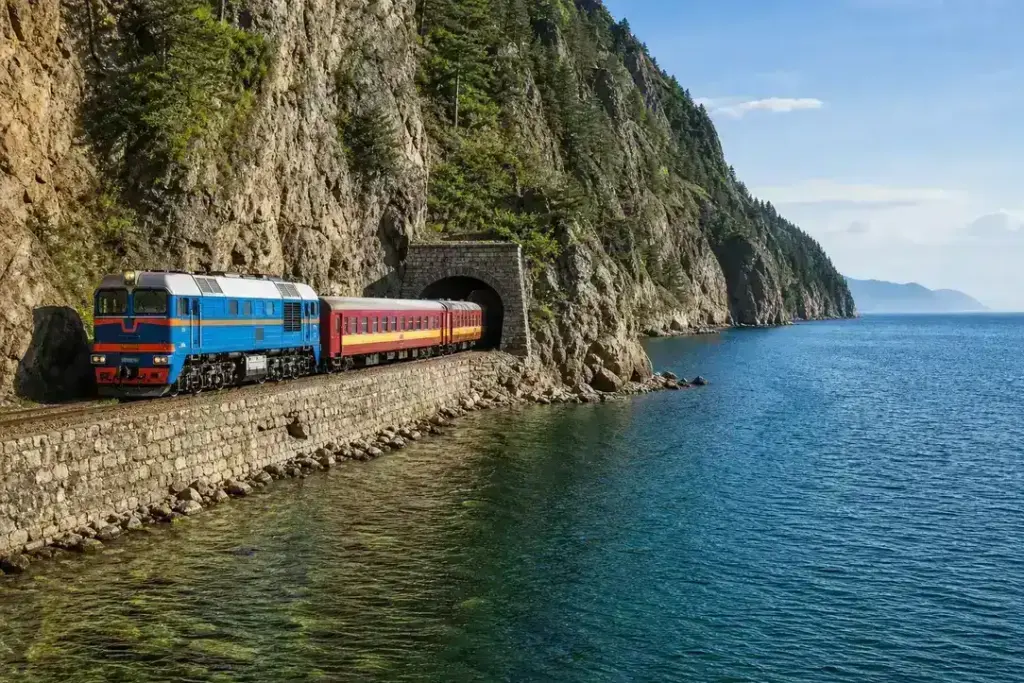
The Circum-Baikal Railway runs along the southwestern shore of Lake Baikal, connecting the town of Slyudyanka to Port Baikal over an 89-kilometer route that once formed a critical link in the Trans-Siberian Railway. When first surveyed in 1894 and completed in 1905, it solved a major engineering problem: trains and passengers previously had to cross the lake by ferry, including using icebreaker ferries in winter.
The railway was called the “golden buckle of the steel belt of Russia” because it connected the western and eastern sections of the Trans-Siberian Railway and was the most expensive section to build. After a hydroelectric station was constructed on the Angara River in 1956, raising water levels and flooding parts of the original line, the railway lost its strategic importance but gained a second life as one of Siberia’s most spectacular tourist routes.
Quick Facts
| Russian name | Кругобайкальская железная дорога |
|---|---|
| Built / opened | 1905 |
| Architect(s) | Russian, Italian, Lithuanian, Polish, and Albanian engineers |
| Address | From Slyudyanka-2 to Port Baikal, Lake Baikal, Irkutsk Oblast, Russia |
| District | Irkutsk Oblast |
| Best time to visit | Tourist trains (Circum-Baikal Express) run May through September, with the best weather and longest daylight in June, July, and August. July and August see the warmest temperatures and the most tourists. Spring (May) and autumn (September) offer fewer crowds and still-pleasant conditions, though weather can be more variable. The local Matanya train runs year-round, but winter travel (November–March) is possible only for hardy travelers who can handle very short daylight hours and occasional service delays. Avoid late autumn and early spring (October, April) when schedules are transitional. |
| Recommended duration | 5–13 hours |
| Website | rzd.ru |
What Is (and Isn't) Part of a Visit to Circum-Baikal Railway, Lake Baikal?
| Part | Status | Notes |
|---|---|---|
| Circum-Baikal Railway historic line (Slyudyanka-2 to Port Baikal) | Included in the standard ticket | The main 89-km section operates year-round; accessible by local Matanya train or seasonal tour trains. |
| Original full Circum-Baikal Railway (260 km to Mysovaya/Babushkin) | Outside / not part of it | The eastern section flooded when the Irkutsk Dam was built in 1956 and is not accessible to visitors. |
| Port Baikal to Listvyanka ferry crossing | Separate ticket or institution | Requires a separate ferry ticket or other transportation; ferry runs seasonally (approximately May–September). |
| Irkutsk to Slyudyanka transport | Separate ticket or institution | Requires advance planning; marshrutka (minibus) or local elektrichka (commuter train) takes 2.5+ hours from Irkutsk. |
| Stops and scenic overlooks along the route | Included in the standard ticket | Tour trains include multiple stops; local Matanya train does not announce or guarantee stops at all viewpoints. |
| Food, lodging or visitor facilities on the railway | Not open to visitors | The railway line itself has no restaurants, hotels, or shops; bring food and water. |
Why Visit Circum-Baikal Railway, Lake Baikal?
Visitors travel the Circum-Baikal Railway primarily for the stunning lakeside scenery and the remarkable engineering feats visible from the train. The route passes through 38 tunnels and over numerous bridges and viaducts carved into steep rocky cliffs—engineering marvels that were cutting-edge when built in the 1890s. The landscape alternates between dramatic rock formations and pristine Baikal shoreline, with the water often just meters from the tracks. Several stops allow visitors to walk and photograph iconic engineering structures like the longest tunnel (777.5 meters) and distinctive stone galleries. The journey combines natural beauty with industrial heritage in a way few other rail routes can match.
How Circum-Baikal Railway, Lake Baikal Is Laid Out
The railway route runs for 89 kilometers from Slyudyanka-2 station in the south to Port Baikal station in the north, hugging the western shore of Lake Baikal’s southern basin. The main operational section consists of four stations (Kultuk, Maritui, Ulanovo, and Baikal) plus one passing place where trains can meet. Key geographical landmarks along the route include the Staraya Angasolka viaduct in the south, the Polovinnaya Valley region featuring both the shortest and longest tunnels, and the Italian Retaining Wall (Italianskaya stena) on the western cliff face. Most visitors travel north from Slyudyanka toward Port Baikal, though trains also run in the reverse direction. Tour trains typically make 4–6 stops lasting 15–40 minutes each at scenic or historically significant points.
Highlights of Circum-Baikal Railway, Lake Baikal
Staraya Angasolka Viaduct
Located at kilometer 149 from the start of the route, the Angasolskiy arched viaduct curves like a Roman aqueduct and represents the beginning of the most complex engineering section. Built in the 1890s using hand-laid stone, it curves gracefully along the shoreline with dramatically steep rock faces above. The structure is 50+ meters long and showcases the period's masonry techniques. Visitors can step out at this stop to view and photograph the viaduct up close against the mountain backdrop.
Tip: Arrive at the stop early if traveling by tourist train, as this is a popular photo spot that can be crowded.
Tunnels Through Solid Rock
The railway features 38 tunnels totaling about 9.5 kilometers, cut directly through rocky cliffs to keep the line as close to the shoreline as possible. Visitors encounter these tunnels continuously as the train passes through them, sometimes for several minutes at a time. The rock is often wet and shiny from seepage. Riding through a tunnel with the lake visible at the far opening creates a unique perspective on how builders in the 1890s carved a path where none naturally existed.
Tip: Sit on the lakeside of the train when possible to see the water and rock faces better; tunnels block the view but create a sense of the engineering challenge.
Polovinnaya Valley: Longest Tunnel
At kilometer 110, the Polovinnaya Valley features both the shortest and longest tunnels on the line, with the longest measuring 777.5 meters. The long tunnel is so straight that you can see daylight at the far end from the entrance. The valley itself opens to a beautiful basin between Chaikin Rock and Polovinny Cape, with two rivers visible from the overlook. This stop is a traditional favorite for tours and allows visitors to grasp the scale of the tunnel engineering.
Tip: If you want a quiet photo of the tunnel entrance and surrounding landscape, consider the local Matanya train which has fewer tourists.
Italian Retaining Wall (Italianskaya Stena)
Near Shumikha station, visitors can see the distinctive Italian Retaining Wall—a curved stone structure built by Italian engineers to support the track along a particularly challenging steep section. The wall curves organically around a rocky outcrop and represents some of the most skilled masonry on the route. Its name reflects the Italian workers brought in for the most difficult construction phases. The wall remains remarkably intact over 120 years later.
Tip: This stop is mentioned on tour itineraries as "Shumikha." Try to get a photo from the lakeside perspective to see the curve of the wall.
Port Baikal Station and Lighthouse
Located at the northern terminus on Cape Baranchik, Port Baikal station features an early 20th-century lighthouse standing on the cape. The station was once a major hub where trains transferred to ferries crossing the lake. The lighthouse, with its white and red striping, is a distinctive landmark visible from the water. The station building, though modest, represents the administrative infrastructure that served Trans-Siberian traffic. A small museum or information kiosk is often present to explain the site's role in railway history.
Tip: If returning to Irkutsk, check ferry schedules to Port Listvyanka (about 5 km across the water) or arrange minibus transport back to Irkutsk.
Stone Galleries and Retaining Walls
The railway includes 16 stone galleries (roofed sections) and approximately 270 reinforcing structures including sustaining walls that support steep slopes. These structures are distributed along the entire route, creating visual variety as the train passes through different engineering solutions to the same fundamental problem: the rocky, steep terrain offers no natural ledge wide enough for a railway. Some walls are 5+ meters high, and in places you can see the marks where dynamite was inserted to blast through solid rock during original construction.
Tip: Ask the guide (on tour trains) to explain the difference between tunnels, galleries, and open track with retaining walls—it helps appreciate the variety of engineering responses.
Atmosphere
The Circum-Baikal Railway experience is defined by the combination of intimate engineering spectacle and pristine natural landscape. The train moves slowly enough to see details of rock formations, often just meters away on the cliff face. Tour trains run with multiple stops for walks, creating a leisurely pace that contrasts with the historic urgency of the route’s original purpose. During stops, the sound of waves and the smell of lake water dominate. In summer (May–September), daylight extends long into the evening, with golden hour light hitting the cliffs mid-journey. On tourist trains, passengers are often relaxed and social, chatting about the engineering or taking photographs. The local Matanya train, by contrast, serves few tourists and feels more utilitarian, with primarily local commuters.
History of Circum-Baikal Railway, Lake Baikal
The Trans-Siberian Railway was decreed into existence by Tsar Alexander III in 1891, with Alexander’s heir, the future Tsar Nicholas II, chairing the construction committee. The Circum-Baikal section was one of seven segments into which the railway was divided, and the first survey was carried out in 1894. Before the railway existed, the problem was acute: trains and passengers had to be transported across Lake Baikal by ferry. Special icebreaker ferries like the SS Baikal were built to carry train cars across the lake in winter, but this solution was slow and unreliable.
Surveyors initially proposed building a pontoon bridge across the lake, but ultimately chose to construct a railway around the southern shore instead. Construction of the line from Irkutsk to Lake Baikal began in the 1890s, with the lakeside section built between 1896 and 1900. A team of Russian, Italian, Lithuanian, Polish, and Albanian engineers tackled the technical challenge: the rocky, steep western shore of Baikal offered almost no flat terrain. The solution required extensive blasting, tunneling, and masonry work.
The first single track was completed in 1905, finally opening non-stop traffic along the entire Trans-Siberian Railway. Initially, only one track was built; from 1911 to 1915 a second track was added, increasing capacity to handle the volume of goods and passengers flowing to and from Russia’s Pacific gateway. In this phase, reinforced concrete was introduced as a new material for bridges and structures alongside traditional stone.
The Circum-Baikal was called the “golden buckle of the steel belt of Russia” because it was the most expensive section to build (far costlier per kilometer than the other sections) and because it literally buckled the two halves of the Trans-Siberian together. For four decades it served as a major freight and passenger artery.
The railway’s strategic importance ended after 1956, when the Irkutsk Hydroelectric Station was constructed on the Angara River downstream, raising water levels and flooding sections of the original line that ran along the river. A new direct route from Irkutsk to Slyudyanka was built away from the dangerous avalanche zones and flooded areas. The Circum-Baikal lost its role as a main Trans-Siberian artery and became a dead-end branch line.
In the 1980s the closed Circum-Baikal section was placed under state protection as an engineering monument. Since the 1990s, as tourism to Lake Baikal grew, the surviving 89-kilometer segment from Slyudyanka to Port Baikal has been operated for tourists. The local Matanya train provides year-round transportation for locals, while seasonal tour trains operate May through September, stopping at key engineering sites and scenic overlooks.
Legends and Myths about Circum-Baikal Railway, Lake Baikal
The Ghost Railway Under Water
Legend – historically unreliable. Local legend claims that when the Irkutsk Dam flooded the original route in the 1950s, workers could sometimes hear faint train whistles echoing from under the water, as if phantom trains still ran the drowned section. Some said that construction workers who died during the original building of the railway were still making their evening runs. Though purely folkloric, the legend reflects the emotional impact of the old route disappearing beneath water after decades of service.
The Builder's Initials in the Stone
Legend – historically unreliable. Visitors and locals occasionally claim to spot initials or names carved into the stone galleries and tunnel walls—said to be left by Italian masons and Russian laborers who wanted to mark their work. Some claim that if you find a name carved into the stonework and research it, you can trace descendants of the original builders still living in Siberia. Whether these carvings are authentic worker marks or later additions remains unclear.
Tickets and Booking for Circum-Baikal Railway, Lake Baikal
| Ticket | Price | Includes |
|---|---|---|
| Circum-Baikal Express (tourist train, Irkutsk departure) | ₽₽₽ | Full-day excursion from Irkutsk including train ride on both legs (Irkutsk–Port Baikal–Irkutsk), multiple guided stops, and return transportation; lunch may or may not be included depending on operator. |
| Circum-Baikal Express (tour operator packages) | ₽₽–₽₽₽ | Varies by operator; typically includes same-day rail journey with stops, professional guide, and often meals; booked through travel agencies rather than direct. |
| Matanya local train, one-way ticket | ₽ | Single journey between Slyudyanka-1 station and Port Baikal (approximately 5 hours); no meals, guide, or guaranteed stops; for independent travelers. |
| Matanya local train, two-segment option | ₽ | Round trip by combining multiple one-way journeys; typically requires staying overnight in Port Baikal or Slyudyanka, or arranging ferry/transport return to Irkutsk. |
₽ budget · ₽₽ moderate · ₽₽₽ upscale · ₽₽₽₽ splurge. Price levels are estimates compared with typical prices for visitors.
Tourist trains (Circum-Baikal Express): Many tour operators sell excursions advertised as “Circum-Baikal Express,” running Wednesday and Saturday departures from Irkutsk and Thursday and Sunday returns from Port Baikal. These must be booked through travel agencies, hotels in Irkutsk, or tour websites; there is no official dedicated ticketing website for the route itself. Book at least 2–3 days ahead during summer. Tours typically include hotel pickup in Irkutsk and return drop-off.
Local Matanya train: Tickets cannot be purchased online and must be bought at Slyudyanka-1 station or aboard the train. The Matanya runs approximately four times weekly (Monday, Thursday, Friday, Sunday) departing Slyudyanka around 13:30 local time. Timetables are available from the Russian Railways website (rzd.ru), but schedules change seasonally. Arrive at the station 15–30 minutes before departure. Backpacks and luggage over a certain size incur an additional small charge.
General notes: Fares for Russian citizens are lower than for foreign visitors. Concession categories (students, children, seniors) have separate rates. Consult the Russian Railways website (rzd.ru) and local tourism offices in Irkutsk for all categories and current availability.
Suggested itineraries Circum-Baikal Railway, Lake Baikal
5 hours (local train one-way)
Board the Matanya local train at Slyudyanka-1 station and ride to Port Baikal, covering 89 km through all major tunnels and scenic sections. The train makes minimal scheduled stops but allows brief waits at stations. Arrive Port Baikal in late afternoon. This option is budget-friendly and gives an authentic local-transport experience. Return via ferry to Listvyanka or arrange minibus back to Irkutsk.
12–13 hours (full-day tour train)
Depart Irkutsk early morning on Circum-Baikal Express (Wednesdays and Saturdays at 08:00). The train makes 4–6 organized stops at engineering landmarks (Staraya Angasolka, Partizan Tunnels, Shumikha, Polovinnaya) for 15–40 minute walks. Lunch is typically provided mid-journey. Return from Port Baikal the same day (Thursday or Sunday evening departure at 15:00–16:00), arriving Irkutsk around 21:00–22:00. Best for first-time visitors wanting to understand the route's history with professional guidance.
2 days (independent, with overnight)
Take local transport from Irkutsk to Slyudyanka (2.5 hours). Board Matanya next morning for the 5-hour railway crossing to Port Baikal. Spend the afternoon exploring Port Baikal settlement and lighthouse. Sleep overnight in Port Baikal, Slyudyanka, or nearby Listvyanka. Return to Irkutsk the following day by ferry, minibus, or reverse train journey. Allows time to hike or photograph without rush.
One-way journey plus side trips
Take the Matanya from Slyudyanka to Port Baikal, then combine with a ferry crossing to Listvyanka (a major Baikal resort town). Spend a night or more in Listvyanka visiting Lake Baikal Museum, local restaurants, and beaches. Return to Irkutsk via ferry and minibus from Listvyanka. This allows visitors to experience the railway as part of a larger Baikal circuit rather than a stand-alone day trip.
How to Get to Circum-Baikal Railway, Lake Baikal
From Irkutsk: The railway does not depart directly from Irkutsk city. To reach it, first travel to Slyudyanka (the southern starting point) or Port Baikal (the northern terminus).
- To Slyudyanka: Travel from Irkutsk by marshrutka (shared minibus) or local elektrichka (commuter train) for 2.5+ hours. Marshrutkas depart from central transit hubs in Irkutsk throughout the day. The elektrichka is slower and cheaper but has limited modern amenities. Both arrive at Slyudyanka’s main station district.
- To Port Baikal: No direct public transport exists; arrange via ferry from Listvyanka (5 km away on the opposite shore) or tour operator transport.
Circum-Baikal Express (tourist train): Operates from Irkutsk; hotels and travel agencies arrange pickup at your accommodation. Trains depart Irkutsk Wednesday and Saturday at 08:00, returning Thursday and Sunday evening.
By private vehicle: Self-drive to Slyudyanka (250 km south of Irkutsk, ~4 hours) or arrange taxi; parking available at Slyudyanka-1 station.
Accessibility
The railway itself offers no wheelchair accessibility; the train cars are vintage or heritage-style with steep steps. Stops at stations involve disembarking to platforms, some of which are not wheelchair-accessible. Passengers with reduced mobility should inform the tour operator in advance; some operators may refuse or require a companion. No accessible restrooms or elevators are available on trains or at stops. Reach out directly to the tour operator or Russian Railways before booking if accessibility is a concern.
Food Nearby
No food or drink vendors operate on the railway line itself. Tour trains typically include meals as part of the package (confirm with your operator). For the budget Matanya train, bring adequate food and water (the journey takes 5+ hours). Small cafés and shops exist at Slyudyanka-1 station and Port Baikal settlement, but options are limited. Listvyanka (accessible by ferry from Port Baikal) has restaurants and shops. Pack snacks, sandwiches, and water bottles.
What to Bring
Bring a camera or smartphone with full battery for the spectacular cliff and tunnel views. Wear layers—weather on the open platforms can be cool and windy, even in summer. Sunscreen and a hat are essential, as there is little shade during stops. Waterproof jacket in case of rain. Sturdy walking shoes for the rocky, sometimes muddy ground at stops. Binoculars to spot geological features and wildlife. Snacks and a refillable water bottle (tour trains may provide water). Motion-sickness medication if prone to nausea during train travel. A notebook to sketch or record observations. Small day bag for camera, water, and documents. Passport required for ticket verification on some services.
Best Views and Photo Spots of Circum-Baikal Railway, Lake Baikal
Staraya Angasolka Viaduct
The arched stone viaduct curves elegantly against the backdrop of steep mountains and rocky shoreline. The structure is best photographed from the platform below or from slightly elevated points nearby. The archway frames lake views beyond.
Best time: Late morning or early afternoon when the western sun illuminates the stone; avoid harsh shadows at noon.
Tunnel entrance with lake beyond
Photograph the mouth of a tunnel with Lake Baikal visible through the opening, creating a frame-within-frame composition. The contrast between dark stone and bright water is dramatic.
Best time: Mid-morning or late afternoon when the far shore of the lake is lit and the tunnel entrance is partially shadowed.
Longest tunnel at Polovinnaya Valley
The 777.5-meter tunnel is so straight that daylight is visible at the far end; photograph from the entrance looking inward, or from the overlook on the platform above showing the tunnel portal in the cliff face.
Best time: Clear days when daylight penetration into the tunnel is maximum; late morning or early afternoon.
Stone gallery sections with lake at the edge
Roofed stone galleries create interesting architectural foregrounds with the open lake and mountains beyond. Photograph the carved stone ceiling or walls with water visible through the gallery opening.
Best time: Overcast days when the stone detail is evenly lit; shadows from sun rays through a gallery can create striking abstract patterns.
Port Baikal Lighthouse
The white and red-striped lighthouse stands on Cape Baranchik at the northern terminus. Photograph it from the platform or from the shore nearby, with Lake Baikal in the background.
Best time: Late afternoon (golden hour) when warm light bathes the lighthouse and surrounding landscape.
Train on the rails with cliff and water
If traveling with a tour group, position yourself at a stop to photograph the train from the platform or shore, showing the line hugging the rocky coastline with the lake beyond.
Best time: Any clear day; the composition works best when the train is partly in shade and partly in sun, contrasting with the bright water.
Photography Rules
Photography is permitted throughout the journey and at all stops. Tours are designed partly for photography, with stops timed for good light. No tripods or drones are permitted on the train or at stations (drones are prohibited in the national park area). Flash photography in tunnels is not necessary and can be disruptive. Bring a camera suited to variable lighting (from bright daylight in open sections to dim interiors in tunnels). The journey provides exceptional opportunities for landscape and architectural photography.
Family Suitability
The Circum-Baikal Railway is moderately family-friendly. Tour trains include multiple short stops suited to young walkers, and the continuously changing views often keep children engaged. The journey lasts 5–13 hours depending on service; younger children may find this tiring. Train cars on tour services are designed for comfort with seats and bars; local trains are less comfortable. Small children should be watched closely on open platforms during stops, as edges near the water are not always fenced. No restrooms onboard are particularly family-friendly. Stroller access is very limited; the terrain is rocky and platforms are not paved. Older children (8+) typically enjoy the engineering aspect and landscape. Bring entertainment, snacks, and patience. The tour-train option is better for families than the budget Matanya train.
Russia Vibes Tips
- Book tour trains (Circum-Baikal Express) at least 3 days in advance during July and August, or they may sell out. Tour companies in Irkutsk book these excursions regularly; hotel concierges can recommend reliable operators.
- Choose seats on the lake side of the train if possible. On the Matanya local train, this is first-come, first-served, so board early. Lake views are far superior to the cliff-wall side.
- If traveling by the budget Matanya train, download an offline map or GPS beforehand, as cell coverage is intermittent and English is rarely spoken on local trains. Carry cash (rubles) for the ticket, as card payment is not always available.
- The longest tunnel (777.5 m at Polovinnaya) takes about 1.5–2 minutes to traverse. Your eyes will not fully adjust to the darkness; the contrast when exiting is dramatic. Take the experience rather than fighting to photograph it.
- Weather on the lake shore can shift quickly. Mornings are often cool and windy; pack a windbreaker even in summer. Afternoon sun can be intense on the open platforms, so sunscreen is essential.
- A small English-language guidebook or online blog post about the railway read beforehand helps you identify landmarks and understand the engineering context, making stops more meaningful and safer if you're traveling independently.
Explore Nearby Circum-Baikal Railway, Lake Baikal
Sights near Circum-Baikal Railway, Lake Baikal
 Listvyanka, Lake Baikal · typical visit: 2–3 days
Main image: AI-generated illustration. It may not show the place exactly as it looks.
 Olkhon Island, Lake Baikal · typical visit: 2–3 days
Main image: AI-generated illustration. It may not show the place exactly as it looks.
 Shamanka Rock, Lake Baikal · typical visit: 30–45 minutesOpen 24 hours
Main image: AI-generated illustration. It may not show the place exactly as it looks.
Related guides
 Lake Baikal: Where to Go, What to See and How to Visit
Main image: AI-generated illustration. It may not show the place exactly as it looks.
 Chersky Stone: Panoramic Viewpoint Over Lake Baikal
Main image: AI-generated illustration. It may not show the place exactly as it looks.
 Olkhon Island Ferry Terminal: Hours, Queues and What to Expect
Main image: AI-generated illustration. It may not show the place exactly as it looks.
 Maloye More, Lake Baikal: Swimming, Fishing, and Winter Ice Roads
Main image: AI-generated illustration. It may not show the place exactly as it looks.
 Slyudyanka, Lake Baikal: The World’s Only Marble Railway Station
Main image: AI-generated illustration. It may not show the place exactly as it looks.
Browse more: More in Irkutsk Oblast · All Lake Baikal · All Landmarks · All Sightseeing · All Sightseeing in Lake Baikal
FAQ: Circum-Baikal Railway, Lake Baikal
Does the Circum-Baikal Railway still operate as a tourist route?
Yes; the 89-km section from Slyudyanka to Port Baikal operates year-round via the local Matanya train and seasonally (May–September) via the Circum-Baikal Express tourist train. The eastern section that originally extended to Mysovaya was flooded in 1956 and is not accessible.
How long is the journey?
The local Matanya train takes approximately 5 hours to cover the 89 km from Slyudyanka to Port Baikal. Tourist trains take 12–13 hours because they include multiple stops for walks and guided tours.
Do I need to book in advance?
Tourist trains (Circum-Baikal Express) should be booked 2–3 days in advance through travel agencies or tour operators. The local Matanya train does not accept online bookings; buy tickets at the station or aboard. Summer weekends can be crowded for both services.
What is the difference between the Circum-Baikal Express and the Matanya train?
The Express is a dedicated tourist train with multiple organized stops, professional guides, meals, and comfortable seating; it runs only May–September on set schedules. Matanya is the local commuter/cargo train with minimal stops and amenities; it runs year-round, is much cheaper, and stops only at scheduled stations unless requested.
Can I reach Port Baikal to visit Listvyanka from there?
Port Baikal has a ferry connection to Listvyanka (about 5 km across the water), but ferries run seasonally (approximately May–September). Check ferry schedules in advance. Alternative: minibuses from Port Baikal can drive around the lake to Listvyanka (1.5+ hours by road).
Is there food available on the train?
No food vendors operate on the railway line. Tour trains include meals as part of the package. For the local Matanya train, bring your own food and water—the journey is 5+ hours with limited options at stations.
What are the key engineering features I should look for?
Watch for 38 tunnels, 16 stone galleries, 200+ bridges, and extensive retaining walls cut into the cliff face. The longest tunnel at Polovinnaya measures 777.5 meters. The Staraya Angasolka viaduct and Italian Retaining Wall are iconic architectural examples. A guide or guidebook helps you identify these features.
Can I hike along the railway or visit it independently?
Yes, hikers can walk sections of the route independently outside the railway corridor, following trails that parallel the tracks. However, the railway itself is a protected zone; do not trespass on the tracks. Tour packages and local guides in Irkutsk can arrange hiking-focused itineraries.
Russia Vibes is a one-person project. A coffee keeps it going

Take this guide with you
Get a free PDF of this guide to print or read offline: key facts, tips and a map link on a few clean pages.
Report an issue on this page
Paying for your trip: please read
Payments and bookings between Russia and many other countries are currently restricted. In practice, cards issued in the EU, the UK, the US and several other countries often cannot be used in Russia, Russian cards usually cannot be used abroad, and some booking platforms, airlines and payment providers limit or pause their services for Russia. The situation changes frequently.
We do not give legal or financial advice, and this site does not encourage anyone to break any rule that applies to them. Whatever you plan, you are responsible for following the laws and regulations that apply to you, including those of your country of residence and citizenship.
Many travelers still organise their stay without problems. It is worth asking your bank or payment provider what is currently possible, contacting hotels, tour operators and carriers directly about the payment methods they accept, and checking which services are open to customers from your country. Clarify payment, cancellation and refund terms before you commit to a booking, and keep your plans flexible.
Partner links on this site may not be available in every country, and prices, availability and rules in our guides can differ from what you see when you book.
How we research and update our guides
About this guide: AI assistance and accuracy
This guide is created with the help of AI and is based on official sources where available. Mistakes can still happen. Opening hours, prices, rules and other details are given to the best of our knowledge as of the date shown and can change without notice. It offers general recommendations only, not professional, legal or travel advice. Please confirm important details with the official source before you travel; you are responsible for your own plans and decisions.
* Affiliate link: as an Amazon Associate we earn from qualifying purchases at no extra cost to you.