
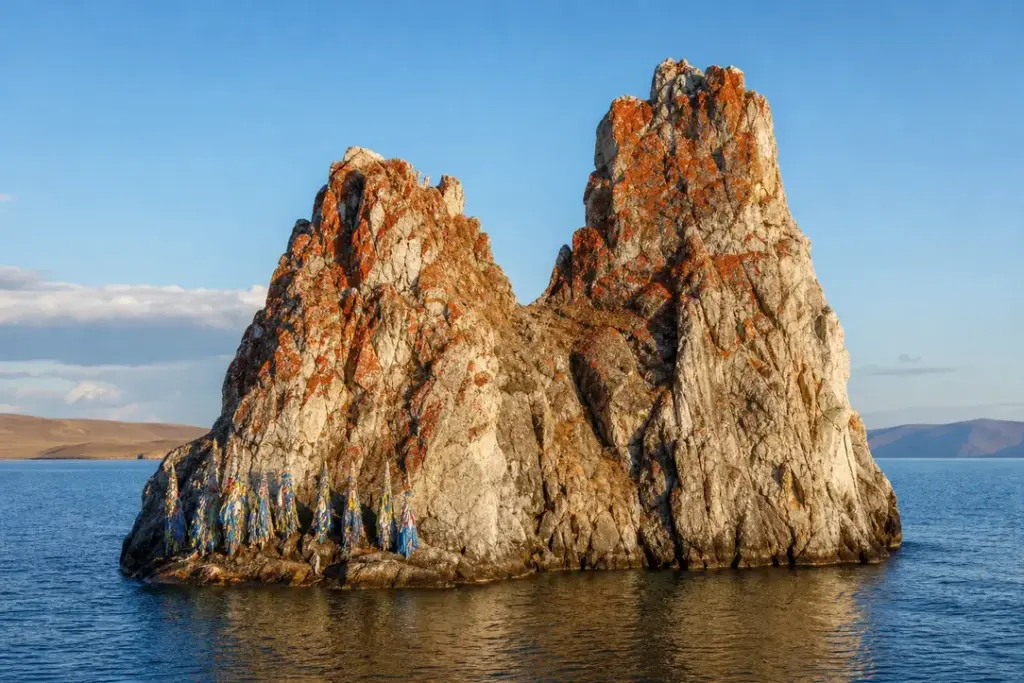
Shamanka Rock, also known as Shaman Rock or Cape Burhan, rises from the western shore of Olkhon Island as the most iconic natural monument of Lake Baikal. Located near Khuzhir, the largest settlement on the island, the white marble formation crowns Cape Burhan and stands among Asia’s nine holiest pilgrimage sites. Shamanka rock is deeply rooted in the spiritual traditions of the Buryat people, the indigenous inhabitants of the region who view it as the dwelling place of protective deities and a centre of shamanic practice for thousands of years.
The rock connects to the island by a narrow isthmus, though from certain angles it appears as a separate formation rising from the water. Visitors can approach on foot across the stony shore, and a cave that passes completely through the rock opens its entrance to the water’s edge.
Current access notice: As of October 2026: The rock is open year-round. Winter visits (February–March) require extreme caution on frozen ice; access should be with local guides only.
Quick Facts
| Russian name | Скала Шаманка |
|---|---|
| Address | Cape Burhan, Olkhon Island, Lake Baikal, Irkutsk Oblast Google MapsApple MapsYandex Maps2GIS |
| District | Olkhonsky |
| Admission | free |
| Best time to visit | Summer (June–August) offers the easiest access and warmest weather, with temperatures around 20–25°C. The white marble and red lichen are most vividly contrasted against the blue water and sky. Autumn (September–October) brings fewer visitors and crisp light. Winter (December–March) freezes the lake, allowing access on ice in February–March with proper precautions, creating a stark and strikingly different landscape. Spring (April–May) brings thawing and unpredictable ice conditions; the transition period is less reliable for winter activities. |
What Is (and Isn't) Part of a Visit to Shamanka Rock, Lake Baikal?
| Part | Status | Notes |
|---|---|---|
| The rock formation and through-cave | Included in the standard ticket | Free access; open 24 hours. Visitors approach by foot across Khuzhir's rocky shore. |
| The serge poles (wooden hitching posts) | Included in the standard ticket | Thirteen traditional poles with coloured cloth, maintained as part of the site's sacred character. |
| Archaeological artefacts from the site | Separate ticket or institution | Ancient items (arrowheads, ceramics, gold jewellery) are held in regional museums, not displayed on site. |
| Khuzhir village and its facilities | Outside / not part of it | The village of Khuzhir is separate from Shamanka Rock but the closest settlement with accommodation and supplies. |
| Pribaikalsky National Park | Included in the standard ticket | Shamanka Rock is within Pribaikalsky National Park; general park rules apply. |
| Guided shamanic or spiritual ceremonies | Separate ticket or institution | Visitors may encounter or arrange spiritual practices, but these are separate activities not included in general access. |
Why Visit Shamanka Rock, Lake Baikal?
This is Lake Baikal’s most recognizable landmark and a place of genuine spiritual significance, not merely a photogenic curiosity. The white marble formation, covered in vivid red lichen, stands visibly distinct against blue water and dark shore. The site offers insight into Buryat shamanism and Buddhist traditions that have coexisted here for centuries. Many visitors make vows or leave offerings at the serge—the 13 wooden poles with coloured cloth tied at the cape, representing traditional hitching posts for the gods’ horses. In winter, when the lake freezes thickly, the frozen landscape surrounding the rock creates an entirely different and equally stunning photograph-worthy environment.
Highlights of Shamanka Rock, Lake Baikal
The Two White Marble Peaks
The rock formation consists of two white marble peaks (approximately 30 and 42 metres tall), joined by a depression. The marble cliffs are covered by bright red lichen underlining the whiteness of the marble cliffs. The contrast between the pale stone and the vivid lichen makes the formation distinctly recognizable from the shore and from across the water. Look for the natural brown formation on the western back side that resembles a dragon's head—a detail many visitors miss but that appears in countless photographs of the site.
Tip: Approach from the south along the shore for the classic view; the angle that shows both peaks clearly is visible once you draw level with the formation.
The Through Cave (Shamanskii)
Water and wind have cut out an open-ended cave through the Burkhan rock closer to the shore, also called Shamanskii. This passage runs completely through the rock. In ancient times, rites and sacrifices were performed in honour of the spirit-master of Olkhon, the most revered deity of Baikal. Historically, only male shamans were allowed to enter the cave. Women were forbidden to even approach the cape, so as not to bring bad luck on themselves. Today the cave is open to visitors, and walking through it is a highlight of the visit.
Tip: Enter at low water for easier access; bring a light as the cave interior is dim. The passage is narrow but navigable for most visitors.
The Thirteen Serge Poles
Near Shaman Rock, there are many wooden poles with colorful cloths tied to them. These poles, called "Serge," symbolize the poles used to tie the gods' horses. There are 13 "serge" pillars on the Cape Burkhan. "Serge" means "hitching post", earlier such a pole was placed near each yurt, and was used not only for tying horses, it was believed that as long as it stood the family would be well. The bright cloths make the site visually distinctive and signal its ongoing sacred significance to visitors.
Tip: The serge poles are often replaced or renewed; photograph them carefully as they change between visits. Many visitors leave small offerings or tie fabric as a personal ritual.
Archaeological Evidence
Archaeologists found ancient household items such as arrowheads, ceramics and gold jewelry in the cave and on the isthmus burials, which are considered to be more than 5,000 years old. These artefacts confirm that the site held spiritual importance for Buryat peoples in prehistory. In the 17th century, when Buddhism began to spread in Siberia, an altar of Buddha appeared in the cave. Lamas from the surrounding datsans would often pray there.
Tip: None of the archaeological finds are displayed on site; they are kept in museums. However, the artefacts testify to the genuine antiquity of the practice of shamanism here.
Winter Perspectives
When Lake Baikal freezes in winter (typically February to March), the frozen bay around Shamanka Rock creates a starkly different and striking landscape. The white marble against white ice, with the distinctive red lichen still visible, offers entirely new photographic possibilities. During February to March, the lake freezes thick enough for visitors to walk close to the rock for unique photo opportunities. Visitors can walk on the ice surface to approach the rock from angles impossible in summer.
Tip: Winter access requires extreme caution and local guidance; check ice thickness with local guides before venturing onto the frozen lake. Do not attempt ice travel alone.
Geological Composition
The rock formation is made of white marble, dolomite, limestone, with inclusions of garnet, quartz and graphite. The geological composition explains both the white colour and the durability of the formation. The red lichen that covers much of the surface contrasts strikingly with these white minerals and is visible from considerable distances across the water.
Tip: The marble composition makes the surface sometimes slippery when wet; wear sturdy footwear with good grip when walking on the rock itself.
Atmosphere
Shamanka Rock is a tall marble rock covered in red lichen, reached by a narrow stile. The approach along Khuzhir’s rocky shore is contemplative and quiet even in summer when visitors are present. The sound of water against stone, the presence of the formation rising from the lake, and the visible care visitors take—tying fabric, making offerings, moving respectfully—creates an atmosphere that feels genuinely sacred rather than manufactured. In summer, the light plays off the white marble and red lichen; in winter, the frozen water around the base creates an ethereal, otherworldly quality. The site does not feel like a tourist attraction despite its fame; it remains a place where both spiritual pilgrims and ordinary visitors recognize something significant.
History of Shamanka Rock, Lake Baikal
Shamanka Rock was previously called “a stone temple”. The first researchers of Lake Baikal—in particular, the famous Russian researcher Vladimir Obruchev—noted that this place causes superstitious horror of the Baikal Buryats.
Archaeological evidence shows that people have visited this site for thousands of years; archaeologists found ancient household items such as arrowheads, ceramics and gold jewelry in the cave and on the isthmus burials, which are considered to be more than 5,000 years old. The Buryat people, adherents of shamanism, established the rock as a centre of ritual practice, making it one of the most important spiritual sites in Siberia.
No one but the shamans had the right to approach the protected location. In need, the Buryats wrapped hooves of their horses with felt and leather so as not to disturb the Master of Lake Baikal. Women were supposed to walk a mile off the rock. This practice reflected the rock’s status as a place of male shamanic authority in traditional Buryat society.
In the 17th century, when Buddhism began to spread in Siberia, an altar of Buddha appeared in the cave. Lamas from the surrounding datsans would often pray there. The coexistence of shamanic and Buddhist practices at the site reflects the broader syncretism of religious traditions in the Baikal region.
Now, it is considered one of the nine great shrines of Asia, along with Shaolin Monastery in China and Mount Kailash in Tibet. This recognition emphasizes the site’s spiritual significance across multiple Asian religious traditions and its importance as a pilgrimage destination.
Legends and Myths about Shamanka Rock, Lake Baikal
The Daughter of the Lake Master
Legend – historically unreliable. According to legend, the guardian deity of the lake had a daughter who tried to elope with a man. To prevent this, the deity threw this rock to block her path. The rock thus represents both a barrier and a symbol of protective divine authority. The local name of the cliff is Maiden. According to legend, this is a stony Buryat woman who out of envy asked the God for a castle which had been given to her husband – a shaman.
The Witch and the Sacred Gold
Legend – historically unreliable. Ancient people believed that the rock consisted entirely of silver and gold. An evil witch, who sent a lot of trouble to the locals and destroyed lives of hundreds of innocents, guarded it. Many tried to kill the witch with selfish intent—who for fame, who for the sake of money—but the witch overcame them. Once an unknown hunter managed to cope with the villain: he let an arrow into her heart with good intention to save people from grief and suffering. The image of the witch later was found in the cave on Cape Burhan.
Shamanic Authority and Divine Dwelling
Legend – historically unreliable. The Buryat people believe that Shaman Rock is the abode of Ugute-noion, one of the thirteen sons of heaven who descended to protect the human world. He chose a cave within the rock as his permanent dwelling, making it a centre of shamanism for centuries. This belief persists in contemporary spiritual practice at the site.
Tickets and Booking for Shamanka Rock, Lake Baikal
Shamanka Rock is free to visit at any time. No tickets are required. Approach the site on foot from Khuzhir village by walking south along the rocky shore towards Cape Burhan; the journey takes approximately 20–30 minutes depending on shore conditions and your pace. The path is an informal trail across stones and sand; wear sturdy shoes. The rock is accessible year-round, though winter ice conditions on the lake (February–March) require local guidance and extreme caution. For winter visits to the frozen surface, arrange a guide in advance through your accommodation in Khuzhir.
Plan and Book
Suggested itineraries Shamanka Rock, Lake Baikal
30–45 minutes
Walk from Khuzhir south along the shore to Shamanka Rock. Circle the formation, photograph from different angles, enter the through-cave, and observe the serge poles. Return to Khuzhir by the same route.
1–2 hours
Depart Khuzhir early morning for better light. Spend time observing the rock's details, the lichen patterns, and the dragon-shaped formation on the back. Sit quietly on the shore opposite the rock before returning to the village. Consider visiting nearby smaller attractions such as the Shaman's Cape to the north.
Half day
Begin in Khuzhir with a visit to the small local museum or ethnographic centre for context on Buryat shamanism. Walk to Shamanka Rock with a local guide if available to learn about spiritual traditions. Spend time at the rock and on the shore, then return to Khuzhir for lunch and rest.
How to Get to Shamanka Rock, Lake Baikal
Shamanka Rock is located on Olkhon Island in Lake Baikal, near the village of Khuzhir. To reach it:
- From Irkutsk: Drive or take a bus approximately 70 kilometres east to Listvyanka, a small settlement at the mouth of the Angara River. The journey takes 1–2 hours by road.
- From Listvyanka to Olkhon Island: Ferry services operate across the Strait of Olkhon to Khuzhir on Olkhon Island. The ferry journey takes approximately 1–3 hours depending on water conditions. Check ferry schedules in advance, as services may be suspended in extreme winter conditions.
- Alternatively, overland route: Drive around the northern and eastern shore of Lake Baikal to Olkhon Island (longer route, approximately 4–6 hours from Irkutsk). This option is available year-round when roads permit.
- From Khuzhir to Shamanka Rock: Walk south along the rocky shore for approximately 20–30 minutes. The path is informal; wear sturdy footwear. The direction is evident as the rock is visible from Khuzhir.
Accessibility
The site has no formal facilities or wheelchair access. Approach is via a natural rocky shore requiring navigation of uneven stone, sand and pebbles. No paved paths exist. The through-cave has a low entrance and narrow interior; access is on foot through water or over rocks depending on lake level. The site presents significant challenges for mobility-restricted visitors or those with walking difficulties. Sturdy footwear with good grip is essential. There are no benches, shelters or rest areas on site. Visitors should be in reasonable physical condition to navigate the terrain.
Food Nearby
Khuzhir village, approximately 20–30 minutes' walk north from Shamanka Rock, has several small cafés and guesthouses offering basic meals. Options are limited and seasonal; expect simple Russian and Buryat cuisine. Bring snacks and water if you prefer not to rely on village facilities. The nearest larger settlement with more food options is Listvyanka on the mainland, accessible by ferry.
What to Bring
Bring sturdy footwear suitable for rocky, uneven terrain. Layer clothing as weather and wind conditions on the lake shore can change rapidly. In summer, bring sun protection (hat, sunscreen) and water; in winter, warm clothing is essential. The approach involves exposure to the open shore and wind; wind-resistant outerwear is recommended. Bring a camera if you wish to photograph the rock. In winter, arrange ice-travel equipment (crampons, rope) through a local guide.
Best Views and Photo Spots of Shamanka Rock, Lake Baikal
South shore perspective across the strait
The most classic view shows both marble peaks clearly, with the red lichen visible against the white stone. The formation rises from the water with serge poles visible in the foreground. Blue water and sky create strong contrast.
Best time: Early morning (summer) or midday (winter on ice) provides the best light. Approach from the south along the rocky shore.
The through-cave entrance at water level
Looking directly at the cave mouth creates a graphic composition framing the darkness of the passage against the white marble surrounding it. The lapping water adds movement and context.
Best time: Low tide in summer offers easier access and better cave entrance visibility. Late afternoon light catches the water and rock together.
Western back face with dragon formation
The natural brown rock formation on the back resembles a dragon's head. This angle is less crowded and offers a unique perspective separate from the standard front view.
Best time: Morning light from the east illuminates the western back face. Accessible by walking around the southern side of the rock.
Winter ice landscape
The white marble against frozen white ice and snow creates a surreal, monochromatic landscape entirely different from summer. Frozen patterns in the ice add texture and foreground interest.
Best time: February–March when ice is thick and stable. Early morning light is best. Requires safe ice-travel conditions and local guidance.
Serge poles with Khuzhir and mountains in background
The thirteen wooden poles with coloured cloth frame the lake and distant mountains beyond. The contrast between the foreground traditional elements and the vast landscape emphasizes scale.
Best time: Golden hour (early morning or late afternoon) brings warmth to the cloth colours and the surrounding landscape.
Photography Rules
Photography is permitted throughout the site. No drones are mentioned in official restrictions, but check current regulations with local authorities before flying. Tripods are usable on the shore. The through-cave is dark; bring a light source if photographing inside. The white marble and red lichen provide excellent subjects in all seasons. The summer shoreline and winter ice create entirely different visual conditions; plan your visit to match your photographic interests.
Family Suitability
Shamanka Rock is suitable for families with children old enough to walk steadily on rocky, uneven terrain (generally ages 6+). The 20–30 minute walk from Khuzhir requires stable footing and parental supervision near the water. The through-cave has a low entrance and narrow passages; it may be frightening for very young children or those with claustrophobia. Strollers are impractical on the rocky shore. The site has no facilities, shelters or food; plan accordingly. In winter, ice conditions are unsafe for young children without professional guidance. The site's spiritual significance makes a quiet, respectful atmosphere; it is not designed as an entertainment attraction.
Russia Vibes Tips
- Arrive early in the morning or late afternoon to avoid the midday tourist rush from Khuzhir (though the site receives far fewer daily visitors than major attractions elsewhere in Siberia). Early visits also offer better light for photography and a more contemplative atmosphere.
- The through-cave is more accessible at lower water levels; ask in Khuzhir when the best crossing time is. If you cannot or do not wish to enter the cave, circling the rock and observing from the shore is equally worthwhile and spiritually significant.
- Bring binoculars if you have them. Viewing the lichen patterns, the carved or eroded details on the marble, and the dragon-shaped formation on the back are rewarding close-up experiences. The red lichen coverage is more intricate and varied than casual observation suggests.
- Locals and visitors often tie fabric or leave small offerings at the serge poles. If you participate in this practice, choose natural, biodegradable materials. This custom is rooted in genuine Buryat tradition, not commercialism.
- If visiting in winter, do not attempt the ice crossing alone. Winter access should be arranged with accommodation providers or local guides in Khuzhir who can assess ice conditions and provide appropriate equipment. The landscape and experience are worth the extra planning, but safety is essential.
- The walk from Khuzhir to Shamanka Rock is easy to underestimate in terms of physical demand. The rocky shore is uneven; wear shoes with proper support and grip. A fall on wet stones is possible. Take your time, and bring water for the return journey.
Explore Nearby Shamanka Rock, Lake Baikal
Sights near Shamanka Rock, Lake Baikal
 Olkhon Island, Lake Baikal · typical visit: 2–3 days
Main image: AI-generated illustration. It may not show the place exactly as it looks.
Related guides
 Lake Baikal: Where to Go, What to See and How to Visit
Main image: AI-generated illustration. It may not show the place exactly as it looks.
 Khuzhir, Lake Baikal: Gateway to Sacred Sites and Ice Adventures
Main image: AI-generated illustration. It may not show the place exactly as it looks.
Browse more: More in Olkhonsky · All Lake Baikal · All Landmarks · All Sightseeing · All Sightseeing in Lake Baikal
FAQ: Shamanka Rock, Lake Baikal
Is Shamanka Rock part of Olkhon Island or separate?
The rock connects to Olkhon Island, though depending on perspective, can appear an island. It is geologically and administratively part of the island; the narrow isthmus that connects them becomes invisible from certain viewing angles, creating the optical illusion of separation.
Can women visit Shamanka Rock?
Yes, women can visit today. Historically, women were forbidden to even approach the cape, so as not to bring bad luck on themselves. This restriction no longer applies. The site welcomes all visitors respectfully.
Can I enter the through-cave?
Yes, the through-cave is open to visitors. Water and wind have cut out an open-ended cave through the Burkhan rock closer to the shore. The entrance is at water level and the passage is narrow; bring a light and wear water-resistant footwear. Entry is unguarded and unsupervised.
How long does a visit take?
A basic visit of 30–45 minutes allows for walking around the rock, photographing and brief observation. A more leisurely visit of 1–2 hours permits careful examination of details, entry to the cave, and quiet time on the shore. Factor in 20–30 minutes of walking time from Khuzhir each way.
Is there an admission fee?
No, Shamanka Rock is free to visit. It is a natural monument within Pribaikalsky National Park, and visitors need no ticket or permit to approach it.
What does 'one of the nine holy sites of Asia' mean?
The rock is considered one of the "Nine Holy Sites of Asia". This recognition connects it to major Asian pilgrimage sites such as Mount Kailash in Tibet and represents its spiritual importance across shamanic and Buddhist traditions. The exact list and definition vary between sources.
Can I visit in winter?
Yes, but only with proper precautions. Winter (February–March) freezes the lake, allowing visitors to approach on ice. However, ice conditions are dangerous; never cross without local guidance, proper equipment and verification of ice thickness. Summer and autumn are easier and safer alternatives.
Are there guides available?
Informal guidance is available through accommodation providers and travel services in Khuzhir and Listvyanka. Formal guided tours are less common than at other Baikal sites. The rock is easy to find on your own from Khuzhir, but a guide adds cultural and historical context.
Russia Vibes is a one-person project. A coffee keeps it going
How we research and update our guides
About this guide: AI assistance and accuracy
This guide is created with the help of AI and is based on official sources where available. Mistakes can still happen. Opening hours, prices, rules and other details are given to the best of our knowledge as of the date shown and can change without notice. It offers general recommendations only, not professional, legal or travel advice. Please confirm important details with the official source before you travel; you are responsible for your own plans and decisions.
Packing for this trip
* Affiliate link: as an Amazon Associate we earn from qualifying purchases at no extra cost to you.

Take this guide with you
Get a free PDF of this guide to print or read offline: key facts, tips and a map link on a few clean pages.
Report an issue on this page
Paying for your trip: please read
International sanctions affect payments between Russia and many other countries. In practice, cards issued in the EU, the UK, the US and several other countries often do not work in Russia, Russian cards usually do not work abroad, and some booking platforms, airlines and payment providers limit or suspend their services for Russia. The situation changes frequently.
We do not give legal or financial advice, and this site does not encourage anyone to break or circumvent sanctions. Whatever you plan, you are responsible for following the laws and regulations that apply to you, including those of your country of residence and citizenship.
Many travelers still organise their stay lawfully. It is worth asking your bank or payment provider what is currently permitted, contacting hotels, tour operators and carriers directly about the payment methods they accept, and checking which services are open to customers from your country. Clarify payment, cancellation and refund terms before you commit to a booking, and keep your plans flexible.
Partner links on this site may not be available in every country, and prices, availability and rules in our guides can differ from what you see when you book.