
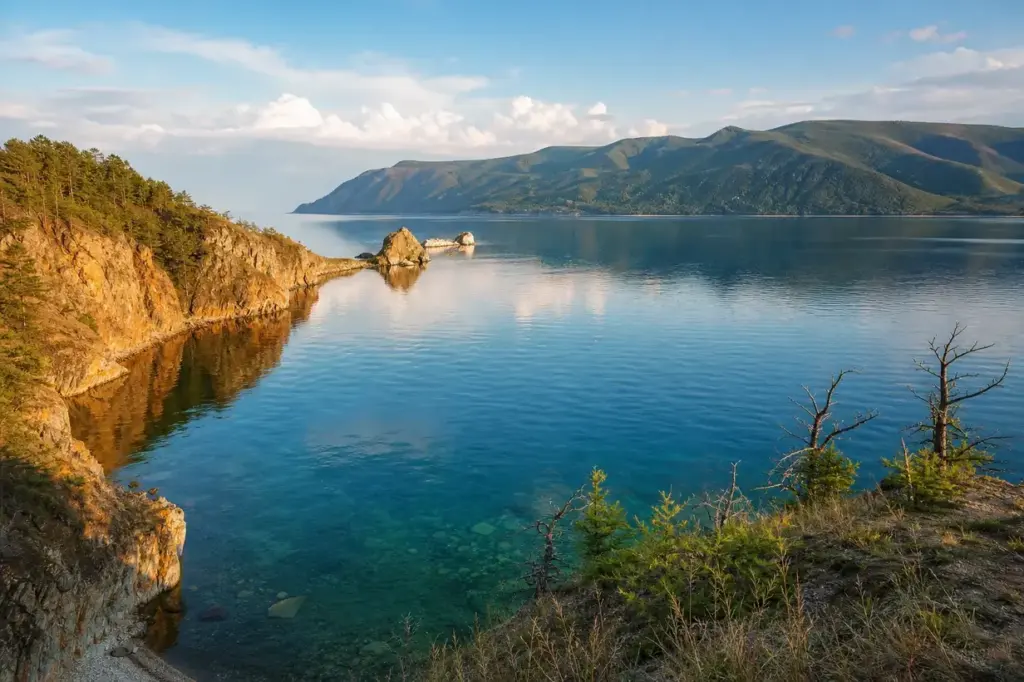
Maloye More, literally the Small Sea, is a strait in Lake Baikal that separates Olkhon Island from the western shore. Despite its modest name, it covers a vast expanse—stretching 70 kilometers in length with widths ranging from just 4 kilometres at its narrowest to 18 kilometres at its widest point. The maximum depth is 210 metres in the northern part where the strait opens to the open Baikal.
In the shallow bays of Maloye More, water warms to 15–22°C on the sunniest summer days, making it one of the warmest swimming areas on Baikal. It is one of the largest shallow parts of the lake, very rich in fish including sturgeon, omul, grayling, and perch. The strait is both a fisherman’s destination and a gateway to exploring one of Siberia’s most distinctive natural regions.
Quick Facts
| Russian name | Малое Море |
|---|---|
| Address | Google MapsApple MapsYandex Maps2GIS |
| District | Irkutsk Oblast |
| Best time to visit | In the shallow bays of Maloye More, water warms to 15–22°C on the sunniest summer days. Summer (July–August) offers the warmest water for swimming and the most reliable boat access. It is estimated that some 150,000 tourists visit Olkhon each year, especially in July–August. June and September provide pleasant weather and fewer crowds, though water remains cool (12–18°C). About 200 sunny days a year make the region reliably dry. Winter (February–April) is ideal for ice road travel and winter photography but requires specialized preparation and vehicle access. Late May and early June bring brief wildflower blooms on surrounding steppe. Autumn (September–October) features dramatic cloud formations and fewer tourists. |
What Is (and Isn't) Part of a Visit to Maloye More, Lake Baikal?
| Part | Status | Notes |
|---|---|---|
| Maloye More itself (the water and strait) | Included in the standard ticket | Access is free; the water and open areas are not restricted to visitors. |
| Olkhon Island | Separate ticket or institution | Olkhon Island requires ferry passage or ice road travel and is the subject of a separate article. |
| Ogoy Island | Separate ticket or institution | Typically visited by organized boat tour; separate article available. |
| Cape Khoboy | Separate ticket or institution | Located on Olkhon Island; covered in separate article on Cape Khoboy, Lake Baikal. |
| Pribaikalsky National Park | Outside / not part of it | Maloye More lies within or adjacent to Pribaikalsky National Park boundaries, but most recreational activities occur outside formal protected area restrictions. |
| Swimming and water activities | Included in the standard ticket | Summer swimming and boating in Maloye More are unrestricted; no permits required for casual recreation. |
Why Visit Maloye More, Lake Baikal?
The Maloye More coast is a favorite for beachgoers, with warm water and air in summer. In summer the water warms up to 19–21°C, attracting many tourists who come to swim, sunbathe, fish or relax, with many tourist centers offering lodging, food, excursions, and holiday activities. You can see Baikal seals at Cape Khoboy on Olkhon Island and Zamogoy Island in the Maloye More Strait. The strait contains islands including Ogoy, Zamogoy, Izhilhey, Oltrec and Khibin, with rivers such as the Sarma flowing into it. The combination of accessible beaches, productive fishing waters, accessible wildlife, and proximity to Olkhon Island’s archaeological sites makes Maloye More an essential stop on any Lake Baikal itinerary.
How Maloye More, Lake Baikal Is Laid Out
Maloye More separates Olkhon Island from the western shore of Baikal. The strait begins at a nominal boundary between the mainland cape Zama and the northern end of Olkhon—Cape Khoboy—where it is at its widest, some 18 kilometres. Gradually narrowing, the strait stretches southwest almost 70 kilometres to Mukhor Bay. At its narrowest point, between the delta of the river Sarma and the Kobylya Golova peninsula, the Maloye Morye is about 4 kilometres wide.
Islands including Ogoy (the largest), Zamogoy, Izhilhey, Oltrec and Khibin are located within the Maloye More, along with rivers including the Sarma flowing into it. Most visitor facilities and settlements are on Olkhon Island, particularly in the villages of Khuzhir and Sakhurte. Access to Maloye More is typically gained by taking a ferry from the mainland to Olkhon, or by traveling along the shores of both the island and the western coast by vehicle.
Highlights of Maloye More, Lake Baikal
Cape Khoboy
Cape Khoboy on Olkhon Island is a location where Baikal seals can be seen. This northern headland marks the northern boundary of Maloye More and is a site of spiritual significance in Buryat shamanic traditions. The cape offers dramatic views across the strait and access to the windiest parts of Lake Baikal, where powerful air currents can be felt even on calm days. Visitors reach it by 4×4 vehicle from Khuzhir village.
Tip: Visit in early morning for the best lighting and before afternoon winds intensify; bring warm clothing as weather is highly changeable.
Ogoy Island
Ogoy is the largest island in the Maloe More strait, with an elongated shape, 2.9 km in length and 0.6 km in width. The island is uninhabited. Located between Olkhon Island and the western shore, it is a popular stop on boat tours and serves as a vantage point for observing wildlife and photographing the surrounding waters and mountains. The island's rocky shores and sparse vegetation are typical of Baikal's island environment.
Tip: Ogoy can typically only be reached by boat tour; visit in calm weather, as water conditions change rapidly.
Mukhor Bay
The largest bay in Maloye More is Moukhor Bay, a very picturesque place rich in fish and having sandy beaches, with a length of 8 km and depth of just 4–5 metres. The bay's shallow waters are ideal for swimming and offer some of the warmest water in the strait during summer months. Sandy beaches line the bay, providing rare flat shoreline on Baikal.
Tip: Mukhor Bay is accessible by road from Khuzhir; camping and informal accommodation are available; visit in July–August for warmest water.
Sarma River and Canyon
The river Sarma flows into the Small Sea. The Sarma winds through a dramatic canyon in the taiga forest along the western shore, creating a striking landscape where river and forest meet the strait. The canyon can be explored on foot and offers opportunities for photography and trekking. It is a less crowded alternative to Olkhon Island's main attractions.
Tip: Allow 3–4 hours for a trek through the Sarma canyon; start early to avoid afternoon heat and plan for river crossings.
Ice Road Access (Winter)
In winter time, visitors can reach Olkhon by marshrutka all the way to Khuzhir via a road on frozen Baikal, with the ice road monitored 24/7 by the Ministry of Emergency Situations from roughly the beginning of February to the middle of April, starting from Kurkut village and extending 11 kilometres. The frozen strait becomes a solid highway during the winter season, offering an entirely different way to experience Maloye More.
Tip: Only travel the ice road between February and mid-April when it is officially monitored and maintained; do not attempt crossing outside these dates.
Fishing and Wildlife
Fish species in Maloye More include sturgeon, omul, grayling and pollan; in the bays one can catch perch and pike, and ice-fishing is very popular. The strait is particularly known for Baikal omul, a endemic fish prized in local cuisine. Summer fishing from boats and beaches is productive, while winter ice-fishing is a traditional activity drawing local and visiting anglers.
Tip: Hire a local guide for fishing; obtain any required permits before fishing; summer fishing requires boats that can be rented in Khuzhir.
Atmosphere
A little amount of precipitation, about 200 sunny days a year, warm water in cozy bays which warms up to 22°C, lovely mountainous and taiga forest landscapes with aromatic herbs, great fishing and road availability made this place quite popular among people. The strait itself is quiet and contemplative compared to mainland tourist destinations—dominated by wind, water, and wildlife sounds. In summer, the water glimmers under near-constant daylight, and boats dot the bays. Mornings bring mist rising from the warm waters into cool air. Winter transforms Maloye More into a stark white expanse of ice, where the silence is near total except for vehicle engines and the cracking of ice. Visitors tend to be outdoors-focused: fishermen, swimmers, photographers, and adventure travelers rather than museum-goers.
History of Maloye More, Lake Baikal
The strait is a result of millions of years of tectonic movement, resulting in the hollowing of the channel between the land and the block of stone forming the Olkhon Island. Geological forces that created the Baikal Rift Valley—one of the most active continental rift zones on Earth—shaped Maloye More over time. The strait’s form reflects the ongoing tectonics that also created Lake Baikal’s exceptional depth.
The region has been inhabited for thousands of years. Olkhon Island contains 143 unique archaeological objects – graves, remains of ancient settlements, ruins, shaman worship monuments and many others. Indigenous Buryat peoples have long held the landscape as spiritually significant, particularly sites such as Cape Burkhan and Cape Khoboy, which remain important in shamanic practice and belief.
Maloye More became more widely known to Russians and international travelers in the 20th century as accessibility improved. Olkhon Island has become the go-to spot for visitors to Baikal. The opening of road access and the establishment of tourist infrastructure on Olkhon Island in the 1990s and 2000s transformed Maloye More from an isolated frontier into a destination for summer tourism and winter adventure travel.
Legends and Myths about Maloye More, Lake Baikal
The Three Brothers
Legend – historically unreliable. According to Buryatian legend, three brothers on Olkhon Island had a father with supernatural powers. Their father turned them into eagles on the condition they would not eat dead meat. However, while flying around the island, they became hungry, found a dead animal, and ate it despite their promise. Enraged, their father turned them into the three rocks that we see today. The Three Brothers (Sagaan-Khushun Cape) remain a visible natural monument and popular tourist site in Maloye More.
Shaman Spirits and Sacred Sites
Legend – historically unreliable. Buryat tradition holds that Maloye More and Olkhon Island are the dwelling place of shaman spirits and ancestors. In Olkhon Island, the cremated remains of shamans were placed inside the trees. The region remains an active site of shamanic practice, pilgrimage, and spiritual observance, with prayer rituals and offerings left at capes and islands throughout the strait.
Tickets and Booking for Maloye More, Lake Baikal
Maloye More is a natural geographic feature with no admission fee or ticketing system. Access is entirely free. To visit the strait and its attractions, arrange transportation via:
- Boat tours: Organized from Khuzhir village on Olkhon Island or from mainland points such as Listvyanka, typically booked through tour operators or guesthouses.
- Private vehicle rental: 4×4 vehicles available for hire in Khuzhir for shore-based exploration.
- Ferry to Olkhon Island: The ferry from mainland to Olkhon crosses the Olkhon Gate, the southern strait connection. See the separate article on Olkhon Island for ferry details.
- Ice road (winter only): Direct access from mainland villages such as Kurkut by vehicle across frozen Baikal from February to mid-April.
No advance booking is required for the water itself. However, boat tours and vehicle rentals should be arranged in advance during peak season (July–August) through local guesthouses or tour operators.
Plan and Book
Suggested itineraries Maloye More, Lake Baikal
Half day (3–4 hours)
Depart Khuzhir village by 4×4 vehicle in early morning. Drive to Cape Khoboy at the northern tip of Olkhon Island for views across Maloye More and potential seal sightings. Return via the western coast road, stopping at rock formations and beaches for photographs. End with a beach walk in late afternoon light.
Full day (8 hours)
Drive from Khuzhir south to Mukhor Bay, swimming and beach time (bring swimwear; water temperature 19–21°C in summer). Picnic lunch. Afternoon boat tour or additional vehicle exploration to smaller islands and capes. Evening return to Khuzhir for dinner.
2 days
Day 1: Explore the mainlands with a steppe turn or forest road leading to caves or unique sights. Day 2: Take a boat tour covering Ogoy Island, wildlife observation points, and returning by sunset. Option: ice fishing in winter (December–March) combined with ice road exploration.
Overnight / 2–3 days
Camp or stay in guesthouse accommodation in Khuzhir or Sakhurte. Day 1: Explore northern capes and Sarma River canyon. Day 2: Boat tour of central strait and islands. Day 3 (optional): Rest day with fishing from beach or casual walks. Winter option: combine with ice road travel and ice cave exploration.
How to Get to Maloye More, Lake Baikal
Maloye More is accessed via Olkhon Island or from mainland villages on the western shore. There are no metro or rail connections. The journey from Irkutsk to Olkhon takes some 6–7 hours on a minibus, riding on a paved road till the lake, then getting on a ferry and continuing on a dirt road.
- From Irkutsk to Khuzhir (Olkhon Island): Marshrutka (shared minibus) from the central bus station takes 6–7 hours, with a ferry crossing included. There are 4 daily buses from the central bus station; a one-way ticket is inexpensive (₽). In winter time, visitors can reach Olkhon by marshrutka all the way to Khuzhir via a road on frozen Baikal, monitored 24/7 by the Ministry of Emergency Situations from roughly the beginning of February to the middle of April.
- From mainland western shore: Small villages such as Sakhurte have ferry access to Olkhon. Road access from Listvyanka (1.5 hours from Irkutsk) leads to mainland points on Maloye More.
- Once at Khuzhir (Olkhon Island): Hire 4×4 vehicles or join organized tours for exploration of the strait and its capes, bays, and islands.
Accessibility
Maloye More offers limited formal accessibility infrastructure. Roads on Olkhon Island and the western shore are unpaved and subject to seasonal mud; 4×4 vehicles are essential and rough terrain makes independent wheelchair access impractical. Ferry crossings to Olkhon may accommodate limited mobility with advance notice to operators. Boat tours vary; some smaller vessels are difficult to board. There are no formal facilities or pathways. Visitors with mobility concerns should hire private vehicle tours that can accommodate their needs and inquire about specific boat accessibility. No official accessibility information is published on governing tourism or park websites; contact local operators in Khuzhir directly.
Food Nearby
Khuzhir village on Olkhon Island offers basic food options, though selection is limited and prices are higher than in Irkutsk. A supermarket called Khoroshiy and small stores sell packaged provisions. Traditional Buryat restaurants serve local dishes including buuzy (meat dumplings), pelmeni, and fish preparations. Many visitors bring food with them or use guesthouse meal services. Fishing enthusiasts catch omul and other local fish for immediate preparation. Informal eateries in Khuzhir and Sakhurte serve simple Russian and Buryat fare. Picnic supplies are best purchased in Irkutsk or Listvyanka before traveling to the strait.
What to Bring
Summer: swimwear, waterproof bag, sun protection (SPF 50+; UV index is high at this latitude), insect repellent, warm layers for evening and wind. Fishing: appropriate gear and bait if planning to fish; most tackle is available locally but not all types. Winter: extreme cold-weather clothing (temperatures drop to –10°C to –25°C), insulated boots, goggles, and hand/foot warmers. Year-round: sturdy hiking boots (unpaved terrain), camera with lens protection from spray and dust, and binoculars for wildlife. A cash supply is essential; there is no exchange currency office nor any bank or ATM on Olkhon island. Bags are not restricted; standard airport-style security does not apply.
Best Views and Photo Spots of Maloye More, Lake Baikal
Cape Khoboy, northern tip
The northernmost point of Olkhon Island offers panoramic views across Maloye More to the Primorsky Range on the western shore. Wind-sculpted capes, rocky formations, and often visible Baikal seals create striking compositions. The sunrise behind the western mountains is a renowned shot.
Best time: Early morning (05:00–07:00) for warm light and calm air before afternoon winds; any clear day in July–August.
Three Brothers (Sagaan-Khushun) Cape, southern Olkhon
Three distinct rock formations rising from the water create an iconic silhouette. The rocks frame views of the central strait and nearby islands. Foreground beach and the rocks' reflection in calm water offer compositional variety.
Best time: Late afternoon for backlighting of rock formations; late May–June for occasional storm clouds adding drama.
Mukhor Bay beaches
Sandy beaches and shallow waters create soft compositions. The bay's expanse of water, surrounding mountains, and taiga create landscape photography opportunities. Summer reflects the bright northern light on sand and water.
Best time: Mid-morning (08:00–11:00) for warm light; any sunny day June–August.
Ogoy Island from water or nearby shore
The island's rocky outline, sparse vegetation, and isolation create distinctive landscape photos. Approach by boat offers dynamic water and light reflections. The island's height and isolation emphasize scale against surrounding water.
Best time: Calm weather for boat access; afternoon light from the western shore for backlighting.
Sarma River canyon and western shore bluffs
Steep canyon walls covered in taiga forest meet the narrow strait water. The river's cutting action creates dramatic erosion patterns. Summer light through forest canopy creates texture and shadow patterns.
Best time: Mid-morning (09:00–12:00) when light enters the steep canyon; June–early July for green forest and possible wildflowers.
Frozen Baikal ice road and ice formations (winter)
The ice road stretching to the horizon, ice hummocks, pressure ridges, and occasional air holes create abstract and architectural compositions. Sunrise and sunset on ice create unique color and shadow. Ice caves and grottoes near Olkhon offer intricate frozen water formations.
Best time: Clear mornings with fresh snow (February–March); sunset for warm colors on white ice; after a freeze thaw cycle for ice cave formations.
Photography Rules
Photography is entirely unrestricted in Maloye More. Drones are technically subject to Russian aviation regulations and may encounter unofficial restrictions; ask local tour operators about current practice. Tripods are permitted. Flash is not an issue for outdoor photography. Winter ice formations and sunrise/sunset light are the most photographed subjects. Early morning and late evening light are optimal. Summer midday light can be harsh. Bring lens protection from water spray, dust, and sand.
Family Suitability
Maloye More is suitable for families, with important considerations. Young children can enjoy beach time in Mukhor Bay and other sandy areas during summer (water warmth 19–21°C, though still cold by southern standards). Vehicle tours are straightforward for families with older children accustomed to rough roads. Stroller use is impractical on unpaved terrain; baby carriers are better. Boat tours vary in suitability; smaller vessels may be unsuitable for very young children due to motion. Winter ice road travel is not recommended for small children due to cold exposure and long hours in vehicles. Guesthouses in Khuzhir typically welcome families and offer simple food appropriate for children. The lack of crowds compared to other tourist destinations makes Maloye More relatively family-friendly, though infrastructure is minimal. Families should hire private guides or operators experienced with children rather than attempting independent exploration.
Russia Vibes Tips
- Book 4×4 vehicles and boat tours in advance during July–August peak season; last-minute availability is limited. Off-season (May–June, September–October) offers better access and lower prices with minimal weather penalty.
- Visit Cape Khoboy before 10:00 AM to avoid afternoon wind, which can reach high speeds and make conditions unpleasant for photography and outdoor time.
- Hire guides who speak your language; many operators speak English but not all. Confirm language capability when booking. A guide enhances wildlife spotting, historical understanding, and safety on remote terrain.
- Bring significantly more cash than anticipated; there is no exchange currency office nor any bank or ATM on Olkhon island. Prices are higher than mainland and change availability is unreliable.
- In winter, only cross the ice road during the official monitored period (approximately February to mid-April). Do not attempt ice travel outside this window, as ice thickness and safety are unpredictable.
- Swimming in summer feels warm but remains cold by non-Arctic standards; acclimatize gradually and never swim alone. Local wisdom advises against extended immersion despite perceived warmth, as hypothermia risk remains significant.
Explore Nearby Maloye More, Lake Baikal
Sights near Maloye More, Lake Baikal
 Olkhon Island, Lake Baikalabout 11.4 km away · typical visit: 2–3 days
Main image: AI-generated illustration. It may not show the place exactly as it looks.
 Cape Khoboy, Lake Baikalabout 40.0 km away · typical visit: 3–4 hours
Main image: AI-generated illustration. It may not show the place exactly as it looks.
 Shamanka Rock, Lake Baikal – about 8.0 km away · typical visit: 30–45 minutesOpen 24 hours
Main image: AI-generated illustration. It may not show the place exactly as it looks.
 Listvyanka, Lake Baikalabout 223.4 km away · typical visit: 2–3 days
Main image: AI-generated illustration. It may not show the place exactly as it looks.
 Khuzhir, Lake Baikalabout 8.9 km away · typical visit: 2–3 days
Main image: AI-generated illustration. It may not show the place exactly as it looks.
Related guides
 Chersky Stone: Panoramic Viewpoint Over Lake Baikal
Main image: AI-generated illustration. It may not show the place exactly as it looks.
 Olkhon Island Ferry Terminal: Hours, Queues and What to Expect
Main image: AI-generated illustration. It may not show the place exactly as it looks.
 Slyudyanka, Lake Baikal: The World’s Only Marble Railway Station
Main image: AI-generated illustration. It may not show the place exactly as it looks.
 Peschanaya Bay, Lake Baikal: Sandy Beach, Stilt Trees and Remote Wilderness
Main image: AI-generated illustration. It may not show the place exactly as it looks.
 Circum-Baikal Railway: Engineering Marvel and Scenic Train Route
Main image: AI-generated illustration. It may not show the place exactly as it looks.
Browse more: More in Irkutsk Oblast · All Lake Baikal · All Parks · All Sightseeing · All Sightseeing in Lake Baikal
FAQ: Maloye More, Lake Baikal
Is Maloye More the same as Olkhon Island?
No. Maloye More is the strait (water channel) between Olkhon Island and the western shore. Olkhon Island is the large landmass within or adjacent to the strait. Most tourist infrastructure is on Olkhon Island; Maloye More itself is the water and surrounding geography.
Can I swim in Maloye More?
In summer the water warms up to 19–21°C, attracting many tourists who come to swim. Swimming is safe in designated bay areas such as Mukhor Bay where the water is warmest. Swim only in summer (July–August) and avoid stronger currents near the strait's center and northern reaches.
Do I need a permit or visa to visit Maloye More?
No special permit is required for Maloye More itself. Standard Russian visa rules apply; check current entry requirements for your nationality. Olkhon Island does not require additional permits beyond national entry regulations.
How do I reach Maloye More from Irkutsk?
The journey from Irkutsk takes some 6–7 hours on a minibus, riding on a paved road till the lake, then getting on a ferry and continuing on a dirt road. Alternatively, hire a private driver or join an organized tour.
What is the best season to visit?
July–August offers the warmest water for swimming, longest daylight, and most reliable access. June and September provide good weather with fewer crowds. Winter (February–April) is best for ice road travel and winter photography.
Can I see Baikal seals (nerpas) in Maloye More?
You can see Baikal seals at Cape Khoboy on Olkhon Island and Zamogoy Island in the Maloye More Strait. Sightings are not guaranteed but more likely with a guide who knows current seal haul-out locations.
Are there restaurants and accommodations in Maloye More?
Many tourist centers offer lodging, food, excursions, and holiday activities. Most are located in Khuzhir village on Olkhon Island, a short vehicle ride from the strait. Guesthouses range from basic to moderate comfort.
Is Maloye More part of a national park?
Maloye More falls within or is adjacent to Pribaikalsky National Park. Most recreational activities are unrestricted for casual visitors; formal park rules may apply to camping and certain activities. Check with local operators for current regulations.
Russia Vibes is a one-person project. A coffee keeps it going
How we research and update our guides
About this guide: AI assistance and accuracy
This guide is created with the help of AI and is based on official sources where available. Mistakes can still happen. Opening hours, prices, rules and other details are given to the best of our knowledge as of the date shown and can change without notice. It offers general recommendations only, not professional, legal or travel advice. Please confirm important details with the official source before you travel; you are responsible for your own plans and decisions.
Packing for this trip
* Affiliate link: as an Amazon Associate we earn from qualifying purchases at no extra cost to you.

Take this guide with you
Get a free PDF of this guide to print or read offline: key facts, tips and a map link on a few clean pages.
Report an issue on this page
Paying for your trip: please read
International sanctions affect payments between Russia and many other countries. In practice, cards issued in the EU, the UK, the US and several other countries often do not work in Russia, Russian cards usually do not work abroad, and some booking platforms, airlines and payment providers limit or suspend their services for Russia. The situation changes frequently.
We do not give legal or financial advice, and this site does not encourage anyone to break or circumvent sanctions. Whatever you plan, you are responsible for following the laws and regulations that apply to you, including those of your country of residence and citizenship.
Many travelers still organise their stay lawfully. It is worth asking your bank or payment provider what is currently permitted, contacting hotels, tour operators and carriers directly about the payment methods they accept, and checking which services are open to customers from your country. Clarify payment, cancellation and refund terms before you commit to a booking, and keep your plans flexible.
Partner links on this site may not be available in every country, and prices, availability and rules in our guides can differ from what you see when you book.