
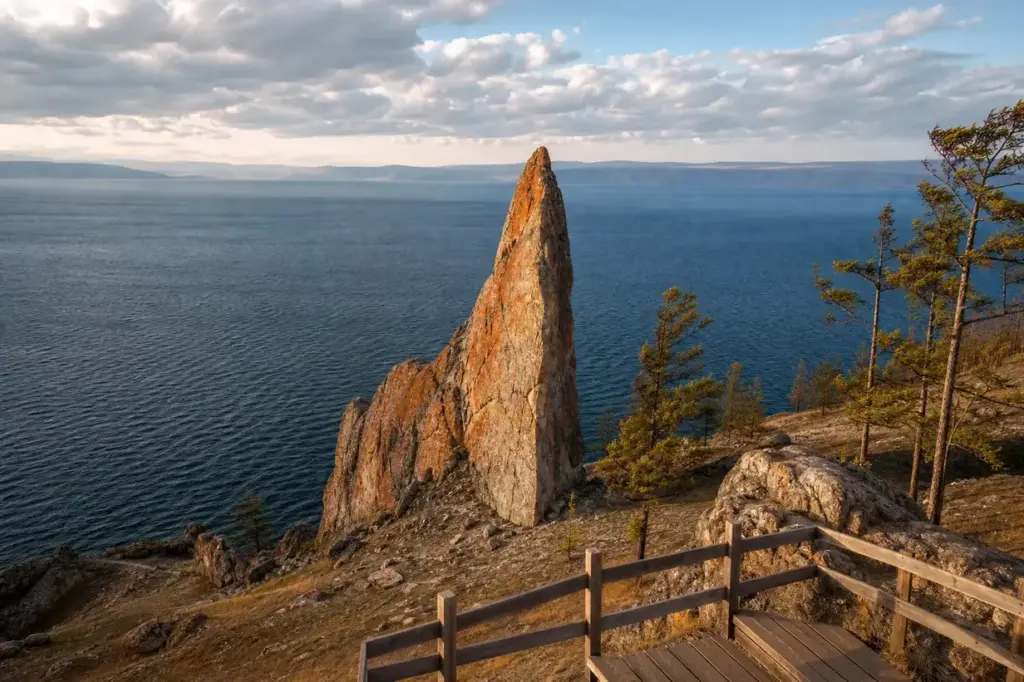
Cape Khoboy (мыс Хобой) crowns the northern tip of Olkhon Island, Lake Baikal‘s largest island. The name comes from the Buryat word for “fang,” describing the rock’s dramatic vertical profile—a phenomenon shaped by millions of years of tectonic activity. Located roughly 40 km north of Khuzhir, the main settlement, the cape marks the meeting point between Baikal’s two main water bodies: the smaller Maloye More (Small Sea) to the west and the open lake to the east.
This is one of Siberia’s most visually striking natural monuments, where pale marble cliffs studded with orange and red lichen drop steeply into water that reaches 1,600 metres deep. The site holds deep spiritual significance for the Buryat people and remains a powerful draw for visitors seeking both geological drama and cultural authenticity.
Quick Facts
| Russian name | Мыс Хобой |
|---|---|
| Address | Northern Olkhon Island, Lake Baikal, Irkutsk Oblast, Russia Google MapsApple MapsYandex Maps2GIS |
| Admission | free |
| Best time to visit | Summer (June–August) offers clear skies and the full vista of open water, with wildflowers blooming along the approach. However, crowds of tour groups are heaviest in July and August, and midday sun flattens photography.September–October brings autumn colours and fewer visitors; light is softer and the landscape shifts to golden and rust tones.Winter (February–March) transforms the site into an ice palace with massive frozen formations and the possibility of driving on the frozen lake. However, the landscape is monochromatic, daylight hours are short, and weather is harsh. Winter visits require more fitness and specialized tours.May and September–early October offer the best balance of weather, light and fewer visitors. Avoid November–January (limited daylight, unreliable roads between seasons) and April–May (ice melting, impassable roads). |
| Recommended duration | 3–4 hours |
What Is (and Isn't) Part of a Visit to Cape Khoboy, Lake Baikal?
| Part | Status | Notes |
|---|---|---|
| Cape Khoboy rock formation and observation platform | Included in the standard ticket | The main attraction is freely accessible via the wooden decking and viewing platform. |
| Wooden decking and toilet facilities | Included in the standard ticket | Facilities are maintained as part of the natural monument; basic toilets are available on-site. |
| Entry to nearby shamanic caves | Outside / not part of it | Most caves are accessible only by boat or specialized climbing; tour operators may offer separate water-based access in summer. |
| Tour from Khuzhir or other settlements | Separate ticket or institution | Transport, guide and all meals are arranged separately by tour operators; the site itself has no admission fee. |
| Olkhon Island national park checkpoint | Included in the standard ticket | Vehicle tours stop at the checkpoint en route; this is managed as part of the itinerary by tour operators. |
| Three Brothers Rocks (Sagaan-Khushun Cape) | Outside / not part of it | Located south of Cape Khoboy and accessed as part of the southern tour route or separately; not part of a standard Khoboy-only visit. |
| Sand Tract | Outside / not part of it | A landscape feature along the northern route near Cape Khoboy but a distinct stop; usually included in organized tours but not part of the cape site itself. |
Why Visit Cape Khoboy, Lake Baikal?
From the observation platform atop the cliff, you witness the full grandeur of Lake Baikal—the distant eastern shore visible only in clear weather, the expanse of water that seems to merge with the horizon. The columnar rock itself displays nature’s patient carving: wind-drilled holes pierce the stone, and from the water or winter ice, the southern profile resembles a maiden’s face.
The site is a working shamanic location. A special platform was historically used for tailagan, gatherings of shamans. In winter, the cape transforms into an ice palace as autumn waves freeze into elaborate ice formations on the rocks. You can see Baikal seals (nerpas) at Cape Khoboy.
Highlights of Cape Khoboy, Lake Baikal
The Fang Rock Formation
The white marble double-peak rock is covered with bright red lichens and contains a through cave worshiped by Buryats. Named from the fang-like stone platform, weathered by winds, frosts and sun into places pierced by holes, with a large opening through the ridge big enough for a person to stand up in with ease. Stand at the observation deck to see the full sculptural impact of the cliff against open water.
Tip: Arrive early or late in the day for the best light on the lichen-covered rocks; midday sun flattens the colours.
The Maiden Profile
The southern end of the fang seen from the side resembles a woman's profile and is called Dyeva (the maiden). The Buryats call the rock "The Maiden," and legend has it she is the daughter of the master of Baikal, frozen in stone, waiting for her father to return. This profile is most dramatic when viewed from the water or from the frozen lake surface in winter.
Tip: If visiting in winter, this view is unmistakable from the ice; in summer, a boat tour reveals the silhouette best.
Observation Platform and Wooden Decking
The rocky cape features wooden decking and wooden observation decks, as well as tables and toilets. The walkway leads safely to the cliff edge, offering a 360-degree panorama of the meeting point between the Small Sea and the main lake. The blue of Baikal and its far distant eastern shore can be seen when weather is good, far enough away to be visible only after rain or a strong wind.
Tip: The platform can be windy and exposed; bring layers and waterproof gear even in summer.
Sacred Shamanic Site
Various shaman rites and offering sacrifices were conducted here. After the adoption of Lamaism, there was Buddha's Altar. According to legend, the cave is an earth castle of Ezhin (or Burkhan), the owner of Olkhon; nobody except shamans has a right to approach the residence of spirit. The cape remains an active place of Buryat spiritual reverence and shamanic practice.
Tip: Treat the site with respect—leave the archaeological features untouched and do not remove stones or make offerings without understanding local custom.
Three Brothers Rocks
A group of rocks in the southern part of the cape is known with the locals as "Three brothers," consisting of three spectacular rocks-pyramids with a cave and grottos, one of which is large enough for entering by boat. These form part of the larger rock assemblage that makes the cape visually distinct.
Tip: The Three Brothers are best appreciated from the boat or vehicle approach; they are visible from the observation platform but appear more imposing from water level.
Baikal Seals (Nerpas)
Visitors can often see Baikal nerpas—fresh-water seals, the lake's only aquatic animals. These endemic seals haul out on boulders near the cape and are among the lake's most distinctive inhabitants. Sightings are more common in colder months.
Tip: Bring binoculars to spot nerpas on the rocks; early morning offers the best chances of observation without disturbance.
Winter Ice Formations
In winter, Khoboy turns into a fabulous ice castle, with heavy autumn waves breaking on the cape staying on the rocks in 'sokui'—ice pillars sprayed into weird forms. This area features the most massive ice caves and hummocks in winter. The transformation is dramatic and accessible by driving across the frozen lake.
Tip: Winter visits require specialist tours with experienced drivers familiar with ice conditions; solo travel on the frozen lake is not advised.
Sand Tract (En Route)
On the way to the cape, the road passes the Sand Tract (20 km north of Khuzhir Settlement), famous for sand dunes that stretch 3 km. This unusual Siberian landscape contrast—desert dunes on an island in a mountain lake—appears along the journey and is worth noting during the drive.
Tip: Ask your tour operator to stop briefly at the Sand Tract to photograph or explore; it's a unique feature that many visitors miss.
Atmosphere
The cape is spare and exposed, with constant wind carrying the cold breath of the lake. The colour palette shifts with season: in summer, pale rock and orange lichen against deep blue water and green taiga hillsides inland; in winter, whites and greys dominate as waves freeze and fog creeps across the ice. Silence prevails except for the wind and the distant sound of ice cracking in winter.
Spiritually, the place carries weight. The Buryat reverence is palpable in the careful placement of offerings and the marked shamanic platform. Tour groups arrive by vehicle and disperse across the wooden platforms, but the size of the site and the vastness of the water create a sense of solitude even among others. The remoteness—nearly two hours’ drive from the nearest settlement—reinforces the feeling of standing at the edge of something vast and ancient.
History of Cape Khoboy, Lake Baikal
Khoboy was considered sacred and served as a place where religious rites were acted out. The Buryat people, indigenous to Olkhon, recognised the cape as a seat of spiritual power long before the arrival of Russians. Various shaman rites and offering sacrifices were conducted here. After the adoption of Lamaism, there was Buddha’s Altar.
The geological formation itself records millions of years of tectonic activity. The island’s appearance is a result of millions of years of tectonic movement resulting in the hollowing of the channel between the land and the block of stone forming the island. The steep slopes of the mountains show the vertical heave of the earth. The cape rocks composed of light marble and studded with brown and red patches of lichens were included in the list of natural monuments of Lake Baikal. This rock assemblage is about 1 km long.
The cape’s name encodes this geological history. Khoboy got its name from the most prominent part—a flat stone platform with a form like the fang of an animal (Khoboy means fang in Buryat). Time, Baikal’s winds, cruel frosts and burning sunshine have left their indelible mark on Khoboy’s fang—in places it is pierced by holes.
Legends and Myths about Cape Khoboy, Lake Baikal
The Dragon's Tooth
Legend – historically unreliable. According to legend, a huge dragon dropped its tooth at Cape Khoboy, which later turned into the pointed cape. This Buryat origin story explains both the fang shape and the spiritual power associated with the place, attributing the distinctive geology to supernatural intervention.
The Maiden of Baikal
Legend – historically unreliable. The Buryats call one rock face "The Maiden," with legend saying she is the daughter of the master of Baikal, frozen in stone, waiting for her father to return. The profile resemblance is visible from certain angles and seasons, making the mythological claim feel grounded in observable reality.
The White Shaman's Spirit
Legend – historically unreliable. It is considered very lucky to see the spirit of the White shaman who sometimes goes out of the waters of Lake Baikal. This reflects the ongoing spiritual significance of the cape in Buryat shamanic belief and the sense of Khoboy as a threshold place between worlds.
Meteorite Impact and Geomagnetic Anomaly
Disputed by historians. Scientists suggest that the legend of the cape is associated with the fall of a space body on the island, most likely a small meteorite, which would explain the strong geomagnetic activity in that area. This modern reinterpretation attempts to explain both the unusual rock formations and the reported spiritual energy.
Tickets and Booking for Cape Khoboy, Lake Baikal
Cape Khoboy is freely accessible and does not require a separate ticket. However, access is practical only as part of an organized tour departing from Khuzhir, the main settlement on Olkhon Island (roughly 40 km away).
Tour operators in Khuzhir offer daily northern-route tours that include Cape Khoboy. Tours typically depart in the morning, last 8–10 hours including travel, and include a driver, basic meals (often fish soup and bread), and time at the cape. Book at your accommodation or with local operators the day before or upon arrival.
Seasonal variations: In summer and autumn, tours travel by road; in winter (roughly February–March), specialized tours travel across the frozen lake and offer views of winter ice formations. Winter tours require stronger fitness and warmer clothing.
Same-day booking is often possible but not guaranteed, especially in peak summer months (June–August). During winter, advance booking is essential as tours operate less frequently and require a minimum group size.
No visa, ID check or advance registration is required for visitors to the cape. Tours are available to international visitors; English-speaking guides are less common but can be arranged at some lodges with advance notice.
Plan and Book
Suggested itineraries Cape Khoboy, Lake Baikal
Full day (8–10 hours)
Depart Khuzhir early morning heading north. Stop at the Sand Tract for photos (30 min). Pass the shamanic poles and checkpoint. Arrive at Cape Khoboy; spend 1–2 hours exploring the observation platform, photographing the fang rock and exploring the cliff-top trails. Lunch is typically served (fish soup, bread, tea). Return to Khuzhir late afternoon. This is the standard full-day northern route.
Northern route with Three Sisters (Full day, 10–12 hours)
Begin as above but extend the itinerary to include the Three Brothers Rocks (Sagaan-Khushun Cape) to the south on the return journey, adding 1–2 hours. This combines the two major northern sights in a single exhausting but rewarding day.
Winter ice tour (8–10 hours)
February–March only. Begin at Khuzhir and drive west onto the frozen lake surface. Travel across the ice toward Cape Khoboy, stopping to observe ice formations and cracks. Reach the cape for 1–2 hours of exploration on the ice or from the cliff. Return across the frozen surface to Khuzhir by late afternoon. Bring warm layers and be prepared for wind.
Sunset visit (4–5 hours)
Some operators offer late-afternoon departures reaching Cape Khoboy in time for sunset (May–August). This requires a shorter, more rushed visit but captures the light at its most dramatic on the rock face. Confirm sunset tour availability upon arrival in Khuzhir.
How to Get to Cape Khoboy, Lake Baikal
From Khuzhir: Cape Khoboy is accessed only via organized tour. Tours depart from your accommodation or from central meeting points in Khuzhir (ask at your lodge).
By road (summer, autumn, early winter): Tour vehicles travel 40 km north from Khuzhir through steppe and past the Sand Tract. The journey takes 1.5–2 hours each way on rough but passable roads. Pass through the Olkhon national park checkpoint (included in tour logistics).
By frozen lake (winter, February–March): Specialized tours depart west from Khuzhir onto the frozen lake surface and approach Cape Khoboy from the water. This route is scenic but requires suitable vehicle and ice conditions; book only with established operators.
Getting to Olkhon Island: To reach Khuzhir, fly or take the train to Irkutsk (the nearest major city, roughly 270 km away), then take a minibus or arrange a transfer to Olkhon. The ferry crossing from the mainland is near the town of Listvyanka. Plan 2–3 days on Olkhon; most visitors stay in Khuzhir village.
Accessibility
The observation platform and wooden decking are accessible to visitors of moderate fitness. However, the site involves walking on uneven terrain and standing at exposed cliff edges; those with mobility limitations, vertigo, or balance issues should assess their comfort level with a tour operator in advance.There are basic toilets at the site. No wheelchair-accessible facilities are reported, and the ground is rough and sloped. Elderly or disabled visitors should confirm accessibility with their tour operator before booking.The cliff edge has no safety railing; supervise children carefully.
Food Nearby
No food or drink vendors operate at Cape Khoboy. All tours include a meal (typically fish soup, bread and tea) prepared by the tour operator or brought from Khuzhir. Bring extra water and snacks (chocolate, nuts, dried fruit) as the site is remote and windy; hunger and dehydration come quickly.In Khuzhir village, basic cafes and guesthouses provide meals the night before and after your tour. Ask your accommodation to pack a thermos of hot tea for the day if not included in your tour.
What to Bring
Summer: Layers (it is windy and cool even when sunny), windproof jacket, hat, sunscreen, sunglasses, sturdy hiking boots (terrain is rough and steep). Bring 1.5–2 litres of water and energy snacks. A camera with a polarizing filter captures the lichen colours best.Winter: Extreme cold weather gear—thermal layers, insulated parka, thick gloves, wool hat covering ears, heavy insulated boots rated to –20°C or below, thermal socks. Hand and foot warmers. Lip balm and moisturizer (wind and cold chap skin). Dark sunglasses (ice glare is intense).Both seasons: Dry bag for camera gear (mist off the lake is common). Binoculars for spotting seals. Portable phone charger (limited connectivity on the island).Tour vehicles may have bag restrictions; ask your operator before packing.
Best Views and Photo Spots of Cape Khoboy, Lake Baikal
Observation platform, fang rock
The main columnar rock with its distinctive fang profile, lichen-covered and framed by open water. The platform directly addresses the rock face; this is the primary image of the cape seen in all guidebooks. Best at golden hour when lichen glows orange and red.
Best time: Early morning (before 10:00) or late afternoon (after 15:00) for warm side-light on the lichen; cloudy days offer even light but less colour.
Cliff edge overlooking Small Sea and Great Baikal
The panoramic junction where the Small Sea (to the west) meets the main lake. The perspective shows the vast emptiness and the distant eastern shore on clear days. Aerial or wide-angle perspective emphasizes the isolation.
Best time: Clear days after rain or strong wind when the distant peninsula is visible. Early morning light is often clearer after overnight temperature drops.
The Maiden profile (from water or ice level)
The southern rock face seen from the frozen lake or by boat shows the silhouette of a woman's head and bosom. This perspective requires approaching from the lake rather than from the platform and is most distinctive in winter or when viewed from a boat.
Best time: Winter (February–March) when you can drive across the ice; late summer or early autumn when the lake is calm enough for boat access. Low-angle, backlighting emphasizes the profile.
Three Brothers Rocks
Three pyramid-shaped rock formations to the south, each distinct. They form a linear composition and are best seen from the approach road or vehicle. Less famous than the main cape but visually striking.
Best time: Morning light from the west. These are visible from the road journey north, so photograph during the approach before reaching the main site.
Winter ice formations and 'sokui' (ice pillars)
Frozen waves and spray create elaborate ice sculptures on the rocks and cliff base. The formations are white and crystalline, catching light beautifully. These appear only in winter and are unique to this location.
Best time: February–March when ice is stable and the sun angle is still low, creating shadows and highlights on the formations. Clear days emphasize the detail.
Sand Tract (en route)
Sandy dunes 20 km south of Cape Khoboy stretch for 3 km—an unusual landscape for the taiga. Wide-angle shots show the contrast between desert and forest. Less photogenic than the cape but documentarily interesting.
Best time: Any clear day; the Sand Tract is not dramatically lit but serves as a landscape transition shot.
Photography Rules
Photography is unrestricted at Cape Khoboy. No drones are permitted (check current Olkhon Island regulations with your tour operator). Tripods are allowed but may be unstable on the windy platform. Flash is not necessary outdoors. The lichen-covered rocks and water are best captured with a polarizing filter and during golden hour (morning or late afternoon); midday light is harsh and washes out colours.
Family Suitability
Cape Khoboy is suitable for families with older children (10+) who can manage a 4–8 hour day trip, handle uneven terrain, and obey cliff-edge safety rules. The long vehicle journey from Khuzhir (1.5–2 hours each way) may test younger children's patience.Strollers are not practical; babies and toddlers require carrying. Young children need constant supervision near the cliff edge. The cold, wind and exposure make the site uncomfortable for very young or sensitive children.Teenagers and active families will find the scale of the landscape and the shamanic history engaging. The drive through the Sand Tract and across the steppe offers environmental learning opportunities.
Russia Vibes Tips
- Arrive at your Khuzhir accommodation at least one day before your planned Cape Khoboy tour to book with an operator, confirm the next departure and acclimatize to the remoteness. Last-minute bookings in peak season are unreliable.
- In summer, book tours departing early (7:00–8:00 am) to ensure you reach the cape by mid-morning when light is good but before midday heat flattens colours and before afternoon wind strengthens.
- The approach road is rough; if you have back or mobility issues, request a vehicle with better suspension and ask to stop periodically during the 1.5-hour journey.
- Bring more water and snacks than you think you'll need. The site is exposed and windy; thirst and hunger arrive faster than inland. The tour lunch is usually modest.
- Do not wander off the marked paths or onto the sacred shamanic platform without a guide's permission. The site remains an active place of Buryat spiritual practice; respect archaeological features and leave offerings untouched.
- If visiting in winter, ask your operator specifically about ice conditions and confirm that the tour is running (some winter tours are canceled due to unsafe ice or extreme weather). Bring emergency contact numbers and fully charge your phone.
Explore Nearby Cape Khoboy, Lake Baikal
Sights near Cape Khoboy, Lake Baikal
 Olkhon Island, Lake Baikal · typical visit: 2–3 days
Main image: AI-generated illustration. It may not show the place exactly as it looks.
Related guides
 Lake Baikal: Where to Go, What to See and How to Visit
Main image: AI-generated illustration. It may not show the place exactly as it looks.
Browse more: All Lake Baikal · All Sightseeing · All Sightseeing in Lake Baikal · All Viewpoints
FAQ: Cape Khoboy, Lake Baikal
How long is the drive from Khuzhir to Cape Khoboy?
The drive north from Khuzhir to Cape Khoboy takes 1.5–2 hours each way on rough roads through the steppe. Total tour time is 8–10 hours including stops and time at the cape. Allow a full day.
Can I visit Cape Khoboy on my own without a tour?
Practical access is via organized tour only. The site is 40 km from the nearest settlement with no public transport, rental cars are extremely limited on Olkhon, and the rough roads require local knowledge. Tours depart daily from Khuzhir during the tourist season.
Do I need to pay to enter Cape Khoboy?
Entry to the cape itself is free. However, the only realistic way to reach it is via a paid tour organized from Khuzhir, which includes transport, a driver, and usually lunch. Tour costs vary but are moderate for a full-day excursion.
Is the site accessible in winter?
Yes. Specialized winter tours operate February–March, traveling across the frozen lake. The landscape transforms into an ice palace, but weather is harsh, daylight is short, and tours require advance booking. Winter tours are physically demanding.
What is the spiritual significance of Cape Khoboy?
Shaman rites and sacrifices were historically conducted here. After the adoption of Lamaism, there was Buddha's Altar. According to legend, the cave is the earth castle of Ezhin (or Burkhan), the owner of Olkhon; only shamans have a right to approach the residence of this spirit. The site remains active in Buryat spiritual practice.
Can I see seals (nerpas) at Cape Khoboy?
You can see Baikal seals at Cape Khoboy. Sightings are more common in colder months when seals haul out on rocks. Bring binoculars to spot them without disturbance.
What is the best time to visit Cape Khoboy?
Summer (June–August) offers clear views but crowds; autumn (September–October) provides fewer visitors and softer light. Winter (February–March) transforms the site into an ice palace but requires hardy fitness. Late May or September–early October offers the best balance of weather, light and accessibility.
Is Cape Khoboy the same as the Three Brothers Rocks?
No. Cape Khoboy is the northernmost point of Olkhon Island, marked by the columnar fang-shaped rock. The Three Brothers Rocks (Sagaan-Khushun Cape) are a separate formation to the south, often included in northern-route tours but reached separately or on the return journey.
Russia Vibes is a one-person project. A coffee keeps it going
How we research and update our guides
About this guide: AI assistance and accuracy
This guide is created with the help of AI and is based on official sources where available. Mistakes can still happen. Opening hours, prices, rules and other details are given to the best of our knowledge as of the date shown and can change without notice. It offers general recommendations only, not professional, legal or travel advice. Please confirm important details with the official source before you travel; you are responsible for your own plans and decisions.
Packing for this trip
* Affiliate link: as an Amazon Associate we earn from qualifying purchases at no extra cost to you.

Take this guide with you
Get a free PDF of this guide to print or read offline: key facts, tips and a map link on a few clean pages.
Report an issue on this page
Paying for your trip: please read
International sanctions affect payments between Russia and many other countries. In practice, cards issued in the EU, the UK, the US and several other countries often do not work in Russia, Russian cards usually do not work abroad, and some booking platforms, airlines and payment providers limit or suspend their services for Russia. The situation changes frequently.
We do not give legal or financial advice, and this site does not encourage anyone to break or circumvent sanctions. Whatever you plan, you are responsible for following the laws and regulations that apply to you, including those of your country of residence and citizenship.
Many travelers still organise their stay lawfully. It is worth asking your bank or payment provider what is currently permitted, contacting hotels, tour operators and carriers directly about the payment methods they accept, and checking which services are open to customers from your country. Clarify payment, cancellation and refund terms before you commit to a booking, and keep your plans flexible.
Partner links on this site may not be available in every country, and prices, availability and rules in our guides can differ from what you see when you book.