
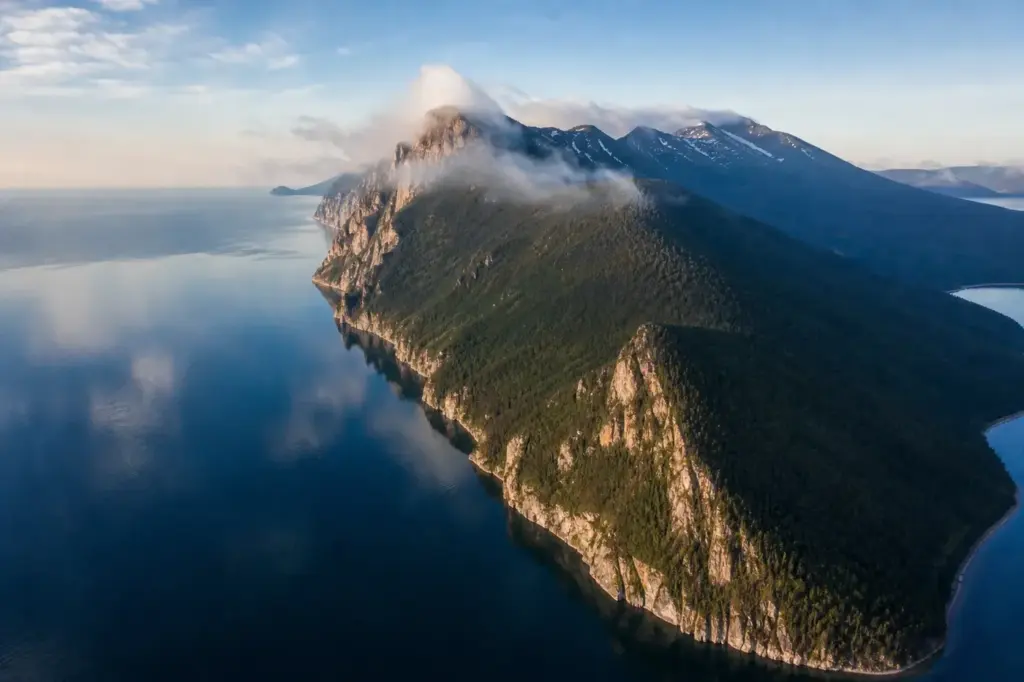
Svyatoy Nos Peninsula, whose name means ‘Holy Cape’ in Russian, is the largest peninsula on Lake Baikal. Located on the eastern shore in Buryatia, it rises dramatically from the water as a mountain ridge extending 56 kilometres into the lake, creating a landscape of forested slopes, granite cliffs, and alpine peaks.
Entirely within Zabaykalsky National Park, the peninsula was an island until about 7,000–8,000 years ago, when sediments from the Barguzin River filled the strait between it and the mainland, creating the low-lying Chivyrkuisky Isthmus. Today, it remains one of Baikal’s most remote and ecologically significant areas, home to Baikal seals and rare mountain forests.
Quick Facts
| Russian name | Святой Нос |
|---|---|
| Address | Zabaykalsky National Park, Republic of Buryatia, Russia Google MapsApple MapsYandex Maps2GIS |
| Admission | free |
| Best time to visit | Late May through September offers the most stable conditions. July and August are warmest, but insects (mosquitoes and midges) peak then; bring strong repellent. June and September provide better weather-to-bug ratios. Wildflowers bloom profusely in June–July on the higher slopes.May and early June see active bird migration and seal activity on Ushkany Islands. September brings clearer air, fewer insects, and larch forests turning gold on the slopes—excellent for photography.Avoid October–April: weather becomes harsh, snow blocks higher elevations, and access is severely restricted. Baikal's surface freezes in January, but crossing the ice requires local knowledge and guides. |
| Recommended duration | 2–4 days |
| Website | zapovednoe-podlemorye.ru |
What Is (and Isn't) Part of a Visit to Svyatoy Nos Peninsula, Lake Baikal?
| Part | Status | Notes |
|---|---|---|
| Svyatoy Nos Peninsula | Included in the standard ticket | The entire mountainous peninsula and isthmus are part of Zabaykalsky National Park; access is free but regulated. |
| Zabaykalsky National Park | Included in the standard ticket | The peninsula is the primary attraction within the park; park entry and use are governed by national park rules. |
| Ushkany Islands | Separate ticket or institution | These seal breeding islands offshore are separate protected areas within the park; access is restricted to protect wildlife. |
| Chivyrkuisky Bay | Included in the standard ticket | The bay encircling the peninsula's east side is part of the park and accessible by boat. |
| Chivyrkuisky Isthmus wetlands | Included in the standard ticket | The bog and lagoon area connecting the peninsula to the mainland is included but access is limited during nesting season. |
| Barguzin Bay to the north | Outside / not part of it | While related geographically, Barguzin Bay to the north is a separate feature and not part of Svyatoy Nos. |
Why Visit Svyatoy Nos Peninsula, Lake Baikal?
Svyatoy Nos offers unmatched wilderness and views. Mount Markova’s summit, at 1,878 metres, provides panoramic views of Lake Baikal’s northern and southern basins from a single vantage point—a rarity on the lake. The peninsula’s shorelines feature ancient granite formations, singing sand beaches that emit musical tones when walked upon, and quiet lagoons. For hikers and nature photographers, the combination of high elevation, dense forests, mountain streams, and pristine lakefront makes it exceptional. The peninsula is also a key habitat for Baikal’s endemic seal population.
How Svyatoy Nos Peninsula, Lake Baikal Is Laid Out
The peninsula divides into two distinct zones. The mountainous core runs northeast to southwest along a continuous ridge, with steep granite cliffs on the western shore and more irregular terrain to the east. The eastern side includes Snake Bay, a large indentation, and flatlands where forests give way to lagoons. The Chivyrkuisky Isthmus, a low, boggy zone to the south, connects the peninsula to the mainland and serves as a major waterfowl nesting area. Most visitor access is from the west via the isthmus or by boat into Chivyrkuisky Bay to the east.
Highlights of Svyatoy Nos Peninsula, Lake Baikal
Mount Markova
The peninsula's highest point at 1,878 metres, Mount Markova is a popular but challenging hiking destination. Its flat summit offers a rare 360-degree view of Lake Baikal, encompassing mountain ranges on all shores. On clear days, the vista extends across both the northern and southern basins of the lake, making it one of Baikal's most celebrated viewpoints. Allow a full day for the ascent and descent; the trail is steep and exposed to weather.
Tip: Begin hikes early and carry water; the exposed ridge can deteriorate quickly in afternoon storms. Local guides in nearby settlements can advise on current trail conditions.
Western Shore Granite Cliffs
The peninsula's west side features dramatic low cliffs composed of ancient granites, rising directly from the water. These formations create a striking contrast with dense taiga forest above. The cliffs are accessible by boat and reveal the geological history of the Baikal rift valley. Many visitors photograph these formations from the water or from viewpoints along the shoreline.
Tip: Early morning light from the east illuminates the cliff faces best; hire a local boat operator from settlements like Ust-Barguzin to access the base of the cliffs safely.
Marokov Beach (Singing Sand)
On the peninsula's eastern shore, this sandy beach is renowned for a distinctive phenomenon: the sand produces a musical tone when walked upon, due to the shape and composition of the sand grains. The beach sits in a quiet cove with surrounding forests and is accessible by boat. It exemplifies the unusual geological features that make Lake Baikal unique.
Tip: Visit in calm weather; boat access can be difficult in rough water. Local guides can explain the geology of the singing sand phenomenon.
Chivyrkuisky Isthmus Wetlands
The low-lying isthmus connecting the peninsula to the mainland is Russia's largest waterfowl nesting area on Baikal. Dominated by bogs and shallow lagoons, it attracts wild ducks, teals, pintails, and other species, especially in spring and summer. The landscape is flat and open, contrasting sharply with the forested mountains. Access is limited to protect nesting birds; visitors often observe from the periphery.
Tip: Visit during spring and autumn migrations (May and September) for the most active bird activity. Bring binoculars and a telephoto lens for wildlife photography.
Forests and Alpine Vegetation
The peninsula supports dense taiga forests of birch, larch, and pine, with rhododendron and dwarf cedar (elfin wood) at higher elevations. These forests are part of a distinct ecosystem adapted to the Baikal microclimate. Hot springs emerge in scattered locations, creating unique microclimates where rare plants grow. The variety of vegetation zones reflects the peninsula's range in elevation and exposure.
Tip: Spring (May–June) and early autumn (September) offer the best combination of mild weather and visible plant diversity. Summer mosquitoes can be intense; bring insect repellent.
Ushkany Islands and Seal Habitat
Just offshore, the Ushkany Islands (not part of the peninsula but closely associated with it) are the primary resting and breeding habitat of Baikal's endemic seal population. These small islands can be viewed from the peninsula's eastern shore or reached by boat. The seals are a keystone species of Baikal and represent one of the lake's most important conservation areas.
Tip: View seals from a distance and do not approach nesting areas; disturbing them is illegal. Early morning and late afternoon are best for seal sightings. Book a guided wildlife tour for safe, knowledgeable observation.
Atmosphere
The peninsula feels remote and primordial. Forested slopes rise steeply from a shoreline of boulders and sand; the air is clear and cool even in summer, carrying the smell of pine and damp earth. In early morning, mist hangs over the water and forest edges, creating a mysterious quality. The sound of small streams cascading down the ridges and the calls of ravens and eagles are the primary sounds; human noise is absent. In spring and early summer, the forest is alive with birdsong; in autumn, the silence deepens as temperatures drop and snow approaches the high peaks. Visitors are few, lending a sense of solitude and timelessness. At Chivyrkuisky Bay, the water often mirrors the surrounding mountains, creating an almost meditative calm.
History of Svyatoy Nos Peninsula, Lake Baikal
Svyatoy Nos has been inhabited and known for centuries. The name—’Holy Cape’—reflects both Russian Orthodox tradition and the peninsula’s sacred significance in Buryat Indigenous culture. Russian explorers in the 17th and 18th centuries used the term ‘nos’ (nose) metaphorically for capes, and the peninsula’s southwestern point was originally called Svyatoy Nos before the name extended to the entire peninsula.
Geologically, the peninsula represents a window into Baikal’s ancient rift geology. The granite formations visible in the cliffs date to the Paleozoic and Archean eras, making them hundreds of millions of years old. About 7,000–8,000 years ago, the peninsula changed from an island to a peninsula when the Barguzin River and smaller streams filled the separating strait with sediment, creating the Chivyrkuisky Isthmus. This geological transition is documented in the peninsula’s landscape and sediment layers.
In the Soviet era, the peninsula remained largely inaccessible and unmanaged, maintaining its wilderness character. In 1986, it became the core of Zabaykalsky National Park, established to protect the unique ecology of Baikal’s eastern shore and the endangered Baikal seal population. Since then, it has been managed as a protected area with limited visitor access, allowing the forests and wildlife to remain largely undisturbed.
Legends and Myths about Svyatoy Nos Peninsula, Lake Baikal
Sacred spirits of the mountains
Legend – historically unreliable. In Buryat tradition, Svyatoy Nos is inhabited by spirits of the mountain and lake, entities that must be respected and approached with proper ritual. The peninsula's Buryat name, Khilmen-Khushun, means 'Sturgeon's Muzzle,' reflecting the shape and its importance as a sacred geography. Local hunters and fishers traditionally leave offerings and perform ceremonies before entering the peninsula's wilderness, a practice that continues among some communities.
The island's transformation
Disputed by historians. Local folklore recalls when Svyatoy Nos was an island, separated from the mainland by a navigable strait. The story of how sediment from the Barguzin River gradually filled the channel and 'married' the island to the shore is embedded in oral tradition. Some versions describe a great storm or flood that accelerated the process, adding drama to what was a gradual geological event.
Tickets and Booking for Svyatoy Nos Peninsula, Lake Baikal
Entry to Svyatoy Nos Peninsula is free as it lies within Zabaykalsky National Park’s protected area. However, visitors must comply with park regulations: no motorised equipment in certain zones, no collection of wildlife or plants, and restrictions on access during sensitive periods such as waterfowl nesting (April–June).
Access is typically by guided tour arranged through lodges and outfitters in nearby settlements such as Ust-Barguzin or through regional tour operators based in Ulan-Ude. Multi-day hiking and camping trips are the main visitor modality. Boat access is essential for reaching many areas; hire through local operators or as part of an organised package. There are no entrance gates or ticket checkpoints; regulations are enforced by park rangers. Check current conditions and permit requirements with the park administration (website: zapovednoe-podlemorye.ru) before travel.
Plan and Book
Suggested itineraries Svyatoy Nos Peninsula, Lake Baikal
Day trip (full day)
Arrange boat access from Ust-Barguzin or another settlement. Visit the western granite cliffs and shoreline for photography and geological observation in the morning. In the afternoon, explore a quiet beach or lagoon on the eastern shore. Return by late afternoon. Best suited for visitors with limited time or limited hiking ability.
2–3 days
Day 1: Arrive by boat; establish a base camp or lodge near the isthmus. Day 2: Hike into the forested lower slopes, visiting streams and smaller peaks for views. Day 3: Boat tour of Chivyrkuisky Bay to observe seals and Ushkany Islands from offshore. This pace allows comfortable hiking and wildlife observation without the full commitment of climbing Mount Markova.
4–5 days
Day 1: Boat arrival and base establishment. Days 2–3: Multi-day hiking expedition into the peninsula, visiting alpine zones and Mount Markova ridge, with camp nights in the wilderness. Day 4: Descent and rest day with light exploration. Day 5: Wildlife and geology focus—boat tour and final observations before departure. Suits experienced hikers and nature enthusiasts.
How to Get to Svyatoy Nos Peninsula, Lake Baikal
Svyatoy Nos Peninsula is remote and requires a multi-stage journey. Nearest city: Ulan-Ude (Buryatia’s capital), about 250 km southwest. From Ulan-Ude, travel north by road or arranged transport to the village of Ust-Barguzin (approximately 200 km), which serves as the primary gateway. From Ust-Barguzin, boat access is essential; hire local operators or book through regional tour companies. The boat journey across Barguzin Bay to the peninsula takes 1–3 hours depending on destination and weather.
Alternative access is via Listvyanka (near Irkutsk, on Baikal’s west shore), but this requires crossing the entire lake by boat—a longer and more challenging route. There is no road to the peninsula; all access is by water or on foot after boat delivery.
Regional tour operators: Contact the park’s official administration or regional tourism organisations in Buryatia for lists of licensed guides and outfitters. Booking in advance (2–4 weeks) is advisable for multi-day trips.
Accessibility
Svyatoy Nos is not accessible for wheelchair users or those with mobility impairments. Terrain is mountainous, with steep trails, rocky ground, and no paved paths. Boat access to the shore is possible but unloading onto beaches involves rocks and uneven surfaces. Camping and multi-day hiking are the primary activities, requiring fitness and endurance. There are no facilities or services on the peninsula itself—all amenities (lodges, food, guides) are in nearby settlements. Anyone with physical limitations should discuss options with a tour operator before booking.
Food Nearby
No food services exist on the peninsula. Visitors on guided trips or camping must bring all provisions or arrange supply through outfitters. Small settlements near Ust-Barguzin (the main gateway) offer basic groceries and simple meals, though selection is limited. Bring high-energy camping food (dried meals, energy bars, nuts), purified water, and any dietary essentials. Fresh water from mountain streams is available but should be boiled or treated. Fishing in the bay is possible but subject to park regulations.
What to Bring
Essential items: waterproof hiking boots (terrain is rocky and often damp), layered clothing (weather changes rapidly; temperatures can drop sharply above 1,500 metres even in summer), a sleeping bag rated to 0°C (if camping), insect repellent (critical in June–August), sunscreen and hat, a headlamp, a map and compass, and a first-aid kit. Bring a tent with strong stakes if planning wilderness camping; wind can be intense at higher elevations. For boat travel, bring a waterproof bag for belongings. Gaiters help protect legs from mud and insects on forest trails.Security and regulations: Leave all valuables in secure lodging in nearby settlements. Park rules prohibit collecting plants, disturbing wildlife, and building fires outside designated areas. Pack out all waste.
Best Views and Photo Spots of Svyatoy Nos Peninsula, Lake Baikal
Mount Markova summit
From 1,878 metres, the 360-degree panorama encompasses Lake Baikal's northern and southern basins, distant mountain ranges, and forests below. On clear days, the view stretches across most of the lake's length. The flat summit offers stable ground for tripod photography.
Best time: Early morning (sunrise) for soft light and clear air; mid-September for crystalline visibility and golden larch forests in lower elevations.
Western granite cliffs from the water
Ancient granite formations rise directly from the lake, often misty at dawn. The contrast between grey stone, dark forest, and deep blue water creates striking compositions. Boat access allows multiple vantage points and angles.
Best time: Early morning with sun from the east, illuminating the cliff faces; clouds often clear by mid-morning.
Marokov Beach
Sandy beach backed by dense forest on the peninsula's eastern shore, often mirror-still water reflecting surrounding peaks. The beach has a timeless, isolated quality ideal for environmental portraiture.
Best time: Late afternoon when light is warm and softer; calm water days only (check weather and sea state before travel).
Chivyrkuisky Bay lagoons
Shallow lagoons with brackish water create unusual colours—ranging from deep green to pale blue—contrasting with forested shores and distant peaks. Reeds frame compositions. Waterfowl and occasional seal activity add wildlife interest.
Best time: May and June during spring migration; September when water clarity is highest and fewer insects are present.
Isthmus wetlands at sunset
Low-lying bogs and shallow water with distant mountain silhouettes create golden-hour compositions. Waterfowl activity adds life to the scene. The expansive, open landscape contrasts with the forested mountains.
Best time: Late May through July when water levels are higher and bird activity is pronounced; aim for clear evenings.
Photography Rules
Photography is permitted throughout the park. No restrictions on tripods, telephoto lenses, or drones exist, but fly drones responsibly and never over wildlife nesting areas. Early morning and late afternoon light is optimal for landscape and cliff photography. Mist on the water at dawn creates atmospheric scenes. Wildlife photography requires patience and distance (bring a long telephoto lens); disturbing seals or birds is illegal. No flash needed for daytime landscape work; it will not improve images and risks disturbing nocturnal animals if hiking at night.
Family Suitability
Svyatoy Nos is challenging for families with young children. The peninsula is remote, with no child-specific facilities, medical services, or emergency rescue capabilities nearby. Hiking trails are steep and poorly marked; children need good fitness. Weather is unpredictable and can be harsh. However, families with children aged 10+ who are experienced hikers and comfortable with wilderness camping can undertake shorter, lower-elevation excursions (1–2 day trips with guides). Boat-based day trips along the shoreline are feasible for younger children with adult supervision. Multi-day expeditions targeting Mount Markova or remote areas are unsuitable for families with small children. Parents should arrange trips only with experienced local guides familiar with families.
Russia Vibes Tips
- Hire a local guide, especially for Mount Markova or multi-day trips. Routes are not well-marked, weather changes rapidly, and local knowledge of stream crossing, safe camping, and wildlife avoidance is invaluable. Guides can be arranged through lodges in Ust-Barguzin or online tour operators serving the region.
- Start early on mountain days. Afternoon storms are common in summer; descending in foul weather is dangerous. Begin hikes at dawn and plan to be off high ridges by early afternoon.
- Respect nesting season restrictions (April–June). The isthmus wetlands are critical for waterfowl reproduction; access is limited to protect birds. Plan trips for May and after mid-June to avoid closures and minimise environmental impact.
- Never approach Ushkany Islands or seal colonies. Seals are easily stressed by human presence and are a protected, endangered species. View from boats at a distance of at least 100 metres; use binoculars and telephoto lenses for observation.
- Bring extra food and water beyond what you think you need. Resupply on the peninsula is impossible. Weather delays may extend trips unexpectedly; additional provisions provide safety margin.
- Register your trip with the park administration or your guide service. In case of emergency, rescuers need to know your planned route and expected return date. The peninsula is remote; search and rescue operations take time.
Explore Nearby Svyatoy Nos Peninsula, Lake Baikal
Sights near Svyatoy Nos Peninsula, Lake Baikal
 Olkhon Island, Lake Baikalabout 115.2 km away · typical visit: 2–3 days
Main image: AI-generated illustration. It may not show the place exactly as it looks.
 Listvyanka, Lake Baikalabout 336.6 km away · typical visit: 2–3 days
Main image: AI-generated illustration. It may not show the place exactly as it looks.
Related guides
 Lake Baikal: Where to Go, What to See and How to Visit
Main image: AI-generated illustration. It may not show the place exactly as it looks.
Browse more: All Lake Baikal · All Landmarks · All Sightseeing · All Sightseeing in Lake Baikal
FAQ: Svyatoy Nos Peninsula, Lake Baikal
Can I visit Svyatoy Nos as a day trip from Listvyanka or Irkutsk?
Technically yes, but it is impractical. Travel from Irkutsk to Listvyanka takes 1 hour, then boat crossing to the peninsula takes 3–5 hours depending on conditions. A meaningful visit requires at least an overnight stay. Most visitors stay 2–4 days. For convenience, arrange multi-day trips through operators in Ulan-Ude, which is closer to the main gateway (Ust-Barguzin).
Do I need a permit to visit the peninsula?
No specific permit is required for free entry to Zabaykalsky National Park. However, you must comply with park regulations (no collection of plants or wildlife, no fires outside designated areas, respect for wildlife closures during nesting season). Your guide or tour operator will brief you on rules. Register your trip with the park administration for safety.
Is Mount Markova a difficult climb?
Markova is steep and exposed, not technical but physically demanding. The ascent is 1,400+ metres of elevation gain on a rough trail. Expect 6–8 hours for the round trip from a base at lower elevation. It requires good fitness and acclimatisation to high elevation. Local guides strongly recommend attempting it only after a day of acclimatisation. Weather can deteriorate rapidly; turn back if storms approach.
Are there lodges or shelters on the peninsula, or must I camp?
There are no permanent shelters on Svyatoy Nos itself. Most visitors either stay at small lodges in nearby Ust-Barguzin and boat in for day visits, or camp on the peninsula during multi-day expeditions. Some tour operators may have seasonal tent camps. Arrange accommodation through your guide or tour operator in advance.
What is the singing sand beach, and why does it make noise?
Marokov Beach on the peninsula's east shore features sand with unusual properties. The sand grains are uniform in size and shape, and when you walk on dry sand, the grains shift and create a musical, squeaking sound. This is a natural phenomenon found in only a few places globally. The effect occurs only on dry sand; wet sand does not sing. It is a memorable sensory experience.
Can I see Baikal seals from the peninsula?
Seals are most reliably seen on Ushkany Islands, visible from the peninsula's east shore or via boat tour. Seals occasionally haul out on the peninsula's rocky shores, but sightings are unpredictable. Early morning and late afternoon are best. Never approach seals; they are endangered and protected. Use binoculars or a telephoto lens for observation.
What is the best season to visit?
June through September is optimal. July–August are warmest but insect-heavy. June and September offer better weather-to-bug ratios, clear skies, and spectacular landscape photography. May has active bird migration but can still be cold. Avoid October–April due to harsh weather, snow, and closures.
Do I need to be an experienced hiker?
Boat-based day trips along the shore require only basic fitness. For forest walks and lower-slope exploration, moderate fitness suffices. Mount Markova and multi-day wilderness expeditions require good fitness, acclimatisation, and navigation experience. Hire a local guide if you lack backcountry experience; guides can adjust routes to your abilities.
Russia Vibes is a one-person project. A coffee keeps it going
How we research and update our guides
About this guide: AI assistance and accuracy
This guide is created with the help of AI and is based on official sources where available. Mistakes can still happen. Opening hours, prices, rules and other details are given to the best of our knowledge as of the date shown and can change without notice. It offers general recommendations only, not professional, legal or travel advice. Please confirm important details with the official source before you travel; you are responsible for your own plans and decisions.
Packing for this trip
* Affiliate link: as an Amazon Associate we earn from qualifying purchases at no extra cost to you.

Take this guide with you
Get a free PDF of this guide to print or read offline: key facts, tips and a map link on a few clean pages.
Report an issue on this page
Paying for your trip: please read
International sanctions affect payments between Russia and many other countries. In practice, cards issued in the EU, the UK, the US and several other countries often do not work in Russia, Russian cards usually do not work abroad, and some booking platforms, airlines and payment providers limit or suspend their services for Russia. The situation changes frequently.
We do not give legal or financial advice, and this site does not encourage anyone to break or circumvent sanctions. Whatever you plan, you are responsible for following the laws and regulations that apply to you, including those of your country of residence and citizenship.
Many travelers still organise their stay lawfully. It is worth asking your bank or payment provider what is currently permitted, contacting hotels, tour operators and carriers directly about the payment methods they accept, and checking which services are open to customers from your country. Clarify payment, cancellation and refund terms before you commit to a booking, and keep your plans flexible.
Partner links on this site may not be available in every country, and prices, availability and rules in our guides can differ from what you see when you book.