
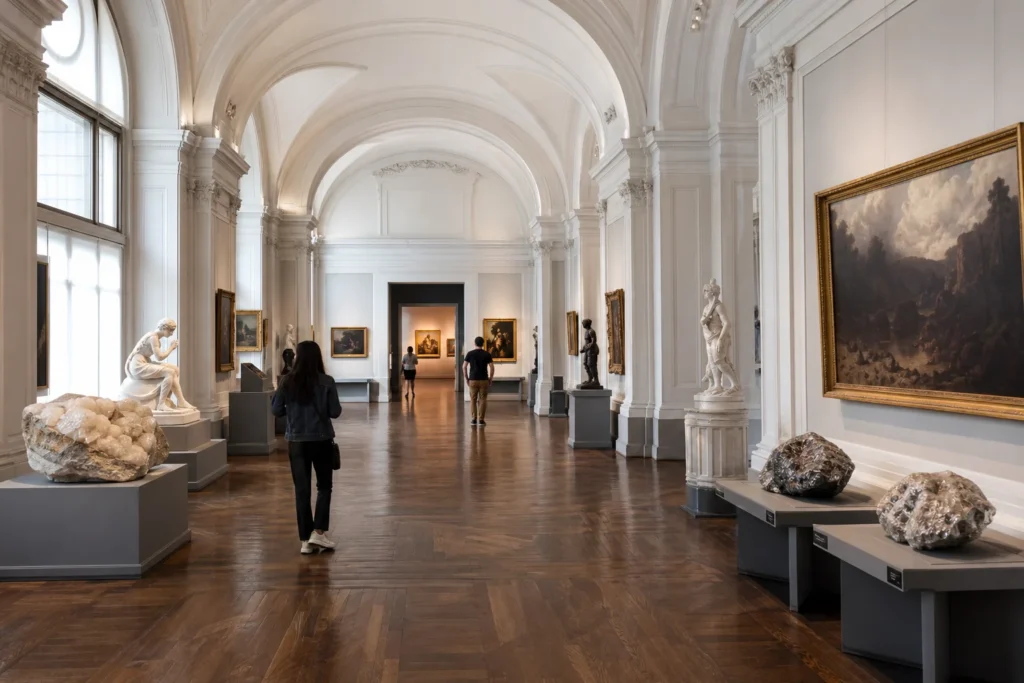
This curated list of museums and galleries in Yekaterinburg guides you by collection type and focus, whether you’re drawn to fine art, contemporary work, specialist subjects, or historical exhibitions. The city offers more than just the flagship museums: smaller galleries reveal distinctive local artistic traditions, from the jeweler’s craft heritage of the Ural region to early Soviet unofficial art. Whether you plan a half-day in one major museum or hop between three specialized collections, you’ll find something worthwhile.
The 10 entries below are organized by type—fine art, contemporary galleries, specialist museums, and civic spaces—so you can match your mood to the venue.
At a Glance
| # | Place | Best for | Good to know |
|---|---|---|---|
| 1 | Yekaterinburg Museum of Fine Arts | Premier art collection | Voevodina Street; on the banks of the Iset River. Paid entry. Check official website (i-z-o.art/en) for current hours and exhibitions. |
| 2 | Boris Yeltsin Presidential Center | Modern history and design | Boris Yeltsin Street. Paid entry. Hours: Tuesday–Sunday 10:00 am–9:00 pm (as of October 2026). Central location in Yekaterinburg City development. |
| 3 | Museum of Stone-Cutting and Jewelry Art History | Ural gemstone heritage | City center. Paid entry. Check official site for hours and current exhibitions. |
| 4 | Sinara Art Gallery | Ural contemporary art | Verkh-Isetsky Boulevard 15/4. Paid entry. Well-organized, small but curated space; plan 45 minutes to an hour. |
| 5 | Ural Vision Gallery | Contemporary art space | Contemporary art gallery; check official site for location, hours, and current exhibitions. |
| 6 | National Centre for Contemporary Arts, Ural Branch | Contemporary art hub | Ural Branch location; paid entry. Check official website for current exhibitions, hours, and programming. |
| 7 | Museum of Naive Art | Outsider and folk art | Yekaterinburg city center. Paid entry. Hours and current exhibitions available on official site. |
| 8 | Art Bird Gallery | Small intimate gallery | Yekaterinburg. Paid entry. Small venue; plan 30 minutes to an hour. Check ahead for exhibition schedule. |
| 9 | Glavny Prospekt International Arts Center | Artist studios and contemporary work | Yekaterinburg. Check official site for hours, current exhibitions, and studio access policies. |
| 10 | D. Mamin-Sibiryak Literary and Memorial House Museum | Literary history and local culture | Yekaterinburg city. Paid entry. Hours on official site. Modest, focused collection; plan 45 minutes. |
How We Chose
All museums and galleries listed are verified as currently operating with public access. The selection prioritizes those with distinctive collections or architecture, or those of particular relevance to visitors new to Yekaterinburg. Opening hours, admission policies and any access limitations vary; check the official website of each venue before visiting, especially for temporary exhibitions which change seasonally. Information is current as of October 2026.
1. Yekaterinburg Museum of Fine Arts – Premier art collection
The largest art museum in the Urals holds over 18,000 works spanning from 14th-century European and Russian art to 20th-century Russian avant-garde. The museum occupies a historic building anchored by a 1730 hospital constructed for the Yekaterinburg Ironworks. Look for the Kasli cast-iron pavilion, a unique metalwork piece, and the extensive collection of Ural gemstone carvings—jade, malachite, and emerald sculptures showcasing the region's mineral wealth.
The collection also includes works acquired from the Hermitage, Tretyakov Gallery, and Pushkin Museum, making it a comprehensive survey of Russian artistic development.
Good to know: Voevodina Street; on the banks of the Iset River. Paid entry. Check official website (i-z-o.art/en) for current hours and exhibitions.
Tip: Allow at least 2–3 hours. The gemstone and metalwork sections are particularly absorbing; many pieces reward close looking. Temporary exhibitions rotate seasonally.
2. Boris Yeltsin Presidential Center – Modern history and design
Opened in 2015, this multifunctional complex houses a museum tracing the 1990s and Russia's post-Soviet transition, plus art galleries, cinema, and library. The architecture itself is striking: a futuristic building with a perforated metal facade that becomes a media screen after dark, designed by Boris Bernaskoni. The museum uses immersive, interactive displays to convey the atmosphere of that historical moment. The center won the 2017 European Museum of the Year award.
Good to know: Boris Yeltsin Street. Paid entry. Hours: Tuesday–Sunday 10:00 am–9:00 pm (as of October 2026). Central location in Yekaterinburg City development.
Tip: The Freedom Hall is the core of the permanent exhibition—a visceral introduction to the era. Temporary exhibitions and cultural events happen year-round; check ahead to see what's on during your visit.
3. Museum of Stone-Cutting and Jewelry Art History – Ural gemstone heritage
A three-floor specialist museum dedicated to the Ural region's world-renowned tradition of stone-cutting and jewelry craftsmanship. The Emerald Room displays exquisite carved gems and jewelry; the Malachite Hall showcases rare natural malachite pieces. The collection spans from the 18th century to modern work. The building itself, a former mining pharmacy from the 1820s, adds to the atmosphere. This museum is essential for understanding why Yekaterinburg became a center of precious stone work.
Good to know: City center. Paid entry. Check official site for hours and current exhibitions.
Tip: The green of malachite and the depth of carved emeralds are best appreciated in person—photographs don't capture the richness. The permanent stone collection runs throughout; temporary jewelry exhibitions rotate on the third floor.
4. Sinara Art Gallery – Ural contemporary art
Housed in the Sinara Centre, a regenerated industrial complex in a historic former metal plant building, this gallery specializes in contemporary and historical art from the Ural region. The collection draws from private and museum holdings and emphasizes the distinctive artistic development of this border region between Europe and Asia. Exhibitions include both permanent holdings and rotating shows, with an emphasis on work by Ural artists that might not be seen in major Moscow or St. Petersburg institutions.
Good to know: Verkh-Isetsky Boulevard 15/4. Paid entry. Well-organized, small but curated space; plan 45 minutes to an hour.
Tip: The gallery bookshop carries context-specific publications about regional artists and contemporary Ural art movements. New exhibitions appear regularly; the permanent collection is intentionally modest, allowing focus on quality.
5. Ural Vision Gallery – Contemporary art space
A modern gallery space spanning over 600 square meters, opened in 2009, dedicated to discovering new artistic voices and introducing contemporary art to a broad audience. The gallery hosts solo and group exhibitions and maintains a small permanent collection alongside rotating shows. The focus is on emerging and established Ural artists working in various media.
Good to know: Contemporary art gallery; check official site for location, hours, and current exhibitions.
Tip: Ural Vision is a good destination if you want to see what contemporary Ural artists are doing now, rather than historical or canonical work. Visit during an active exhibition for the full experience.
6. National Centre for Contemporary Arts, Ural Branch – Contemporary art hub
Established in 1999, this branch of the national contemporary arts network has become a vibrant center for cutting-edge art and culture in Yekaterinburg. The space hosts exhibitions, performances, and cultural programming alongside a gallery of contemporary work. It serves both as a showcase for emerging talent and a venue for experimental art projects.
Good to know: Ural Branch location; paid entry. Check official website for current exhibitions, hours, and programming.
Tip: This venue often hosts lectures, performances, and artist talks alongside visual exhibitions. Timing a visit with an event can deepen your understanding of the work on view.
7. Museum of Naive Art – Outsider and folk art
A specialist museum dedicated to naive art and folk traditions. Naive art—work created outside formal academic training—has a strong presence in Russian and Ural culture. This museum celebrates that tradition with exhibitions of paintings, textiles, and crafts that reflect local and regional artistic practice outside the mainstream gallery world.
Good to know: Yekaterinburg city center. Paid entry. Hours and current exhibitions available on official site.
Tip: Naive and folk art often reveals authentic local sensibility and storytelling that formal fine art galleries may not capture. Smaller collections, so plan 30–45 minutes.
8. Art Bird Gallery – Small intimate gallery
A smaller contemporary gallery consistently mentioned as a favorite by visitors for its curated selection and intimate scale. The gallery focuses on accessible contemporary art and maintains a clean, well-organized space. It often features work by emerging and established regional artists in rotating exhibitions.
Good to know: Yekaterinburg. Paid entry. Small venue; plan 30 minutes to an hour. Check ahead for exhibition schedule.
Tip: Perfect for a quick focused visit or if you want a less overwhelming alternative to larger institutions. The smaller scale allows for real conversation with artists or curators if timing allows.
9. Glavny Prospekt International Arts Center – Artist studios and contemporary work
An arts center that combines gallery space with working artist studios. This gives visitors a chance to see both finished exhibitions and work in progress, sometimes meeting artists directly. The center emphasizes living contemporary practice rather than retrospective display.
Good to know: Yekaterinburg. Check official site for hours, current exhibitions, and studio access policies.
Tip: Visiting when the studios are active gives the most authentic sense of the space. Call ahead to see if artist hours align with your visit.
10. D. Mamin-Sibiryak Literary and Memorial House Museum – Literary history and local culture
The home and archive of Dmitry Mamin-Sibiryak, a major Ural writer and chronicler of 19th-century regional life and industry. The museum preserves the house as a memorial to his work and era, with exhibits about his life, manuscripts, and the cultural history of Yekaterinburg. For visitors interested in Russian literature and local heritage beyond visual art.
Good to know: Yekaterinburg city. Paid entry. Hours on official site. Modest, focused collection; plan 45 minutes.
Tip: Literature and local history museums offer a different lens on a place than visual art alone. English-language materials may be limited; consider a guide if you want deeper context.
Russia Vibes Tips
- Many museums have temporary exhibitions alongside permanent collections; these rotate seasonally. Always check the official website before visiting to see what's on display during your dates. A 'permanent' collection may look entirely different if temporary shows are occupying the main galleries.
- Yekaterinburg has both large civic museums and small intimate galleries. If you visit two or three museums in one day, mix scales—alternate a large survey museum like the Fine Arts Museum with a small specialist gallery or contemporary space. This prevents fatigue and gives variety.
- The Ural's gemstone heritage is a thread connecting several museums. If you're interested in this theme, the Stone-Cutting Museum is the deepest dive, but the Fine Arts Museum's gemstone carvings also illustrate the tradition. Visiting both gives fuller context.
- Photography may be restricted in some galleries, particularly in museum displays with fragile objects. Ask at the entrance rather than assuming. Video is usually not permitted.
- English-language descriptions are available in major museums like the Fine Arts Museum and Yeltsin Center, but smaller galleries and specialist museums may have only Russian labels. Bring a translation app if detailed context matters to you, or hire a local guide for deeper interpretation.
Explore Nearby Museums & Galleries by Type, Yekaterinburg
Browse more: All Culture Lists · All Guides · All Guides in Yekaterinburg · All Yekaterinburg
FAQ
Which museum is best for a first-time visitor to Yekaterinburg?
The Yekaterinburg Museum of Fine Arts gives the broadest overview of Russian and Ural art history in one afternoon. If you're more interested in contemporary culture and recent history, start with the Boris Yeltsin Presidential Center, which is more interactive and less traditionally museum-like. Both are central and easy to navigate.
Can I see Ural gemstone art without visiting a specialist museum?
Yes. The Yekaterinburg Museum of Fine Arts has an extensive collection of Ural-carved gemstones alongside other artworks. However, the Museum of Stone-Cutting and Jewelry Art History dedicates three floors entirely to this tradition and shows the full range of techniques and historical development, making it the deeper experience.
Are the galleries free?
No. All listed museums and galleries charge admission. Exact prices vary and change; check the official website of each venue. Some may offer discounts for students or groups.
Do I need to book tickets in advance?
For most museums, walk-in tickets are available, but during major holidays or special exhibitions, advance booking may be wise. Check the official website. The Yeltsin Center may have ticketing info online; larger museums typically allow booking in advance.
Is there a combined ticket for multiple museums?
No unified pass covers all museums listed here. Some are independent institutions; others are part of different municipal or private networks. Buy individual tickets for each venue you plan to visit.
Are these museums accessible for visitors with mobility limitations?
The newer venues (Boris Yeltsin Presidential Center, Sinara Art Gallery) are designed with modern accessibility standards. Older buildings (like the Fine Arts Museum in a 1730 structure) may have stairs or uneven floors. Contact the museum directly if you have specific mobility needs; staff can advise on access.
What is the difference between the Fine Arts Museum and the contemporary galleries?
The Fine Arts Museum is a comprehensive civic institution with collections spanning centuries, focusing on historical art and major Russian masters. Contemporary galleries (Sinara, Ural Vision, National Centre for Contemporary Arts) show work made in the last 20–30 years and emphasize emerging local artists and experimental practice. Visit both for a full picture of the art scene.
Are there English-language guides or tours?
The major museums (Fine Arts Museum, Yeltsin Center) have some English signage and materials. Smaller galleries may not. Independent professional guides are available for hire in Yekaterinburg if you want deeper interpretation; book in advance through your hotel or a local tourism office.
Russia Vibes is a one-person project. A coffee keeps it going
How we research and update our guides
About this guide: AI assistance and accuracy
This guide is created with the help of AI and is based on official sources where available. Mistakes can still happen. Opening hours, prices, rules and other details are given to the best of our knowledge as of the date shown and can change without notice. It offers general recommendations only, not professional, legal or travel advice. Please confirm important details with the official source before you travel; you are responsible for your own plans and decisions.

Take this guide with you
Get a free PDF of this guide to print or read offline: key facts, tips and a map link on a few clean pages.
Report an issue on this page
Paying for your trip: please read
International sanctions affect payments between Russia and many other countries. In practice, cards issued in the EU, the UK, the US and several other countries often do not work in Russia, Russian cards usually do not work abroad, and some booking platforms, airlines and payment providers limit or suspend their services for Russia. The situation changes frequently.
We do not give legal or financial advice, and this site does not encourage anyone to break or circumvent sanctions. Whatever you plan, you are responsible for following the laws and regulations that apply to you, including those of your country of residence and citizenship.
Many travelers still organise their stay lawfully. It is worth asking your bank or payment provider what is currently permitted, contacting hotels, tour operators and carriers directly about the payment methods they accept, and checking which services are open to customers from your country. Clarify payment, cancellation and refund terms before you commit to a booking, and keep your plans flexible.
Partner links on this site may not be available in every country, and prices, availability and rules in our guides can differ from what you see when you book.