
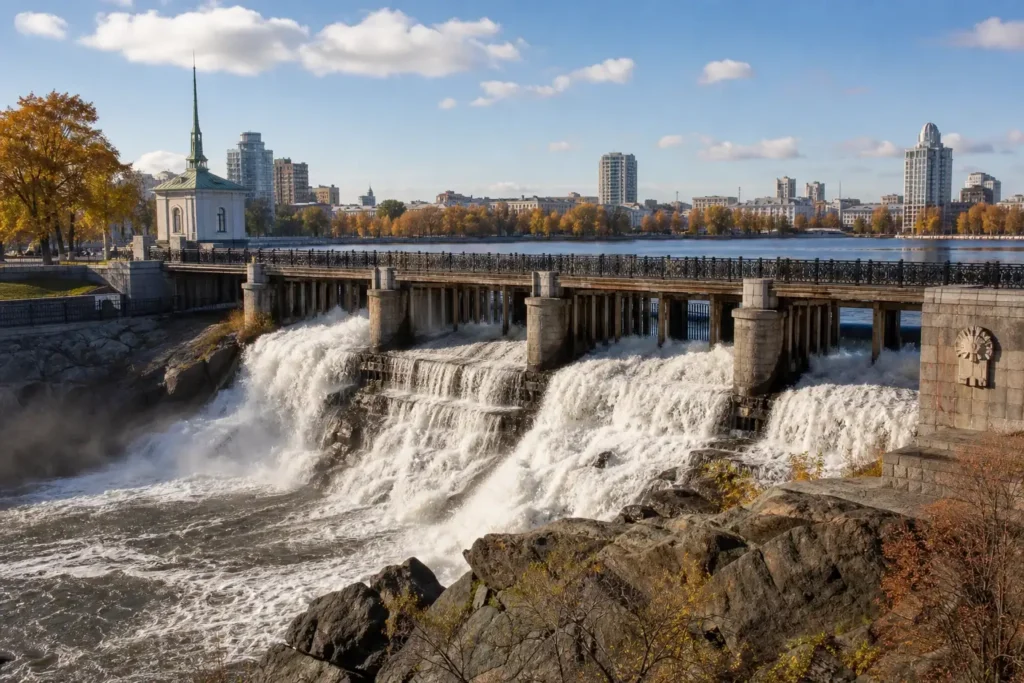
Plotinka is a historic dam and embankment area on the Iset River that serves as a central gathering place for locals and tourists. The name refers both to the dam itself and to the surrounding Historical Square at the heart of Yekaterinburg.
Construction began in 1721 on the initiative of prominent statesman V. N. Tatishchev and was completed on September 11, 1723, under Wilhelm de Gennin’s leadership. The dam’s foundation was built from Ural larch, wood that resists rot and becomes as hard as stone when submerged in water. The site remains one of the most iconic in Russia’s Urals.
Quick Facts
| Russian name | Плотинка |
|---|---|
| Built / opened | 1723 |
| Architect(s) | Wilhelm de Gennin |
| Address | Prospekt Lenina, Historical Square, Yekaterinburg Google MapsApple MapsYandex Maps2GISOpenStreetMap |
| District | Leninski |
| Metro | Ploshchad 1905 Goda (Red Line, 10 min walk) |
| Opening hours | Open 24 hours |
| Admission | free |
| Best time to visit | Spring (May) and autumn (September–October) offer the most pleasant weather and fewer crowds, with clear views of the water and surrounding architecture. Summer (June–August) is busiest with street performers and outdoor activities on the pond. Winter is quieter and atmospheric, though ice can make the embankment slippery. Visit early morning or late afternoon for better light and fewer people. |
| Recommended duration | 1–2 hours |
What Is (and Isn't) Part of a Visit to Plotinka, Yekaterinburg?
| Part | Status | Notes |
|---|---|---|
| Plotinka Dam (the structure itself) | Included in the standard ticket | Free public access; you can walk across Lenin Avenue on the dam at any time. |
| Historical Square and surrounding public spaces | Included in the standard ticket | Free public access to walk, sit, and view monuments and architectural sights. |
| Water Tower Museum | Separate ticket or institution | Located at the dam; requires a separate ticket and has its own opening hours. |
| City Pond activities (boating, catamarans) | Separate ticket or institution | Rentals and activities on the pond require separate payment and booking through local operators. |
| Museum of Architecture and Industrial Equipment of the Urals | Separate ticket or institution | Located nearby; requires separate ticket and opening hours—verify hours locally. |
| Rhodonite stone display | Included in the standard ticket | Free to view in the Historical Square. |
| Restaurants and cafés | Outside / not part of it | Many surround Plotinka but are separate businesses with their own prices and hours. |
Why Visit Plotinka, Yekaterinburg?
The 209-metre long dam is a recognized industrial monument. You can see the slits through which water ran to work the wheels like a water mill.
A wealth of cultural and architectural gems is concentrated around Plotinka, including the Museum of Architecture and Industrial Equipment of the Urals, monuments to the city’s founders, and picturesque walking areas. Beautiful and clean, it mixes history with everyday life—urban artists showing off their work, old men locked in intense chess battles, kids racing around, couples snapping photos by the water, and the embankment lined with restaurants and cafés.
How Plotinka, Yekaterinburg Is Laid Out
In the modern sense, Plotinka encompasses not only the hydraulic facility on the Iset River but also the territory of Historic Square, whose borders are Lenin and Malysev Streets, Vojvodina and Gorky Streets.
The main street, Lenin Avenue, runs over the dam wall. Next to the statues of the two founders stands a water tower built in the 1880s, which consists of granite in the lower part with a souvenir shop, while the upper wooden part houses a museum about Yekaterinburg’s beginnings.
Relics of early industry dot the surrounding Historical Park, including lumps of Ural rock and a large sample of rhodonite, while on the left bank of the Iset River rises a monument to the founders of Yekaterinburg on the site of their first iron mill.
Highlights of Plotinka, Yekaterinburg
The Dam Structure
The 209-metre long dam, first built in 1723, was reconstructed twice, and is now a recognized industrial monument. Its foundation is made from Ural larch, wood that has the remarkable property of becoming as hard as stone when submerged in water, resisting rot. Walk across it on Lenin Avenue and notice how it connects the city to the pond on either side.
Tip: Stand on the downstream side to see the water flow through the sluices most clearly.
Monument to the Founders
Vasily Tatishchev and Georg de Gennin are considered the city's founders, and in 1998 a monument to them both was erected here. The bronze statues face the dam and pond, marking the exact spot where Yekaterinburg's industrial foundation was laid.
Tip: Local tradition calls the monument 'Beavis and Butt-head' because of the founders' posture; locals often gather and chat here.
Water Tower and Museum
A water tower built in the 1880s to serve a railway factory consists of granite in the lower part, where there is now a souvenir shop, while the upper wooden part houses a museum about the beginnings of Yekaterinburg. The tower has become an iconic symbol of the site.
Tip: The museum inside requires a separate ticket; check opening hours locally as times may vary seasonally.
City Pond (Gorodskoy Pond)
The dam was built in 1723 to form a pond that supplied water to the Yekaterinburg Plant. Today the pond is a pleasant recreational area where locals fish, walk, and relax. In summer you can rent a catamaran or go boating and feed the ducks.
Tip: The pond is separate from the dam and creates a natural partition; the dam itself has no admission, but activities on the pond may require booking.
Rhodonite Stone
A large sample of rhodonite—the Ural's pink mineral—is displayed in the Historical Park. This gem-quality stone marks the industrial heritage of the region and sits near a carved inscription noting the founding year 1723.
Tip: Touch the stone for good luck—it's a local tradition, though the edges may be worn smooth from decades of hands.
Historical Square Architecture
In 1886, architect Kozlov created a public garden around Plotinka. The square now features neoclassical buildings, fountains, and walking paths that create one of Yekaterinburg's most atmospheric public spaces. Samples of rocks mined in the Urals mountains are placed along the walks of the public garden.
Tip: Visit in late afternoon when light catches the water and the architectural details of surrounding buildings become most photogenic.
Iset River Embankment
Below the dam, the Iset River flows through a narrow channel carved by the dam's current. The urban story of Plotinka makes itself known by the noise of water coming from the culvert. The sound of rushing water is unmistakable and becomes a sensory landmark of the site.
Tip: Climb down to the lower level to see the water flow—there are safe viewing areas, though stairs can be slippery in winter.
Atmosphere
The area serves as a vibrant gathering place for both locals and visitors. It mixes history with everyday life—urban artists showing off their work, old men locked in intense chess battles, kids racing around, and couples snapping photos by the water. On the other side of the dam, skateboarders and skaters gather.
Speed boats cut across the river adding energy, while the embankment is lined with restaurants and cafés where you can linger for hours. Musicians and street performers often perform here on weekends, especially in warmer months, creating a lively, almost festival-like atmosphere despite the site’s industrial origins.
History of Plotinka, Yekaterinburg
Construction of Plotinka began in 1721 on the initiative of prominent statesman V. N. Tatishchev and was completed on September 11, 1723, under Wilhelm de Gennin’s leadership. The primary purpose was to provide water for the Yekaterinburg factory and power its mechanisms, which essentially gave life to the future city.
The dam’s foundation was made from Ural larch, wood that resists rot and becomes as hard as stone over time, providing incredible strength and allowing Plotinka to become a reliable foundation for the developing factory production.
In the 30th of the 19th century, a support wall was erected over the dam, making it possible to connect it to the City Pond with a full-sized avenue now called Lenin Avenue. In 1886, architect Kozlov created a public garden around the Plotinka, which made it one of the main sights of the city. Over time, Plotinka was rebuilt and reinforced many times, adapting to the city’s needs, and in the 19th century, a cozy square was added, decorated with busts of Peter I and Catherine I, adding cultural significance to the site.
The dam survived the Soviet era and remains a federal cultural heritage site. Despite its age and the industrial development around it, Plotinka has retained its original purpose and character, serving as a living connection between Yekaterinburg’s industrial past and its modern identity.
Legends and Myths about Plotinka, Yekaterinburg
The Ural Larch That Turns to Stone
Legend – historically unreliable. The dam's foundation is made from Ural larch, which has an amazing property: when submerged in water, it not only resists rot but becomes as hard as stone over time. Local legend attributes the dam's three-century survival to this unique wood, making it seem almost magical that a structure built in 1723 remains intact without modern reinforcement.
The Founders' Watch
Legend – historically unreliable. Local lore says that de Gennin and Tatishchev, the founders of the city, 'watch' the dam on the Iset River from their monument, as this was the beginning of the construction of Yekaterinburg. Locals say that as long as the founders watch over the dam, the city will prosper.
Tickets and Booking for Plotinka, Yekaterinburg
Plotinka itself is free and open to the public 24 hours. No ticket or advance booking is needed to walk on the dam, view the monuments, or spend time in the Historical Square. However, if you wish to visit the Water Tower Museum or take a guided tour of the site, you must book separately and check local information for current hours and rates.
Plan and Book
Suggested itineraries Plotinka, Yekaterinburg
1 hour
Walk across the dam on Lenin Avenue from the city side, observe the water flow, view the founders' monument and rhodonite stone. Descend to the lower embankment to hear the rushing water. Take a photo at the scenic overlook looking at the pond and surrounding architecture. This is the minimum to grasp Plotinka's significance.
2 hours
Follow the 1-hour itinerary, then explore the Historical Square in detail. Visit the Water Tower, rest on benches overlooking the pond, and observe the Iset River's current. If museums are open, peek into one. Grab a coffee or light snack at a nearby café. Watch street performers if present.
Half day
Begin with the 2-hour itinerary. Then visit the Museum of Architecture and Industrial Equipment (allow 1–1.5 hours), explore nearby Sevastyanov House or other historic buildings, walk the full embankment, and have a longer meal at a restaurant overlooking the dam. End with a sunset view from the water's edge or a walk through the evening-lit Historical Square.
How to Get to Plotinka, Yekaterinburg
Plotinka is located in the Historical Square area in the very heart of Yekaterinburg. If you are in the central part of the city, you can most likely reach it easily on foot. The nearest metro station is Ploshchad 1905 Goda (Red Line), about a 10-minute walk south through the city center.
From the metro station, head north on Ulitsa Lenina (Lenin Street) toward the city center. The dam is clearly marked and visible once you reach the Historical Square. Bus routes also serve the area, and the site is easily reached by taxi or ride-share from any part of the city center. Parking is available on nearby streets, though spaces fill quickly during peak hours.
Accessibility
Plotinka is fully accessible at street level on Lenin Avenue and the Historical Square. The dam itself is flat and easy to cross. The embankment has benches and resting areas at regular intervals. The Water Tower Museum may have stairs; check locally. The lower embankment level can be reached by stairs, which may be steep or slippery in winter. No official accessible parking is marked, but street parking nearby is available.
Food Nearby
The embankment is lined with restaurants and cafés where you can linger for hours. A mix of casual cafés, small restaurants serving Russian and international cuisine, and fast-food chains operate around the Historical Square. Many have outdoor seating with views of the water. Bring cash; not all venues accept cards, and ATMs are available in the surrounding streets.
What to Bring
Comfortable walking shoes (the embankment is paved but can be slippery in rain or ice). In summer, bring sunscreen and water—there is limited shade on the dam. In winter, dress warmly; wind off the water can be cold. A camera for photos. Small snacks or money to buy refreshments from the many cafés.
Best Views and Photo Spots of Plotinka, Yekaterinburg
Downstream edge of the dam, looking up at the water flow
The rushing water through the sluices creates dramatic spray and sound. The rhodonite stone and the dam's structure frame the composition. Most photogenic on cloudy days when water detail is clearest.
Best time: Midday or early afternoon for even light on the water and stone.
The founders' monument, facing the pond and dam
The bronze statues with the dam and City Pond behind create a layered, historical composition. The monument's position makes it ideal for portraits with historical context.
Best time: Late afternoon when side light catches the bronze and reduces harsh shadows.
Lenin Avenue on the dam, looking toward the city center
Urban architecture and the street scene with water and trees blend historic and modern Yekaterinburg. The layering of buildings in the distance adds depth.
Best time: Golden hour (late afternoon) when light is warm and soft.
Lower embankment level, looking across the river toward Sevastyanov House
The Iset River, trees, and historic mansions create a romantic, 19th-century atmosphere. Water reflects surrounding architecture.
Best time: Early morning when mist may rise off the river, adding atmosphere.
Historical Square walking paths among monuments and Ural stone samples
Close-up details of monuments, rock samples, and architectural elements. Intimate portraits and architectural studies work well here.
Best time: Overcast days for even, soft light that brings out stone texture.
Photography Rules
Photography is free and unrestricted in public areas. Tripods and professional equipment may need permission; ask locals. Sunrise and sunset light is best. Drones are not permitted in the central city without official authorization. The water and architectural details provide excellent compositional opportunities.
Family Suitability
Skateboarders and skaters gather on the other side of the dam, and the site attracts families on weekends. The flat, open spaces are safe for young children to run and explore. The embankment has resting areas and public restrooms are available nearby. Strollers navigate the paved paths easily, though the dam itself has no railing, so supervise small children. The water and sounds attract children, though the current beneath is strong—do not allow children near the water's edge. Older children enjoy the monuments and ice skating in winter.
Russia Vibes Tips
- Visit in the early morning before crowds arrive and light is ideal for photography and quiet contemplation of the historic significance.
- The 'Beavis and Butt-head' monument nickname is widely known locally; use it when asking directions if you get lost, and locals will smile and point you the right way.
- The sound of water is loudest and most dramatic immediately after the dam at the sluice gates; descend to the lower level to experience it fully.
- Do not attempt to walk on frozen water in winter, even though locals sometimes do; the ice beneath the dam's current is unpredictable and unsafe.
- Check for street performances and concerts on weekends, especially in summer; local artists often perform on the embankment, adding spontaneous cultural value to a visit.
- Ask at a nearby café or the water tower about guided tours in English; some local guides offer informal tours explaining the dam's history and significance.
Explore Nearby Plotinka, Yekaterinburg
Browse more: More in Leninski · All Landmarks · All Sightseeing · All Sightseeing in Yekaterinburg · All Yekaterinburg
FAQ: Plotinka, Yekaterinburg
Is Plotinka a museum? Do I need a ticket?
Plotinka itself is a free public landmark, not a museum, and requires no ticket. The dam, monuments, and Historical Square are open to visitors 24 hours. However, the Water Tower at the site contains a small museum about Yekaterinburg's founding, which requires a separate ticket. Museums nearby also charge admission.
Can I walk across the dam?
Yes, the dam is a public thoroughfare. Lenin Avenue runs directly over it. You can walk freely from the city side to the pond side at any time, day or night.
What is the Rhodonite stone?
It is a large sample of rhodonite, the Urals' distinctive pink mineral, displayed in the Historical Square near the founders' monument. An inscription marks it as the site where the city was founded in 1723. It is free to view and touch.
Is Plotinka suitable for families with young children?
Yes, the flat, open spaces and monuments attract families. However, do not let children near the water's edge—the current is strong beneath the dam. Strollers navigate the paved paths easily. The site has benches, public restrooms nearby, and is safe during daylight hours.
Can I rent a boat or canoe on the City Pond?
Yes, local operators offer catamarans, boats, and other water activities on the City Pond. These are separate from Plotinka and require booking and payment with the operators. Check local tourist information for current availability and prices.
What is the best time to visit Plotinka?
Spring and autumn offer pleasant weather and fewer crowds. Summer is busier but features street performances and outdoor activities. Winter is quieter and atmospheric, though the embankment can be slippery with ice. Early morning or late afternoon are best for light and solitude at any season.
How long should I spend at Plotinka?
A quick visit to see the dam and monuments takes 30 minutes to 1 hour. To explore the Historical Square, watch street performers, and enjoy the atmosphere, allow 2 hours. A half-day visit includes the nearby museums and restaurants.
Is there parking near Plotinka?
Street parking is available on nearby roads, though spaces fill quickly during peak hours. No official dedicated parking lot is marked. Public transport (metro, bus) is the most reliable way to reach Plotinka. Ride-share apps are also common in Yekaterinburg.
Russia Vibes is a one-person project. A coffee keeps it going
How we research and update our guides
About this guide: AI assistance and accuracy
This guide is created with the help of AI and is based on official sources where available. Mistakes can still happen. Opening hours, prices, rules and other details are given to the best of our knowledge as of the date shown and can change without notice. It offers general recommendations only, not professional, legal or travel advice. Please confirm important details with the official source before you travel; you are responsible for your own plans and decisions.

Take this guide with you
Get a free PDF of this guide to print or read offline: key facts, tips and a map link on a few clean pages.
Report an issue on this page
Paying for your trip: please read
International sanctions affect payments between Russia and many other countries. In practice, cards issued in the EU, the UK, the US and several other countries often do not work in Russia, Russian cards usually do not work abroad, and some booking platforms, airlines and payment providers limit or suspend their services for Russia. The situation changes frequently.
We do not give legal or financial advice, and this site does not encourage anyone to break or circumvent sanctions. Whatever you plan, you are responsible for following the laws and regulations that apply to you, including those of your country of residence and citizenship.
Many travelers still organise their stay lawfully. It is worth asking your bank or payment provider what is currently permitted, contacting hotels, tour operators and carriers directly about the payment methods they accept, and checking which services are open to customers from your country. Clarify payment, cancellation and refund terms before you commit to a booking, and keep your plans flexible.
Partner links on this site may not be available in every country, and prices, availability and rules in our guides can differ from what you see when you book.