
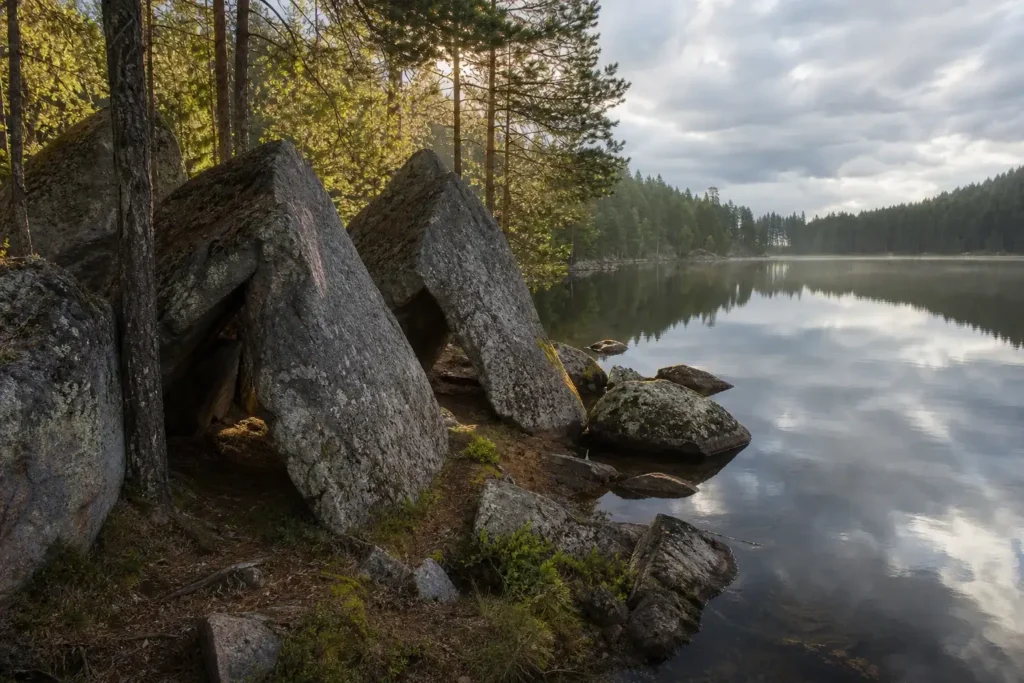
Lake Shartash and its famous Stone Tents occupy a rare pocket of wilderness within Yekaterinburg‘s eastern edge. The lake is one of the oldest lakes in the Urals—1 million years old, formed when tectonic movement created a basin later sculpted by glaciers. The Stone Tents themselves are unique natural monuments of granite rock, stacked in a formation that resembles pitched tents.
The area draws locals for cycling, picnicking, forest walks, and photography. A beautiful pine forest grows around the lake, which makes this place ideal for recreation. Unlike most of Yekaterinburg, Shartash remains undeveloped—a place to breathe forest air and watch squirrels rather than to shop or dine.
Quick Facts
| Russian name | Шарташское озеро и Каменные Палатки |
|---|---|
| Distance from the nearest major city | 1,816 km |
| Travel time from the nearest major city | 24–26 hours by train; 2 hours 45 minutes by flight plus local transport |
| Address | Ulitsa Otdykha, Kirovsky District, Yekaterinburg OpenStreetMap · Google Maps |
| Opening hours | Open 24 hours; daylight hours recommended for trails and sightseeing |
| Admission | free |
| Best time to visit | Spring (May–June) and early autumn (September–October) offer the best conditions: mild temperatures, reliable daylight, and minimal insect activity. Weekdays might offer a more tranquil experience than weekends. Summer (July–August) is warm but can be buggy near the water, especially at dusk. Winter (December–February) brings snow, which transforms the landscape but makes trails slippery; the lake sometimes freezes, allowing ice walks. Some caution is advised during winter due to slippery conditions. Late afternoons in any season offer good light for photographers. |
| Recommended duration | 2–4 hours |
What Is (and Isn't) Part of a Visit to Shartash Stone and Lake, Yekaterinburg?
| Part | Status | Notes |
|---|---|---|
| Stone Tents granite formation | Included in the standard ticket | Free public access; the main sightseeing draw. |
| Lake Shartash shore access | Included in the standard ticket | Walking and viewing from the shore is free. Swimming is not permitted; water quality concerns are cited in local notices. |
| Forest park trails | Included in the standard ticket | The 12.5 km cycling trail and walking paths are free and open. |
| Rope park and climbing course | Separate ticket or institution | Separate facility with own entrance fee and operators; not included in general park access. |
| Sports facilities (basketball, tennis, exercise equipment) | Separate ticket or institution | Some areas have use fees or rental requirements; check locally for current terms. |
| Shartash Granite Quarry | Outside / not part of it | Active industrial site 2–3 km away; not a visitor attraction. |
| Picnic and barbecue facilities | Included in the standard ticket | Barbecue cabins are available for rent; bring your own food or arrange rental locally. |
How to Get from the nearest major city to Shartash Stone and Lake, Yekaterinburg
| Option | Duration | Price | Notes |
|---|---|---|---|
| Taxi or personal car from Yekaterinburg centre | 15–20 minutes depending on traffic | ₽₽ | The most direct option. Parking is available near the main entrance on Ulitsa Otdykha. Cost depends on distance and traffic. |
| Public transport (bus or tram) from city centre | 30–45 minutes including walk | ₽ | Trams 13 and 15 serve the area; bus routes also connect to the park. Exit at stops on Ulitsa Vysotskogo or Ulitsa Otdykha and follow directional signs into the forest park. Schedules run frequently during peak hours. |
| Bicycle from city centre | 1–1.5 hours | ₽ | Yekaterinburg has dedicated cycling paths. Rentals available at the main park entrance. Flat terrain makes it feasible for casual cyclists. Return journey same duration. |
₽ budget · ₽₽ moderate · ₽₽₽ upscale · ₽₽₽₽ splurge. Price levels are estimates compared with typical prices for visitors.
Why Visit Shartash Stone and Lake, Yekaterinburg?
Shartash offers an authentic escape into nature without leaving the city. The name comes from Turkic words meaning “lake of yellow stone” or “swamp lake”, and the geological story of the place is written in granite and water—layers of human activity visible here since the Neolithic era. The 12.5 km cycling trail around the lake gives a full forest experience in a few hours, passing through the Stone Tents formation, a place long held sacred by local peoples. Weekday mornings offer solitude and the best light for photographers.
Highlights of Shartash Stone and Lake, Yekaterinburg
Stone Tents (Kamenniye Palatki)
The signature granite boulders rise from the north shore like stacked flat stones, each two to three meters across. The natural granite monument of the Iron Age was a place for shamanistic people. The formation is a federal cultural heritage site. Visitors can clamber among the rocks, which offer views back over the lake and forest. The stone shows weathering patterns typical of glacial erratics—scratches and polish marks left by ice.Tip: Visit in early morning for soft light that highlights the stone's texture and colours.
Tip: Visit in early morning for soft light that highlights the stone's texture and colours.
Lake Shore Walk
The promenade along the southern and eastern shore is the easiest approach for visitors without hiking boots. Pine and birch forest crowds the water edge, creating a tunnel effect; the water stays visible through clearings. You pass tame ducks and squirrels accustomed to visitors. The water in the lake was formed about a million years ago, and the lake remains one of Yekaterinburg's two main natural water bodies.Tip: The route is flat but can be muddy after rain; waterproof shoes help.
Tip: The route is flat but can be muddy after rain; waterproof shoes help.
Forest Park Cycling Route
The cycling trail around the lake is 12.5 km, taking experienced riders 2–3 hours. The route passes through old-growth pine, open meadows, and a small village of dacha houses (Izoplit). Rental bicycles are available near the main entrance. The route is popular with local families on weekends and nearly empty on weekday mornings.Tip: Bring bug spray in late spring and summer; the forest can be buggy near the water.
Tip: Bring bug spray in late spring and summer; the forest can be buggy near the water.
Sunset Views from the Western Shore
The western shore is the least wooded, offering unobstructed views across the lake towards the Stone Tents and the city skyline beyond. At sunset the water reflects orange and pink light, and the granite rocks glow. This zone attracts photographers and couples.Tip: Arrive 45 minutes before sunset and bring a picnic; no vendors operate here.
Tip: Arrive 45 minutes before sunset and bring a picnic; no vendors operate here.
Rope Park and Sports Zone
A ropes course and rope bridges sit in the forest north of the main entrance, adjacent to basketball courts, tennis tables, and a sports ground with exercise equipment. These facilities are modern and well-maintained but are separate venues with their own entrance and operators. The rope park offers a view of the Stone Tents from above.Tip: Check opening hours in advance; the rope park has seasonal and weather-dependent closures.
Tip: Check opening hours in advance; the rope park has seasonal and weather-dependent closures.
Granite Formations at Water's Edge
Beyond the main Stone Tents, smaller granite boulders dot the shoreline, especially on the eastern side. These formations create natural alcoves and photo backdrops. The rocks stretch for tens of meters along Lake Shartash, the result of many years of exposure to natural forces. They sit at the water's edge, accessible on foot.Tip: Rocks are slippery in wet conditions; wear grip-soled shoes if you plan to walk on them.
Tip: Rocks are slippery in wet conditions; wear grip-soled shoes if you plan to walk on them.
Atmosphere
The atmosphere is one of quiet escape. Pine forest dominates the soundscape—wind in needles, occasional bird calls. The water is still and reflective, rarely visited by motorboats. Weekday mornings are nearly silent; weekends bring families, cyclists, and joggers, especially after 10 a.m. In summer, insect sound rises, especially near the water at dusk. The light is soft and filtered through the canopy, creating pools of shadow and gold. Tame wildlife—gray squirrels and dabbling ducks—move unbothered through the space, creating a sense that humans are guests rather than owners.
History of Shartash Stone and Lake, Yekaterinburg
Traces of human activity can be observed since the late Neolithic era. The lake basin itself formed through tectonic processes over millions of years; glaciers then sculpted it into its current shape during the last ice age.
The natural granite monument was a place for shamanistic people, suggesting use by indigenous Uralic peoples for ceremonial or sacred purposes. The Stone Tents are listed as a federal cultural heritage site. The name Shartash derives from Turkic etymology; the area became part of Yekaterinburg’s administrative boundary when the city expanded eastward.
In the Soviet era, the site was designated a nature reserve and protection zone. A granite quarry was opened nearby—the Shartash Granite Quarry began development in the mid-20th century and continues to supply building material to the city. The forest park infrastructure expanded in recent decades, adding trails, small facilities, and recreational amenities while keeping the core area protected.
Tickets and Booking for Shartash Stone and Lake, Yekaterinburg
Entry to Shartash Stone and Lake is free and requires no advance booking. The site is a public natural area open year-round. Daylight hours are recommended for safe trail exploration; the forest does not have artificial lighting and is not advisable after dark, especially in autumn and winter months.
For activities such as bicycle rental, rope park entry, or barbecue cabin reservation, inquire at the main entrance or contact the local park office. These services have their own pricing and availability, which changes seasonally. No voucher or ID is needed for general park access.
Plan and Book
Suggested itineraries Shartash Stone and Lake, Yekaterinburg
2 hours
Enter via the main gate on Ulitsa Otdykha. Spend 45 minutes exploring the Stone Tents formation, climbing among the rocks and taking photos. Walk along the shore for another 45 minutes, moving south and east through the forest to open viewpoints. Return via the entrance route. Suitable for visitors with limited time or young children.
3–4 hours
Begin at the Stone Tents (45 minutes). Cycle or walk partway around the lake's western shore (1 hour), stopping at viewpoints. Return via the forest trails (45 minutes), exploring smaller paths and vegetation changes. End with sunset views if timing allows. Bring snacks and water.
Full day (6–7 hours)
Complete the 12.5 km cycling loop, taking breaks at the Stone Tents, the village of Izoplit, and the southern shore. Bring a picnic. Rent bicycles or use your own. This option reveals the full extent of the forest and the lake's perimeter, including less-visited areas. Best on weekdays when crowds are minimal.
Half day with transport back to city
Spend 2–3 hours on site (Stone Tents plus a short walk), then return by public transport or taxi to explore Yekaterinburg's central museums or restaurants before evening. Good for visitors combining nature with city sightseeing.
How to Get to Shartash Stone and Lake, Yekaterinburg
From Yekaterinburg city centre: The easiest approach is by taxi or personal car. The journey takes 15–20 minutes from the central square (Ploshchad 1905 Goda) heading east to Ulitsa Otdykha in the Kirovsky District. Parking is available at the main park entrance.
By public transport: Trams 13 and 15 are reachable on Ulitsa Vysotskogo, 11. Exit at stops near the lake and follow signs into the forest park—a short walk of 5–10 minutes. Bus routes also serve the area; ask the driver if the route stops at Shartash or Otdykha Street. Frequency is good during peak hours (7–9 a.m. and 4–7 p.m. on weekdays).
By bicycle: Yekaterinburg has dedicated cycling paths. From the city centre, follow the signs toward the eastern districts. The route is flat. Bicycle rentals are available near the main entrance if you don’t have your own.
Accessibility
The main park entrance and western shore path are flat and wheelchair-accessible, though the surface is natural earth and can be muddy after rain. No formal accessibility infrastructure (ramps, handrails, accessible restrooms) is documented. The Stone Tents themselves involve climbing and scrambling, unsuitable for wheelchair users or people with limited mobility. Picnic areas near the entrance are reachable by accessible routes. For current accessibility details, contact the Yekaterinburg parks office or check local resources.
Food Nearby
No cafés or restaurants operate within the park itself. The nearest options are 1–2 km away in the surrounding Kirovsky District. Bring a picnic and water; this is essential for a comfortable visit. Barbecue facilities are available for rent if you arrange in advance. Vending machines or food stands do not operate reliably in the park zone.
What to Bring
Comfortable walking shoes with grip soles (trails are soft earth and rocks can be slippery when wet). A picnic and drinking water—no food services exist on site. Bug spray in summer. A light jacket even in warm months; the forest is cool and shaded. A camera for the Stone Tents and sunset views. Sunscreen and a hat. In winter, add warm layers and possibly microspikes for icy sections. A small bag for litter (leave no trace is expected). Security is not a concern; bags need not be locked.
Best Views and Photo Spots of Shartash Stone and Lake, Yekaterinburg
Stone Tents from the south
Looking north across low vegetation, the boulder stack rises against the sky. The formation shows its full height and layered stacking effect. Best in morning light when shadows define the edges between stones.
Best time: Early morning, 7–9 a.m., for angled light and minimal crowds
Lake and Stone Tents from the western shore
The lake's open water in foreground, Stone Tents on the far shore, and forest closing in at the edges. The perspective shows the full context of the monument within the landscape.
Best time: Late afternoon, 4–6 p.m., for warm light reflecting on water
Close-up of granite surfaces
The weathered texture of individual boulders—glacial scratches, lichen, moss patches. These details reveal the stone's age and geological history through macro perspective.
Best time: Midday when light is direct and textural detail is clear
Forest canopy and forest floor
Pine trunks, soft needled ground, dappled light filtering through branches. The mood is contemplative and quiet, showing the woodland feel of the park.
Best time: Any time; this shot works in diffuse, overcast light
Sunset from the western shore
The lake surface reflects orange and pink sky. The Stone Tents and forest edge darken into silhouette. The mood is serene and painterly.
Best time: 45 minutes before to 15 minutes after sunset, with clear skies
Photography Rules
No restrictions on standard photography. Tripods are permitted. Drones are not allowed in the park (standard Russian regulation for urban protected areas). Flash photography is unnecessary and discouraged for wildlife. The best light occurs in early morning (golden hour) and late afternoon before sunset. The granite formations photograph well from low angles to emphasise their height and texture. The lake's surface creates mirror reflections in calm, early-morning conditions.
Family Suitability
Suitable for families with children ages 6 and up. The main Stone Tents and shore walk are short enough for young attention spans (1–2 hours). Children enjoy climbing on rocks (with supervision) and spotting squirrels and ducks. Strollers cannot navigate forest trails but the entrance area and paved paths near sports facilities are stroller-accessible. No playgrounds are located directly at the Stone Tents, though a rope course and sports grounds nearby offer activities. The lack of vendors or facilities means families must bring their own food and water. Supervision is essential near the rocky formations and the lake edge.
Russia Vibes Tips
- Visit on a weekday morning to avoid the crowds that gather on weekends and after 10 a.m. The solitude enhances the experience and improves photography.
- Wear waterproof shoes if visiting after rain; the forest floor becomes muddy and trails can be slippery. Dry conditions are ideal.
- Do not attempt to swim in the lake despite the temptation; signs prohibit swimming due to water quality concerns, and the practice is enforced.
- Bring your own supplies. No shops, cafés, or vendors operate in the park. A picnic, water, and snacks are essential for a comfortable visit lasting more than 1–2 hours.
- Allow extra time if you rent bicycles; many first-time visitors underestimate the 12.5 km loop and rush the experience. Plan for 3–4 hours if cycling, not 2.
- Use the rope park and sports facilities as separate add-on activities with their own fees and hours; they are not included in free park access and require advance research into current pricing and schedule.
Explore Nearby Shartash Stone and Lake, Yekaterinburg
Sights near Shartash Stone and Lake, Yekaterinburg
 Mamayev Kurgan, Volgograd · typical visit: 3–4 hoursOpen daily 09:00–18:00
Main image: AI-generated illustration. It may not show the place exactly as it looks.
 Gorky Central Park of Culture and Recreation, Kazan · typical visit: 1.5–2 hoursOpen 24 hours
Main image: AI-generated illustration. It may not show the place exactly as it looks.
Related guides
 Volga Embankment and River Life, Volgograd: War Memorials and Riverside Walks
Main image: AI-generated illustration. It may not show the place exactly as it looks.
Browse more: All Day Trips · All Day Trips in Yekaterinburg · All Parks · All Yekaterinburg
FAQ: Shartash Stone and Lake, Yekaterinburg
Is there an entrance fee?
Lake Shartash is a public recreational area with generally no entrance fee to access the lake and its surrounding parklands. The Stone Tents are also free. Specialized services like bicycle rental or rope park entry have separate fees.
Can I swim in the lake?
No. Swimming is prohibited due to water quality concerns, and signs enforce the restriction. The lake is for viewing and photographing, not for bathing.
How long does a visit take?
To simply enjoy the water views and take a short stroll, 1–2 hours is sufficient. However, Shartash is a vast forest park, so for a full experience, it is better to set aside 2 to 4 hours. The full cycling loop takes 6–7 hours.
What is the difference between the Stone Tents and the lake?
The Stone Tents are a specific granite rock formation on the north shore—a federal heritage monument. The lake is the water body itself. The park encompasses both plus the surrounding forest. Most visitors see both in a single visit.
Is the site accessible by car?
Yes. Taxi or private car is the most comfortable way, with the trip from the city center taking about 15–20 minutes depending on traffic, and parking zones available near popular park entrances.
When is the best time to visit?
Spring and early autumn offer mild weather and low insect activity. Weekday mornings have fewer visitors. Avoid late evening and winter night hours when trails lack lighting. Late afternoon suits photographers seeking golden-hour light.
Are there food and beverage services?
No cafés or shops operate within the park. Bring your own picnic, water, and snacks. Barbecue facilities are available for rent if booked in advance.
Is a guide needed?
No. The main attractions—Stone Tents and lake shore—are clearly visible and easily explored. Trail signs exist but are minimal. Cyclists should bring a map or GPS app. Independent visits are straightforward and safe during daylight.
Russia Vibes is a one-person project. A coffee keeps it going
How we research and update our guides
About this guide: AI assistance and accuracy
This guide is created with the help of AI and is based on official sources where available. Mistakes can still happen. Opening hours, prices, rules and other details are given to the best of our knowledge as of the date shown and can change without notice. It offers general recommendations only, not professional, legal or travel advice. Please confirm important details with the official source before you travel; you are responsible for your own plans and decisions.

Take this guide with you
Get a free PDF of this guide to print or read offline: key facts, tips and a map link on a few clean pages.
Report an issue on this page
Paying for your trip: please read
International sanctions affect payments between Russia and many other countries. In practice, cards issued in the EU, the UK, the US and several other countries often do not work in Russia, Russian cards usually do not work abroad, and some booking platforms, airlines and payment providers limit or suspend their services for Russia. The situation changes frequently.
We do not give legal or financial advice, and this site does not encourage anyone to break or circumvent sanctions. Whatever you plan, you are responsible for following the laws and regulations that apply to you, including those of your country of residence and citizenship.
Many travelers still organise their stay lawfully. It is worth asking your bank or payment provider what is currently permitted, contacting hotels, tour operators and carriers directly about the payment methods they accept, and checking which services are open to customers from your country. Clarify payment, cancellation and refund terms before you commit to a booking, and keep your plans flexible.
Partner links on this site may not be available in every country, and prices, availability and rules in our guides can differ from what you see when you book.