
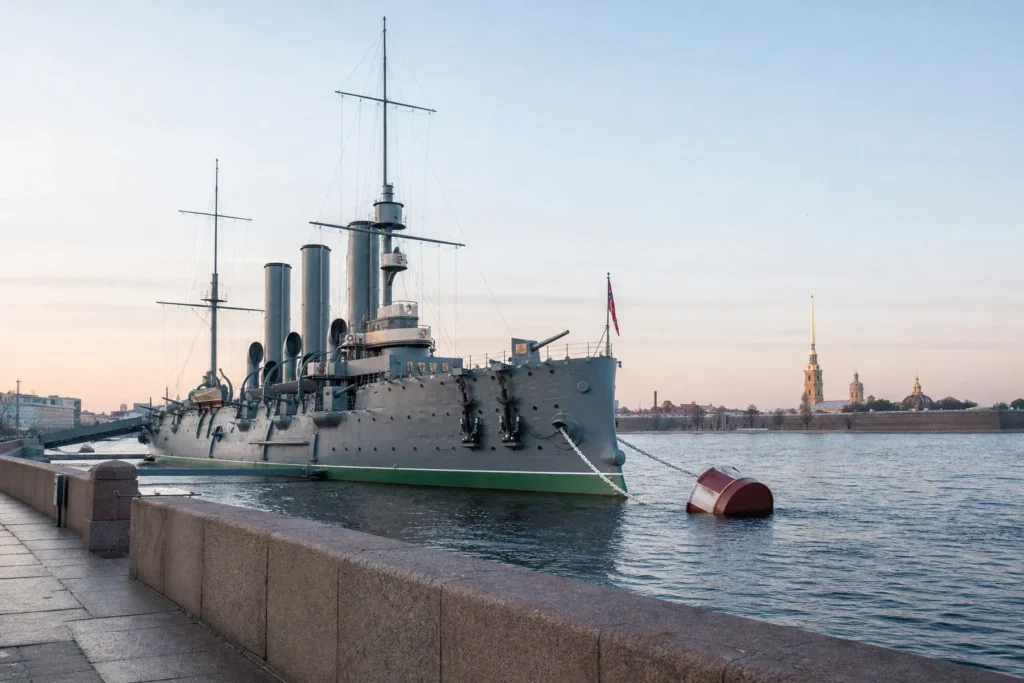
The cruiser Aurora is one of the best-known ships in Russia. Launched in 1900, she fought at Tsushima, served in the First World War and became a symbol of the October Revolution of 1917. Today she is moored on the Neva at Petrogradskaya Embankment and open as a museum, a branch of the Central Naval Museum.
Visitors can walk the upper deck, look at the guns and go below to exhibition halls on the ship’s history. This page explains what you can see on board, how to avoid long queues, how much it costs and how to reach the ship from the metro or from the Peter and Paul Fortress.
Quick Facts
| Russian name | Крейсер «Аврора» |
|---|---|
| Built / opened | 1956 |
| Architect(s) | Built at the New Admiralty shipyard in Saint Petersburg (Pallada-class protected cruiser) |
| Address | Санкт-Петербург, Петроградская набережная, 2/4 (напротив Нахимовского училища) OpenStreetMap · Google Maps |
| District | Petrogradsky District |
| Metro | Gorkovskaya (Line 2, about 15–20 minutes on foot) Petrogradskaya (Line 2, about 1.9 km on foot) |
| Opening hours | Most sources give Wednesday to Sunday, roughly 10:00 or 11:00 to 18:00, with the ship closed on Mondays and Tuesdays. The museum's main building lists Tuesday as its closed day, so the Aurora branch's own hours are worth checking on the official site (as of October 2026 – check the official site). Entry is free on Navy Day (26 July). |
| Admission | A museum ticket (₽₽); schoolchildren, students and pensioners pay less (₽), and preschool children enter free. Foreign visitors may pay a higher rate. |
| Best time to visit | Weekday mornings, soon after opening, are usually quieter, since long queues are reported in high season and on weekends. Spring to early autumn is best for the deck and the views. The ship is closed on Mondays and Tuesdays according to most sources, and entry is free on Navy Day, when it is very crowded. |
| Recommended duration | 1–1.5 hours |
| Website | eng.navalmuseum.ru/filials/cruiser_aurora |
| Last updated | October 16, 2026 |
What Is (and Isn't) Part of a Visit to Cruiser Aurora, Saint Petersburg?
| Part | Status | Notes |
|---|---|---|
| Upper deck and bow guns | Included in the standard ticket | Part of the museum visit with a ticket. |
| Exhibition halls inside the ship | Included in the standard ticket | Six halls on the history of the ship, from Tsushima to the Second World War and the Nakhimov School. |
| Engine and boiler rooms and combat cabin | Separate ticket or institution | Historically shown only to organised groups; check whether they are open. |
| Guided or audio tours | Separate ticket or institution | Run by the museum or private operators and paid separately from the entry ticket. |
| Central Naval Museum main building | Outside / not part of it | A separate museum at Truda Square with its own ticket. |
| Nakhimov Naval School | Outside / not part of it | The building opposite the ship; a working school, not open to visitors. |
Why Visit Cruiser Aurora, Saint Petersburg?
Aurora is a real warship of the early twentieth century, one of the few surviving ships of the Russian Empire’s fleet, and she is closely tied to events that shaped the century. From the deck you can see the Neva, the Peter and Paul Fortress and the embankment, and inside, six halls tell the ship’s story from Tsushima to the siege of Leningrad.
The visit is compact and works well with a walk along Petrogradskaya Embankment. Whatever you think of the history, the ship is a rare chance to stand on the deck of a cruiser from the era of Tsushima.
How Cruiser Aurora, Saint Petersburg Is Laid Out
The cruiser is moored bow-on to the embankment, with a gangway from Petrogradskaya Embankment, opposite the Nakhimov Naval School. You board by the gangway and can walk along the upper deck towards the bow, where the guns and the view of the Neva are.
The museum exhibition is inside the ship, in six halls: Hall 1 covers the ship’s history, Hall 3 the Russo-Japanese War, Hall 4 the revolution and civil war, Hall 5 the Second World War and the ship’s years as a training base for the Nakhimov School, and Hall 6 is used for temporary exhibitions.
Allow time for the queue at the ticket office, which can be long in high season. A sensible order is to walk along the upper deck first, then go below to the halls, and finish with a view from the bow towards the fortress.
Highlights of Cruiser Aurora, Saint Petersburg
The upper deck and bow guns
Walking along the deck gives a direct sense of the ship's size: about 127 metres long and over 16 metres wide. The 152 mm guns on the forecastle and along the sides recall the cruiser's years of active service. From the bow you look across the Neva towards the Peter and Paul Fortress.
The ship carried eight 152 mm guns when she was completed and fourteen after 1915.
Tip: Go up on deck first, before the halls fill up.
The blank shot of 1917
Aurora is best known for the night of the October Revolution. On the eve of the assault on the Winter Palace she was sent to clear loyalist cadets from the bridge, and she fired the blank shot that, according to Russian tradition, signalled the start of the assault. The ship became a symbol of the revolution from that moment.
The exhibition also explains the less familiar parts of her history.
Tip: Read the captions in the revolution hall; they separate the tradition from the documented events.
Tsushima and the Russo-Japanese War
Aurora took part in the Battle of Tsushima in May 1905, where her captain, Yevgeny Yegoriev, was killed. Afterwards she sailed to Manila, where she was interned. The hall dedicated to the war shows models, documents and objects from the voyage.
Before Tsushima she was also hit by friendly fire in the Dogger Bank incident of 1904.
Tip: Look for the ship models, which show how the cruiser compared with others of her time.
The siege of Leningrad and the Nakhimov School
During the Second World War the cruiser's guns were removed to defend Leningrad on land, and the ship herself was shelled and bombed. She was sunk in the harbour at Oranienbaum in September 1941, later raised and repaired. From 1948 she was moored here as a training base for pupils of the Nakhimov Naval School.
The fifth hall covers these years.
Tip: The Nakhimov School building stands opposite the ship on the embankment.
The restorations
In 1984–87 the hull below the waterline was replaced with a new welded hull built to the original drawings, and the old lower section was cut off and sunk near the shore. The restoration also showed that some parts, including armour plates, were originally made in Britain. Between 2014 and 2016 the ship was overhauled again at Kronstadt before returning to her mooring.
Much of what you see above the waterline is original.
Tip: Ask staff or read the panels about what is original and what was replaced.
The view from the Neva
The cruiser's mooring on Petrogradskaya Embankment gives a view along the river towards the Peter and Paul Fortress and, across the water, the city centre. The ship itself is also a striking sight from the opposite bank and from the water.
It is one of the best places on the Petrograd side for a view of the Neva.
Tip: Walk along the embankment to see the cruiser's silhouette from a distance.
Atmosphere
On the embankment the grey hull and the long gun barrels stand out against the river and the sky. The deck feels spacious and slightly austere, with the wind off the Neva and the smell of paint and metal, and the sound of tourists on the gangway. Inside, the halls are smaller and dimmer, with models, photographs and uniforms.
The mood is respectful but not solemn: families, school groups and tourists share the narrow passages, and queues can form at the gangway in summer. The setting, with the fortress across the water, gives the visit a sense of being at the heart of the city’s history.
History of Cruiser Aurora, Saint Petersburg
Aurora was laid down on 23 May 1897 at the New Admiralty shipyard in Saint Petersburg, launched on 11 May 1900 and commissioned in July 1903. She was a Pallada-class protected cruiser, about 127 metres long and displacing some 6,700 tonnes, with a crew of around 590, and she was named after an earlier frigate Aurora of the Crimean War.
Her first big test came in the Russo-Japanese War. During the voyage of the Baltic Fleet to the Far East in 1904 she was hit by friendly fire in the Dogger Bank incident. At the Battle of Tsushima in May 1905 her captain, Yevgeny Yegoriev, was killed, and she later put into Manila, where she was interned.
In the First World War Aurora patrolled and bombarded the coast in the Baltic. In 1915 her armament was increased to fourteen 152 mm guns, and in late 1916 she was moved to Petrograd for repairs. There the crew sided with the Bolsheviks in 1917.
On the eve of the October Revolution the cruiser was sent to clear cadets from Nikolayevsky Bridge and fired a blank shot that, according to Russian lore, signalled the assault on the Winter Palace. She was awarded the Order of the Red Banner in 1927, and later the Order of the October Revolution.
In the Second World War her guns were taken off for the land defence of Leningrad and the ship was docked at Oranienbaum, where she was repeatedly shelled and bombed. On 30 September 1941 she was damaged and sunk in the harbour. She was raised and repaired after the war and moored in 1948 at Petrogradskaya Embankment, opposite the Nakhimov Naval School, which used her as a training base.
A ship museum was set up on board in 1950, and on 5 July 1956 it became a branch of the Central Naval Museum. The ship was placed under state protection in 1960. Between 1984 and 1987 she underwent a major restoration in which the hull below the waterline was replaced with a new welded one, built to the original drawings.
In September 2014 Aurora was towed to Kronstadt for another overhaul and returned to her mooring on 16 July 2016. She has been visited by roughly thirty million people since opening as a museum, and she remains in the navy’s ownership.
Legends and Myths about Cruiser Aurora, Saint Petersburg
The shot that began a revolution
Disputed by historians. Soviet history presented Aurora's blank shot on the night of 7 November 1917 as the signal for the storming of the Winter Palace. Historians point out that the shot was a blank and that the assault unfolded in a more confused way than the legend suggests; some also note that the cruiser did not fire at the palace itself. The shot is real, but its role as the exact starting signal is contested.
Tickets and Booking for Cruiser Aurora, Saint Petersburg
| Ticket | Price | Includes |
|---|---|---|
| Adult ticket | ₽₽ | Entry to the ship, the upper deck and the exhibition halls. |
| Foreign visitor ticket | ₽₽ | Entry to the ship and the exhibition; foreign visitors may pay a higher rate than Russian citizens. |
| Schoolchildren, students and pensioners | ₽ | A reduced ticket for the same visit. |
| Preschool children | Free | Free entry for young children. |
₽ budget · ₽₽ moderate · ₽₽₽ upscale · ₽₽₽₽ splurge. Price levels are estimates compared with typical prices for visitors.
Tickets are sold at the ship and online through the Central Naval Museum’s website and partner sellers. Queues at the ticket office can be long, so buying in advance is usually worth it.
- Choose a time slot if one is offered, particularly at weekends and in summer.
- Admission is free on Navy Day (26 July), which brings very large crowds.
- Audio tours and lectures are sold separately by private operators and do not include the entry ticket.
Rates differ for Russian citizens, foreign visitors and concession categories; check the museum’s website for the current categories and prices.
Plan and Book
Suggested itineraries Cruiser Aurora, Saint Petersburg
1 hour
Board the ship, walk along the upper deck to the bow for the view, then visit the halls on the history of the cruiser.
1.5–2 hours
Spend time on deck and in all the halls, then walk along Petrogradskaya Embankment to look at the ship's silhouette from a distance.
Half day
Visit the cruiser, then walk to the Peter and Paul Fortress and spend the afternoon there. Have lunch on the Petrograd side.
How to Get to Cruiser Aurora, Saint Petersburg
By metro: the closest stations are Gorkovskaya and Petrogradskaya, both on Line 2. From Gorkovskaya it is roughly a 15 to 20 minute walk; from Petrogradskaya the walk is about 1.9 km.
On foot: the ship is moored on Petrogradskaya Embankment, a short walk from Sampsonievsky Bridge, and not far from the Peter and Paul Fortress.
By taxi: ask for Petrogradskaya Embankment, 2 (Петроградская набережная, 2), the Cruiser Aurora.
Accessibility
The tourist portal lists the cruiser as accessible for people with disabilities, but this is a historic warship with narrow passages, steps and decks, so access to all areas is unlikely. Contact the museum before you go to find out which parts of the ship and which halls can be reached by wheelchair or stroller.
Food Nearby
There are no verified cafes on the ship. Cafes and restaurants can be found on the Petrograd side, around Kamennoostrovsky Prospekt and near Gorkovskaya metro, and across the water by the Peter and Paul Fortress.
What to Bring
A windproof layer, since the deck is exposed to the Neva wind, and comfortable shoes with good grip for stairs and steel decks. Bring your ticket on your phone if you booked online.
Best Views and Photo Spots of Cruiser Aurora, Saint Petersburg
Petrogradskaya Embankment in front of the ship
The cruiser's grey hull, funnels and guns along the water, with the embankment in the foreground.
Best time: Morning light from the opposite bank; late afternoon for warmer colours.
The bow of the ship
A view along the Neva towards the Peter and Paul Fortress, with the ship's guns in the foreground.
Best time: Clear mornings.
Across the river
From the opposite embankment the whole cruiser appears with the Petrograd skyline behind it.
Best time: Sunset or the blue hour.
On the water
A boat trip along the Neva passes the cruiser at close range and gives a different angle.
Best time: Summer evenings.
Photography Rules
Photography rules on board were not verified. Look for signs at the entrance and in the halls, and ask staff before using flash or a tripod. Drone rules were not verified; avoid flying one near the ship and the central embankments without checking local restrictions.
Family Suitability
A good visit for children who like ships and history; being on a real warship holds attention, and preschool children enter free. The decks, steps and narrow passages need supervision, and strollers are difficult on board. Queues can be long in summer, so go early.
Russia Vibes Tips
- Buy tickets in advance online if you can. Long queues at the ticket office are reported, especially in summer and at weekends.
- Check the days before you go. Most sources say the ship is closed on Mondays and Tuesdays, but the museum's own listing for the branch should be checked.
- Do not confuse the ship with the Central Naval Museum's main building. That museum is at Truda Square and has its own ticket.
- Dress for the wind. The deck is exposed, and it is cooler by the river than in the streets.
- Read the captions about 1917. They explain what is documented and what is tradition about the famous shot.
Explore Nearby Cruiser Aurora, Saint Petersburg
Sights near Cruiser Aurora, Saint Petersburg
 Peter and Paul Fortress, Saint Petersburg · typical visit: 2–4 hours
Main image: AI-generated illustration. It may not show the place exactly as it looks.
 State Museum of Political History of Russia, Saint Petersburgabout 700 m away (~11 min walk) · typical visit: 1.5–2.5 hours
Main image: AI-generated illustration. It may not show the place exactly as it looks.
 Summer Garden, Saint Petersburgabout 1.2 km away (~19 min walk) · typical visit: 1–2 hours
Main image: AI-generated illustration. It may not show the place exactly as it looks.
 Saint Michael's Castle, Saint Petersburgabout 1.7 km away (~27 min walk) · typical visit: 1.5–2 hours
Main image: AI-generated illustration. It may not show the place exactly as it looks.
 Russian Ethnographic Museum, Saint Petersburgabout 1.8 km away (~29 min walk) · typical visit: 2–3 hours
Main image: AI-generated illustration. It may not show the place exactly as it looks.
 Spit of Vasilyevsky Island, Saint Petersburgabout 2.2 km away · typical visit: 1–2 hours, plus time for any museum
Main image: AI-generated illustration. It may not show the place exactly as it looks.
Metro stations near Cruiser Aurora, Saint Petersburg
 Gorkovskaya Metro Station, Saint Petersburgabout 1.0 km away (~17 min walk)
Main image: AI-generated illustration. It may not show the place exactly as it looks.
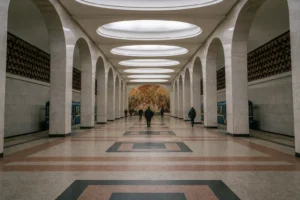 Ploshchad Lenina Metro Station, Saint Petersburgabout 1.1 km away (~18 min walk)
Main image: AI-generated illustration. It may not show the place exactly as it looks.
Train stations and river piers near Cruiser Aurora, Saint Petersburg
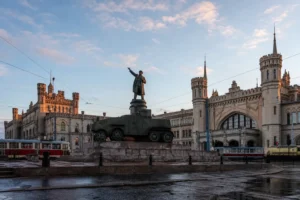 Finlyandsky Railway Station, Saint Petersburgabout 1.1 km away (~18 min walk)
Main image: AI-generated illustration. It may not show the place exactly as it looks.
Related guides
 Best Museums, Saint Petersburg: 9 Picks and What to See
Main image: AI-generated illustration. It may not show the place exactly as it looks.
 Best Things to Do, Saint Petersburg: 10 Sights, Boats and Views
Main image: AI-generated illustration. It may not show the place exactly as it looks.
 Petrogradskaya Metro Station, Saint Petersburg: Closed-Type Hall
Main image: AI-generated illustration. It may not show the place exactly as it looks.
 Chkalovskaya Metro Station, Saint Petersburg: Aviation Hall
Main image: AI-generated illustration. It may not show the place exactly as it looks.
 Central Naval Museum, Saint Petersburg: Hours and Highlights
Main image: AI-generated illustration. It may not show the place exactly as it looks.
Browse more: More in Petrogradsky District · All Museums · All Saint Petersburg · All Sightseeing · All Sightseeing in Saint Petersburg
FAQ: Cruiser Aurora, Saint Petersburg
Is the cruiser Aurora a museum?
Yes. It is a branch of the Central Naval Museum, opened on board in 1956. The ship is moored on the Neva at Petrogradskaya Embankment.
When is the Aurora open?
Most sources say Wednesday to Sunday, roughly 10:00 or 11:00 to 18:00, closed on Mondays and Tuesdays. Check the museum's website before you go.
How much does it cost?
A standard ticket is moderately priced, with reduced rates for schoolchildren, students and pensioners and free entry for preschool children. Foreign visitors may pay more than Russian citizens.
Did Aurora really start the revolution?
She fired a blank shot on the night of 7 November 1917 that, according to tradition, signalled the assault on the Winter Palace. Historians say the exact role of the shot is contested.
Is the ship original?
Largely, but not entirely. In 1984–87 the hull below the waterline was replaced with a new welded one built to the original drawings, and she was overhauled again in 2014–16.
What can I see inside?
Six halls with models, paintings, documents and objects on the ship's history, including Tsushima, 1917, the siege of Leningrad and the Nakhimov School.
How do I get there by metro?
Take Line 2 to Gorkovskaya or Petrogradskaya and walk. From Gorkovskaya it is about 15 to 20 minutes.
Is the cruiser still in the navy?
Yes. She remains in the ownership of the Russian Navy, even though she is open as a museum and has been moored here since 1948.
Russia Vibes is a one-person project. A coffee keeps it going
Last updated: October 16, 2026. Found an error or something out of date? Report it and we will check and fix it.
How we research and update our guides
About this guide: AI assistance and accuracy
This guide is created with the help of AI and is based on official sources where available. Mistakes can still happen. Opening hours, prices, rules and other details are given to the best of our knowledge as of the date shown and can change without notice. It offers general recommendations only, not professional, legal or travel advice. Please confirm important details with the official source before you travel; you are responsible for your own plans and decisions.
International sanctions affect payments between Russia and many other countries. In practice, cards issued in the EU, the UK, the US and several other countries often do not work in Russia, Russian cards usually do not work abroad, and some booking platforms, airlines and payment providers limit or suspend their services for Russia. The situation changes frequently. We do not give legal or financial advice, and this site does not encourage anyone to break or circumvent sanctions. Whatever you plan, you are responsible for following the laws and regulations that apply to you, including those of your country of residence and citizenship. Many travelers still organise their stay lawfully. It is worth asking your bank or payment provider what is currently permitted, contacting hotels, tour operators and carriers directly about the payment methods they accept, and checking which services are open to customers from your country. Clarify payment, cancellation and refund terms before you commit to a booking, and keep your plans flexible. Partner links on this site may not be available in every country, and prices, availability and rules in our guides can differ from what you see when you book.Paying for your trip: please read

Take this guide with you
Get a free PDF of this guide to print or read offline: key facts, tips and a map link on a few clean pages.