
Updated
Best museums for history Kaliningrad spans centuries of complex history—from the Teutonic Knights’ fortress city through wartime destruction to Soviet transformation. This list covers 10 major museums and sites that serious history visitors should explore, each telling a different thread of the story.
Whether you’re interested in pre-war Prussian culture, the dramatic 1945 assault on Königsberg, medieval amber trade routes, or maritime history, these museums offer concrete artifacts and immersive settings. Most are clustered in or near the city center and are accessible by public transport.
At a Glance
| # | Place | Best for | Good to know |
|---|---|---|---|
| 1 | Kaliningrad Regional Museum of History and Arts | Largest museum, comprehensive coverage | City center, near Lower Pond; paid entry; open most days; check official site for hours. |
| 2 | Königsberg Cathedral | Medieval survivor, architectural landmark | Kneiphof Island, city center; free entry to exterior and museum spaces; check current opening hours. |
| 3 | Friedland Gates Museum | Soviet victory, Cold War era | Friedland Gates area; paid entry; check official site for current hours; near central tram lines. |
| 4 | Amber Museum | Medieval trade, natural history | Dohna Tower, city center; paid entry; check official website for hours. |
| 5 | Museum of the World Ocean | Maritime heritage, warships and submarines | Peter the Great Embankment, waterfront; paid entry; inner vessels require separate tickets; check official site. |
| 6 | Bunker Museum | WWII military command post | Kaliningrad city; paid entry; check hours and advance booking requirements on official channels. |
| 7 | Ruins of Royal Castle | Medieval fortress site, archaeology | Central Square (Tsentral'naya Ploshchad'), city center; free; open-air site. |
| 8 | Kronprinz Museum | Multi-era history, curated installations | Kaliningrad city center; paid entry; check official hours. |
| 9 | Great Patriotic War History Museum | Soviet WWII perspective | Kaliningrad; paid entry; verify current hours. |
| 10 | Dom Kitoboya (Whale Hunter's House) | Soviet domestic life and material culture | Kaliningrad city; paid entry; small, intimate spaces. |
| 11 | Museum of East Prussia | Pre-war regional culture and traditions | Kaliningrad region; verify location and paid/free status via current sources. |
How We Chose
Entries were selected based on:
- Verification as currently operating museums and sites (as of October 2026)
- Genuine focus on history rather than art or general tourism
- Accessibility to independent visitors without mandatory guided tours
- Location within Kaliningrad city proper or immediate suburbs
- Diversity of historical periods covered: medieval, Prussian, military, maritime, Soviet
- Inclusion of both paid museums and free archaeological sites
1. Kaliningrad Regional Museum of History and Arts – Largest museum, comprehensive coverage
The main repository of regional history, housed in the restored 1912 Stadthalle building near Lower Pond. Contains archaeological artifacts from the 6th–16th centuries, extensive World War II exhibits including a panoramic diorama of the April 1945 Assault of Königsberg, medieval weapons, and post-war Kaliningrad history. The WWII section stands out for its immersive layout with soldier statues and historically accurate furnishings.
Photography without flash or tripod is permitted; the museum allows visitors to walk freely among the exhibits.
Good to know: City center, near Lower Pond; paid entry; open most days; check official site for hours.
Tip: Start here before visiting other museums—it sets the chronological and geographical context and helps you understand the city's dramatic transition from Königsberg to Kaliningrad.
2. Königsberg Cathedral – Medieval survivor, architectural landmark
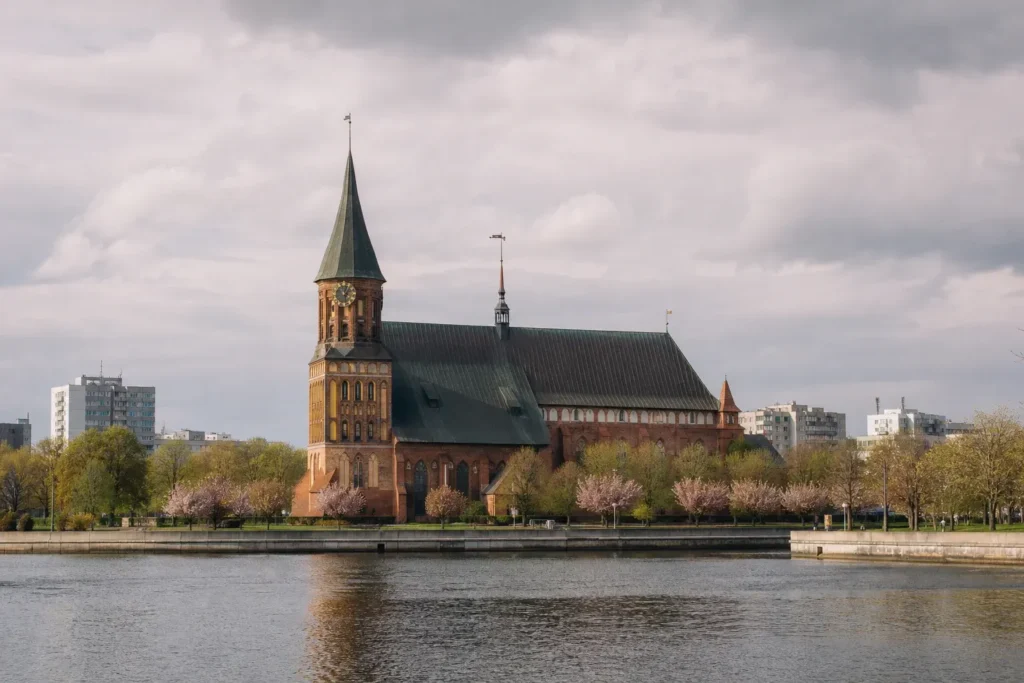
A Brick Gothic cathedral standing on Kneiphof Island since the 14th century, originally built as a place of worship for Prince-Bishops. Nearly destroyed in World War II but meticulously rebuilt. The cathedral houses a museum space and serves as a working place of religious life. The scale and restoration details show the ambition of medieval Königsberg, and the structure's very survival through devastation makes it historically powerful.
The tomb of philosopher Emanuel Kant lies within, making it a pilgrimage site for Enlightenment scholars.
Good to know: Kneiphof Island, city center; free entry to exterior and museum spaces; check current opening hours.
Tip: Visit early morning to avoid tourist groups, and observe how the rebuilt interior differs from surviving photographs—this contrast itself reveals the scale of 1945 destruction.
3. Friedland Gates Museum – Soviet victory, Cold War era
Housed in the restored Friedland Gate, one of Königsberg's surviving fortifications from 1657. The museum documents Soviet history, the 1945 capture of the city, and the Cold War years when Kaliningrad was a closed military zone. Exhibits include military equipment, personal items, photographs, and historical reconstructions. The gate itself is an architectural artifact of the city's defensive history.
Good to know: Friedland Gates area; paid entry; check official site for current hours; near central tram lines.
Tip: The museum offers optional old-tram tours—confirm availability before visiting, as these run seasonally and are not daily.
4. Amber Museum – Medieval trade, natural history
Located in the Dohna Tower in the city center, this museum holds over 6,000 amber artifacts spanning from the 4th century BC to modern times. Exhibits include raw amber samples showing prehistoric insects and plants, finished jewelry, art sculptures, and examples of how amber was identified and valued across centuries. The museum illustrates why amber trade made Königsberg wealthy and connected to European markets.
The 1,280-square-meter tower itself is a historic fortification structure.
Good to know: Dohna Tower, city center; paid entry; check official website for hours.
Tip: Bring a magnifying glass or phone camera—many amber pieces are small and the fine details (preserved insects, fracture patterns) are best seen close up.
5. Museum of the World Ocean – Maritime heritage, warships and submarines
Sited along the waterfront with access to a rare collection of historical vessels. The centerpiece is the Quay of Historical Fleet: the research ship Vityaz (one of the world's largest research vessels), the submarine B-413 (the country's only floating submarine museum), and the space communication ship Cosmonaut Viktor Patsaev. These vessels document the city's naval and scientific history.
Exhibits inside explore the Baltic maritime trade routes, fishing traditions, and oceanographic research from the Soviet era onwards.
Good to know: Peter the Great Embankment, waterfront; paid entry; inner vessels require separate tickets; check official site.
Tip: Tour the submarine and research ship early in the day—queues form by mid-morning on weekends, and these spaces are cramped and may feel uncomfortable if crowded.
6. Bunker Museum – WWII military command post
A preserved Soviet bunker that served as a military command center during and after World War II. The museum documents the final phase of the 1945 Assault of Königsberg from a military perspective, with exhibits on command, communications, troop movements, and civilian impact. The cramped, authentic bunker setting creates an atmospheric understanding of wartime conditions.
Good to know: Kaliningrad city; paid entry; check hours and advance booking requirements on official channels.
Tip: Not suitable for claustrophobic visitors—the bunker interiors are narrow and can feel oppressive. Visit on a less crowded weekday if possible.
7. Ruins of Royal Castle – Medieval fortress site, archaeology
The scattered remains of Königsberg Castle, founded by the Teutonic Knights in 1255 and demolished in 1968–1969 after World War II damage. What survives is a sunken archaeological site with fragments of the cellar, foundations, and the southern terrace. From here, views open toward the Königsberg Cathedral. The site is marked by recent archaeological excavations and small plaques explaining the original layout.
The castle once housed the Prussian Museum (with 240,000 artifacts) and the Amber Room during World War II; both were lost during the war or afterward.
Good to know: Central Square (Tsentral'naya Ploshchad'), city center; free; open-air site.
Tip: Stand on the terrace facing the cathedral—this perspective matches historical engravings and helps you mentally reconstruct the medieval fortress skyline.
8. Kronprinz Museum – Multi-era history, curated installations
A smaller but curated museum covering regional history from medieval times through World War II and the Soviet era. Known for well-designed thematic installations and atmospheric settings that convey daily life across different periods. The museum combines military history, civilian experiences, and cultural artifacts to show how Königsberg transformed into Kaliningrad.
The adjoining Stirlitz themed café adds to the immersive, mid-century atmosphere.
Good to know: Kaliningrad city center; paid entry; check official hours.
Tip: The museum is smaller and less crowded than the Regional Museum—better for a focused, intimate visit. The café stay pairs well with a museum visit to extend the thematic experience.
9. Great Patriotic War History Museum – Soviet WWII perspective
Explores the Soviet experience of the Second World War, with exhibits on Red Army operations, the siege and assault of Königsberg, soldiers' accounts, military equipment and the experiences of civilians. The museum balances military history with social history, documenting how the war shaped the region and its people.
Good to know: Kaliningrad; paid entry; verify current hours.
Tip: Combine this visit with the Bunker Museum to see both Soviet command-level strategy and ground-level military experience from the same historical moment.
10. Dom Kitoboya (Whale Hunter's House) – Soviet domestic life and material culture
A private museum housed in a restored early 20th-century building, recreating Soviet-era daily life and interior design from the 1950s–1980s. While not strictly medieval or military history, it documents the material culture and social life of post-war Kaliningrad, showing how ordinary residents lived in a closed Soviet military city. Furnishings, appliances, photographs, and personal items convey the texture of Soviet everyday experience.
Good to know: Kaliningrad city; paid entry; small, intimate spaces.
Tip: This museum is best for visitors interested in social and domestic history rather than political or military events—it complements the larger military-focused museums with an alternative angle.
11. Museum of East Prussia – Pre-war regional culture and traditions
Documents the cultural heritage, customs, crafts, and daily life of the former East Prussian region before World War II. Exhibits include traditional clothing, household objects, agricultural tools, folk art, and ethnographic materials that show how people lived across the region's towns and countryside. This museum preserves the material culture that was largely lost after 1945.
Good to know: Kaliningrad region; verify location and paid/free status via current sources.
Tip: Useful for understanding the pre-war context—visit this before other museums to grasp what the region looked like before Soviet takeover.
Russia Vibes Tips
- Many museums close on Mondays or Tuesdays. Verify opening days and hours on official websites before visiting; hours change seasonally. Most accept cash and card payment.
- The Regional Museum of History and Arts is the most comprehensive; allocate 2–3 hours. Other museums require 45 minutes to 1.5 hours each. Plan your route to cluster nearby sites (the castle ruins, cathedral, and Dohna Tower are walkable from each other).
- Few museum labels are in English; consider hiring a guide for deeper context, or download a translation app. The largest museums sometimes offer English-language audio guides or printed materials—ask at the entrance.
- Many WWII sites and museums in Kaliningrad focus on Soviet narratives. If you want German-language perspectives on the pre-war city, look for exhibits on medieval and early modern Königsberg instead, which tend to be more balanced.
- October–April: indoor museums are less crowded and preferable due to cold, damp weather. May–September: popular with groups; visit early or visit lesser-known museums like Kronprinz or Dom Kitoboya to avoid crowds.
- Bring sturdy shoes—the castle ruins site is uneven, the bunker involves stairs and narrow passages, and museum floors are often worn stone. The cathedral and amber museum have standard access.
Explore Nearby Best Museums for History, Kaliningrad
Browse more: All Culture Lists · All Guides · All Guides in Kaliningrad · All Kaliningrad
FAQ
Is Königsberg Cathedral the same as the city's main church today?
Yes. The cathedral survived World War II destruction (unlike the castle) and was rebuilt in the 1990s. It serves both as a museum space and an active place of worship, so visiting hours depend on services. The exterior is always visible. Inside, you'll find the tomb of philosopher Emanuel Kant.
Can I see the inside of Royal Castle?
No. The castle was demolished in 1968–1969 after war damage. Today only archaeological excavations of the cellar and foundation remain. The site is open-air and free, but there is no interior. You can view remnants and read plaques explaining the original layout.
Which museum best shows the city's pre-war German history?
The Amber Museum and Königsberg Cathedral illustrate medieval and early modern periods. The Regional Museum of History and Arts has a Prussian section. The Museum of East Prussia covers pre-war daily life and regional culture. For comprehensive pre-war context, visit these three.
Is there a single ticket for multiple museums?
No. Each museum requires a separate ticket. However, the Friedland Gates Museum and Regional Museum of History and Arts sometimes offer combined or discounted passes—check their official sites.
Are these museums suitable for first-time visitors to Kaliningrad?
Yes. Start with the Regional Museum of History and Arts to understand the full timeline, then visit the cathedral and castle ruins for the medieval context, and finally explore the WWII-focused museums and the waterfront Museum of the World Ocean for a complete picture.
Do I need a guide to visit these museums?
No. Most museums allow independent visits and are clearly labeled. However, English-language information is limited, so a guide or translation app is helpful for deeper understanding, especially for WWII exhibits.
Can I visit Kaliningrad museums without a visa or special permission?
As of October 2026, standard Russian visa rules apply. Kaliningrad is no longer a closed military zone. However, you must check the current entry requirements for Russia at the Russian government website or your country's Russian embassy, as rules change.
Why are there so many museums about World War II?
The city's identity was transformed by the 1945 Assault of Königsberg and the Soviet takeover. Much of the pre-war city was destroyed, and the war marks the boundary between German Königsberg and Russian Kaliningrad. Museums document this pivotal moment and its ongoing legacy.
Russia Vibes is a one-person project. A coffee keeps it going
How we research and update our guides
About this guide: AI assistance and accuracy
This guide is created with the help of AI and is based on official sources where available. Mistakes can still happen. Opening hours, prices, rules and other details are given to the best of our knowledge as of the date shown and can change without notice. It offers general recommendations only, not professional, legal or travel advice. Please confirm important details with the official source before you travel; you are responsible for your own plans and decisions.

Take this guide with you
Get a free PDF of this guide to print or read offline: key facts, tips and a map link on a few clean pages.
Report an issue on this page
Paying for your trip: please read
International sanctions affect payments between Russia and many other countries. In practice, cards issued in the EU, the UK, the US and several other countries often do not work in Russia, Russian cards usually do not work abroad, and some booking platforms, airlines and payment providers limit or suspend their services for Russia. The situation changes frequently.
We do not give legal or financial advice, and this site does not encourage anyone to break or circumvent sanctions. Whatever you plan, you are responsible for following the laws and regulations that apply to you, including those of your country of residence and citizenship.
Many travelers still organise their stay lawfully. It is worth asking your bank or payment provider what is currently permitted, contacting hotels, tour operators and carriers directly about the payment methods they accept, and checking which services are open to customers from your country. Clarify payment, cancellation and refund terms before you commit to a booking, and keep your plans flexible.
Partner links on this site may not be available in every country, and prices, availability and rules in our guides can differ from what you see when you book.