
Updated
Kaliningrad stands as Russia’s window onto European history, preserving centuries of Prussian heritage in its brick Gothic churches, fortress towers and elegant merchant buildings. Known until 1945 as Königsberg, this western Russian enclave balances its German past with contemporary Russian life, making it unique among Russian cities.
This guide covers 11 essential Prussian heritage sites within and near Kaliningrad city. Each entry has been verified as currently operating based on official sources and represents the most concrete surviving links to the Duchy of Prussia and the Free City of Königsberg. The selection prioritizes places where visitors can directly observe Prussian architecture, history and craftsmanship on site.
Route: 3 stops, about 7–9 hours including walking (estimate)
At a Glance
| # | Place | Best for | Good to know |
|---|---|---|---|
| 1 | Kaliningrad Cathedral | Kant's tomb and brick Gothic landmark | Kant Island, central Kaliningrad; paid entry; allow 1–1.5 hours for visit and tower climb |
| 2 | Kaliningrad Regional Museum of History and Arts | Prussian history in former Stadthalle | Near Lower Pond, central Kaliningrad; paid entry; plan 2–3 hours for the main museum |
| 3 | Amber Museum | Amber treasures in fortress tower | Ploshchad Marshala Vasilevskogo, central Kaliningrad; paid entry; allow 1.5–2 hours |
| 4 | Museum of Fine Arts (Königsberg Stock Exchange) | Renaissance palace and art collection | River embankment, central Kaliningrad; paid entry; allow 1–2 hours |
| 5 | Bunker Museum | German command post, April 1945 | Separate from main museum; paid entry; allow 1–1.5 hours; claustrophobic spaces may challenge some visitors |
| 6 | Rybnaya Derevnya (Fishing Village) | Half-timbered Königsberg reconstruction | Pregolya River embankment; free to walk through; shops and cafes are open seasonally |
| 7 | Brandenburg Gate | Last surviving city gate | Central Kaliningrad; free to view externally; limited interior access |
| 8 | Friedrichsburg Gate (Museum of Ship Restoration) | Prussian gate with maritime collection | Central Kaliningrad near harbor; free or paid entry depending on exhibitions; allow 1–1.5 hours |
| 9 | Königsberg City Hall (Stadthaus) | Prussian civic architecture | Victory Square area, central Kaliningrad; exterior viewing only |
| 10 | Fort No. 5 (King Frederick William III) | Prussian military fortification | Ring around central Kaliningrad; outdoor access; allow 1 hour for exterior viewing |
| 11 | Wrangel Tower | Fortress tower with city views | Eastern edge of city center; exterior access; may have limited interior access |
| 12 | Kaliningrad City History Exhibition at the Bunker's Main Museum Building | Königsberg's transformation documented | Main museum at Lower Pond; paid entry; plan 2–3 hours for thorough visit |
How We Chose
Entries were chosen based on these criteria:
- Verified as currently open and accessible to visitors
- Direct connection to Prussian history or German East Prussian architecture
- Physical structures from the pre-1945 Prussian or Königsberg period, or museums housed in such structures
- Sufficient surviving detail to recognize Prussian design, engineering or cultural context on visit
- Located within walking distance of central Kaliningrad or easily reached by local transport
All dates and construction details verified through official museum websites and historical records. Closure dates and accessibility have been confirmed as of October 2026.
1. Kaliningrad Cathedral – Kant's tomb and brick Gothic landmark
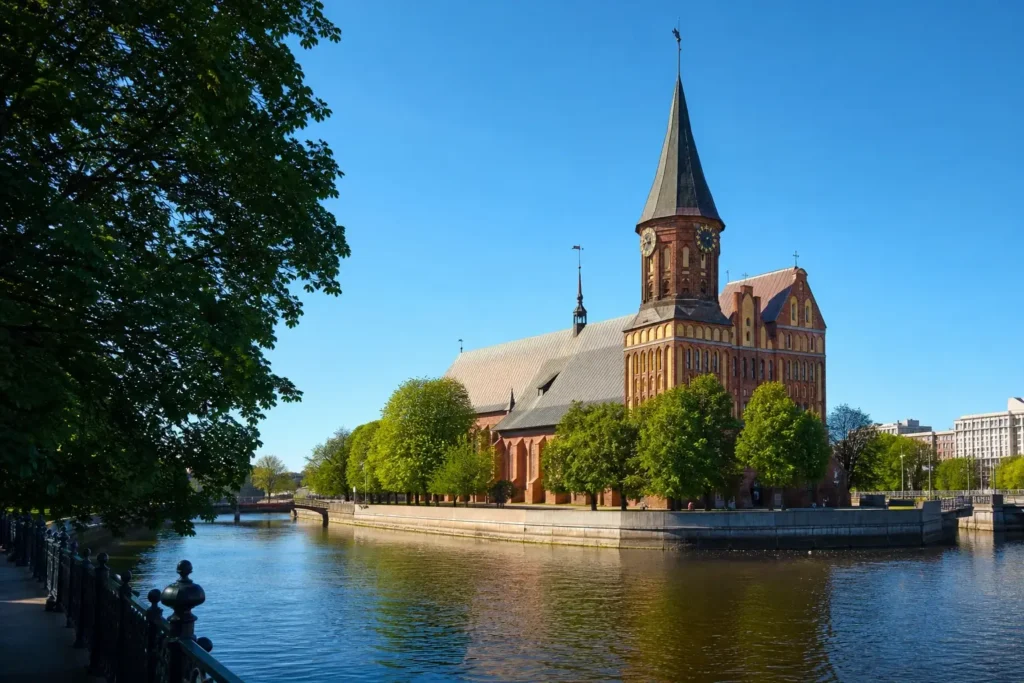
The 14th-century Königsberg Cathedral houses Immanuel Kant's tomb. The cathedral nearly burned to the ground during World War II, and received its modern German Gothic look during subsequent restoration work. The cathedral houses a museum and concert organ. The exterior remains immediately recognizable as a Prussian brick Gothic church; the interior includes a colonnade around Kant's sarcophagus added during 20th-century renovation. Visitors can climb the bell tower for views across the city.
Located on Kant Island, a small island in the Pregolya River near the city center.
Good to know: Kant Island, central Kaliningrad; paid entry; allow 1–1.5 hours for visit and tower climb
Tip: Organ concerts are held regularly; check the official site in advance if this interests you. The island can only be reached by bridge; the Cathedral stands prominently and is easy to spot from across the river.
2. Kaliningrad Regional Museum of History and Arts – Prussian history in former Stadthalle
Located in the heart of the city, near the picturesque Lower Pond, in the historic building of the former Stadthalle, built in 1912. The building was built by Berlin architect Richard Zeil, originally the city hall (Stadthalle) and also a performing arts center in Königsberg, Germany. The main historical museum of the region, covering a broad period from prehistoric times in East Prussia to the modern Kaliningrad Region, the museum is housed in a former Königsberg villa and offers exhibitions devoted to archaeology, the region's natural environment, the history of Königsberg, World Wars I and II, and the postwar period. The Stadthalle building itself—a grand Prussian civic structure—is worth seeing for its architecture.
Good to know: Near Lower Pond, central Kaliningrad; paid entry; plan 2–3 hours for the main museum
Tip: The Bunker Museum, a branch of this complex, is located at the former German command post where the surrender of Königsberg was signed in April 1945. It requires a separate visit but offers unique World War II context.
3. Amber Museum – Amber treasures in fortress tower
The amber museum was established in Kaliningrad because the largest discovered deposit of the Baltic gem – more than 90% of the world's reserves, is near the town of Yantarnoye. Housed within the Dohna Tower, the Amber Museum contains an impressive collection of over 6,000 amber exhibits, with stunning artworks and intricate jewelry that date back to as early as the 4th century BC. Located in old Rosegarten Gates, the museum is home to the world's second largest piece of amber. The displays include an exposition about the famous Amber Room and showcase a copy of the Amber Cabinet. The tower itself, built in 1853 in neo-Gothic style, was part of Königsberg's 19th-century fortress ring.
Good to know: Ploshchad Marshala Vasilevskogo, central Kaliningrad; paid entry; allow 1.5–2 hours
Tip: The museum sits in a defensible fortress tower that is itself a piece of Prussian military engineering. Label text is limited in English; take time to study the amber specimens themselves, especially the amber inclusions (trapped insects) which are the most scientifically distinctive pieces.
4. Museum of Fine Arts (Königsberg Stock Exchange) – Renaissance palace and art collection
The Museum of Fine Arts is located in the building of the former Königsberg Stock Exchange, built in the heart of pre-war Königsberg on the bank of the river Pregel, designed by architect H. Müller in 1870–1875, in the style of Italian neo-Renaissance with elements of Classicism. It is now an architectural gem of the Kaliningrad region. The building's ornate facades and proportions are characteristic of late 19th-century Prussian merchant architecture. The museum displays contemporary and historical art collections.
Good to know: River embankment, central Kaliningrad; paid entry; allow 1–2 hours
Tip: The exterior deserves careful observation for its decorative stonework and proportions. The riverfront location offers good photography of the building facade.
5. Bunker Museum – German command post, April 1945
A branch of the Kaliningrad Regional Historical and Art Museum, it is located in an actual German bomb shelter that served as the headquarters of the German command during the storming of Königsberg in April 1945. The exhibition is dedicated to the assault on the fortress-city of Königsberg and the history of the signing of the act of capitulation. The former command post of the German Königsberg fortress, known as the "Bunker" (or Lasch Bunker), this site holds significant historical importance as the place where the decision regarding the surrender of the Königsberg garrison was made in April 1945. Visitors walk through actual underground rooms where the final German command decisions were made.
Good to know: Separate from main museum; paid entry; allow 1–1.5 hours; claustrophobic spaces may challenge some visitors
Tip: The bunker is a real underground structure from World War II, not a reconstruction, which makes it a rare surviving German military site from the final months of the war. Arrive early as group sizes are controlled in these confined spaces.
6. Rybnaya Derevnya (Fishing Village) – Half-timbered Königsberg reconstruction
Opened in 2006, this charming destination features stunning half-timbered buildings reminiscent of old Konigsberg, creating an enchanting atmosphere for history and architecture enthusiasts alike. Nestled along the picturesque banks of the Pregolya River, Rybnaya Derevnya is a captivating riverside complex that transports visitors back to Kaliningrad's Prussian heritage. The complex reconstructs historic Königsberg riverside merchant and fishing dwellings using traditional half-timbered construction methods. This is a modern recreation, not original Prussian buildings, but the architectural vocabulary and riverside setting authentically represent Old Königsberg's character.
Good to know: Pregolya River embankment; free to walk through; shops and cafes are open seasonally
Tip: The buildings are mostly reconstructions completed after the Soviet period; they function as a living museum rather than a collection of original structures. Best visited on a clear day to enjoy riverside walks and photo opportunities.
7. Brandenburg Gate – Last surviving city gate
The historic Brandenburg Gate, which once marked the city entrances, reflects the military past of former Königsberg. This Prussian fortified gate structure stands as one of the surviving entrances to historic Königsberg. Its Gothic brick form is characteristic of Prussian military architecture from the 19th century. The gate forms part of Kaliningrad's defensive ring built during the period when Königsberg was a major fortress city.
Good to know: Central Kaliningrad; free to view externally; limited interior access
Tip: The Brandenburg Gate is best viewed from outside and photographed from the surrounding streets. As a functional historic structure, its interior may not always be open to casual visitors.
8. Friedrichsburg Gate (Museum of Ship Restoration) – Prussian gate with maritime collection
The Ship Revival Center in Friedrichsburg Gate includes a fun collection of international boats and marks a famous Kaliningrad maritime site. Friedrichsburg Gate is one of the surviving city gates from the Königsberg fortification system. The gate now houses a collection related to maritime heritage and ship restoration, preserving the city's history as a major Baltic port under Prussian rule.
Good to know: Central Kaliningrad near harbor; free or paid entry depending on exhibitions; allow 1–1.5 hours
Tip: The gate structure itself is the primary architectural interest. Interior exhibitions may change; verify current status before visiting.
9. Königsberg City Hall (Stadthaus) – Prussian civic architecture
The building was designed by architect Hanns Hopp in 1923, when the city was known as Königsberg, Germany. It was originally the Handelshof, a trade hall located at the square Hansaplatz and near the Ostmesse trade fair. By 1927, however, it became the Stadthaus, Königsberg's new city hall. The Stadthaus was damaged during World War II, but survived the war. The building remained the municipal seat of government in post-war Kaliningrad, receiving a new facade. The Stadthaus represents 1920s Prussian civic design and continues to function as an administrative center.
Good to know: Victory Square area, central Kaliningrad; exterior viewing only
Tip: The building's exterior renovations after the war changed its appearance; the original 1920s proportions remain visible. The location on Victory Square provides context for comparing Prussian and Soviet-era architecture.
10. Fort No. 5 (King Frederick William III) – Prussian military fortification
The Forts of Kaliningrad are twelve military fortifications built between 1820 and 1890 in a ring around the city, forming the Prussian defense system of Königsberg. Fort No. 5, named after the Prussian king, stands as one of the surviving examples of this 19th-century fortress ring. The fort was part of the strategic defensive architecture that made Königsberg one of Europe's strongest fortified cities during the Prussian period.
Good to know: Ring around central Kaliningrad; outdoor access; allow 1 hour for exterior viewing
Tip: This fort and others in the ring are best approached by local transport. Most remain partially restored outdoor structures; phone ahead to confirm access, as some are occasionally closed or restricted.
11. Wrangel Tower – Fortress tower with city views
Wrangel Tower is a Prussian fortress tower that survives from Königsberg's 19th-century ring of fortifications. The brick structure is characteristic of Prussian military engineering designed to defend the city. The tower offers views across modern Kaliningrad and the Pregolya River, allowing visitors to understand the city's strategic defensive layout under Prussian rule.
Good to know: Eastern edge of city center; exterior access; may have limited interior access
Tip: Best photographed from across the river or from nearby streets. The surrounding area has been redeveloped, but the tower's Prussian proportions remain clearly visible.
12. Kaliningrad City History Exhibition at the Bunker's Main Museum Building – Königsberg's transformation documented
The museum is housed in a former Königsberg villa and offers exhibitions devoted to archaeology, the region's natural environment, the history of Königsberg, World Wars I and II, and the postwar period. The Stadthalle building (main museum) chronicles how Königsberg evolved from a medieval castle town to a 19th-century fortress-city and later industrial center. Exhibits document the city's role in Prussian history, from the Teutonic Knights through the industrial era. This context is essential for understanding the Prussian buildings scattered throughout the modern city.
Good to know: Main museum at Lower Pond; paid entry; plan 2–3 hours for thorough visit
Tip: This museum provides the historical framework for understanding why Kaliningrad's Prussian sites matter and how they fit into the city's chronology. Visit this early in your trip to understand the context of other sites.
Russia Vibes Tips
- Most Prussian sites cluster within walking distance of the Pregolya River. Start at Kant Island (Cathedral) and work outward; the river embankment offers the best orientation and photography of the historic streetscape.
- Brick Gothic and neo-Gothic architectural styles dominate Prussian Kaliningrad. Learn to recognize pointed arches, buttresses, and the distinctive red-brick construction method used in northern Europe—it helps identify surviving original fragments among Soviet-era reconstructions.
- English labeling in museums is minimal. Bring a translation app or guidebook; the physical structures themselves are often more informative than text when exploring fortifications and public buildings.
- Several sites charge separate admission (Cathedral, Amber Museum, Regional Museum, Bunker). Consider purchasing a combined ticket if one is offered; verify current options at the main museum upon arrival.
- Avoid visiting fortifications and exposed exterior sites during heavy rain or snow; ice makes Prussian brick surfaces treacherous, and many forts have uneven ground. Late spring through early autumn offers the best conditions.
- Street names changed after 1945; ask locals for directions using modern Russian names rather than historical German ones. However, museum maps and heritage signs often show both names, which aids navigation and understanding.
Explore Nearby Best Prussian Heritage Sites, Kaliningrad
Browse more: All Culture Lists · All Guides · All Guides in Kaliningrad · All Kaliningrad
FAQ
Is there an official Amber Room in Kaliningrad?
No. The original Amber Room from the Catherine Palace at Tsarskoye Selo (near Saint Petersburg) was moved to Königsberg during World War II and disappeared. The Amber Museum in Kaliningrad displays reconstructed fragments and a replica Amber Cabinet created by modern craftspeople, allowing visitors to understand what the room looked like, but the original remains lost.
Which Prussian buildings in Kaliningrad are original pre-1945 structures?
The Cathedral, Königsberg Stock Exchange (Museum of Fine Arts), Stadthalle (Regional Museum), Brandenburg Gate, Friedrichsburg Gate, and the fortress towers (Wrangel, Dohna Tower at Amber Museum) are original or substantially restored pre-1945 structures. Rybnaya Derevnya is a modern reconstruction using historical architectural vocabulary.
Can I visit the forts around Kaliningrad?
Yes. Twelve forts were built between 1820 and 1890 to defend Königsberg. Several remain accessible for exterior viewing and some allow limited interior access. Confirm opening before visiting, as access and restoration status varies. Most require local transport to reach.
Why does Kaliningrad feel so different from other Russian cities?
Kaliningrad was part of Germany (Königsberg, East Prussia) until 1945 and was only incorporated into the Soviet Union after World War II. The surviving brick Gothic churches, merchant houses, fortifications, and urban layout reflect nearly 700 years of Prussian and German cultural development before becoming a Russian city. This unique history shapes its architecture and atmosphere.
Are there any original Prussian residences I can visit?
Limited. Most Prussian homes were destroyed during World War II or demolished afterward. The Amber Museum is housed in a Prussian fortress tower. Some villas survive as state buildings or offices. Rybnaya Derevnya recreates the appearance of historic merchant riverside dwellings but consists of modern reconstructions.
How long should I spend visiting Prussian heritage sites?
Plan 3–4 days for a thorough exploration: one day for the Cathedral, Regional Museum, and Stadthalle; one day for the Amber Museum and gates; one day for fortifications and walking the old city layout; one day for day trips to sites like Friedrichsburg Gate and outer forts. A focused visit requires 1–2 days for the main sites.
Do I need a guide to understand Prussian Kaliningrad?
A guide is helpful but not essential. Official museum guides and English-language plaques provide context at major sites. However, a knowledgeable guide greatly enriches understanding of Königsberg's history, the city's strategic layout, and which surviving fragments belong to which historical periods. Check for English-speaking guides at the Regional Museum or through local tourism information.
Is Immanuel Kant actually buried in the Cathedral?
Yes. The philosopher Immanuel Kant (1724–1804), one of Prussia's most famous sons, is buried at the Cathedral on Kant Island. Königsberg Cathedral is famous as the burial site of German philosopher Immanuel Kant, whose sarcophagus was supplemented with a colonnade during 20th-century renovations. His tomb is a major reason visitors seek out the Cathedral.
Russia Vibes is a one-person project. A coffee keeps it going
How we research and update our guides
About this guide: AI assistance and accuracy
This guide is created with the help of AI and is based on official sources where available. Mistakes can still happen. Opening hours, prices, rules and other details are given to the best of our knowledge as of the date shown and can change without notice. It offers general recommendations only, not professional, legal or travel advice. Please confirm important details with the official source before you travel; you are responsible for your own plans and decisions.

Take this guide with you
Get a free PDF of this guide to print or read offline: key facts, tips and a map link on a few clean pages.
Report an issue on this page
Paying for your trip: please read
International sanctions affect payments between Russia and many other countries. In practice, cards issued in the EU, the UK, the US and several other countries often do not work in Russia, Russian cards usually do not work abroad, and some booking platforms, airlines and payment providers limit or suspend their services for Russia. The situation changes frequently.
We do not give legal or financial advice, and this site does not encourage anyone to break or circumvent sanctions. Whatever you plan, you are responsible for following the laws and regulations that apply to you, including those of your country of residence and citizenship.
Many travelers still organise their stay lawfully. It is worth asking your bank or payment provider what is currently permitted, contacting hotels, tour operators and carriers directly about the payment methods they accept, and checking which services are open to customers from your country. Clarify payment, cancellation and refund terms before you commit to a booking, and keep your plans flexible.
Partner links on this site may not be available in every country, and prices, availability and rules in our guides can differ from what you see when you book.