
Last updated
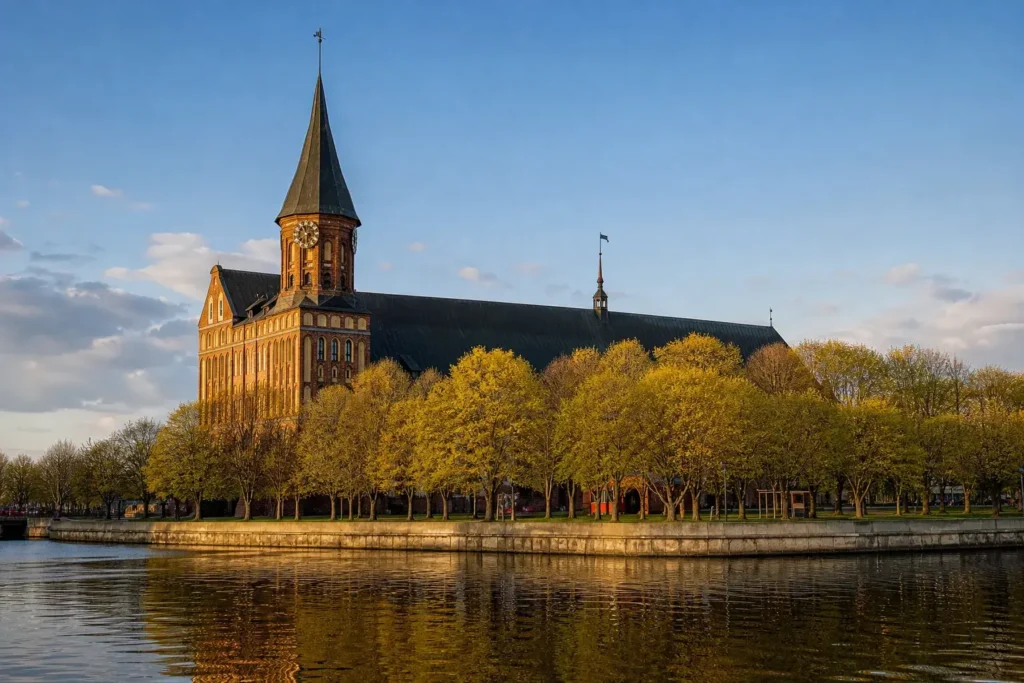
Königsberg Cathedral stands on Kneiphof Island as the most significant surviving building from the city’s German past. This brick Gothic monument, begun in 1333 and largely completed by 1380, served as the cathedral of the Prince-Bishops of Samland for centuries. Today it functions as a multifaceted cultural centre: a museum of local history, a concert venue, and home to Immanuel Kant’s memorial tomb.
The cathedral’s story includes near-total destruction in August 1944 when RAF bombing raids destroyed the roof and spires, leaving a gutted shell for decades. Restoration began in the 1990s, and in 1994 a new spire was dramatically installed by helicopter. The building now welcomes visitors year-round to experience its Gothic vaults, monumental 700-pipe organ, and the history of Königsberg embedded in its walls.
Quick Facts
| Russian name | Кафедральный собор Королевского замка |
|---|---|
| Built / opened | 1380 |
| Address | улица Канта, 1, Калининград, 236039 OpenStreetMap · Google Maps |
| District | Central District |
| Opening hours | Mon-Sun 10:00-19:00 |
| Admission | ₽ |
| Best time to visit | Late spring through early autumn (May to September) offers the most reliable weather and maximum daylight for photography. Organ concerts often occur in the evening and are a highlight; check the website for schedules. Winter months are quieter but daylight is limited. Summer weekends tend to be busier; weekday visits are more peaceful. |
| Recommended duration | 2–3 hours |
| Website | sobor39.ru |
| Last updated | October 18, 2026 |
What Is (and Isn't) Part of a Visit to Königsberg Cathedral, Kaliningrad?
| Part | Status | Notes |
|---|---|---|
| Cathedral interior and Gothic architecture | Included in the standard ticket | Main ticket covers access to the interior spaces, vaults, and architectural features. |
| Museum exhibitions | Included in the standard ticket | History displays and contextual panels about Königsberg and the cathedral are part of the standard admission. |
| Immanuel Kant memorial chapel | Included in the standard ticket | The cenotaph and memorial to the philosopher are accessible from the cathedral interior. |
| Organ concerts | Separate ticket or institution | Evening and special concerts require a separate ticket; check the official website for schedules. |
| Cathedral exterior and Kneiphof Island | Included in the standard ticket | The building's exterior and the surrounding park are freely accessible. |
| Lutheran and Orthodox chapels | Included in the standard ticket | Two active chapels within the cathedral serve Lutheran and Russian Orthodox communities; visitors may view them but should be respectful during services. |
Why Visit Königsberg Cathedral, Kaliningrad?
The cathedral is the last major reminder of Königsberg’s medieval and early modern grandeur. Its massive brick structure—88 metres long and 32 metres high—dominates Kneiphof Island and shows the architectural ambitions of the Teutonic Order and the merchant republic that followed. The cathedral’s current restoration has transformed it into a living space for concerts and exhibitions. For those interested in the contested history of East Prussia and the German-Soviet conflict, it provides essential visual and material testimony.
Highlights of Königsberg Cathedral, Kaliningrad
The Gothic Vaults and Interior Spaces
Walk through the three-nave structure with its distinctive high vaults and pointed arches characteristic of brick Gothic. The cathedral was originally built with a single nave, but a three-nave section was added later to the western part. Look up at the ribbed vaulting that defines the space and imagine the medieval and Reformation-era services once held here. The interior tells the story of layered use: the upper choir was for knights, the lower for ordinary parishioners.
Tip: Enter through the west entrance to appreciate the scale and height of the main space first.
The 700-Pipe Organ
One of the largest organs in Russia fills the cathedral with sound during concerts. The instrument was installed in 1928 and represents decades of Lutheran musical culture. Post-war restoration replaced the original with a modern instrument that still defines the acoustic character of the space. Check the official website for concert schedules, as organ music is the cathedral's signature experience.
Tip: Book tickets in advance for evening organ concerts; they fill quickly and the reverberant space creates an unforgettable atmosphere.
Immanuel Kant's Memorial
The philosopher Immanuel Kant was buried in a chapel adjoining the cathedral in 1804. Though his original tomb was destroyed in World War II, a memorial chapel with a cenotaph (empty tomb) was created in his honour during restoration. Kant spent his entire life in Königsberg and remains the city's most famous son. The modest memorial reflects his philosophical legacy and the city's intellectual history.
Tip: The Kant memorial is in a separate small chapel; ask staff where to find it as it is not immediately obvious.
The 1994 Spire Restoration
The cathedral's current spire is a modern engineering feat: it was installed by helicopter in 1994 after decades of the building standing as a burned-out shell. The original spires were destroyed in 1944 raids and had been replaced by a simple gable roof before full restoration began. The restored spire is visible from across the river and marks the cathedral's symbolic return to Kaliningrad's skyline.
Tip: Walk to the bridge or embankment on the opposite bank of the Pregolya River for the best exterior photographs of the spire.
Museum Exhibitions
The cathedral now houses exhibitions about Königsberg's history, the Teutonic Order, medieval religious life, and the city's multicultural past. Artifacts, reproductions of historical documents, and interpretive panels tell the story of how this building served multiple communities—Catholic, Lutheran, and briefly Orthodox. The exhibitions explain the cathedral's role in the city and its near-miraculous survival.
Tip: Allow time to read the captions and contextual displays; they add significantly to understanding what you're seeing.
Kneiphof Island Setting
The cathedral sits on Kneiphof Island in the Pregolya River, surrounded by a park that occupies the site of the medieval city. The island was the spiritual and administrative heart of Königsberg but now stands quiet and largely undeveloped. The surrounding landscape emphasizes the cathedral's isolation as the sole surviving major building from that era. The river, bridges, and tree-lined paths create a contemplative setting.
Tip: Walk around the exterior and the island to understand the cathedral's isolation and its role as a solitary monument in the landscape.
Atmosphere
The cathedral interior feels monumental and austere—high brick vaults, sparse decoration, and echoing stone create a sense of scale and history. The light entering through tall windows illuminates the empty space in a way that emphasizes the building’s skeleton rather than visual ornament. The organ’s presence is felt even in silence; when concerts occur, the reverberating sound transforms the space entirely.
Kneiphof Island around the cathedral is quiet, park-like, and almost eerie—a green space where a dense medieval city once stood. Visitors tend to move slowly and speak quietly, aware they are in a space that survived war and abandonment. The cathedral feels both monumental and fragile: a memorial to a lost world, kept alive by music and memory.
History of Königsberg Cathedral, Kaliningrad
The cathedral’s construction began in 1333 when Bishop Johann Clare acquired the eastern half of Kneiphof Island from the Teutonic Knights. A 1333 treaty with Grand Master Luther von Braunschweig established the bishop’s autonomy and the site as a cathedral precinct. Early construction was defensive in character: the eastern wall was built three metres thick with defensive passages, though the Grand Master objected and the other walls were halved in thickness. By 1351 the cathedral had a roof, and reconstruction immediately began, continuing until 1382. The main construction was complete by 1380.
Over the 14th and 15th centuries, the interior was decorated with frescoes and the cathedral accumulated artistic treasures: wood carvings, Renaissance monuments, and religious reliquaries. In 1544 both original spires burned after a fire, and only the southern spire was rebuilt; the northern was replaced by a simple gable. In 1587 the first organ was installed, and by the early 17th century it had 60 registers, making it one of the most celebrated musical instruments in the region. A fourth organ was installed in 1928.
After the Reformation, the cathedral became Lutheran property and remained Protestant until 1945. During World War II, Königsberg was heavily bombed by the RAF. In late August 1944, two night raids destroyed much of the old city. The cathedral’s roof and spires were destroyed in the bombing; a bomb also killed about a hundred people sheltering inside, mostly children. The building stood as a burnt-out shell for decades.
In the post-war Soviet period, the city was renamed Kaliningrad and rebuilt as a Soviet model city with little reference to its German heritage. Kneiphof Island was converted to a park. The cathedral remained closed and deteriorating. Restoration began in the early 1990s during the Perestroika period. In 1994, a new spire was dramatically installed by helicopter and the building was reopened. Since then, it has been restored as a concert hall, museum, and cultural centre, serving both tourists and residents as a witness to Königsberg’s complex history.
Legends and Myths about Königsberg Cathedral, Kaliningrad
Immanuel Kant's Eternal Walk
Legend – historically unreliable. Legend says that Immanuel Kant's daily routine was so precise that the people of Königsberg set their clocks by his afternoon walk. He was supposedly never more than a few minutes late, and he would pass by the cathedral on his habitual route through the city. After his death in 1804, locals joked that his ghost still made the same walk. The story illustrates how Kant's life was woven into the city's identity and the cathedral's position in civic life.
The Mermaid Weathervane
Legend – historically unreliable. A decorative weathervane in the form of a mermaid crowned one of the cathedral's spires, installed in the 15th century as an ornament. It survived centuries of storms and wars until the 1944 bombing. Locals spoke of the mermaid as a guardian or symbol of the city's commerce and connection to the sea. The figure has become a symbol of Königsberg's lost maritime identity.
Tickets and Booking for Königsberg Cathedral, Kaliningrad
| Ticket | Price | Includes |
|---|---|---|
| Adult admission | ₽ | Access to the cathedral interior, museum exhibitions, and Kant memorial. |
| Reduced admission | ₽ | Students, children, and senior citizens; rates vary; check official site for current categories. |
| Organ concert tickets | ₽₽ | Evening performances feature the 700-pipe organ; booking essential. |
₽ budget · ₽₽ moderate · ₽₽₽ upscale · ₽₽₽₽ splurge. Price levels are estimates compared with typical prices for visitors.
Official tickets: Purchase at the cathedral or online via the official website (sobor39.ru). The cathedral is open most days; check the website for the current detailed schedule and any closures.
Hours may vary depending on concerts, exhibitions, or special events. The website lists current hours, concert times, and any restrictions.
Same-day tickets are usually available, but organ concerts and special events often sell out in advance, so booking ahead is recommended.
Rates for Russian citizens and concessions (students, seniors, pensioners) differ significantly from international visitor rates. All current ticket categories, prices, and accessibility information are published on the official website.
Plan and Book
Suggested itineraries Königsberg Cathedral, Kaliningrad
1–2 hours
Quick visit: Enter through the west door, walk the main nave appreciating the Gothic vaults, visit the museum exhibits briefly, and locate the Kant memorial. Exit to walk around the cathedral exterior and Kneiphof Island. Best for those short on time or primarily interested in the architecture.
2–3 hours
Standard visit: Explore the interior vaults, examine museum displays carefully, visit the Kant memorial, and walk the island. If an organ concert is scheduled, attend if time permits. This allows time to absorb the building's scale and historical context.
3–4 hours
Full immersion: Combine the cathedral visit with a concert (usually evening), or allow extra time for photography and contemplation. Read all exhibit panels, explore every accessible section, and walk the full perimeter of Kneiphof Island to understand the cathedral's isolation in the landscape.
How to Get to Königsberg Cathedral, Kaliningrad
The cathedral is located at ulitsa Kanta (Kant Street), 1, on Kneiphof Island in the Pregolya River. There are no metro stations on Kneiphof Island itself; the nearest transport hub is Central Kaliningrad.
On foot: From the city centre (Victory Square area), walk west and south toward the river. Follow signs to Kneiphof Island or use a map app. The island is accessible via several bridges; the bridge near the cathedral entrance is clearly marked. The walk from the city centre takes 10–15 minutes.
By bus or taxi: Take a bus or taxi to one of the Kneiphof access points, or ask the driver to take you to ulitsa Kanta. Most drivers know the location well.
Parking: Limited parking is available near the cathedral; arrive early or use paid parking lots in the city centre and walk.
Accessibility
The cathedral has a main-floor entrance and steps to ascend to the door. Contact the cathedral directly via the official website or phone to confirm accessibility features and assistance for visitors with mobility limitations. The interior is primarily at ground level, but some areas may be accessed via stairs. Specific accessibility details should be verified with the venue in advance.
Food Nearby
The cathedral sits in a quiet park area with limited immediate dining options. Walk to the nearby city centre (15 minutes) for cafes, restaurants, and shops. Local options include simple cafes and bakeries (look for 'kafe' signs) in the surrounding residential areas. For a proper meal, return to Victory Square or the Bauman Street area where options are concentrated.
Best Views and Photo Spots of Königsberg Cathedral, Kaliningrad
Opposite bank of the Pregolya River
A classic view of the cathedral's western facade and restored spire reflected in or framed by the river. The bridge and tree-lined embankment provide vantage points across the water. Best for capturing the full silhouette and the dramatic brick Gothic proportions.
Best time: Late afternoon when the sun is behind you, lighting the cathedral's east-facing facade.
Kneiphof Island bridge approaches
The cathedral rises suddenly as you approach on the main bridge, framed by the river and park. This perspective emphasizes the building's scale and isolation on the island.
Best time: Early morning light, when shadows define the brick texture and the air is often clearer.
Cathedral entrance courtyard
Stand at the main western entrance and photograph the facade head-on, capturing the twin towers (or asymmetrical towers after 1544) and the gothic details of the entrance. The courtyard space gives room to step back.
Best time: Mid-morning when the light is even and the entrance is clearly illuminated.
Interior vaulting from the nave floor
Look up at the ribbed vault ceiling and the soaring lines of the interior from the main nave. The perpendicular lines of the Gothic style converge dramatically. Use the full height of the space for impact.
Best time: When sunlight streams through the tall windows (late morning to early afternoon), creating contrast between light and shadow on the vaulting.
Photography Rules
Photography is generally permitted in the interior and exterior of the cathedral. Indoor photography does not require flash for most of the building due to the height and light. Tripods may require permission; check with staff. The exterior and Kneiphof Island offer excellent photographic opportunities, especially from the bridges across the river. Drones are not permitted.
Family Suitability
The cathedral is suitable for families and children interested in history and architecture. The interior is open and safe to walk; children can appreciate the dramatic scale of the vaults. The surrounding Kneiphof Island park is pleasant for a walk. Organ concerts appeal to all ages but are best for children over 8 who can sit still for a performance. Stroller access to the main floor is possible, but the entrance has steps. Families should note that the cathedral contains some solemn historical elements related to World War II; older children may benefit from context.
Russia Vibes Tips
- Visit the official website (sobor39.ru) before your trip to check current opening hours, concert schedules, and any special exhibitions. Hours vary due to concerts and services.
- If you attend an evening organ concert, book tickets in advance online. The reverberant acoustics and the cathedral's height create an unforgettable musical experience. Concerts fill quickly.
- Allow time to walk around the exterior and Kneiphof Island to understand the cathedral's isolation and its role as the only major survivor of medieval Königsberg. The surrounding park context matters.
- The cathedral still functions as a place of worship; two active chapels serve Lutheran and Orthodox communities. Be respectful and avoid services in progress.
- Bring good shoes for walking the stone floors inside and the paths around Kneiphof Island. The interior can be cool even in summer; a light jacket is useful.
Explore Nearby Königsberg Cathedral, Kaliningrad
Sights near Königsberg Cathedral, Kaliningrad
 Fishing Village, Kaliningrad – about 550 m away (~9 min walk) · typical visit: 1.5–2 hoursOpen 24 hours
Main image: AI-generated illustration. It may not show the place exactly as it looks.
 Museum of the World Ocean, Kaliningrad – about 750 m away (~12 min walk) · typical visit: 2–3 hoursOpen 10:00–18:00, closed Mon
Main image: AI-generated illustration. It may not show the place exactly as it looks.
 Brandenburg Gate, Kaliningradabout 1.5 km away (~24 min walk) · typical visit: 30–45 minutes
Main image: AI-generated illustration. It may not show the place exactly as it looks.
 Amber Museum, Kaliningradabout 1.9 km away (~31 min walk) · typical visit: 2–3 hours
Main image: AI-generated illustration. It may not show the place exactly as it looks.
Related guides
 LOFT1890 Wine Bar: Historic Brewery Warehouse Turned Nightlife HubOpen 24 hours
Main image: AI-generated illustration. It may not show the place exactly as it looks.
 Volgograd Metrotram: Routes, Tickets and How to Ride
Main image: AI-generated illustration. It may not show the place exactly as it looks.
 Scotch Hostel, Volgograd: Budget Lodging with Style
Main image: AI-generated illustration. It may not show the place exactly as it looks.
 Rustaveli: Georgian Cuisine and Wine in Central VolgogradOpen daily 12:00–00:00
Main image: AI-generated illustration. It may not show the place exactly as it looks.
 Restaurant Marusya, Volgograd: Russian Cuisine on Alley of Heroes
Main image: AI-generated illustration. It may not show the place exactly as it looks.
Browse more: More in Central District · All Churches · All Kaliningrad · All Sightseeing · All Sightseeing in Kaliningrad
FAQ: Königsberg Cathedral, Kaliningrad
Is Königsberg Cathedral the same as the Cathedral of Christ the Saviour I see on postcards?
No. Königsberg Cathedral (the brick Gothic building on Kneiphof Island) is the medieval cathedral. The Cathedral of Christ the Saviour is a large modern Russian Orthodox cathedral on Victory Square completed in 2006. They are completely different buildings in different locations. Königsberg Cathedral is the historic one; Christ the Saviour is contemporary.
Can I visit the cathedral without a ticket?
The exterior and Kneiphof Island are freely accessible for walking and photography. Entry to the interior, museum exhibitions, and Kant memorial requires a ticket. Organ concerts require separate ticket purchase.
Is Immanuel Kant buried in the cathedral?
Kant was originally buried in a chapel adjoining the cathedral in 1804. His original tomb was destroyed in World War II bombing. A memorial chapel with a cenotaph (empty symbolic tomb) was created during post-war restoration. The memorial is accessible as part of your cathedral visit.
Can I attend an organ concert without touring the rest of the cathedral?
Typically yes, though you enter the cathedral building for the concert. Concert tickets are separate from daytime admission. Check the website for concert-only ticket options and schedules.
How long should I plan to spend here?
A quick visit (architecture and exterior only) takes 1–2 hours. A full tour including exhibitions and reflection takes 2–3 hours. Adding an organ concert extends the visit to an evening outing. Allow extra time if you want to photograph extensively.
Is the cathedral wheelchair accessible?
The main entrance has steps. Contact the cathedral directly via sobor39.ru or phone (+7 401 263-17-05) to discuss accessibility options and whether staff can assist with mobility needs.
What is the difference between visiting in summer versus winter?
Summer offers longer daylight, better weather for walking Kneiphof Island, and more frequent concerts. Winter is darker and quieter but the building can be colder. Both seasons are open to visitors; check hours online as they may vary by season.
Are there ruins of other medieval buildings on Kneiphof Island?
No, the cathedral is the sole surviving major medieval structure on the island. The rest of Königsberg was largely destroyed in World War II. Kneiphof Island is now a park with no other historical buildings visible; the cathedral's solitude emphasizes its survival.
Russia Vibes is a one-person project. A coffee keeps it going
How we research and update our guides
About this guide: AI assistance and accuracy
This guide is created with the help of AI and is based on official sources where available. Mistakes can still happen. Opening hours, prices, rules and other details are given to the best of our knowledge as of the date shown and can change without notice. It offers general recommendations only, not professional, legal or travel advice. Please confirm important details with the official source before you travel; you are responsible for your own plans and decisions.
International sanctions affect payments between Russia and many other countries. In practice, cards issued in the EU, the UK, the US and several other countries often do not work in Russia, Russian cards usually do not work abroad, and some booking platforms, airlines and payment providers limit or suspend their services for Russia. The situation changes frequently. We do not give legal or financial advice, and this site does not encourage anyone to break or circumvent sanctions. Whatever you plan, you are responsible for following the laws and regulations that apply to you, including those of your country of residence and citizenship. Many travelers still organise their stay lawfully. It is worth asking your bank or payment provider what is currently permitted, contacting hotels, tour operators and carriers directly about the payment methods they accept, and checking which services are open to customers from your country. Clarify payment, cancellation and refund terms before you commit to a booking, and keep your plans flexible. Partner links on this site may not be available in every country, and prices, availability and rules in our guides can differ from what you see when you book.Paying for your trip: please read
Report an issue on this page

Take this guide with you
Get a free PDF of this guide to print or read offline: key facts, tips and a map link on a few clean pages.