- Address
- Санкт-Петербург, Кирочная улица, дом 8, литера В
- Nearest metro
- Chernyshevskaya (Line 1), Ploshchad Vosstaniya (Line 1)
- Time needed
- 45–90 minutes
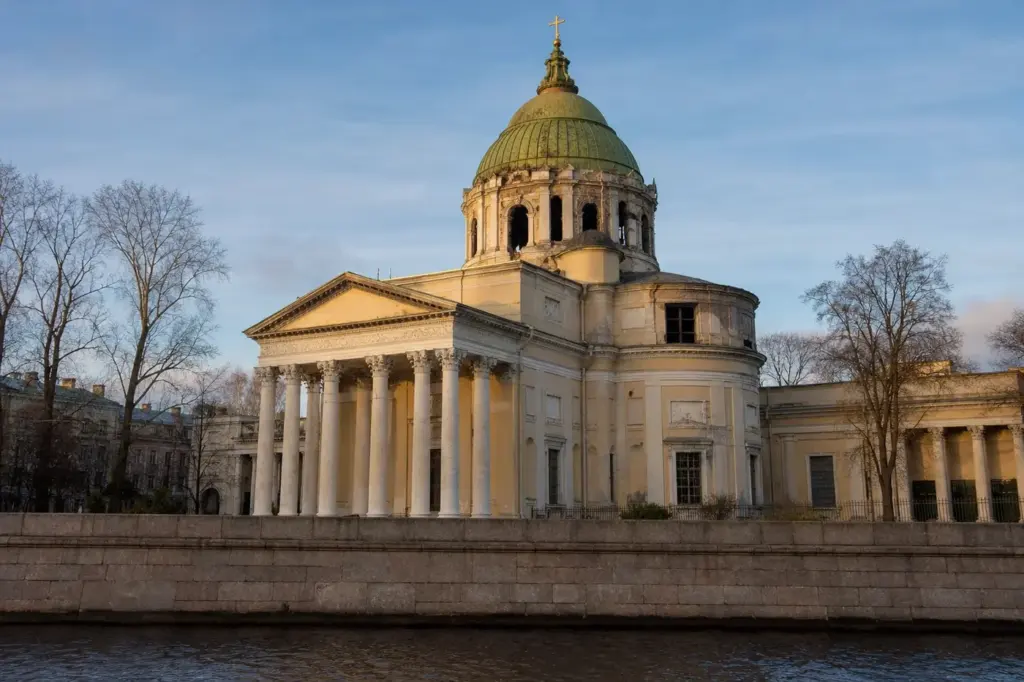
Annenkirche, Saint Petersburg is a distinctive landmark in the Tsentralny District of Saint Petersburg. The exterior reflects the restrained eighteenth-century classical design of Yury Felten. It looks relatively conventional from the street, which makes the interiors especially surprising. Visitors can understand its character by studying not only the principal feature but also the smaller details and the street or landscape around it. Unlike a generic sightseeing stop, this place has a specific historical function and a setting that explain why it belongs on a carefully planned walking route.
Darkened walls, damaged plaster and the great central volume preserve visible reminders of the devastating 2002 fire. The atmosphere is intentionally unlike a pristine reconstructed church. A visit works best when the public areas are clearly distinguished from separate venues or restricted rooms. The official events calendar is the reliable guide to whether the hall is available for an exhibition, service or concert. An ordinary visit should not be planned around a fixed daily opening schedule. This guide explains what can actually be seen, how to approach the site from central Saint Petersburg, and how to combine it with neighbouring attractions without assuming that every part of a historic complex is open.
Quick Facts
| Russian name | Анненкирхе (церковь Святой Анны) |
|---|---|
| Built / opened | 1779 |
| Architect(s) | Yury Felten |
| Address | Санкт-Петербург, Кирочная улица, дом 8, литера В Google MapsApple MapsYandex Maps2GIS |
| District | Tsentralny |
| Metro | Chernyshevskaya (Line 1, Walk towards Kirochnaya Street and continue to number 8.) Ploshchad Vosstaniya (Line 1, Continue northwest through the central streets towards Kirochnaya Street.) |
| Admission | Exhibition admission varies by programme; worship access follows parish arrangements. |
| Best time to visit | Spring and autumn provide moderate conditions for combining Annenkirche with a walk through nearby streets. Summer offers longer daylight for exterior photography; winter offers a different atmosphere but requires suitable clothing and caution on potentially icy pavements. For photographs, morning or late afternoon often makes architectural surfaces easier to read. The official events calendar is the reliable guide to whether the hall is available for an exhibition, service or concert. An ordinary visit should not be planned around a fixed daily opening schedule. |
| Website | annenkirche.com |
What Is (and Isn't) Part of a Visit to Annenkirche, Saint Petersburg?
| Part | Status | Notes |
|---|---|---|
| Church exterior | Included in the standard ticket | Church exterior can be appreciated as part of the ordinary public visit. |
| Main exhibition hall | Included in the standard ticket | Main exhibition hall can be appreciated as part of the ordinary public visit. |
| Lutheran services | Not open to visitors | Lutheran services is not open for independent visitor exploration. |
| Concert performances | Separate ticket or institution | Concert performances requires a separate programme or belongs to another attraction. |
| Temporary exhibition sections | Separate ticket or institution | Temporary exhibition sections requires a separate programme or belongs to another attraction. |
| Staff and technical rooms | Not open to visitors | Staff and technical rooms is not open for independent visitor exploration. |
| Kirochnaya Street | Outside / not part of it | Kirochnaya Street is nearby or outside the principal site and should not be confused with its admission scope. |
Why Visit Annenkirche, Saint Petersburg?
The interest of Annenkirche lies in the combination of the classical portico and street facade, the fire-marked main hall and the wider urban setting. Temporary creative displays change the way the hall is experienced. Installations should not be mistaken for permanent architectural fittings, and the current exhibition must be checked separately.
The building remains the home of a Lutheran congregation, not merely an art gallery. The devotional use explains why some periods are quieter or reserved for services. Allow time to look closely rather than merely passing through. Visitors interested in architecture can examine materials and proportions; history enthusiasts can connect the design with its original purpose; photographers can compare different viewpoints.
How Annenkirche, Saint Petersburg Is Laid Out
The site is easiest to understand by starting at the classical portico and street facade. From there, move towards the fire-marked main hall and continue to the current exhibition installations. The relationship between these elements explains the structure more clearly than treating them as isolated photo opportunities.
Musical events make use of the unusual acoustics and striking space. A concert is a separate event rather than a substitute for normal exhibition access. Public circulation routes may be distinct from interiors, exhibition spaces and neighbouring institutions. Kirochnaya Street takes its name from the church and offers an architectural context different from the grand Nevsky Prospekt corridor. Plan to finish with a look back at the main landmark from a greater distance: the surrounding streets, river or park often reveal proportions that are hidden when standing too close.
Highlights of Annenkirche, Saint Petersburg
The classical portico and street facade
The exterior reflects the restrained eighteenth-century classical design of Yury Felten. It looks relatively conventional from the street, which makes the interiors especially surprising. This feature is especially informative when compared with the fire-marked main hall. The contrast shows how different parts of the place serve different purposes: visual decoration, practical use, movement or historical memory. It also helps explain why a close view and a wider view can produce quite different impressions.
Tip: Begin with a clear view of the classical portico and street facade, then change position to compare its details with the overall setting; avoid assuming neighbouring buildings share the same visitor access.
The fire-marked main hall
Darkened walls, damaged plaster and the great central volume preserve visible reminders of the devastating 2002 fire. The atmosphere is intentionally unlike a pristine reconstructed church. This feature is especially informative when compared with the current exhibition installations. The contrast shows how different parts of the place serve different purposes: visual decoration, practical use, movement or historical memory. It also helps explain why a close view and a wider view can produce quite different impressions.
Tip: Begin with a clear view of the fire-marked main hall, then change position to compare its details with the overall setting; avoid assuming neighbouring buildings share the same visitor access.
The current exhibition installations
Temporary creative displays change the way the hall is experienced. Installations should not be mistaken for permanent architectural fittings, and the current exhibition must be checked separately. This feature is especially informative when compared with church services and community activity. The contrast shows how different parts of the place serve different purposes: visual decoration, practical use, movement or historical memory. It also helps explain why a close view and a wider view can produce quite different impressions.
Tip: Begin with a clear view of the current exhibition installations, then change position to compare its details with the overall setting; avoid assuming neighbouring buildings share the same visitor access.
Church services and community activity
The building remains the home of a Lutheran congregation, not merely an art gallery. The devotional use explains why some periods are quieter or reserved for services. This feature is especially informative when compared with concerts in the historic shell. The contrast shows how different parts of the place serve different purposes: visual decoration, practical use, movement or historical memory. It also helps explain why a close view and a wider view can produce quite different impressions.
Tip: Begin with a clear view of church services and community activity, then change position to compare its details with the overall setting; avoid assuming neighbouring buildings share the same visitor access.
Concerts in the historic shell
Musical events make use of the unusual acoustics and striking space. A concert is a separate event rather than a substitute for normal exhibition access. This feature is especially informative when compared with the kirochnaya street setting. The contrast shows how different parts of the place serve different purposes: visual decoration, practical use, movement or historical memory. It also helps explain why a close view and a wider view can produce quite different impressions.
Tip: Begin with a clear view of concerts in the historic shell, then change position to compare its details with the overall setting; avoid assuming neighbouring buildings share the same visitor access.
The Kirochnaya Street setting
Kirochnaya Street takes its name from the church and offers an architectural context different from the grand Nevsky Prospekt corridor. This feature is especially informative when compared with the classical portico and street facade. The contrast shows how different parts of the place serve different purposes: visual decoration, practical use, movement or historical memory. It also helps explain why a close view and a wider view can produce quite different impressions.
Tip: Begin with a clear view of the kirochnaya street setting, then change position to compare its details with the overall setting; avoid assuming neighbouring buildings share the same visitor access.
Atmosphere
The atmosphere around Annenkirche changes with the weather and the pace of the surrounding district. In daylight the architectural details and surfaces are easier to read, while quieter moments allow attention to shift from the main feature to its smaller elements. The contrast between the landmark and the everyday city around it is part of the experience.
The exterior reflects the restrained eighteenth-century classical design of Yury Felten. It looks relatively conventional from the street, which makes the interiors especially surprising. A slow walk often reveals the site more successfully than remaining at a single viewpoint. The character also depends on its use: a working public crossing, shop, religious building, palace, park or museum can feel different during active hours and quieter periods.
History of Annenkirche, Saint Petersburg
The Lutheran congregation had roots in Saint Petersburg’s early German-speaking community. Its original wooden church was moved as the city expanded. In 1775 construction began on a larger stone church designed by Yury Felten, and the new building was consecrated in 1779. It gave the community an enduring place of worship and contributed its name to Kirochnaya Street.
During the twentieth century the interior was radically repurposed and became associated with the Spartak cinema and later entertainment uses. A fire in 2002 severely damaged the building, leaving the scorched surfaces that became central to its later identity. After the building returned to Lutheran use, the congregation combined worship with concerts, exhibitions and cultural activities. Rather than erasing every mark of the fire, the space came to be known for the contrast between a dignified classical shell and its raw interior.
Tickets and Booking for Annenkirche, Saint Petersburg
| Ticket | Price | Includes |
|---|---|---|
| General visitor admission or scheduled event | ₽₽ | Admission only to the activity or public areas specified by the venue; check the official booking description. |
| Guided visit or special programme | ₽₽–₽₽₽ | The announced guided route or event, when offered; neighbouring institutions and unrelated rooms are not automatically included. |
₽ budget · ₽₽ moderate · ₽₽₽ upscale · ₽₽₽₽ splurge. Price levels are estimates compared with typical prices for visitors.
The most reliable booking route is the venue’s own website, where it distinguishes ordinary entry from scheduled exhibitions, tours, services or performances. Check exactly which spaces the selected ticket includes. The sales calendar may open in stages; a date not yet listed does not prove that an event is sold out.
Where an on-site cashier operates, same-day availability depends on the programme and remaining places. Take any proof required for a concession and follow the entrance instructions for the booked activity. Do not expect automatic admission to separate buildings or private rooms.
Rates for Russian citizens and concessions may differ. Check the official visitor or ticket page at www.annenkirche.com for the current categories and conditions.
Suggested itineraries Annenkirche, Saint Petersburg
30 minutes
Start with the classical portico and street facade and continue to the fire-marked main hall. Compare the details with the broader surroundings rather than rushing between stops. Where an interior or event is involved, use only the publicly available route for the selected programme. Finish by walking towards a nearby landmark to put the site in the context of central Saint Petersburg.
1 hour
Start with the classical portico and street facade and continue to the fire-marked main hall, then the current exhibition installations, then church services and community activity. Compare the details with the broader surroundings rather than rushing between stops. Where an interior or event is involved, use only the publicly available route for the selected programme. Finish by walking towards a nearby landmark to put the site in the context of central Saint Petersburg.
2 hours
Start with the classical portico and street facade and continue to the current exhibition installations, then concerts in the historic shell, then the kirochnaya street setting. Compare the details with the broader surroundings rather than rushing between stops. Where an interior or event is involved, use only the publicly available route for the selected programme. Finish by walking towards a nearby landmark to put the site in the context of central Saint Petersburg.
How to Get to Annenkirche, Saint Petersburg
By metro: Chernyshevskaya on Line 1 is a useful starting point. Walk towards Kirochnaya Street and continue to number 8.
Alternative: Ploshchad Vosstaniya on Line 1 also provides an approach. Continue northwest through the central streets towards Kirochnaya Street.
From the centre: Start from the Nevsky Prospekt area and use the metro or an up-to-date city map to connect with the nearest station. A taxi can be useful when weather or mobility makes the walk inconvenient; use the Russian address shown above to identify the correct location.
Accessibility
The practical accessibility of Annenkirche depends on the specific public area and any booked interior programme. Surrounding streets and pedestrian routes may involve kerbs, uneven historic surfaces and seasonal ice. Visitors using wheelchairs should confirm an appropriate entrance and available assistance directly with the operator before an interior visit; do not assume lifts, adapted toilets or free companion entry where these have not been verified. For exterior views, choose broad public approaches and avoid stairs leading down to embankments or restricted courtyards.
Food Nearby
Cafés, bakeries and casual restaurants can be found in the surrounding Saint Petersburg neighbourhood. The nearest useful choice depends on whether the visit ends at a metro station, canal, park entrance or major avenue. For a longer meal, seek streets with several options rather than assuming the attraction itself provides a café. Business openings and menus can change, so specific restaurant names have been omitted where their present operation was not independently verified.
What to Bring
Wear comfortable walking shoes and dress for the season. Bring a light waterproof layer during changeable weather and warm, slip-resistant footwear in winter. A phone with an offline map helps when moving through side streets or across bridges. For photography, a small camera is more convenient than bulky equipment. Keep personal belongings compact, particularly when visiting a working religious institution, museum or performance venue.
Best Views and Photo Spots of Annenkirche, Saint Petersburg
Facade on Kirochnaya Street
This viewpoint highlights facade on kirochnaya street and helps show the relationship between the landmark’s identifying details and its urban or park setting. Vary the framing to include some surrounding architecture rather than isolating every detail.
Best time: Morning for softer activity and clear detail
Main hall from entrance
This viewpoint highlights main hall from entrance and helps show the relationship between the landmark’s identifying details and its urban or park setting. Vary the framing to include some surrounding architecture rather than isolating every detail.
Best time: Late afternoon for side light
Central hall looking upward
This viewpoint highlights central hall looking upward and helps show the relationship between the landmark’s identifying details and its urban or park setting. Vary the framing to include some surrounding architecture rather than isolating every detail.
Best time: Daylight when architectural surfaces are visible
Exhibition installations
This viewpoint highlights exhibition installations and helps show the relationship between the landmark’s identifying details and its urban or park setting. Vary the framing to include some surrounding architecture rather than isolating every detail.
Best time: Early evening for atmosphere
Photography Rules
Exterior photography from ordinary public areas is generally possible, subject to posted instructions. Indoor photography and recording may be restricted during worship, performances or exhibitions. Ask staff before using flash or a tripod, and do not assume permission for commercial filming or drones. Respect private areas and keep pedestrian routes clear.
Family Suitability
Annenkirche can be a useful stop for families when the programme matches children’s interests. Short exterior visits are often easier for younger children than long interpretation-heavy tours; older children may enjoy identifying unusual architectural shapes and comparing historical details. The setting may include traffic, water, stairs or fragile exhibits, so adults should supervise closely. Check event age recommendations and stroller access before booking an interior programme.
Russia Vibes Tips
- Look for the classical portico and street facade rather than photographing only the best-known facade; its details help explain the original function of the place.
- Look for the fire-marked main hall rather than photographing only the best-known facade; its details help explain the original function of the place.
- Look for the current exhibition installations rather than photographing only the best-known facade; its details help explain the original function of the place.
- Look for church services and community activity rather than photographing only the best-known facade; its details help explain the original function of the place.
- Look for concerts in the historic shell rather than photographing only the best-known facade; its details help explain the original function of the place.
- Look for the kirochnaya street setting rather than photographing only the best-known facade; its details help explain the original function of the place.
Keep reading
Nearby
FAQ: Annenkirche, Saint Petersburg
What is the main reason to visit?
The most recognizable feature is the classical portico and street facade. The exterior reflects the restrained eighteenth-century classical design of Yury Felten. It looks relatively conventional from the street, which makes the interiors especially surprising. Visitors with limited time should begin there and then compare it with the neighbouring surroundings.
Can you visit without a guide?
It depends on the programme and which areas are available; consult the venue calendar. The official events calendar is the reliable guide to whether the hall is available for an exhibition, service or concert. An ordinary visit should not be planned around a fixed daily opening schedule.
What is included in an ordinary visit?
The public or ticketed areas specified in the scope section are the appropriate starting point. Neighbouring buildings and restricted interiors should not be treated as included merely because they share a historic setting.
Is advance booking necessary?
Advance booking is sensible when a specific exhibition, tour or performance is the main purpose. Special events may have separate arrangements.
Which metro station is useful?
Chernyshevskaya on Line 1 is a suitable approach. Walk towards Kirochnaya Street and continue to number 8. Check your starting point to choose the route requiring the fewest changes.
How long should the visit take?
A practical visit usually takes 45–90 minutes. The exact time depends on whether the plan includes an interior programme, careful photography or a longer walk through the surrounding neighbourhood.
Is it suitable for children?
Families can enjoy the visual features, especially the fire-marked main hall. Choose a short visit for younger children and confirm event age guidance for concerts, museums or exhibitions.
What can be combined with a visit?
Nearby options include Tauride Garden, Transfiguration Cathedral, Liteyny Prospekt. These are independent places, and any interior admission or event arrangements should be checked separately.
Russia Vibes is a one-person project. A coffee keeps it going
Hotels near Annenkirche, Saint Petersburg
Distances are straight-line, from OpenStreetMap data.
Planning your trip? Russia Travel Guide

Take this guide with you
Get a free PDF of this guide to print or read offline: key facts, tips and a map link on a few clean pages.
About this page
Report an issue on this page
Paying for your trip: please read
Payments and bookings between Russia and many other countries are currently restricted. In practice, cards issued in the EU, the UK, the US and several other countries often cannot be used in Russia, Russian cards usually cannot be used abroad, and some booking platforms, airlines and payment providers limit or pause their services for Russia. The situation changes frequently.
We do not give legal or financial advice, and this site does not encourage anyone to break any rule that applies to them. Whatever you plan, you are responsible for following the laws and regulations that apply to you, including those of your country of residence and citizenship.
Many travelers still organise their stay without problems. It is worth asking your bank or payment provider what is currently possible, contacting hotels, tour operators and carriers directly about the payment methods they accept, and checking which services are open to customers from your country. Clarify payment, cancellation and refund terms before you commit to a booking, and keep your plans flexible.
Partner links on this site may not be available in every country, and prices, availability and rules in our guides can differ from what you see when you book.
How we research and update our guides
About this guide: AI assistance and accuracy
This guide is created with the help of AI and is based on official sources where available. Mistakes can still happen. Opening hours, prices, rules and other details are given to the best of our knowledge as of the date shown and can change without notice. It offers general recommendations only, not professional, legal or travel advice. Please confirm important details with the official source before you travel; you are responsible for your own plans and decisions.
* Affiliate link: as an Amazon Associate we earn from qualifying purchases at no extra cost to you.