
Shirokaya Rechka is a residential neighborhood in Yekaterinburg‘s Akademicheskiy District, sprawling across the southwestern fringe of the city. Originally a workers’ settlement centered on a peat enterprise, it has transformed from a quiet cottage-home zone into a rapidly developing urban district with modern apartment blocks alongside older single-family homes.
For most visitors, Shirokaya Rechka remains off the main tourist path, but it offers a genuine view of how Yekaterinburg is reshaping its outer neighborhoods and preserves some distinctive historical layers worth exploring.
Quick Facts
| Russian name | Широкая Речка |
|---|---|
| Address | Yekaterinburg, Akademicheskiy District, Russia OpenStreetMap · Google Maps |
| District | Akademicheskiy District |
| Best time to visit | Spring (May–June) and autumn (September–October) offer mild weather and clear skies for walking and photography. Summer is warm but can be humid. Avoid winter unless you are prepared for snow and cold; the district is less maintained than the city center. Victory Day (May 9) brings ceremonial visits to the war memorial. Weekdays are quieter for exploring; weekends see more resident activity. |
What Is (and Isn't) Part of a Visit to Shirokaya Rechka, Yekaterinburg?
| Part | Status | Notes |
|---|---|---|
| Shirokorechenskoe Cemetery | Included in the standard ticket | The main historical site in the neighborhood; open to visitors. Contains war memorial, soldier graves, and graves of notable citizens. |
| Residential streets and cottage neighborhoods | Included in the standard ticket | Public streets; visitors may walk through the district to observe architecture and urban transformation. |
| Modern apartment complexes | Outside / not part of it | Private residential buildings; exterior viewing only from public streets. |
| Aurora residential complex | Outside / not part of it | A 25-story private apartment building; not open to non-residents. |
| Former peat factory site | Outside / not part of it | No longer exists as an accessible structure; mostly redeveloped or occupied by private residences. |
Why Visit Shirokaya Rechka, Yekaterinburg?
Shirokaya Rechka appeals to travelers interested in understanding contemporary Russia beyond the city center. The neighborhood reveals how Soviet-era industrial settlements are being redeveloped: the skeleton of the old peat industry and narrow-gauge railway are visible in place names and old structures, while new high-rises replace the cottage neighborhoods. The Shirokorechenskoe Cemetery is a substantial historical site with a Second World War memorial and graves of notable Yekaterinburg residents. For photographers and urban explorers, the district offers authentic residential landscapes and a mix of architectural eras.
Highlights of Shirokaya Rechka, Yekaterinburg
Shirokorechenskoe Cemetery War Memorial
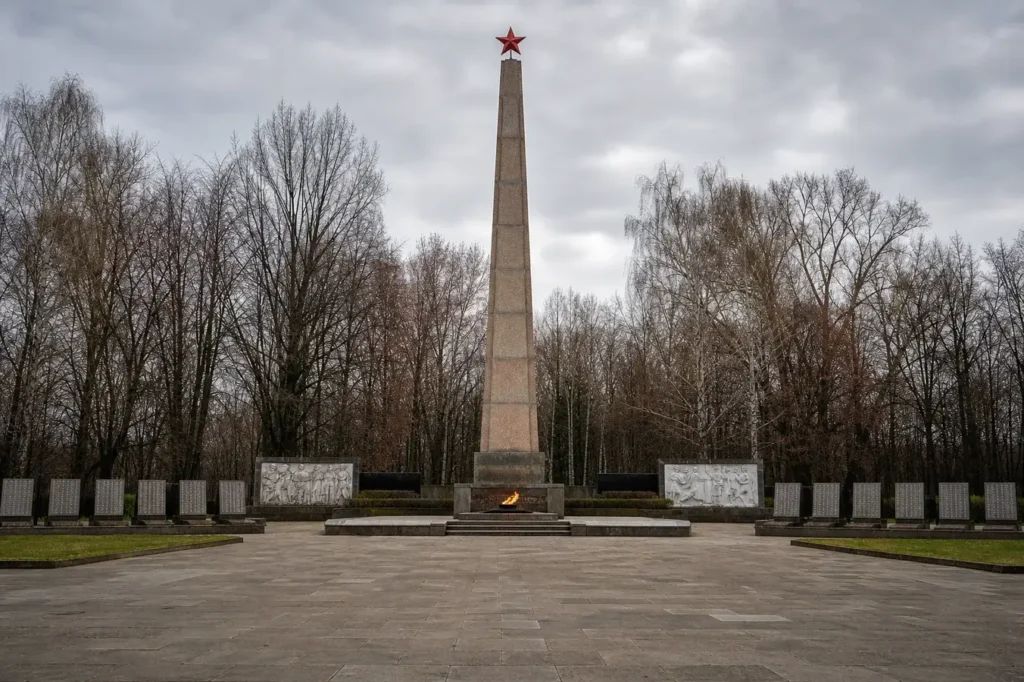
The cemetery contains a prominent war memorial featuring a tall stella topped with a Soviet star and eternal flame, surrounded by granite plaques bearing the names of fallen soldiers. The complex includes relief panels depicting major Second World War battles—Moscow, Leningrad, Stalingrad, Kursk, and Berlin. Located on the Moscow Highway (7 km from the city center), the memorial was restored for the anniversary of the war's end. The cemetery is the fourth largest in Yekaterinburg and contains the graves of many soldiers who died in local hospitals.
Tip: Visit on Victory Day (May 9) when locals leave flowers at the memorial. Buses heading to Raduga Shopping Mall pass the cemetery.
Residential Architecture Transition
The neighborhood's built landscape captures the evolution of Russian housing over two decades. Before 2000, Shirokaya Rechka consisted almost entirely of detached cottages and small residential homes. In the late 2000s, this changed dramatically with the arrival of multi-story apartment blocks (10–17 floors) along Sobolev Street. The 25-story Aurora complex became a local landmark when completed, housing 1,300 apartments. Walking the area reveals the physical clash between old and new development patterns.
Tip: Sobolev Street shows the most dramatic transformation. Compare the cottage neighborhoods to the east with the modern tower clusters to the west for a clear sense of this shift.
Peat Industry Heritage
Shirokaya Rechka grew as a workers' settlement around a peat enterprise that operated a brick factory and narrow-gauge railway. Though the industrial complex is largely gone, the neighborhood's name and street layouts preserve this history. Old railway beds and former factory sites are scattered through the district, and local residents remember the narrow-gauge trains that once connected the settlement to Yekaterinburg proper.
Tip: Local guides or community members can point out remnants of the old railway line and former factory boundaries, though these are not formally marked.
Atmosphere
Shirokaya Rechka feels like an outer neighborhood in any growing Russian city—part suburban calm, part urban construction site. The pace is noticeably slower than central Yekaterinburg, with tree-lined streets and stretches of intact cottage neighborhoods that still dominate the eastern portions. In recent years this quiet has been disrupted by cranes and new buildings, especially along main roads. Families, retirees, and workers make up the resident population. The mix of old architecture, new development, and semi-rural fringes creates an unpolished, authentic urban atmosphere without the heritage tourism infrastructure of the city center.
History of Shirokaya Rechka, Yekaterinburg
Shirokaya Rechka’s story begins in the 1930s–1950s as Soviet industry expanded across the Urals. A peat extraction enterprise was established in the area, and around it grew a settlement to house workers. The peat facility operated a briquette factory and even a narrow-gauge railway to transport materials. This industrial anchor earned the settlement official status as a workers’ settlement (posyolok) by the mid-20th century, with a population that fluctuated between 1,100 and 5,000 residents depending on the period.
From the 1950s through the 1990s, Shirokaya Rechka remained a quiet, peripheral zone of cottage homes and small residential streets. It belonged to the Verkh-Isetsky District administrative structure but was often overlooked in city planning. The peat industry gradually declined after the Soviet collapse, and by the 1990s the settlement had shifted to purely residential use.
The 2000s brought the first major transformation. Rising property values in Yekaterinburg’s center pushed developers outward, and Shirokaya Rechka’s relatively low land costs made it attractive for large housing projects. Beginning around 2008–2010, multi-story apartment towers began replacing cottage zones along main arteries, particularly Sobolev Street. The Aurora complex (2010s) became the symbolic centerpiece of this redevelopment. In 2021, administrative reorganization brought Shirokaya Rechka into the newly formed Akademicheskiy District, formally integrating it into the city’s modern structure.
Today the neighborhood is marked by this duality: older cottage neighborhoods persist in the south and east, while new residential towers cluster in the north and along transit corridors. The Shirokorechenskoe Cemetery remains a fixed historical anchor, preserving memory of Second World War soldiers and notable citizens.
Legends and Myths about Shirokaya Rechka, Yekaterinburg
The Peat Railway Phantom
Legend – historically unreliable. Local residents and historians speak of the narrow-gauge railway that once ran from the peat factory through Shirokaya Rechka to connect with the main Yekaterinburg rail lines. Old-timers claim small steam locomotives hauled peat briquettes daily, and the route shaped early street layouts. Though the railway has been entirely removed, its bed persists as a slightly raised or sunken line in some places. Whether this is folklore or collective memory of real infrastructure is unclear, but the story persists among long-time residents as part of the district's industrial identity.
The Buried Factory
Disputed by historians. Some accounts suggest the original peat factory complex lies beneath modern housing developments, with underground structures and storage vaults sealed but not demolished. Residents report that construction crews occasionally uncover brick foundations, machinery parts, and coal dust while building new apartments. The narrative frames this as a deliberate Soviet practice—building over rather than removing industrial infrastructure—though no archaeological survey has confirmed the extent of buried facilities.
Tickets and Booking for Shirokaya Rechka, Yekaterinburg
Shirokaya Rechka is a residential neighborhood open to public access. There are no tickets required to visit or walk through the district. The Shirokorechenskoe Cemetery is free to enter. Most access is on foot; buses serve the area, connecting to the metro system and city center.
Plan and Book
Advertisement: these are partner links. If you book or buy through them, we may earn a commission at no extra cost to you.
Suggested itineraries Shirokaya Rechka, Yekaterinburg
1–2 hours
Walk from the cemetery to view the war memorial and surrounding graves. Return to the main road and explore Sobolev Street on foot to see the contrast between old cottage neighborhoods and modern apartment towers. Stop at a local café or shop if present.
Half day
Begin at the cemetery for the war memorial and historical context. Walk through the older cottage neighborhoods in the eastern portions to understand the pre-2000s character. Gradually move west to observe the newer high-rise developments and Aurora complex from the outside. Visit local shops or cafés to get a sense of daily life. End by walking along a main boulevard to see how the neighborhood connects to surrounding areas.
How to Get to Shirokaya Rechka, Yekaterinburg
Shirokaya Rechka is not directly served by metro. The nearest station is on the Red Line (Line 1), several kilometers away. Most visitors take a local bus from the metro system or city center. Buses heading to Raduga Shopping Mall and other southern destinations pass through the neighborhood on the Moscow Highway (7-km mark from downtown). A taxi or ride-share app (Yandex Taxi, Uber) is the quickest option from central Yekaterinburg for the Shirokorechenskoe Cemetery or specific addresses. The neighborhood sprawls over about 4 km², so having transport or planning a walking route in advance is advisable.
Accessibility
The neighborhood is flat and consists of streets and public pavements, making it generally walkable. The Shirokorechenskoe Cemetery is accessible on foot with basic paths. Specific facilities for wheelchair users or mobility assistance at the cemetery are not publicly detailed; contact local authorities for current accessibility information. Public toilets are limited; plan accordingly.
Food Nearby
Shirokaya Rechka is a residential area with limited commercial development compared to the city center. Local shops and small cafés exist along main streets, but choices are basic. Raduga Shopping Mall (nearby, serving the district) may have food options. For reliable dining, travel back toward the city center or use delivery apps. Bread shops, convenience stores, and small grocers serve residents but are not tourist destinations.
What to Bring
Comfortable walking shoes are essential, as the district requires walking between scattered sites. Bring water, especially in summer. Layers for temperature changes (spring/autumn). A camera for architectural photography and urban landscapes. Sun protection (hat, sunscreen) in clear weather. No specific security items are needed; the area is residential and safe.
Best Views and Photo Spots of Shirokaya Rechka, Yekaterinburg
Shirokorechenskoe Cemetery War Memorial stella
The tall stella with the Soviet star and eternal flame is the most iconic structure in the neighborhood. Shot from the front, it dominates the memorial complex. The granite plaques and relief panels depicting Second World War battles surround it, creating visual context.
Best time: Early morning light creates dramatic shadows on the stella; late afternoon (4–5 pm) captures warm, golden light. Victory Day (May 9) brings flowers and flags for ceremonial photographs.
Sobolev Street looking east to west
One vantage captures the architectural contrast: old cottage homes in the foreground with modern multi-story towers rising in the background. This visual juxtaposition illustrates the neighborhood's transformation.
Best time: Afternoon when modern buildings catch side light. Clear days show the height contrast most dramatically. Avoid midday direct sun, which flattens depth perception.
Aurora residential complex from Sobolev Street
The 25-story complex is visible from multiple street angles and dominates the local skyline. Frame it from street level to show its scale relative to surrounding older buildings.
Best time: Golden hour (early morning or late afternoon) shows architectural detail. Cloudy days render modern tower facades more evenly.
Photography Rules
Photography is generally permitted in public spaces and at the cemetery memorial. The war memorial and cemetery grounds are appropriate for respectful photography. Avoid photographing residents in private homes. Note that restoration or maintenance may affect the condition of monuments or structures; check current conditions before planning a photo visit.
Family Suitability
Shirokaya Rechka is suitable for family walks and exploration of a working residential neighborhood. The mostly flat streets are stroller-friendly. The cemetery is peaceful and educational for older children learning about history, though younger children may find it sobering. There are no specialized attractions (playgrounds, museums, entertainment) aimed at children in the neighborhood itself. Families interested in urban development, architecture, and seeing how ordinary Russians live in outer districts will find it rewarding. Access to shops and cafés is limited, so plan meals beforehand.
Russia Vibes Tips
- The cemetery is the primary reason to visit; plan your trip accordingly. Allow 45 minutes to an hour for the war memorial alone if you read plaques and examine the relief panels.
- Bring a map or use offline maps on your phone; street names repeat across the neighborhood, and Cyrillic signs can be confusing for non-Russian speakers.
- Visit on a weekday morning to avoid crowds and experience the neighborhood's quieter character. Weekends bring more local resident activity.
- Do not expect restaurants, museums, or shops of tourist quality. This is an authentic residential zone; treat it as such and plan food and necessities before arriving.
- The Aurora complex and other modern buildings are private residential properties; respect privacy and do not enter or photograph residents.
- If interested in the peat industry history, ask local older residents (if your Russian permits or with a guide). They retain vivid memories of the factory era and narrow-gauge railway.
Where to Find Shirokaya Rechka, Yekaterinburg in Russia
More chains in Russia
 Chkalovsky, Yekaterinburg
Main image: AI-generated illustration. It may not show the place exactly as it looks.
 Downtown/City Center, Yekaterinburg
Main image: AI-generated illustration. It may not show the place exactly as it looks.
 Kirovsky, Yekaterinburg
Main image: AI-generated illustration. It may not show the place exactly as it looks.
 Leninsky, Yekaterinburg
Main image: AI-generated illustration. It may not show the place exactly as it looks.
 Uralmash, Yekaterinburg
Main image: AI-generated illustration. It may not show the place exactly as it looks.
 Verkh-Isetsky, Yekaterinburg
Main image: AI-generated illustration. It may not show the place exactly as it looks.
Browse more: More in Akademicheskiy District · All Hidden Russia · All Neighborhoods · All Neighborhoods in Yekaterinburg · All Yekaterinburg
FAQ: Shirokaya Rechka, Yekaterinburg
Is Shirokaya Rechka part of Yekaterinburg city?
Yes. It was incorporated into Yekaterinburg in 2004 as a residential microdistrict. Originally a separate workers' settlement (posyolok), it is now administratively part of the Akademicheskiy District.
What is the main reason to visit Shirokaya Rechka?
The Shirokorechenskoe Cemetery and its Second World War memorial. It is one of the largest cemeteries in the region and contains graves of soldiers and notable Yekaterinburg residents. The memorial is historically significant.
How do I get to Shirokaya Rechka from the city center?
There is no direct metro connection. Take a local bus from the city center or nearest metro station toward the southern suburbs (buses to Raduga Shopping Mall pass through). Alternatively, use a taxi or ride-share app. Travel time is 20–40 minutes depending on traffic.
Is Shirokaya Rechka safe to visit?
Yes, it is a safe residential neighborhood. There are no known risks to visitors walking during daylight hours. Standard urban precautions apply, but crime is not an issue compared to major cities.
What was Shirokaya Rechka originally?
A workers' settlement built around a peat extraction enterprise in the mid-20th century. The peat factory produced briquettes and operated a narrow-gauge railway. This industrial base shaped the neighborhood until the late 1990s.
What is the Aurora complex?
A 25-story residential apartment building built in the 2010s with 1,300 units. It symbolizes the modern redevelopment of Shirokaya Rechka from a cottage neighborhood to a high-density urban zone. It is a private building, not open to tourists.
Are there restaurants or shops in Shirokaya Rechka?
Basic residential shops and small cafés exist but are limited. Raduga Shopping Mall nearby offers more options. For dining and shopping, plan to return to central Yekaterinburg or use delivery services.
Can I take photos in the cemetery?
Yes, photography in the cemetery and at the war memorial is permitted. Photograph respectfully, avoiding graves. The memorial and relief panels are the most significant subjects.
Russia Vibes is a one-person project. A coffee keeps it going
How we research and update our guides
About this guide: AI assistance and accuracy
This guide is created with the help of AI and is based on official sources where available. Mistakes can still happen. Opening hours, prices, rules and other details are given to the best of our knowledge as of the date shown and can change without notice. It offers general recommendations only, not professional, legal or travel advice. Please confirm important details with the official source before you travel; you are responsible for your own plans and decisions.

Take this guide with you
Get a free PDF of this guide to print or read offline: key facts, tips and a map link on a few clean pages.
Report an issue on this page
Paying for your trip: please read
International sanctions affect payments between Russia and many other countries. In practice, cards issued in the EU, the UK, the US and several other countries often do not work in Russia, Russian cards usually do not work abroad, and some booking platforms, airlines and payment providers limit or suspend their services for Russia. The situation changes frequently.
We do not give legal or financial advice, and this site does not encourage anyone to break or circumvent sanctions. Whatever you plan, you are responsible for following the laws and regulations that apply to you, including those of your country of residence and citizenship.
Many travelers still organise their stay lawfully. It is worth asking your bank or payment provider what is currently permitted, contacting hotels, tour operators and carriers directly about the payment methods they accept, and checking which services are open to customers from your country. Clarify payment, cancellation and refund terms before you commit to a booking, and keep your plans flexible.
Partner links on this site may not be available in every country, and prices, availability and rules in our guides can differ from what you see when you book.