
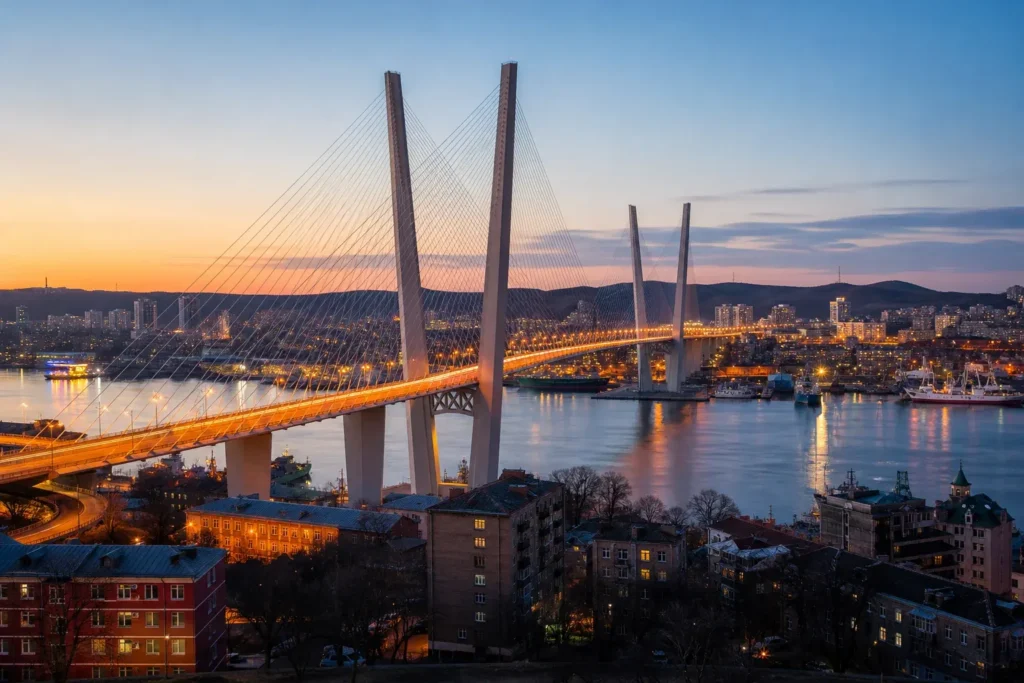
This three-day itinerary introduces first-time visitors to Vladivostok, a dramatic port city in Russia’s Far East where land and sea meet. The route assumes a moderate pace, mixing essential city landmarks with excursions to offshore islands and military heritage sites. You’ll walk the embankments that define the city, cross two of the world’s most striking cable-stayed bridges, explore a sprawling fortress museum, and discover why locals compare their city to San Francisco: hilly, coastal, and surrounded by fog.
By the end of these three days in Vladivostok, you will have seen the defining architecture of the post-Soviet Far East, understood the city’s military and naval past, and experienced the geography that has shaped Vladivostok since its founding as a garrison port.
At a glance: Day 1 focuses on city landmarks: the Golden Bridge, railway station, embankments, and hillside viewpoints. Day 2 crosses the Russky Bridge to explore the offshore island and its military fortifications. Day 3 dives into the Vladivostok Fortress Museum complex and local maritime museums before concluding at the submarine S-56.
Day 1: Bridges and Embankments
Start with Vladivostok's most recognizable symbols: the two cable-stayed bridges built for the 2012 APEC summit. Walk the waterfront embankments to understand the city's relationship with the sea, visit the iconic railway station, and climb to viewing platforms for panoramic perspectives. This day establishes Vladivostok's geographic and architectural character without requiring tickets or advance planning.
- Golden Bridge (Zolotoy Most) – Cable-stayed span across Golden Horn Bay with pedestrian walkways; pause mid-bridge for city and water views (30 minutes)
- Svetlanskaya Street – Historic main thoroughfare with shops, cafes, and notable buildings including the GUM department store (1–1.5 hours)
- Vladivostok Railway Station – Neo-Byzantine palace-like terminus; interior worth viewing even if not traveling (30 minutes)
- Korabelnaya and Tsesarevich Embankments – Waterfront promenade with naval memorials and sea views (1.5–2 hours)
- Eagle's Nest Hill viewpoint – Steep climb to highest observation point overlooking city, bridges, and bays (1 hour round trip)
Tip: Visit the Golden Bridge early in the day, particularly on a clear morning. Fog is common, especially in summer and autumn, and can obscure the bridges and views within hours. The pedestrian walkway is free and open during daylight.
Day 2: Russky Island and Offshore Fortifications
Cross the Russky Bridge to visit the island that was closed to civilian access until 2012. Explore the Voroshilov Battery, a twin-turret coastal fortress now a museum branch, and hike through military ruins set against coastal landscape. The bridge itself is a significant sight; driving or walking across it takes 20–30 minutes depending on stops. This day reveals the strategic geography behind Vladivostok's founding.
- Russky Bridge – Cable-stayed structure; the world's second-longest, spanning Eastern Bosphorus strait with highest pylons and longest cable stays in the world (30 minutes–1 hour crossing or viewing)
- Voroshilov Battery – Twin-turret fortress with three underground levels; branch of the Pacific Fleet Museum; check the official website for current access (1.5–2 hours)
- Russky Island beaches and military ruins – Pristine bays and hillside fortification remains; free to explore (1–2 hours, depending on routes taken)
Tip: Begin the Russky Bridge crossing in the afternoon for better light and fewer vehicles. The island can be cold and windswept even when the mainland is mild. Bring sturdy shoes for uneven ground around fortifications. Verify Voroshilov Battery hours on the official website before visiting; winter access may be limited.
Day 3: Fortress Museum and Submarine Heritage
Spend the morning in the sprawling Vladivostok Fortress Museum, a 200-hectare complex with outdoor displays of Soviet-era military machinery and casemate exhibitions on fortification history. The fortress was built in 1877 but never saw combat. Finish with the S-56 submarine museum in the city center. Both sites require tickets but reflect Vladivostok's identity as a strategic garrison and naval power.
- Vladivostok Fortress Museum – Large-scale defensive complex with military equipment displays and underground casemates; budget 2–3 hours (₽₽)
- SubmarineS-56 Museum – Decommissioned Soviet submarine on display; guided tours available; check hours in advance (1 hour)
- Narkovskoye (Arsenal) Memorial complex – Naval war memorial near the fortress (30 minutes)
- Sukhanov House Museum – 19th-century wooden mansion offering domestic history contrast to military sites; check opening hours (45 minutes–1 hour)
- Central Square (Ploshchad Bortsov Revolyutsii) – Soviet monument and gathering space; walk and café break (30 minutes)
Tip: Visit the Fortress Museum early in the day; it closes at 6 pm and you need at least 2 hours to see both outdoor and indoor exhibits. The S-56 submarine is close to the city center and is a short stop. Many museums close on Mondays; verify hours before your visit. Check the official websites for the most current opening times, as they can change seasonally.
Russia Vibes Tips
- Vladivostok is consistently shrouded in fog, especially from May through October. Plan outdoor activities for early morning when visibility is best. Bridges and viewpoints may be obscured within hours. Winter (December–February) offers clearer skies but cold temperatures and occasional snow.
- The city is very hilly. Sturdy, comfortable walking shoes are essential. The funicular railway on Svetlanskaya Street can help with elevation changes, but understanding which streets go uphill helps you plan efficient routes.
- Most museums and attractions are open daily except Mondays. Always check official websites or call ahead before your visit, especially if you're traveling in winter or during public holidays, as hours vary. Many sites post schedules on their websites; verify times for attractions.
- The Russky Bridge can be crowded in mid-morning and late afternoon. Walk or drive it early or very late in the day for fewer people and better light. On clear evenings, the bridge and skyline offer exceptional photography angles.
- Bring cash (rubles) to museums; many smaller sites accept only cash at ticket windows. Card payment is common in central shops and cafes but not everywhere. ATMs are readily available on Svetlanskaya Street and near the railway station.
- Vladivostok is closer to Tokyo (under 3 hours by flight) than to Moscow (9 hours). The city feels more Pacific-oriented than Russian in atmosphere. Most signage is in Russian; learn basic Cyrillic before traveling or use translation apps for menu reading and navigation.
Explore Nearby Three Days in Vladivostok, Vladivostok
Browse more: All First-Time Itineraries · All Itineraries · All Itineraries in Vladivostok · All Vladivostok
FAQ
Can you walk across the Golden Bridge?
Yes. Special pedestrian tracks run the length of the bridge on a calm day. The bridge is free for pedestrians. On windy or foggy days, walking may feel uncomfortable due to exposure and limited visibility. The crossing takes 20–30 minutes at a normal pace.
Do you need a ticket to see the Russky Bridge?
No. The bridge is free to cross by car or on foot (via separate pedestrian paths). You can stop at viewpoints along the bridge road without paying. However, specific attractions on Russky Island, like the Voroshilov Battery museum, require entry tickets.
How long does the Russky Bridge crossing take?
Approximately 20–30 minutes by car, depending on traffic and stops. On foot, allow 1–2 hours if you pause for photos and views. Pedestrians use a separate safe path parallel to the vehicle lanes.
Is the Vladivostok Fortress Museum worth a full day?
No, but it merits 2–3 hours. The site covers 200 hectares with outdoor machinery displays and underground casemate exhibitions. Most visitors need 2–3 hours to see highlights. The outdoor areas are self-guided; indoor exhibits have limited text, so a guide is helpful for context.
Can you visit the S-56 submarine year-round?
Generally yes, but hours vary by season. Check the official website before your visit. Winter weather or special events may affect access. Tours are usually available but may require advance booking on busy days.
What should I know about visiting in winter?
Winter (December–February) brings clear skies and excellent visibility for bridges and panoramic views, but temperatures drop to freezing. Many outdoor sites remain accessible, but some museum hours may contract. Fog is less common but snow and ice can affect transport. Layer clothing and wear insulated boots.
Is a guide necessary in Vladivostok?
Not essential but helpful. Independent visitors can navigate the main attractions using maps and walk descriptions. However, fortification history, military significance, and local context are better understood with expert commentary. Many museums do not provide extensive English-language information.
Can you reach Vladivostok by train?
Yes, the city is a major terminus of the Trans-Siberian Railway. The journey from Moscow takes about 7 days. Vladivostok Railway Station is a spectacular landmark and serves regional connections. International flights are faster; Tokyo and Seoul are direct regional gateways.
Russia Vibes is a one-person project. A coffee keeps it going
How we research and update our guides
About this guide: AI assistance and accuracy
This guide is created with the help of AI and is based on official sources where available. Mistakes can still happen. Opening hours, prices, rules and other details are given to the best of our knowledge as of the date shown and can change without notice. It offers general recommendations only, not professional, legal or travel advice. Please confirm important details with the official source before you travel; you are responsible for your own plans and decisions.

Take this guide with you
Get a free PDF of this guide to print or read offline: key facts, tips and a map link on a few clean pages.
Report an issue on this page
Paying for your trip: please read
International sanctions affect payments between Russia and many other countries. In practice, cards issued in the EU, the UK, the US and several other countries often do not work in Russia, Russian cards usually do not work abroad, and some booking platforms, airlines and payment providers limit or suspend their services for Russia. The situation changes frequently.
We do not give legal or financial advice, and this site does not encourage anyone to break or circumvent sanctions. Whatever you plan, you are responsible for following the laws and regulations that apply to you, including those of your country of residence and citizenship.
Many travelers still organise their stay lawfully. It is worth asking your bank or payment provider what is currently permitted, contacting hotels, tour operators and carriers directly about the payment methods they accept, and checking which services are open to customers from your country. Clarify payment, cancellation and refund terms before you commit to a booking, and keep your plans flexible.
Partner links on this site may not be available in every country, and prices, availability and rules in our guides can differ from what you see when you book.