
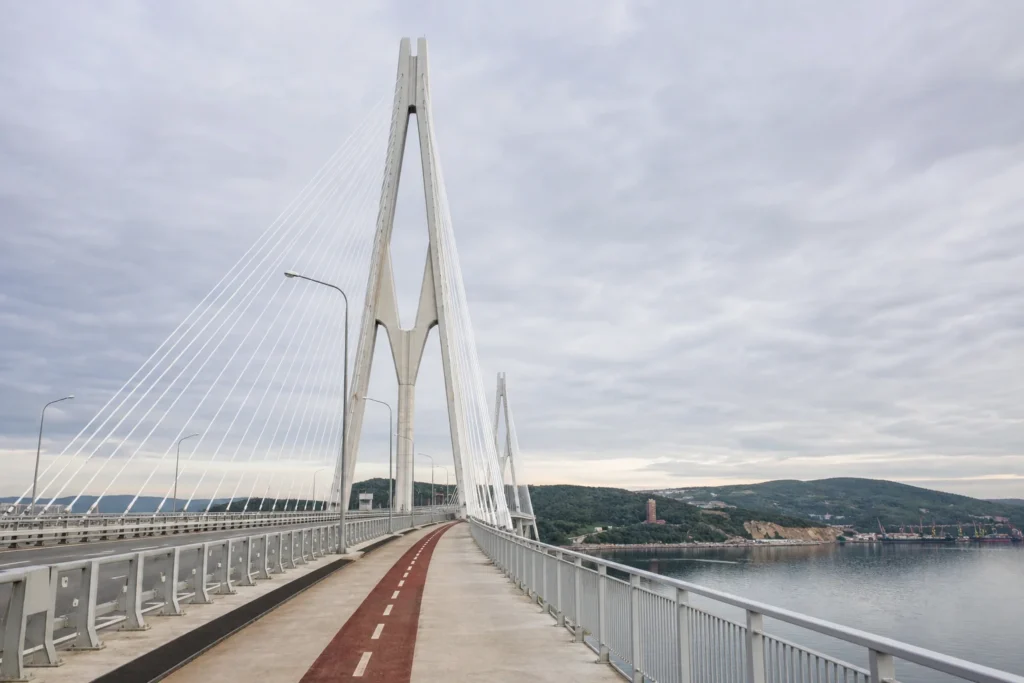
Russky Island, accessed via the iconic Russky Bridge, is a major day trip from Vladivostok that combines stunning engineering with university campus exploration and coastal views. The bridge itself—one of the longest cable-stayed spans globally at 3.1 km—opened in 2012 and connects the island to the mainland.
The island is home to the Far Eastern Federal University (FEFU) campus, a sprawling modern complex that occupies much of the accessible area. Visitors come for the bridge views, campus architecture, and the rare chance to see a Russian university built for the 2012 APEC Summit.
Quick Facts
| Russian name | Остров Русский, Русский мост, кампус ДВФУ |
|---|---|
| Distance from the nearest major city | 9,300 km |
| Travel time from the nearest major city | about 9 hours by flight |
| Built / opened | 2012 |
| Architect(s) | Vladimir Tokarev (bridge engineer); architectural team led by architect Norman Foster (for bridge design concept) |
| Address | Russky Island, Vladivostok OpenStreetMap · Google Maps |
| Opening hours | Daily 24 hours (bridge); FEFU campus hours vary by building |
| Best time to visit | Late May through September offers the most reliable weather—clear skies, manageable temperatures, and minimal rain. Mornings provide the best light for bridge photography and views of the mainland. Avoid November to March, when fog, rain, and cold limit visibility and comfort. Weekday mornings see fewer campus visitors than weekends, making the island feel quieter and more peaceful. |
| Recommended duration | 3–4 hours |
| Website | dvfu.ru |
What Is (and Isn't) Part of a Visit to Russky Island with the Russky Bridge and FEFU campus, Vladivostok?
| Part | Status | Notes |
|---|---|---|
| Russky Bridge pedestrian and cycling path | Included in the standard ticket | Free to cross on foot or by bicycle; vehicle drivers pay a toll. The 3.1 km crossing takes 20–30 minutes each way. |
| FEFU campus grounds and waterfront | Included in the standard ticket | Open to the public during daylight hours. Most outdoor areas, pathways, and the waterfront promenade are accessible without a ticket or ID. |
| FEFU campus buildings (interior) | Not open to visitors | Academic buildings, library, student centers and dormitories are for students and official visitors only. Do not attempt to enter restricted areas. |
| Island forests and remote beaches | Outside / not part of it | Most of the island beyond the main campus complex is undeveloped, forested, and either inaccessible or poorly marked. The interior should not be explored without local guidance. |
| Popov Island | Not open to visitors | This neighboring island is a protected nature reserve and military area, clearly visible from Russky Island but not accessible to visitors. |
How to Get from the nearest major city to Russky Island with the Russky Bridge and FEFU campus, Vladivostok
| Option | Duration | Price | Notes |
|---|---|---|---|
| Shuttle bus from central Vladivostok | 40–50 minutes including wait time | ₽ | Official FEFU shuttle buses run from central Vladivostok to the campus. Schedule varies; check with the university or Vladivostok tourism office for current times. This is the most convenient option if you don't have a car or bicycle. |
| Taxi or ride-hailing app | 25–35 minutes depending on traffic and starting point | ₽₽ | Yandex Taxi and other ride-hailing services serve the route. Fares vary by time of day; peak hours in morning and evening are more expensive. |
| Rental bicycle or e-bike from Vladivostok | 1–1.5 hours cycling plus return | ₽ | Vladivostok has several bike rental shops near the waterfront. Cycling across the bridge is scenic but exposed to wind; bring layers. The bridge path is well-maintained and dedicated for pedestrians and cyclists. |
| Personal car or rental car | 25–35 minutes depending on traffic | ₽₽ | Parking is available at the FEFU campus entrance. The bridge toll-free for private vehicles. This gives maximum flexibility for exploring the island and side roads. |
₽ budget · ₽₽ moderate · ₽₽₽ upscale · ₽₽₽₽ splurge. Price levels are estimates compared with typical prices for visitors.
Why Visit Russky Island with the Russky Bridge and FEFU campus, Vladivostok?
The Russky Bridge is an engineering marvel—its cable-stayed design and length make it visually striking and a symbol of Russia’s infrastructure ambitions in the Far East. Walking or cycling across it offers panoramic views of Amur Bay and surrounding mountains. The FEFU campus features contemporary architecture worth exploring, and the island’s remote, forested setting contrasts sharply with urban Vladivostok. Photography enthusiasts find excellent vantage points along the bridge and at campus overlooks.
Highlights of Russky Island with the Russky Bridge and FEFU campus, Vladivostok
The Russky Bridge Cable Stays
The bridge's most distinctive feature is its pair of diamond-shaped pylon towers rising 160 meters above the deck, supporting massive cables that fan out to hold the span. From the pedestrian/cycling path, these pylons frame views of Amur Bay. Look for the cable arrangements at mid-span and from the embankments on either side—they photograph dramatically in morning and late afternoon light.
Tip: The bridge is most striking photographed from Vladivostok's waterfront before crossing, or from Russky Island shore looking back toward the mainland.
FEFU Campus Waterfront
The Far Eastern Federal University occupies 1,630 hectares on the island. The main campus buildings cluster near the bridge entrance, featuring modern angular architecture built for the 2012 APEC Summit. The waterfront promenade offers unobstructed views across Amur Bay toward the mainland and surrounding headlands.
Tip: Much of the campus is accessible without special permission, but respect building boundaries and avoid entering administrative offices. Campus maps are available at the main entrance.
Amur Bay Vista from the Bridge
Walking or cycling the 3.1 km bridge takes 20–30 minutes and rewards you with 360-degree views of Amur Bay. On clear days, you can see the narrow strait separating Russky Island from Popov Island to the east, and the mountains of the Vladivostok mainland to the northwest. This is one of Vladivostok's best vantage points for understanding the city's geography.
Tip: Go on a clear day; morning light favors mainland views, while late afternoon backlights the bay. On overcast or rainy days, the bridge experience is far less rewarding.
Island Forests and Beaches
Beyond the main campus, Russky Island is heavily forested and largely undeveloped. Small beaches and coves exist along the island's perimeter, though most are not clearly marked or easily accessible. The island feels surprisingly wild for being connected to a major city.
Tip: Do not stray far from marked paths or the campus; the interior of the island can be difficult to navigate and some areas may be restricted.
Popov Island in the Distance
From the bridge or campus waterfront, Popov Island is visible across a narrow strait. This is a nature reserve and strictly off-limits to visitors, but worth noting as part of the scenic context. Its rocky shores and lighthouse are visible from Russky Island.
Tip: Popov Island is not accessible; do not attempt to cross the strait. It is a protected nature reserve and military area.
Atmosphere
Russky Island feels removed from Vladivostok despite the bridge connection—it’s windier, quieter, and more expansive than the city center. The FEFU campus brings student life and activity, but large portions of the island remain undeveloped forest. The bridge itself is exhilarating to cross on foot or by bike, with wind often noticeable mid-span. On clear days, the views are panoramic and calming; fog or rain can make the experience gray and isolating. Late morning and afternoon bring more campus activity and better light; early morning feels almost deserted.
History of Russky Island with the Russky Bridge and FEFU campus, Vladivostok
Russky Island was long a strategic military location, with fortress installations and coastal defenses built during the Russian Empire. In the Soviet era, it remained restricted to military and civilian researchers. The island’s transformation began in the early 2000s when the Russian government decided to develop it as a modern university center and economic hub for the Far East.
The Russky Bridge, formally the Vladimir Tokarev Bridge, was constructed between 2008 and 2012 as the primary access route for the Far Eastern Federal University campus. Designed by structural engineer Vladimir Tokarev, with input from international design teams, the cable-stayed span became one of the world’s longest of its type at completion. The bridge’s 160-meter pylons and 3.1 km length symbolized Russia’s commitment to infrastructure development in the Far East during a period of economic growth.
FEFU itself was established at its current Russky Island location in 2010, with the main campus buildings completed by 2012 for the APEC Summit, an international economic conference hosted by Russia that year. The university consolidated several Far Eastern institutions into one large federal university, reflecting Moscow’s strategy to strengthen higher education and economic ties across the Russian Pacific region. Today, FEFU operates as a major research and educational institution with approximately 40,000 students.
Tickets and Booking for Russky Island with the Russky Bridge and FEFU campus, Vladivostok
There is no admission fee to visit Russky Island, use the bridge, or explore the FEFU campus grounds and waterfront. The bridge is open 24 hours year-round and free for pedestrians and cyclists; vehicle drivers pay a small toll at the bridge toll booth. To reach the island, arrange transport via shuttle bus, taxi, bicycle or private car (see the Options section for details). No advance booking is required to visit the island or cross the bridge on foot, but if using the official FEFU shuttle, check the schedule in advance with the university or local tourism services in Vladivostok, as times may change seasonally.
Plan and Book
Suggested itineraries Russky Island with the Russky Bridge and FEFU campus, Vladivostok
Half day (3–4 hours)
Depart Vladivostok mid-morning by taxi or shuttle bus (30 min). Cross the Russky Bridge on foot or by bike, pausing for photos (30–45 min). Explore the FEFU campus waterfront and main buildings (1–1.5 hours). Walk a section of the campus grounds or shoreline (30 min). Return to Vladivostok by late afternoon (30 min). Total: 3–4 hours on the island.
Full day (6–8 hours)
Arrive mid-morning by taxi or shuttle. Cross the bridge slowly, photographing views and towers. Spend 2 hours exploring the FEFU campus, waterfront, and interior pathways. Take a picnic lunch or eat at campus cafes (if available). Visit any viewpoints or accessible beaches on the island's perimeter. Cycle or walk secondary campus roads. Return to Vladivostok by late afternoon or early evening (30 min). Total: 6–8 hours including return travel.
With overnight stay
Vladivostok itself offers accommodation options; few or no hotels currently operate on Russky Island for tourists. Spend a full day exploring the island as described above. Evening: return to Vladivostok for dinner and lodging. This gives flexibility to revisit the bridge at different times of day or explore other Vladivostok attractions.
How to Get to Russky Island with the Russky Bridge and FEFU campus, Vladivostok
By shuttle bus: The Far Eastern Federal University operates shuttle buses from central Vladivostok to the campus (journey ~40–50 min). Pick-up locations are near major hotels and the central train station. Confirm the current schedule by calling FEFU or visiting a Vladivostok tourism center.
By taxi or ride-hailing: Yandex Taxi and other apps serve the route from Vladivostok center to Russky Island (25–35 min). Fares typically run ₽₽ per trip.
By bicycle: Rent a bike in central Vladivostok (near the waterfront or major hotels) and cycle to the bridge entrance. The route is mostly flat but can be windy; allow 1–1.5 hours. The bridge has a dedicated pedestrian/cycling path (3.1 km, 20–30 min crossing).
By car: If renting a car, drive toward the bridge on the main road from central Vladivostok (25–35 min depending on traffic). Parking is available at the FEFU campus entrance. The bridge has a small toll for vehicles.
Accessibility
The Russky Bridge has a dedicated, paved pedestrian and cycling path with handrails on both sides, making it accessible for visitors with mobility aids. The path is well-maintained and relatively flat. The FEFU campus pathways are also paved and mostly level, though some areas involve gentle slopes. Accessible restroom facilities are available near the main campus entrance. Specific wheelchair access information for individual campus buildings is not published online; inquire at the main campus entrance upon arrival.
Food Nearby
The FEFU campus has cafes and dining facilities, though most are primarily for students; some may serve visitors during meal times. No significant restaurant cluster exists on Russky Island itself. Plan to bring snacks or a picnic lunch if spending a full day, or eat before arriving. Return to central Vladivostok for dinner at restaurants near the waterfront or in residential neighborhoods.
What to Bring
Layers and a windbreaker—the bridge and island are exposed to Amur Bay wind, especially mid-span, even on calm days in the city. Comfortable walking shoes with good grip for bridge crossing (it can be slippery in rain). Sunscreen and sunglasses on clear days. A water bottle and snacks if spending a full day. Insect repellent in summer. Camera or phone for the excellent views and bridge photography.
Best Views and Photo Spots of Russky Island with the Russky Bridge and FEFU campus, Vladivostok
Bridge pylon towers (mid-span)
Stand directly beneath or near one of the two 160-meter cable-stay pylons to frame the diamond-shaped towers against sky and cables. The geometric lines and scale create striking architectural shots. Water and distant shores frame the background.
Best time: Morning or late afternoon for directional light. Midday sun creates harsh shadows. Clear days essential for definition.
Bridge toward Vladivostok (western approach)
Looking back toward the mainland from mid-bridge, the Vladivostok shoreline, mountains, and urban skyline create context. The receding bridge deck and cables form leading lines toward the city.
Best time: Late morning to mid-afternoon when mainland is well-lit. Avoid heavy fog.
Bridge from Vladivostok waterfront
Before crossing, photograph the bridge from Vladivostok's waterfront or embankment. The full span, pylons, and cable arrangement are visible in context against open water. This is often the most dramatic angle.
Best time: Morning light from the east; late afternoon backlights the far side. Windier late afternoons can add wave texture to the water.
FEFU campus waterfront promenade
The promenade overlooks Amur Bay with the bridge visible as a distant horizontal line. Modern campus buildings, sea, and distant hills create a composed, urban-natural contrast.
Best time: Late afternoon for warm light and shadow definition on buildings. Clear days for mountain visibility.
Photography Rules
Photography is allowed freely throughout the island and on the bridge. Drones are not permitted. Tripods may be used on campus grounds away from main pathways, but check with campus security if setting up for extended shoots. Flash is not needed outdoors; it's best avoided indoors if you do enter any open campus buildings.
Family Suitability
Russky Island is reasonably family-friendly. Children can cross the bridge safely on the pedestrian path (hold their hand; the path is wide but exposed). Campus grounds are open and mostly flat, suitable for strollers on paved paths. Restrooms and water are available near the main campus entrance. There are few activities specifically designed for children (no museums, playgrounds, or attractions on the island itself), so the visit is best suited to families interested in scenic walks, bridge engineering, and outdoor exploration. Older children (8+) who can handle a 20–30 minute bridge crossing will enjoy the experience. Younger children may find it long and windy.
Russia Vibes Tips
- Go on a clear day. Fog and rain are common in spring, fall, and winter, severely limiting views. The bridge is most rewarding when you can see across Amur Bay to the mainland mountains.
- Cross the bridge deliberately. Don't rush; stop mid-span or at the pylons to absorb the views and take photos. The experience is as much about the crossing itself as the destination.
- Bring cash if using the campus cafes. Not all campus dining facilities accept cards, and no ATMs are guaranteed in remote areas of the island.
- Respect campus boundaries. The FEFU campus is an active university; do not enter academic buildings, dormitories, or restricted areas marked with signs. Stick to pathways and outdoor areas.
- Allow 2–3 hours minimum for a meaningful visit. Crossing the bridge alone takes 20–30 min each way plus 20–30 min of photography or contemplation. Campus exploration adds another 1–1.5 hours. A half-day commitment is realistic.
- Check transport options before arriving. Shuttle bus schedules may vary seasonally, and last return buses leave by early evening. Plan your return journey to avoid being stranded.
Explore Nearby Russky Island with the Russky Bridge and FEFU campus, Vladivostok
Browse more: All Day Trips · All Day Trips in Vladivostok · All Landmarks · All Vladivostok
FAQ: Russky Island with the Russky Bridge and FEFU campus, Vladivostok
Is the Russky Bridge toll-free for pedestrians?
Yes, the bridge is completely free for pedestrians and cyclists. Only motor vehicles pay a small toll at the bridge toll booth. You can walk or cycle across anytime, 24 hours a day.
Can I visit the FEFU campus without being a student?
Yes, the campus grounds and waterfront are open to the public during daylight hours. You can walk the pathways, explore the exterior of buildings, and enjoy the waterfront. However, academic buildings, dormitories, and interior facilities are restricted to students and official visitors.
How long does it take to cross the Russky Bridge?
On foot or by bicycle, the 3.1 km bridge takes 20–30 minutes to cross at a normal pace. If you stop for photos or to enjoy the views, allow longer. The path is well-maintained and has handrails.
Is there food or water on Russky Island?
The FEFU campus has cafes and vending machines, but they primarily serve students. No dedicated restaurants or tourist facilities exist on the island. Bring snacks, water, and a picnic lunch for a full day visit, or eat before arriving.
Can I see Popov Island from Russky Island?
Yes, Popov Island is clearly visible across a narrow strait to the east. However, it is a protected nature reserve and military area, completely off-limits. Do not attempt to cross to it.
Is the bridge safe to cross in wind or rain?
The bridge path is paved with handrails and is structurally safe in normal weather. However, wind can be strong mid-span, and rain makes the surface slippery. Wear appropriate clothing and grip-soled shoes. Avoid crossing in heavy storms.
Is there parking on Russky Island?
Yes, parking is available at the FEFU campus entrance for vehicles. No parking fee is charged. For pedestrians and cyclists arriving by taxi or shuttle, the campus entrance area is the primary drop-off point.
What is FEFU and why is it on Russky Island?
FEFU (Far Eastern Federal University) consolidated several educational institutions into one major research university, established on Russky Island in 2010. The island location was developed as part of Russia's strategy to strengthen higher education and economic development in the Far East. The main campus buildings were completed by 2012 for the APEC Summit.
Russia Vibes is a one-person project. A coffee keeps it going
How we research and update our guides
About this guide: AI assistance and accuracy
This guide is created with the help of AI and is based on official sources where available. Mistakes can still happen. Opening hours, prices, rules and other details are given to the best of our knowledge as of the date shown and can change without notice. It offers general recommendations only, not professional, legal or travel advice. Please confirm important details with the official source before you travel; you are responsible for your own plans and decisions.

Take this guide with you
Get a free PDF of this guide to print or read offline: key facts, tips and a map link on a few clean pages.
Report an issue on this page
Paying for your trip: please read
International sanctions affect payments between Russia and many other countries. In practice, cards issued in the EU, the UK, the US and several other countries often do not work in Russia, Russian cards usually do not work abroad, and some booking platforms, airlines and payment providers limit or suspend their services for Russia. The situation changes frequently.
We do not give legal or financial advice, and this site does not encourage anyone to break or circumvent sanctions. Whatever you plan, you are responsible for following the laws and regulations that apply to you, including those of your country of residence and citizenship.
Many travelers still organise their stay lawfully. It is worth asking your bank or payment provider what is currently permitted, contacting hotels, tour operators and carriers directly about the payment methods they accept, and checking which services are open to customers from your country. Clarify payment, cancellation and refund terms before you commit to a booking, and keep your plans flexible.
Partner links on this site may not be available in every country, and prices, availability and rules in our guides can differ from what you see when you book.