
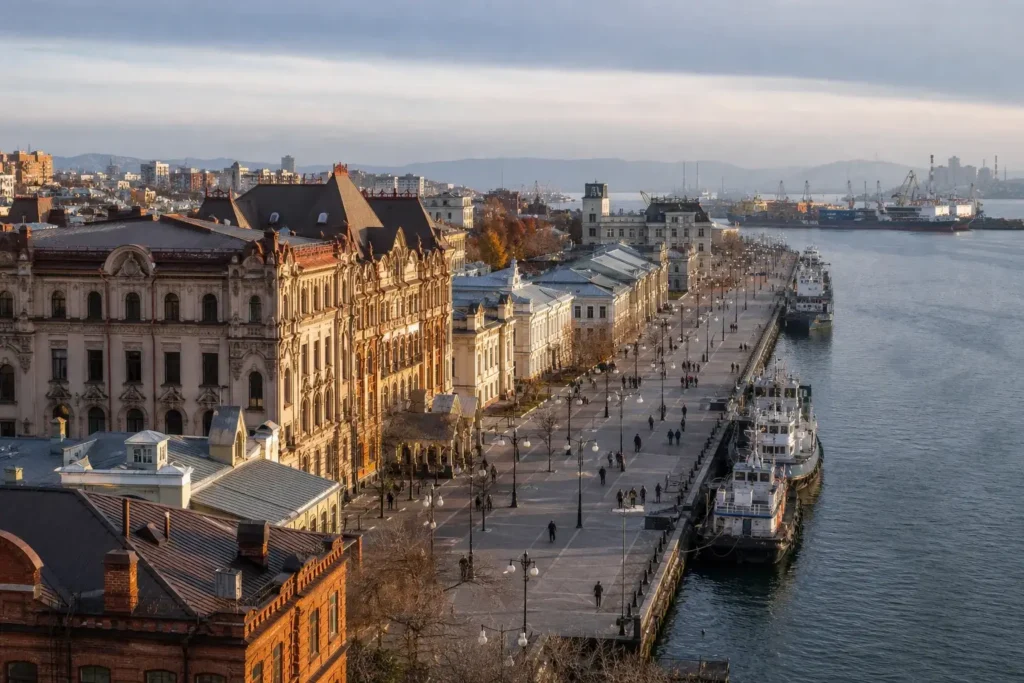
Vladivostok‘s museums document the Russian Far East’s unique history—from frontier exploration and imperial fortification to Soviet naval power and contemporary creativity. This list covers 10 essential cultural stops for history enthusiasts, art lovers, and anyone wanting to understand how this Pacific port city developed.
Each venue chosen is verified as operating and either holds significant regional importance or offers insights that first-time visitors find essential. The city’s major institutions cluster in the historic centre, while contemporary art spaces and specialist museums are scattered across different neighbourhoods.
At a Glance
| # | Place | Best for | Good to know |
|---|---|---|---|
| 1 | Vladimir K. Arseniev Museum of Far East History | Regional heritage anchor | Svetlanskaya Street, central Vladivostok; paid admission; allows photography (sometimes for a small additional fee); open Tuesday–Sunday; official website: arseniev.org |
| 2 | Vladivostok Fortress Museum | Military fortifications and history | Sportivnaya Embankment (Batareynaya Ulitsa, 4a); paid admission; outdoor sections require walking on uneven ground; guided tours available; open daily |
| 3 | Primorye State Art Gallery | Russian and European paintings | Aleutskaya Street (main venue); multiple locations (separate tickets may apply); paid admission; open Tuesday–Sunday; website: primgallery.com |
| 4 | S-56 Submarine Museum | Soviet naval vessel | Korabelnaya Embankment, central waterfront; paid admission; board the vessel with guide; open daily; short walk from metro and city centre |
| 5 | Sukhanov House Museum | 19th-century household and administration | Sukhanova Street, 9; paid admission; open daily; small venue—plan 45 minutes |
| 6 | V. K. Arsenyev Memorial House | Explorer's home and archive | Arsenyeva Street, 15; paid admission; open daily; compact space—allow 30–45 minutes |
| 7 | ZARYA Center for Contemporary Art | Modern and experimental art | Prospekt 100-Letiya Vladivostoka, 155; paid admission (or free for some events); open daily; website available; situated slightly outside the main city centre—plan a separate journey |
| 8 | Pacific Fleet Military Museum | Naval history and hardware | Central waterfront area; paid admission; open daily; exact address and hours should be confirmed before visit |
| 9 | Nostalgia Art Gallery | Russian art and café culture | Central Vladivostok (Prospekt 100-Letiya area); free entry to gallery space; café operates with separate charges; open daily |
| 10 | Museum of 20th Century Military Technology | Vehicles, weapons, and equipment | Location outside central Vladivostok; paid admission; outdoor exhibits vulnerable to weather; allow 1–2 hours |
How We Chose
Entries were selected based on:
- Verified as currently operating as museums or cultural institutions
- Representing the breadth of regional and local history, military heritage, and visual arts
- Accessible to walk-in visitors (major galleries and museums, not private collections)
- Located within or very near central Vladivostok; most reachable on foot or by short transit ride
- Offering content with recognizable physical exhibits or spaces visitors can experience on site
1. Vladimir K. Arseniev Museum of Far East History – Regional heritage anchor
The foundation for understanding Primorsky Krai's nature, indigenous peoples, early exploration, and Vladivostok's founding. Housed in a 1903–1906 banking building on Svetlanskaya Street, the permanent exhibits span three floors: local wildlife and ecosystems on the first floor; archaeological and ethnographic materials on the second; and the city's own history—including photographs, documents, and everyday objects—on the third. Interactive displays and hands-on elements encourage engagement.
Good to know: Svetlanskaya Street, central Vladivostok; paid admission; allows photography (sometimes for a small additional fee); open Tuesday–Sunday; official website: arseniev.org
Tip: Plan at least two hours. The third-floor section on Vladivostok's history is often cited as the most absorbing part; the first floor's taxidermy displays and the Amur tiger exhibit engage family groups.
2. Vladivostok Fortress Museum – Military fortifications and history
Construction of this extensive fortress complex began in 1878 as part of Vladivostok's coastal defence system, intended to protect the city and its naval facilities from potential attacks. The planned fortifications were never fully completed. Today, the museum occupies parts of this hilltop complex with exhibits of period cannons, weapons, maps, photographs, and documents. Dioramas reconstruct scenes from the fortress's operational history. The location itself, on Sportivnaya Embankment overlooking the harbour, provides context for why the site was strategically chosen.
Good to know: Sportivnaya Embankment (Batareynaya Ulitsa, 4a); paid admission; outdoor sections require walking on uneven ground; guided tours available; open daily
Tip: Bring a jacket; much of the exhibit space is outdoors or in unheated buildings. Come in daylight to make use of the views and to read historic markers. Early morning is less crowded.
3. Primorye State Art Gallery – Russian and European paintings
The only major art museum in Russia's Far East, opened in 1966. The permanent collection emphasizes Soviet-era Russian art, 18th–20th century European paintings and graphics received on loan from Moscow's Tretyakov Gallery and the Hermitage, and a decorative arts collection. The main gallery occupies a renovated early 20th century building on Aleutskaya Street; a secondary exhibition space on Partizansky Prospect shows Russian works from the classical period.
Good to know: Aleutskaya Street (main venue); multiple locations (separate tickets may apply); paid admission; open Tuesday–Sunday; website: primgallery.com
Tip: The two buildings require separate visits and separate tickets—not all art is in one place. The Aleutskaya Street building is the main facility; Partizansky Prospect focuses on classical Russian painters.
4. S-56 Submarine Museum – Soviet naval vessel
A working submarine, built in 1936 and delivered to the Pacific Fleet in 1941, is permanently moored at Korabelnaya Embankment as a museum vessel. Visitors can tour the cramped interior and get a sense of life aboard a Soviet-era submarine during its active service until 1975. The vessel sits alongside other memorials to the Pacific Fleet on the same waterfront promenade.
Good to know: Korabelnaya Embankment, central waterfront; paid admission; board the vessel with guide; open daily; short walk from metro and city centre
Tip: The interior is genuinely tight—claustrophobic visitors may find it challenging. Children under a certain height or age may not be permitted below deck (check on arrival). Go early to avoid queues on sunny days.
5. Sukhanov House Museum – 19th-century household and administration
A preserved wooden mansion from the late 19th century, this is the only museum in Russia devoted to a Tsarist official's domestic life. Sukhanov was a state counselor who shaped early Vladivostok's development. The house displays period furniture, family photographs, household items, and documents revealing the lifestyle of the Primorsky elite. Interactive programs and themed tours offer context for visitors.
Good to know: Sukhanova Street, 9; paid admission; open daily; small venue—plan 45 minutes
Tip: This quiet, less-crowded museum offers an intimate look at how powerful families lived in the Far East. Guides (if available) provide personal anecdotes about the Sukhanov family that textbooks don't.
6. V. K. Arsenyev Memorial House – Explorer's home and archive
The residence of Vladimir Klavdievich Arsenyev, a renowned Far Eastern explorer, writer, and scientist whose expeditions documented the region's geography and indigenous peoples. The house-museum displays his personal belongings, manuscripts, photographs, and expedition equipment. It serves as both a biographical portrait and an archive of early 20th-century exploration in the Russian Far East.
Good to know: Arsenyeva Street, 15; paid admission; open daily; compact space—allow 30–45 minutes
Tip: Arsenyev is the namesake of the regional museum system; this intimate house-museum complements the larger regional museum's broader collection if you're interested in his work and era.
7. ZARYA Center for Contemporary Art – Modern and experimental art
Opened in 2013 in a converted factory loft, ZARYA is the only contemporary art centre in the Russian Far East. It programs exhibitions, film screenings, performances, and artist talks in visual art, theatre, literature, music, design, and new media. Many labels in English. The space encourages participatory and experimental work, especially by local artists and international visitors responding to the region's natural and cultural landscape.
Good to know: Prospekt 100-Letiya Vladivostoka, 155; paid admission (or free for some events); open daily; website available; situated slightly outside the main city centre—plan a separate journey
Tip: Check the current program before visiting; the space is project-based rather than a permanent collection museum. Film screenings and performances often attract younger audiences and attract more casual visitors than traditional museums.
8. Pacific Fleet Military Museum – Naval history and hardware
Dedicated to the history of the Russian Pacific Fleet and its role in regional defense and exploration. Exhibits include weapons, naval uniforms, documents, scale models of ships, and photographs spanning Soviet and post-Soviet eras. The museum's history is closely tied to Vladivostok's identity as a major naval base.
Good to know: Central waterfront area; paid admission; open daily; exact address and hours should be confirmed before visit
Tip: This museum is often grouped with other Korabelnaya Embankment monuments; you can visit the submarine and fleet memorials on the same walk.
9. Nostalgia Art Gallery – Russian art and café culture
Opened in 1988, this gallery blends art viewing with traditional Russian hospitality—visitors can enjoy Russian coffee and cuisine in the main hall while surrounded by Russian and contemporary art. Some artworks are for sale. The venue occupies a restored historic space and emphasizes cultural revival and tradition.
Good to know: Central Vladivostok (Prospekt 100-Letiya area); free entry to gallery space; café operates with separate charges; open daily
Tip: A relaxed, informal alternative to formal museum visits. Useful for a coffee break combined with art browsing rather than a structured cultural experience.
10. Museum of 20th Century Military Technology – Vehicles, weapons, and equipment
A specialist collection of Soviet and Russian military hardware—tanks, artillery pieces, vehicles, and smaller weapons—displayed outdoors and in buildings. Represents the region's strategic military importance throughout the 20th century. Less formal than official state museums; appeal is primarily to military history enthusiasts and technically minded visitors.
Good to know: Location outside central Vladivostok; paid admission; outdoor exhibits vulnerable to weather; allow 1–2 hours
Tip: Go on a clear day to fully appreciate outdoor exhibits. This is a niche venue; skip it unless military hardware or Soviet-era technology specifically interests you.
Russia Vibes Tips
- Vladivostok's main museums cluster around the city centre and Korabelnaya Embankment waterfront. You can visit 2–3 major venues on foot in a single day; plan for 3–4 hours per museum if you linger on exhibits.
- Most museums close on Mondays or one weekday; confirm opening hours before setting out. Tourist information centres near the railway station have current schedules. Many are open Tuesday–Sunday, 10:00–19:00 or similar.
- Photography is typically permitted but sometimes a small additional fee applies—ask at the entrance. Many exhibits have Cyrillic labels only; English descriptions are inconsistent. Having a phone translation app open helps.
- Admission prices are moderate; students and pensioners often qualify for discounts. The Vladimir K. Arseniev Museum is the most visited; arrive early or mid-week to avoid queues.
- Winter visits require warm clothing—many museum spaces, especially the Fortress, have limited heating and include outdoor sections. Summer is comfortable but busier. Autumn (September–October) is calm and clear.
- Do not assume one ticket covers all branches of the Arseniev museum system or the Primorye Art Gallery's two locations—each typically requires separate admission. Ask museum staff for clarification on multi-site passes if they exist.
Explore Nearby Museums & Cultural Sites, Vladivostok
Browse more: All Culture Lists · All Guides · All Guides in Vladivostok · All Vladivostok
FAQ
Are Vladivostok's museums easy to reach by public transport?
Yes. The main museums—Vladimir K. Arseniev Museum, Fortress Museum, and waterfront venues—are within walking distance of central Vladivostok and near bus routes. The metro does not extend to most museums, but local buses and trams connect them. ZARYA Center and some military museums are slightly further out; a taxi or ride-hailing app is practical.
Can I visit the S-56 submarine with children?
Yes, but with reservations. The interior is genuinely cramped, and very young children or those with mobility issues may struggle. Age and height restrictions may apply for below-deck access. Check with staff on arrival. Children often enjoy the novelty despite the tight spaces.
Do I need a guide to understand the museums?
No. Most major venues have informational panels and are navigable independently. The Vladimir K. Arseniev Museum and Fortress Museum may benefit from a guide for context and background stories; ask at the entrance whether guides are available and what the cost is.
Is English spoken or available at these venues?
Limited. Some galleries label exhibits in English; others do not. ZARYA Center often includes English labels. Translating labels with your phone is practical. Staff usually speak minimal English; simple gestures and a phrase book help.
Are there different admission prices for Primorsky State Art Gallery's two buildings?
Yes. The main gallery (Aleutskaya Street) and the Partizansky location typically require separate tickets. The Partizansky space focuses on classical Russian painters and may have a different admission structure. Ask at either location for details on combined passes or discounts.
Which museum is best for learning about the city's founding and early history?
The Vladimir K. Arseniev Museum of Far East History, especially its third-floor exhibition on Vladivostok's development from the 1860s onward. It combines photographs, objects, and interactive displays that tell the city's story clearly.
Can I visit the Fortress Museum if I have mobility issues?
Partially. The Fortress complex is built on hills with uneven terrain and outdoor sections. Some buildings and exhibits are more accessible than others. Call ahead to ask which exhibits are reachable by less strenuous routes.
Is it worth visiting both the Arseniev Museum and the Arsenyev Memorial House?
If you're keenly interested in the explorer and early Far Eastern science, yes—the house is intimate and biographical. For general regional history, the main Arseniev Museum is sufficient. They complement rather than duplicate each other.
Russia Vibes is a one-person project. A coffee keeps it going
How we research and update our guides
About this guide: AI assistance and accuracy
This guide is created with the help of AI and is based on official sources where available. Mistakes can still happen. Opening hours, prices, rules and other details are given to the best of our knowledge as of the date shown and can change without notice. It offers general recommendations only, not professional, legal or travel advice. Please confirm important details with the official source before you travel; you are responsible for your own plans and decisions.

Take this guide with you
Get a free PDF of this guide to print or read offline: key facts, tips and a map link on a few clean pages.
Report an issue on this page
Paying for your trip: please read
International sanctions affect payments between Russia and many other countries. In practice, cards issued in the EU, the UK, the US and several other countries often do not work in Russia, Russian cards usually do not work abroad, and some booking platforms, airlines and payment providers limit or suspend their services for Russia. The situation changes frequently.
We do not give legal or financial advice, and this site does not encourage anyone to break or circumvent sanctions. Whatever you plan, you are responsible for following the laws and regulations that apply to you, including those of your country of residence and citizenship.
Many travelers still organise their stay lawfully. It is worth asking your bank or payment provider what is currently permitted, contacting hotels, tour operators and carriers directly about the payment methods they accept, and checking which services are open to customers from your country. Clarify payment, cancellation and refund terms before you commit to a booking, and keep your plans flexible.
Partner links on this site may not be available in every country, and prices, availability and rules in our guides can differ from what you see when you book.