
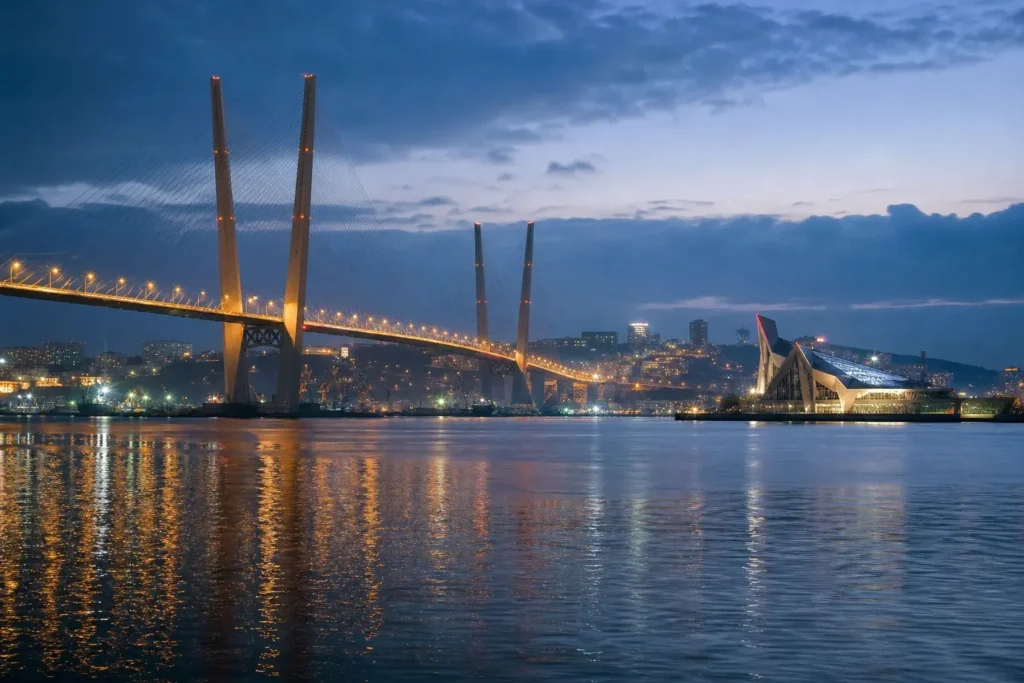
This five-day itinerary is designed for first-time visitors who want to understand Vladivostok beyond its iconic Golden Bridge. The pace mixes walking through historic neighborhoods, museum visits, waterfront explorations, and a day trip to Russky Island. By the end, you’ll have seen the architecture, learned the city’s military and naval heritage, and recognized why Vladivostok has been described as Europe in the Far East.
The route assumes a moderate pace with time for cafés, photography, and spontaneous detours. Most days involve 3–5 hours of active walking or travel.
At a glance: Day 1: Svetlanskaya Street and the city center, including the railway station and Eagle's Nest Hill viewpoint. Day 2: Korabelnaya Embankment and maritime monuments, then the Primorsky Stage theatre complex. Day 3: Russian Island fortifications and battery museums. Day 4: Sportivnaya Embankment and the cathedral district, plus the Primorsky Oceanarium. Day 5: Museums and the old town, with a choice between the Fortress Museum or Arseniev Museum of Far East History.
Day 1: Central Vladivostok and Views from Above
Begin in the historic center to get oriented. Walk the main commercial street, visit the beautiful railway station, then climb to the city's best viewpoint overlooking the bays and bridges. The morning is architectural; the afternoon focuses on views and orientation.
- Svetlanskaya Street – Historic shopping street with pastel buildings and arcades (1 hour)
- Vladivostok Railway Station – 1890s Tsarist-era terminus with painted interior and cobblestones (45 minutes)
- GUM Department Store – Art Nouveau building sister to Moscow's GUM (20 minutes to view exterior)
- Eagle's Nest Hill (Vidovaya Ploshchadka) – Extinct volcano hilltop with 360° views of Golden Horn Bay, bridges and monuments (1.5 hours)
- Admirala Fokina Street – Pedestrian Arbat area with cafés and local shops (1 hour for strolling)
Tip: Start early on Svetlanskaya to avoid crowds and catch morning light on the buildings. The walk to Eagle's Nest takes 15 minutes from the upper end of the street—wear comfortable shoes and bring water.
Day 2: Waterfront Monuments and the Mariinsky Theatre
Explore the city's maritime identity along Korabelnaya Embankment, where most of Vladivostok's naval monuments and memorials stand. End with a visit to the striking modern theatre complex overlooking the harbor.
- Korabelnaya Embankment – Central waterfront with submarine S-56, memorial ship Krasniy Vimpel, and Tsar Nicholas II Triumphal Arch (2 hours)
- Memorial to the Pacific Navy – Large obelisk resembling a sail (included in embankment walk)
- Chapel of St. Andrew – Historic wooden chapel on the embankment (20 minutes)
- Tsesarevich Embankment – Start of a scenic walk beneath the Golden Bridge with photo angles (1 hour)
- Primorsky Stage of the Mariinsky Theatre – Modern glass theatre complex with cafe and viewing platforms overlooking the bridge and bay (1–2 hours (attend a performance if time allows, or visit the exterior and cafe))
Tip: The submarine S-56 requires a separate ticket and a guide; book ahead for non-Russian speakers. Best light for bridge photography is late afternoon from Tsesarevich Embankment. The theatre cafe offers views without a ticket.
Day 3: Russky Island Fortifications and Views
Take a day trip across the Russky Bridge to explore fortress batteries, abandoned military installations, and coastal views. This is a more active day with walking and exploring Soviet-era military sites. Check if sites are open before departing.
- Russky Bridge approach – View the cable-stayed span from Novosiltsevskaya Battery (1 hour)
- Novosiltsevskaya Battery – Historic artillery emplacement with views of the Russky Bridge (1.5 hours)
- Voroshilov Battery – One of only two surviving 12-inch armored turret batteries in Russia, with underground tunnels (1.5 hours (may require guide; check access))
- Fort Pospelov – Restored coastal fortress with bunkers and views over the straits (1 hour (if open))
- Russky Island scenic points – Walking trails through hills and coastal areas (flexible)
Tip: Russky Island requires a car or taxi; it's not served by public transport. Many military sites have restricted or guide-only access—call ahead or use a local guide. Bring waterproof jackets; this area is windy and exposed.
Day 4: Parks, Cathedral and the Oceanarium
Explore the southern embankment and the Orthodox cathedral quarter, then visit Russia's first oceanarium. This day balances active sightseeing with indoor attractions and is suitable for rest or different interests.
- Sportivnaya Embankment – Historic waterfront park with musical fountain and recreation areas (1.5 hours)
- Admiral's Park (Admiralskiy Park) – Park with memorial structures and city views (1 hour)
- Cathedral of the Intercession – Large Orthodox cathedral with gold domes visible across the city (45 minutes (check service times))
- Primorsky Oceanarium – Largest aquarium in the Far East with Arctic and Pacific exhibits (2–3 hours)
- Botanical Garden-Institute – If time allows, natural gardens with local flora (1–2 hours)
Tip: The oceanarium is in a separate building from the theatre complex—don't confuse the two. Bring cash for small donations at the cathedral if entering during services.
Day 5: Museums and the Old Town
Choose between two major museums based on your interests: military history or regional natural and cultural heritage. Then walk the old town, exploring the architecture and smaller galleries of the historic district.
- Vladivostok Fortress Museum – Military complex with cannons, weaponry and siege-era artifacts; construction began 1878 (2–3 hours (with guide recommended for full context))
- Or: Arseniev Museum of Far East History – Regional natural history, ethnography and exploration with Siberian specimens (2–3 hours)
- Old town streets – Historic wooden buildings and Soviet-era architecture (1.5 hours of walking)
- Primorsky State Art Gallery – Local and regional art in historic building (1–2 hours if open)
- Local cafés and markets – Final exploration and lunch (1 hour)
Tip: The Fortress Museum requires the most time to understand the exhibits; a guided tour in English may not always be available, so study the context beforehand. The Arseniev Museum is better for those interested in natural history and exploration. Both are free or very inexpensive to enter.
Russia Vibes Tips
- The Golden Bridge (Zolotoy Bridge) and Russky Bridge are closed to pedestrians; they can only be crossed by car. The best views are from Tsesarevich Embankment (under the Golden Bridge), Eagle's Nest Hill (above the city), or Novosiltsevskaya Battery on Russky Island (viewing the Russky Bridge).
- Vladivostok sits on multiple steep hills with frequent fog and wind off the Sea of Japan. Wear layers and bring a wind-resistant jacket even in summer. Comfortable walking shoes are essential—many streets are steep and cobblestoned in the old center.
- Most museums and monuments are free or very inexpensive, but Russian-language signage dominates. Download offline maps and a translation app before arrival. The submarine S-56 and some fortress sites require pre-booked guides; do this before your trip if English-language tours are important to you.
- The city's best light for photography occurs in the late afternoon when fog clears from the bay and bridges. Plan key photos—especially of the bridges and Eagle's Nest—for after 15:00 in warmer months.
- Russky Island is accessible only by car; public buses do not serve the fortresses. If you lack a car, hire a taxi for the day or book a guided tour. Many sites on the island require access passes or guides, so travel independently only if you can read Russian signage or contact the sites ahead.
- Vladivostok's dining scene includes fresh seafood restaurants and Korean, Chinese and Vietnamese cuisine reflecting its location near Asia. Bring cash in rubles; many smaller restaurants and museums do not accept international cards. Ask locals for current ATM locations.
Explore Nearby Five Days in Vladivostok, Vladivostok
Browse more: All Itineraries · All Itineraries in Vladivostok · All Short Stays · All Vladivostok
FAQ
Can you walk across the Golden Bridge or Russky Bridge?
No. Both bridges are closed to pedestrians and cyclists; only vehicles are permitted. The best views of the Golden Bridge are from Tsesarevich Embankment directly beneath it, or from Eagle's Nest Hill above the city. The Russky Bridge can be seen from Novosiltsevskaya Battery on Russky Island.
How do you get to Russky Island?
Only by car, using the Russky Bridge toll road from the city. There is no public transport to the island. Hire a taxi, rent a car, or book a guided tour. Many fortress sites on the island require access passes or guides—contact them in advance or arrange a tour.
Is the Submarine S-56 included in any ticket package?
No. The S-56 requires a separate ticket and must be visited separately from the Korabelnaya Embankment walk. Tours are typically in Russian; arrange an English-language guide ahead if needed. It sits directly on the embankment near other monuments.
What is the best day trip from Vladivostok besides Russky Island?
Russky Island is the main recommended day excursion for this itinerary due to its fortresses and views of the Russky Bridge. Other sites exist in the region, but they require longer travel times and planning. Check current access and transport options locally before committing.
Is a guide necessary for the Vladivostok Fortress Museum?
Not required, but recommended. The museum's signs are primarily in Russian, and the military history context benefits from explanation. English-language guides may not be always available; book ahead or plan to study the fortress's 1878 construction history and design independently.
How long does it take to reach Eagle's Nest Hill from downtown?
Approximately 15 minutes on foot from the upper end of Svetlanskaya Street, or 30–40 minutes from the railway station area. The hill sits on an extinct volcano and is the city's highest public viewpoint. Bring water and wear suitable shoes.
What is the Primorsky Stage and is it the same as the Oceanarium?
No—they are separate complexes. The Primorsky Stage of the Mariinsky Theatre is a modern glass theatre on the eastern promontory overlooking the bay, built for APEC 2012. It hosts ballet, opera and performances. The Primorsky Oceanarium is a separate aquarium facility nearby. Both have cafés, but different purposes.
Are the museums open every day?
Most major museums and monuments are open daily or closed only on Mondays, but hours vary by season and site. Check the official websites or call ahead before planning your visit, especially for smaller galleries or fortress sites that may have seasonal closures or maintenance.
Russia Vibes is a one-person project. A coffee keeps it going
How we research and update our guides
About this guide: AI assistance and accuracy
This guide is created with the help of AI and is based on official sources where available. Mistakes can still happen. Opening hours, prices, rules and other details are given to the best of our knowledge as of the date shown and can change without notice. It offers general recommendations only, not professional, legal or travel advice. Please confirm important details with the official source before you travel; you are responsible for your own plans and decisions.

Take this guide with you
Get a free PDF of this guide to print or read offline: key facts, tips and a map link on a few clean pages.
Report an issue on this page
Paying for your trip: please read
International sanctions affect payments between Russia and many other countries. In practice, cards issued in the EU, the UK, the US and several other countries often do not work in Russia, Russian cards usually do not work abroad, and some booking platforms, airlines and payment providers limit or suspend their services for Russia. The situation changes frequently.
We do not give legal or financial advice, and this site does not encourage anyone to break or circumvent sanctions. Whatever you plan, you are responsible for following the laws and regulations that apply to you, including those of your country of residence and citizenship.
Many travelers still organise their stay lawfully. It is worth asking your bank or payment provider what is currently permitted, contacting hotels, tour operators and carriers directly about the payment methods they accept, and checking which services are open to customers from your country. Clarify payment, cancellation and refund terms before you commit to a booking, and keep your plans flexible.
Partner links on this site may not be available in every country, and prices, availability and rules in our guides can differ from what you see when you book.