
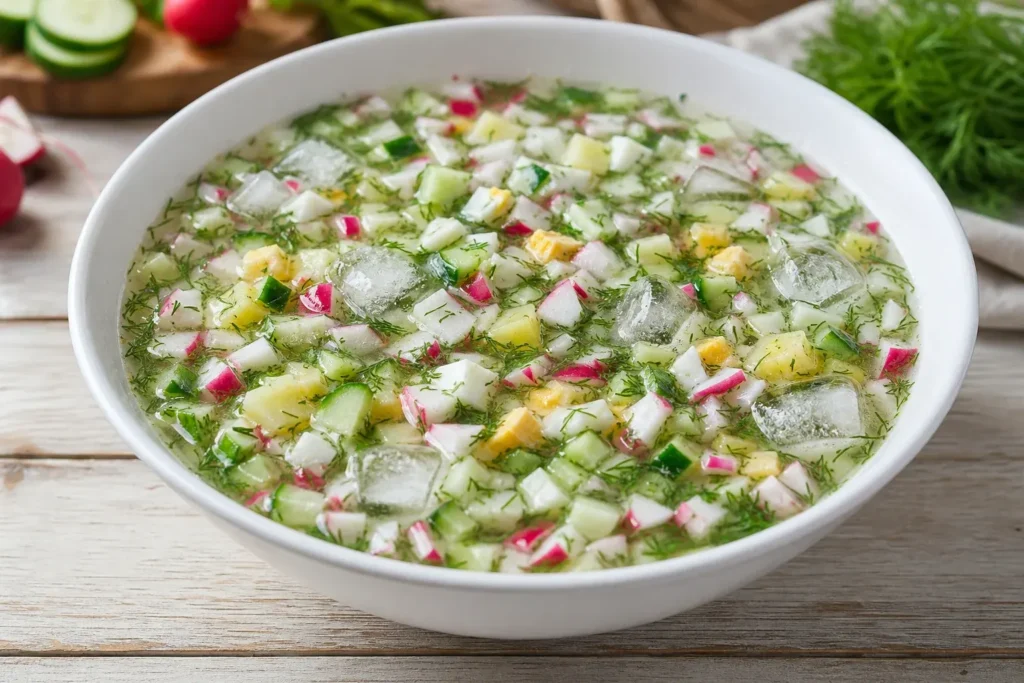
Okroshka is a traditional Russian cold soup made with finely chopped vegetables, herbs and often eggs and cooked meat. Known locally as окрошка, it is especially associated with warm-weather eating and can be found in different versions across Russia, including Volgograd. Unlike conventional soups, its ingredients are prepared separately and served cold.
This guide explains how to make okroshka at home using a refreshing kvass base, with kefir as an alternative. You will learn how to prepare the vegetables, balance the flavours and serve the soup correctly. The recommended method is to chill the chopped ingredients and add the liquid shortly before eating.
Quick answer: Boil and cool the potatoes and eggs, chop the vegetables and cooked meat, combine with herbs and pour over chilled, unsweetened kvass just before serving. Approximately 45–60 minutes plus cooling.
At a Glance
| Type | Dishes |
|---|---|
| Local name | Окрошка |
| Origin | Traditional Russian cuisine, widely prepared throughout Russia, including the Volga region |
| Servings | 4 servings |
| Total time | Approximately 45–60 minutes of preparation and cooking, plus chilling |
| Difficulty | Easy |
History and Story of Okroshka, Volgograd
Okroshka is a traditional Russian cold soup associated with seasonal vegetables, herbs and fermented or cultured liquids. Its name is connected with the Russian verb kroshit, meaning to crumble or chop into small pieces. This reflects the central preparation technique: the solid ingredients are finely cut before the liquid is added.
The dish developed within the wider tradition of Russian cold foods and fermented grain drinks. Earlier variations did not always contain the same vegetables and proteins used in modern recipes. Ingredients changed over time as food preferences and availability evolved.
Kvass became a characteristic liquid base for okroshka. Its slightly sour, fermented grain flavour contrasts with the vegetables and cooked ingredients. Less sweet forms are especially suitable for the dish.
Modern versions frequently include potatoes, cucumber, radishes, spring onions, dill, boiled eggs and cooked meat or sausage. Sour cream, mustard and horseradish may be used to adjust richness and sharpness.
Kefir-based okroshka is another familiar preparation. Kefir produces a different flavour and texture: tangier in a dairy-based way, often creamier and more opaque than kvass. It may be diluted with chilled water to achieve the desired consistency.
Okroshka is widely known in Russia and cannot be assigned confidently to one specific city. Its presence in the Volga region is part of a larger culinary tradition rather than proof of an exclusively Volgograd origin.
For travellers visiting Volgograd in warmer weather, okroshka offers an alternative to the hot soups frequently associated with Russian cooking. The defining experience is the contrast between cold liquid, soft cooked potatoes and eggs, crisp vegetables and fragrant herbs.
The dish is also useful for understanding Russian food vocabulary. The liquid base matters as much as the ingredients themselves, so ordering okroshka na kvase or okroshka na kefire can lead to noticeably different bowls.
The home recipe here uses chicken and kvass, but it is not intended to represent the only traditional version. Okroshka is a flexible dish with many established variations.
Ingredients
- 800 ml unsweetened bread kvass
- 250 g potatoes
- 200 g fresh cucumber
- 120 g radishes
- 150 g cooked chicken breast
- 2 medium eggs
- 40 g spring onions
- 20 g fresh dill
- 80 g sour cream
- 10 g prepared mustard, optional
- 4 g fine salt
- 1 g ground black pepper
How Okroshka, Volgograd Is Made
Step 1: Cook the potatoes and eggs
Wash the potatoes and boil them in lightly salted water until tender. Cook the eggs separately until hard-boiled. Drain the potatoes and cool both ingredients completely. Peel the potatoes and eggs once they are cool enough to handle. Avoid mixing warm ingredients with the fresh vegetables, because the finished soup should remain cold.
Tip: Preparing the potatoes and eggs in advance reduces the amount of cooking needed when you want to serve the soup.
Step 2: Prepare the fresh vegetables
Wash the cucumbers, radishes, spring onions and dill. Dice the cucumbers and radishes into small, fairly uniform pieces. Finely chop the spring onions and dill. The size of the vegetables matters because okroshka is intended to contain a balanced mixture of ingredients in each spoonful rather than large separate chunks.
Tip: Use a sharp knife and avoid crushing the cucumber, which can release unnecessary moisture.
Step 3: Cut the cooked ingredients
Dice the cooled potatoes, hard-boiled eggs and fully cooked chicken into pieces similar in size to the vegetables. Transfer them to a large mixing bowl. The mixture should look colourful, with pale potatoes and eggs, green cucumber and herbs, and pink or red radish pieces.
Tip: Make sure the chicken is cooked completely before cooling and chopping it.
Step 4: Combine and season
Add the chopped spring onions, dill, salt and black pepper to the bowl. Mix the ingredients gently without crushing the potatoes. Stir the optional mustard into the sour cream in a separate small bowl. This allows the sharper seasoning to be distributed evenly when the soup is assembled.
Tip: Begin with modest seasoning because the kvass and sour cream will affect the final balance.
Step 5: Chill the prepared mixture
Cover the bowl and refrigerate the chopped ingredients until thoroughly cold. Chill the kvass separately. Keeping the solids and liquid apart helps preserve the texture of the vegetables and prevents the potatoes from absorbing too much liquid before serving.
Tip: If preparing the mixture in advance, use a covered food-safe container and keep it refrigerated.
Step 6: Assemble the soup
Divide the chilled vegetable and chicken mixture among four soup bowls. Pour cold, unsweetened kvass over each portion until the ingredients are comfortably submerged. Add a spoonful of the seasoned sour cream mixture and stir gently. Taste and adjust the salt or mustard if necessary.
Tip: Choose a slightly tart kvass rather than a sweet soft-drink-style version.
Step 7: Serve immediately
Serve the finished okroshka cold, with a spoon. The mixture should have a light, refreshing consistency and clearly distinguishable chopped ingredients. Offer additional sour cream separately if desired. Keep any remaining vegetable mixture and kvass refrigerated in separate containers rather than leaving assembled soup standing at room temperature.
Tip: A little extra fresh dill can be added immediately before serving for a stronger herbal aroma.
Variants
- Okroshka with kvass: Uses cold, preferably unsweetened bread kvass as the liquid base.
- Okroshka with kefir: Uses fermented milk, sometimes diluted with chilled water.
- Okroshka with boiled beef: Replaces chicken with cooled, cooked beef.
- Okroshka with cooked sausage: A common modern variation using diced sausage.
- Vegetarian okroshka: Omits meat and may include additional vegetables and eggs.
- Fish okroshka: A variation prepared with cooked and cooled fish.
- Okroshka with horseradish: Includes a small amount of horseradish for a sharper taste.
- Okroshka with mineral water: Often uses chilled mineral water to adjust the consistency of a kefir-based soup.
Common Mistakes to Avoid
- Using sweet dessert-style kvass, which can make the savoury soup taste sugary.
- Adding kvass while the cooked potatoes and eggs are still warm.
- Cutting the vegetables into large, uneven pieces.
- Mixing the liquid into the chopped ingredients long before serving.
- Using too much mustard before tasting the completed soup.
- Confusing okroshka with hot vegetable soup and attempting to heat it.
- Assuming every okroshka contains the same meat, liquid base or dairy ingredients.
How to Order and Eat It
Okroshka is served cold in a soup bowl and eaten with a spoon. It is usually presented as a light meal or a starter, particularly during warm weather.
The chopped vegetable mixture should remain clearly visible rather than being blended into a smooth soup. Each spoonful ideally contains a mixture of cucumber, radish, potato, herbs and other ingredients.
The liquid base is an important choice. Kvass gives a fermented grain flavour with gentle acidity, while kefir creates a creamier dairy-based soup. Both versions can be served with additional fresh herbs or sour cream.
In Volgograd, travellers who want a particular variation should ask whether the restaurant prepares okroshka with kvass or kefir. Do not assume that the liquid base or meat ingredient will be the same everywhere.
At home, prepare the ingredients in advance but add the liquid only shortly before eating. This helps maintain the contrasting textures that make the dish distinctive.
To order: Можно, пожалуйста, окрошку на квасе? (Mozhno, pozhaluysta, okroshku na kvase?)
Diet and Allergens
- Contains egg
- Contains milk through sour cream
- Contains chicken
- Traditional rye kvass contains gluten
- Fermented kvass may contain alcohol
- No pork in this recipe
- Not vegetarian with the specified chicken
- Kefir-based versions contain milk
Russia Vibes Tips
- Ask whether okroshka is served на квасе (na kvase) or на кефире (na kefire) before ordering.
- Try the kvass version first if you are interested in the traditional fermented grain flavour.
- Chop the vegetables into similarly sized pieces rather than blending them; texture is central to the dish.
- Keep the liquid and vegetables separately chilled until serving to preserve their freshness.
- If making kefir okroshka, add chilled water gradually until it reaches a pleasant soup consistency.
- Taste the completed soup before adding extra sour cream, mustard or horseradish.
Explore Nearby Okroshka, Volgograd
Browse more: All Food & Drink · All Other
FAQ
What is okroshka?
Okroshka is a traditional Russian cold soup made from chopped vegetables, herbs and often eggs and cooked meat. Its liquid base is commonly kvass or kefir. Unlike a hot soup, the vegetables and other ingredients are prepared separately, cooled and combined with the cold liquid shortly before serving.
Is okroshka served cold or hot?
Okroshka is served cold. The chilled liquid and vegetables are essential to its character, particularly during warm weather. Heating the assembled soup would change its texture and flavour. Cooked ingredients such as potatoes, eggs and meat are prepared beforehand and allowed to cool before being added.
Is okroshka better with kvass or kefir?
Both versions are established, and the choice is personal. Kvass produces a lighter soup with fermented bread notes and gentle acidity. Kefir creates a creamier, tangier dairy flavour. Visitors unfamiliar with the dish may find it useful to try both versions rather than treating one as universally better.
What kind of kvass should I use for okroshka?
A less sweet, slightly sour bread kvass is generally the best choice for savoury okroshka. Sweet bottled kvass can make the dish taste unbalanced. Some products are intended specifically for cold soup preparation. Check the ingredients and flavour profile before choosing your liquid base.
Can I make okroshka without meat?
Yes. A vegetarian version can contain potatoes, cucumber, radishes, fresh herbs and boiled eggs. For a fully vegan version, both the eggs and dairy ingredients must be omitted or replaced. Also check the ingredients of the chosen liquid base, particularly when using a commercially prepared product.
Can I prepare okroshka the day before?
You can prepare and refrigerate the cooked ingredients and chopped vegetables in advance. Keep the liquid base separate until serving. This reduces the risk of the vegetables becoming watery and the potatoes absorbing too much liquid. Use proper refrigeration and avoid leaving perishable ingredients at room temperature.
Does okroshka contain alcohol?
The answer depends on the liquid base. Kvass is produced by fermentation and can contain alcohol, with the amount varying between products and preparation methods. Kefir also involves fermentation. Anyone who must avoid alcohol entirely should check the ingredients and product information rather than assuming every version is alcohol-free.
Where can I try okroshka in Volgograd?
Look for okroshka in restaurants and cafés serving traditional Russian cuisine, especially when seasonal cold dishes are offered. Availability differs between establishments and menus. The word окрошка identifies the dish, while на квасе and на кефире indicate the two common liquid bases.
Russia Vibes is a one-person project. A coffee keeps it going
How we research and update our guides
About this guide: AI assistance and accuracy
This guide is created with the help of AI and is based on official sources where available. Mistakes can still happen. Opening hours, prices, rules and other details are given to the best of our knowledge as of the date shown and can change without notice. It offers general recommendations only, not professional, legal or travel advice. Please confirm important details with the official source before you travel; you are responsible for your own plans and decisions.

Take this guide with you
Get a free PDF of this guide to print or read offline: key facts, tips and a map link on a few clean pages.
Report an issue on this page
Paying for your trip: please read
International sanctions affect payments between Russia and many other countries. In practice, cards issued in the EU, the UK, the US and several other countries often do not work in Russia, Russian cards usually do not work abroad, and some booking platforms, airlines and payment providers limit or suspend their services for Russia. The situation changes frequently.
We do not give legal or financial advice, and this site does not encourage anyone to break or circumvent sanctions. Whatever you plan, you are responsible for following the laws and regulations that apply to you, including those of your country of residence and citizenship.
Many travelers still organise their stay lawfully. It is worth asking your bank or payment provider what is currently permitted, contacting hotels, tour operators and carriers directly about the payment methods they accept, and checking which services are open to customers from your country. Clarify payment, cancellation and refund terms before you commit to a booking, and keep your plans flexible.
Partner links on this site may not be available in every country, and prices, availability and rules in our guides can differ from what you see when you book.