
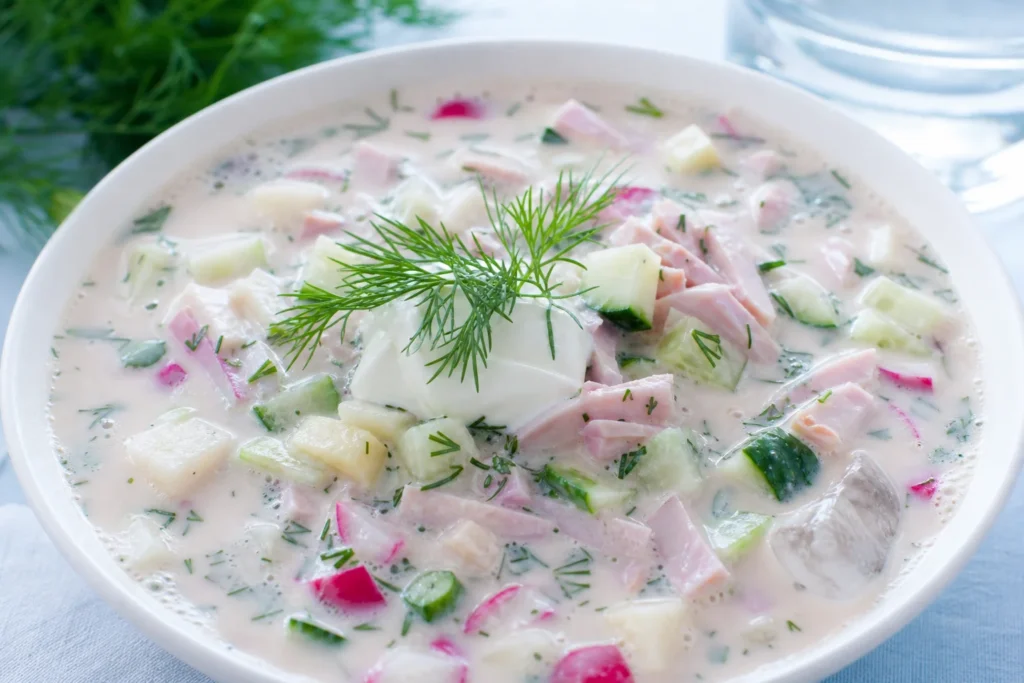
Looking to prepare a genuine Russian summer dish that has been made since the 18th century? Okroshka, a refreshing cold soup, is the answer. This article shows you how to make okroshka Russian summer soup at home, step by step.
This traditional recipe is designed for warm weather when you want something light, nourishing, and chilled. The key is fine, uniform dicing of fresh ingredients and choosing your base liquid—either kvass (fermented rye drink) or kefir (fermented milk). Both are widely available, and either will give you the authentic tangy flavor.
Quick answer: Dice all ingredients small and uniformly, boil potatoes and eggs beforehand, then combine everything in a large pot with cold kvass or kefir, sour cream, and salt. Chill before serving. Takes 30–40 minutes plus chilling time.
At a Glance
| Type | Dishes |
|---|---|
| Local name | Окрошка |
| Origin | Okroshka originated in the Volga region of Russia in the 18th century. The first published recipe appeared in 1790 in Nikolai Osipov's cookbook. The name comes from the Russian verb kroshit, meaning to crumble or chop into small pieces. It is traditionally associated with river workers on the Volga who combined dried fish with kvass and later enriched the dish with fresh vegetables. |
| Servings | 3–4 servings |
| Total time | 30–40 minutes plus chilling |
| Difficulty | Easy |
History and Story of Okroshka, Nizhny Novgorod
Okroshka emerged in the Volga region of Russia in the 18th century. The first published recipe, dated 1790, appears in Nikolai Osipov’s cookbook. The name derives from the Russian verb kroshit (to crumble or chop). According to culinary tradition, the dish was invented by river workers—barge haulers known as burlaks—on the Volga River who would rehydrate dried fish with kvass and later added fresh vegetables to create a portable, nourishing meal. Over time, it evolved from a simple working-class dish into a beloved summer staple across Russia and Eastern Europe.
Ingredients
- 400 ml kvass or kefir (fermented milk drink)
- 200 g boiled potatoes
- 3–4 boiled eggs
- 1 large cucumber or 2–3 medium
- 4–6 radishes
- 150–200 g cooked meat (ham, sausage, or boiled beef)
- 100 ml sour cream
- 1 bunch fresh dill
- 1 bunch green onions (spring onions)
- Salt to taste
How Okroshka, Nizhny Novgorod Is Made
Step 1: Prepare the potatoes
Wash and peel 400 g of potatoes. Cut them into small cubes (about ½ cm). Place in a pot, cover with water, add a splash of salt, and boil for 8–10 minutes until soft but not falling apart. Drain well and set aside to cool completely. For faster cooling, rinse with cold water.
Tip: Even-sized pieces cook faster and look better in the finished soup.
Step 2: Hard-boil the eggs
Place 3–4 eggs in a pot of cold water, bring to a boil, then remove from heat and let sit covered for 10 minutes. Transfer to cold water, peel when cool, and dice finely.
Tip: Cool eggs quickly to stop them from turning gray around the yolk.
Step 3: Dice the vegetables and meat
Peel and finely dice the cucumber and radishes into small, uniform pieces. Cut the cooked meat (ham or boiled beef) into similar-sized cubes. Chop the green onions and dill finely. Keep all ingredients separate until you are ready to assemble.
Tip: Uniform dicing is essential—it keeps the soup from becoming a mushy salad and allows flavors to blend evenly.
Step 4: Mix the base
In a large bowl, whisk together 400 ml cold kvass or kefir with 100 ml sour cream until smooth. Add salt to taste. This tangy, slightly sour liquid is the soul of the soup.
Tip: If your kvass is very strong or salty, taste as you add—you can always add more sour cream to balance.
Step 5: Combine all ingredients
Place all the diced potatoes, eggs, vegetables, and meat into a large pot. Pour the kvass and sour cream mixture over everything. Stir gently to combine without breaking up the pieces. Add more cold water or kvass if you prefer a thinner soup.
Tip: Some Russians add a pinch of mustard powder or fresh lemon juice for extra tang.
Step 6: Chill and serve
Cover and refrigerate for at least 30 minutes, or until very cold. Some people add a handful of ice cubes on hot days. Pour into bowls, stir gently to mix, top with a dollop of sour cream and fresh dill, and serve immediately.
Tip: Okroshka is always served ice-cold; warm okroshka is not authentic.
Variants
- Okroshka with kefir: uses fermented milk instead of kvass for a creamier, tangier flavor
- Vegetarian okroshka: omits meat entirely, relying on eggs and vegetables
- Okroshka with buttermilk or ayran: regional variations using other soured dairy bases
- Modern restaurant versions: sometimes use mineral water with lemon juice instead of kvass or kefir
- Winter okroshka: rarely made in cold months but historically used preserved vegetables, pickles, and stored meats
Common Mistakes to Avoid
- Chopping ingredients too coarsely: this turns okroshka into a chunky salad rather than a soup. Keep pieces small and uniform.
- Not cooling potatoes and eggs thoroughly before adding: warm ingredients will make the soup lukewarm and spoil the refreshing effect.
- Adding the liquid too early: if made more than a few hours ahead, the vegetables begin to soften and lose their crunch. Assemble just before serving or add the base liquid only 1–2 hours ahead.
- Skipping the sour cream: this is essential for the tangy, creamy texture. Never use just kvass alone.
- Using hot or room-temperature kvass: all ingredients must be cold. Chill everything separately before combining.
- Serving in summer without ice cubes: on a hot day, the soup warms up quickly. Add ice cubes just before serving to keep it truly cold.
How to Order and Eat It
Okroshka is eaten as a main course, especially on hot summer days. Stir gently before each spoonful to mix the liquid with the vegetables and meat. Most Russians add an extra dollop of sour cream directly into their bowl at the table. Serve in shallow bowls and eat with a large spoon. It is complete as a meal on its own, but may be followed by bread or a light dessert.
To order: Мне две порции окрошки, пожалуйста [Mne dve portsii okroshki, pozhaluysta]
Russia Vibes Tips
- Always serve okroshka ice-cold straight from the refrigerator. If it has warmed, add ice cubes or return it to the cold for 15 minutes. Warm okroshka loses its appeal and feels wrong to Russians.
- In Russian restaurants, okroshka is typically available only from May or June through August or September. If you see it on the menu in winter, it is either a special or the kitchen is using preserved kvass.
- Kvass varies widely in saltiness and strength. If you are using store-bought kvass for the first time, mix a small batch first to check the flavor balance. Some brands are very vinegary; others are milder and sweeter. Taste and adjust.
- Dice all your ingredients before starting to combine them. Once you add the cold liquid, the vegetables will begin to soften, so preparation beforehand ensures maximum crunch and texture.
- Many home cooks add a teaspoon of mustard powder or a squeeze of fresh lemon juice to their okroshka for extra depth. This is a subtle variation that lifts the flavor without changing the dish fundamentally.
- The sour cream topping at the table is not optional—it cools the soup further, adds richness, and mellows the tang. Every Russian bowl gets a dollop.
Explore Nearby Okroshka, Nizhny Novgorod
Browse more: All Food & Drink · All Food & Drink in Nizhny Novgorod · All Nizhny Novgorod · All Other
FAQ
Is okroshka a soup or a salad?
It is both. Okroshka is classified as a cold soup because it contains a liquid base (kvass or kefir), but it also resembles a salad in its use of finely chopped raw vegetables. The distinction depends on the amount of liquid; more liquid makes it a soup, less makes it more salad-like.
Can I make okroshka without kvass or kefir?
Yes, but the flavor will be different. Some regions use buttermilk, mineral water with lemon juice, or ayran (fermented yogurt). However, authentic okroshka relies on fermentation for its distinctive tangy taste.
Does okroshka contain pork?
Not necessarily. Traditional recipes use ham, sausage, or boiled beef. Some are vegetarian. Always check the meat content with the restaurant or use your own ingredients at home if this matters to you.
How long ahead can I prepare okroshka?
Prepare components (boil potatoes and eggs, dice vegetables) up to 4 hours ahead, but do not combine them with the liquid base until 1–2 hours before serving. If mixed too far ahead, vegetables soften and lose their crunch.
Does kvass contain alcohol?
Traditional kvass is fermented and contains a trace of alcohol (less than 1%), which is negligible and acceptable for children. It tastes slightly fermented and fizzy, not intoxicating.
Can I eat okroshka in winter in Russia?
Normally no—it is a strictly summer dish. Restaurants remove it from menus in October. Some home cooks make it year-round, but it is very unusual outside the warm months.
What should the texture be like?
Vegetables should remain crunchy and distinct, not soft. The soup should taste tangy from the kvass or kefir, cool, and creamy from the sour cream. If it feels like a warm salad or tastes flat, something has gone wrong.
Is sour cream required?
Yes. Sour cream is essential for the authentic flavor and texture. It provides tang, richness, and helps bind the ingredients. Never omit it.
Russia Vibes is a one-person project. A coffee keeps it going
How we research and update our guides
About this guide: AI assistance and accuracy
This guide is created with the help of AI and is based on official sources where available. Mistakes can still happen. Opening hours, prices, rules and other details are given to the best of our knowledge as of the date shown and can change without notice. It offers general recommendations only, not professional, legal or travel advice. Please confirm important details with the official source before you travel; you are responsible for your own plans and decisions.

Take this guide with you
Get a free PDF of this guide to print or read offline: key facts, tips and a map link on a few clean pages.
Report an issue on this page
Paying for your trip: please read
International sanctions affect payments between Russia and many other countries. In practice, cards issued in the EU, the UK, the US and several other countries often do not work in Russia, Russian cards usually do not work abroad, and some booking platforms, airlines and payment providers limit or suspend their services for Russia. The situation changes frequently.
We do not give legal or financial advice, and this site does not encourage anyone to break or circumvent sanctions. Whatever you plan, you are responsible for following the laws and regulations that apply to you, including those of your country of residence and citizenship.
Many travelers still organise their stay lawfully. It is worth asking your bank or payment provider what is currently permitted, contacting hotels, tour operators and carriers directly about the payment methods they accept, and checking which services are open to customers from your country. Clarify payment, cancellation and refund terms before you commit to a booking, and keep your plans flexible.
Partner links on this site may not be available in every country, and prices, availability and rules in our guides can differ from what you see when you book.