
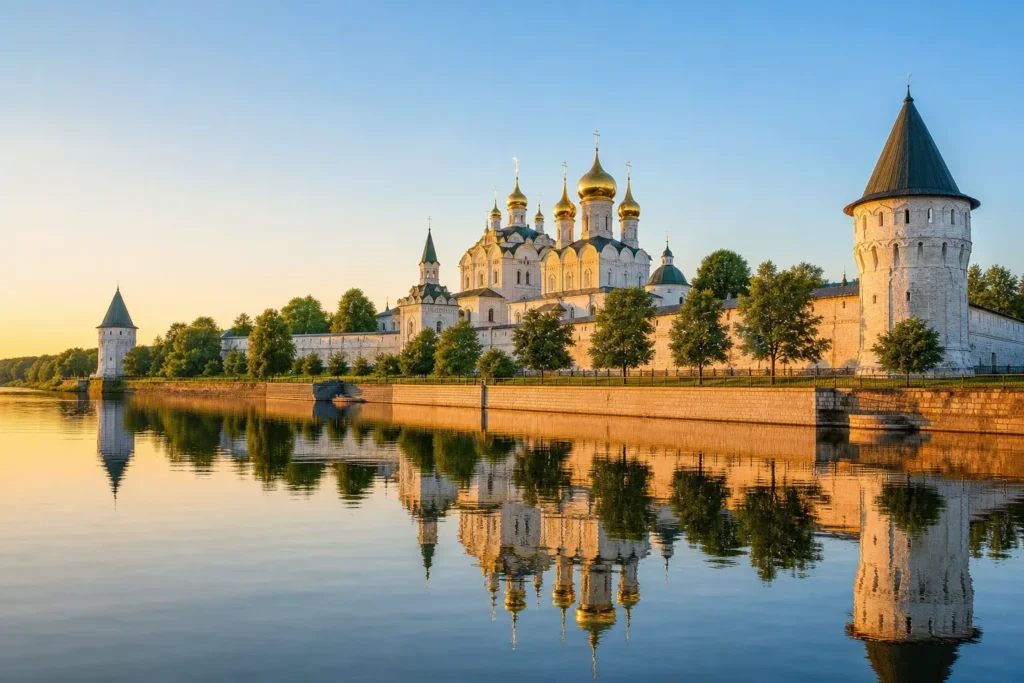
Makaryevo is a small settlement on the left bank of the Volga River, 100 km east of Nizhny Novgorod, home to one of Russia’s oldest and most picturesque Orthodox convents. Makaryevo day trip typically involves a ferry crossing from Lyskovo on the opposite bank, where white stone walls and golden-domed churches emerge from the Volga landscape. The Zheltovodsky Makaryev Convent of the Holy Trinity stands as a working female monastery, still active and restored, with a centuries-old history tied to one of medieval Russia’s most important figures.
Most visitors reach Makaryevo by car and ferry, or by organized tour from Nizhny Novgorod’s river station during summer months. The site draws pilgrims, history enthusiasts, and river travelers; it sees far fewer tourists than other major Orthodox sites, yet offers exceptional views and genuine monastic atmosphere.
Quick Facts
| Russian name | Макарьево |
|---|---|
| Distance from the nearest major city | 600 km via Nizhny Novgorod |
| Travel time from the nearest major city | 9–11 hours via Nizhny Novgorod |
| Built / opened | 1435 |
| Address | Макарьево, Лысковский район, Нижегородская область OpenStreetMap · Google Maps |
| Opening hours | Daily 09:00-18:00 |
| Admission | free |
| Best time to visit | May through September is optimal: warm weather, ferry service at full frequency, tours operating, convent grounds fully accessible. May is excellent for apple blossoms in the gardens; late August and September bring fewer tourists and cooler, clearer light. June through July brings peak summer heat and occasional mosquitoes (bring repellent). October and April are transitional; spring brings unpredictable weather and occasional ferry delays due to ice breakup. November through March is feasible but ferries are less frequent, temperatures are cold, and snow may limit site exploration. Orthodox holidays (particularly Easter, May 9 Victory Day, and November holidays) see increased pilgrimage crowds. |
| Recommended duration | 4–6 hours including transport |
What Is (and Isn't) Part of a Visit to Makaryevo, Nizhny Novgorod?
| Part | Status | Notes |
|---|---|---|
| Zheltovodsky Makaryev Convent of the Holy Trinity | Included in the standard ticket | The working Orthodox female monastery with churches, fortress walls, gardens, and shops. Free entry to the grounds and exterior access to churches. |
| Church interiors and services | Included in the standard ticket | You may attend Orthodox services or enter churches when not in active use; respect worship times and dress codes (head coverings for women). |
| Refectory (dining hall) and other historic buildings | Separate ticket or institution | Interior access to major structures beyond churches may require special permission from the convent; typically open to pilgrims but not guaranteed for casual tourists. |
| Monastic shop and pastry stall | Included in the standard ticket | Located within the convent grounds; open during visiting hours. Sells religious items, souvenirs, and food. |
| Ferry crossing from Lyskovo | Separate ticket or institution | Passenger ferry operates year-round; separate fee charged. Vehicle ferries also available but operate seasonally and on fixed schedules. |
| Lyskovo town itself | Outside / not part of it | A separate provincial Russian town with 19th-century architecture and churches; interesting as a destination on its own but not part of the Makaryevo convent visit. |
| Nearby river towns and villages | Outside / not part of it | Rabotki, Bor, and other Volga settlements are separate attractions; standard day trip focuses on the convent only. |
How to Get from the nearest major city to Makaryevo, Nizhny Novgorod
| Option | Duration | Price | Notes |
|---|---|---|---|
| Organized tour from Nizhny Novgorod River Station | Full day (8–10 hours including transport) | ₽₽ | May to September, departing from Nizhny Novgorod's River Terminal (Rechnoy Vokzal). Tours include hydrofoil or ferry transport and a guide. Book in advance during summer. Evening return to Nizhny Novgorod. This is the easiest option for those without a car and the most popular way to visit. |
| Car rental via ferry from Lyskovo | 5–6 hours on site plus 3–4 hours driving from Nizhny Novgorod | ₽ | Drive to Lyskovo (90 km southeast of Nizhny Novgorod, approximately 2 hours), park near the ferry terminal, cross by vehicle ferry to the convent (ferry operates year-round; frequency depends on season and water conditions). Return by the same route. Ferries depart regularly but less frequently in winter. Allows maximum flexibility and time at the site. |
| Private car with ferry (foot passenger only) | 4–5 hours on site plus 2.5–3 hours driving | ₽ | Drive to Lyskovo, park securely, walk onto the foot passenger ferry. Faster than driving a car across, but requires leaving your car behind. Ferry crossing takes 20–30 minutes. Good option for a focused visit without vehicle transfer logistics. |
| Minibus group tours from Nizhny Novgorod | Full day (8–10 hours) | ₽₽ | Several tour operators offer minibus excursions departing from city hotels or meeting points. Tours typically include road transport to Lyskovo and ferry crossing, with guide commentary. Depart early morning, return evening. Book through hotel concierge or Russian travel agencies. |
₽ budget · ₽₽ moderate · ₽₽₽ upscale · ₽₽₽₽ splurge. Price levels are estimates compared with typical prices for visitors.
Why Visit Makaryevo, Nizhny Novgorod?
The convent itself is the primary reason to visit—a working Orthodox female monastery with striking architecture that photographs beautifully from the Volga. Stone churches with gold cupolas sit encircled by fortress walls with towers, reflecting in river waters. Inside, visitors encounter peaceful gardens, active nun communities, small shops selling religious items and pastries, and the historic churches where services still occur.
The journey itself is part of the appeal: the ferry crossing, the fortress-like appearance of the walls as you approach, and the quietness of the place compared to more visited pilgrimage sites. The location on the Volga is historically significant—the monastery once hosted one of Russia’s largest medieval trade fairs and influenced Volga commerce for centuries.
Highlights of Makaryevo, Nizhny Novgorod
Trinity Cathedral
The central and most prominent building of the convent, rebuilt in 1658 after the original monastery was destroyed by Tatars in 1439. The cathedral is one of the first major stone structures constructed on the site after the monastery's revival in 1620. Its white walls and golden dome are visible from across the Volga and form the iconic silhouette of the entire ensemble. The exterior can be photographed from any angle within the convent; interior visits depend on service schedules.
Tip: Visit during morning hours when light hits the golden dome at its best; the cathedral interior is typically closed to casual visitors, so plan around Orthodox service times if you wish to enter.
Church of the Dormition with Refectory
Built in 1651 alongside the Trinity Cathedral, this church features an attached two-story refectory (trapeznaya), a large communal dining hall spanning 420 square meters. This building illustrates the practical layout of Orthodox monastic life and monastic kitchens. The refectory remains one of the few original structures from the main 17th-century construction phase, though it was repurposed as a warehouse during the Soviet era.
Tip: The refectory building is occasionally open to visitors or nun groups; ask at the main gate or entrance for access, as it may be in active use for the convent's daily operations.
Fortress Walls and Watchtowers
The convent is surrounded by white stone defensive walls punctuated by towers, built in the 17th century when the monastery served as both a spiritual center and a practical frontier stronghold. The fortress design reflects the monastery's dual role: protecting monks and defending Russian interests on the Volga during an era of Tatar raids and border tensions. The walls frame the internal churches and gardens, creating a cohesive architectural ensemble.
Tip: Walk the full perimeter of the walls to appreciate the fortification design; the view improves as you move around, and the south-facing wall catches afternoon light best for photographs.
Church of St. Michael the Archangel
A smaller church located above the southern gate of the convent, built as part of the main 17th-century construction phase. This gatehouse church combines practical fortification function (as a gate tower) with religious purpose, typical of Orthodox monastery design. The church provides views over the Volga from its elevated position.
Tip: The gate church often offers the clearest view of the Volga from within the walls; climb to the gate tower in late afternoon when the river light is strongest.
The Makariev Fair History
From the mid-16th century until 1816, the monastery grounds hosted the Makariev Fair, one of Russia's largest medieval and early modern trade markets. Ships arrived from across the Volga trade network, merchants exchanged goods, and the fair became so significant that it influenced Russian commerce for 250 years. A massive fire in 1816 forced the fair to relocate to Nizhny Novgorod proper, where it continued as the Nizhny Novgorod Fair. The convent's economic importance waned after this move.
Tip: Understanding the fair context—which is marked by small signs and occasional informational materials—transforms a visit from sightseeing into understanding medieval Russian economics and the Volga's role as a commercial artery.
Volga Riverbank and Ferry Landing
The convent sits directly on the floodplain of the Volga, with views across the river to Lyskovo on the opposite bank. The ferry landing is the main entry point for visitors and remains in active use for both pilgrims and tourists. The riverbank offers the most photographed vantage point of the entire ensemble—the reflection of the white walls and golden domes in the water creates the iconic image of the convent.
Tip: Arrive at the ferry landing early in the morning to photograph the convent before crowds and boats disturb the water; the reflection quality is best in calm conditions and golden-hour light.
Monastic Gardens and Apple Trees
Within the fortress walls, the nuns maintain gardens and orchards, including old apple trees, which add seasonal color and life to the interior spaces. These gardens were part of the original monastic design, providing food and medicinal plants for the community. The gardens create pockets of quiet and greenery that contrast with the stone architecture.
Tip: Visit in late spring (May) when apple trees bloom, or in late summer (August–September) when fruits ripen; these seasons add visual interest to the convent grounds and are less crowded than peak summer.
Monastery Shop and Pastry Selling
A small shop inside the convent sells religious items (icons, candles, crosses, bells, calendars, magnets) at modest prices, plus pastries and baked goods made by the nuns or local vendors. The cake shop is noted as selling inexpensive, good-quality sweets. This is both a functioning pilgrimage supply point and a minor income source for the convent community.
Tip: Buy pastries early in your visit before popular items sell out; prices are very reasonable and they make for good snacks for the ferry return or picnic on the grounds.
Atmosphere
Makaryevo feels quiet and timeless, especially outside peak summer tourist seasons. The white stone walls and golden domes create an almost dreamlike appearance, particularly when viewed from the Volga or at sunset. Within the grounds, you encounter working nuns going about daily routines, prayer services echoing from churches, and the sound of the river beyond the walls.
The air carries the scent of old stone, flowers in season, and river moisture. Most visitors move slowly and speak softly—the place has genuine spiritual weight rather than the polished, crowded atmosphere of major pilgrimage centers. Summer brings more tourists and occasional organized groups, but even in peak season it never feels packed. In autumn and early summer, the site is nearly empty, allowing for contemplative wandering.
History of Makaryevo, Nizhny Novgorod
The Zheltovodsky Makaryev Convent traces its origins to one of Russian Orthodox history’s most revered figures, Macarius of Unzha (c. 1349–c. 1444), a monk and hermit saint. Macarius initially traveled to Yellow Lake (Zheltye Vody), a shallow oxbow lake of the Volga, and in 1435 established a small wooden monastery on its marshy floodplain meadows. The site held spiritual appeal—a wilderness suitable for monastic retreat—and practical appeal as a stopping point for river traffic.
Within four years, in 1439, the monastery faced catastrophe: a Tatar raiding party burned and destroyed the wooden structures and took Macarius prisoner. Unwilling to allow the site to be rebuilt due to the ongoing danger, Tatar authorities dispersed the monks. Macarius himself eventually departed for the Kostroma region to the north, where he founded other monasteries, leaving the Yellow Lake site abandoned for nearly two centuries.
Revival came in 1620 when a monk named Avraamiy from Murom, then at a monastery in Tetyushka, received permission to restore the convent. Avraamiy rebuilt the wooden churches and monastic cells, and crucially, obtained a charter from Tsar Mikhail Fedorovich granting the monastery the right to collect customs duties on river traffic. This economic privilege transformed the monastery into a wealthy and influential institution.
Between 1620 and 1670, the monks executed an ambitious building campaign of stone churches. The Trinity Cathedral rose in 1658, the Church of the Dormition and its massive refectory in 1651, the bell tower in 1651, and the Church of St. Michael the Archangel above the southern gate as part of the defensive wall complex. These red and white stone structures replaced wood and established the architectural ensemble that largely survives today.
The monastery’s prosperity peaked when the Makariev Fair—the region’s largest seasonal trade market—took permanent residence on monastery lands. From the mid-16th century until 1816, merchants, craftspeople, and river traders converged annually at the monastery grounds. The fair attracted ships from across the Volga network, became one of Russia’s most economically important markets, and brought wealth and prestige to the convent. The fair was so famous that it drew merchants from Central Asia and Europe.
In 1816, a massive fire devastated the fair, and authorities decided to relocate it permanently to Nizhny Novgorod itself. This single decision eroded the monastery’s primary income source. By the early 19th century, another misfortune struck: the Volga shifted its course, absorbing the Yellow Lake that had given the monastery its name and spiritual significance. The river threatened the monastery with annual spring floods, eroding the banks and undermining walls.
In 1859, the main cathedral dome collapsed, and structural damage accumulated. Concerned for the safety and viability of the monastic community, the Nizhny Novgorod Orthodox Diocese dissolved the monastery in 1869, leaving a single caretaker monk in the compound. The Soviet era brought further decay: the buildings were seized and converted into an orphanage and later a veterinary school (1943).
Restoration began after Soviet rule ended. The Makaryev Monastery was reopened in 1991 and operational since then as a female convent. Reconstruction work continues to address Soviet-era damage and structural problems inherited from the Soviet period. The convent now functions as an active Orthodox women’s monastery under the Nizhny Novgorod Diocese, with nuns living and worshipping on site according to traditional Orthodox practice.
Tickets and Booking for Makaryevo, Nizhny Novgorod
| Ticket | Price | Includes |
|---|---|---|
| Convent entry | Free | Access to all monastery grounds, fortress walls, gardens, church exteriors, and monastic shop. |
| Ferry crossing (foot passenger, Lyskovo to Makaryevo, round trip) | ₽ | One-way passage across the Volga. Ferries operate year-round; typical crossing 20–30 minutes. |
| Vehicle ferry (car crossing) | ₽₽ | One-way crossing with private vehicle. Seasonal operation (spring to autumn); book in advance or check with Lyskovo ferry station. |
₽ budget · ₽₽ moderate · ₽₽₽ upscale · ₽₽₽₽ splurge. Price levels are estimates compared with typical prices for visitors.
Visiting the convent: No advance booking or tickets required. Simply arrive at the main entrance within visiting hours and enter freely. The convent is an active Orthodox female monastery; respect all posted signs, dress modestly (covered shoulders, knees; head coverings recommended for women in churches), and do not photograph inside churches unless explicitly permitted. Nuns and pilgrims may ask visitors to move away from active worship areas.
Ferry crossing: Foot passenger ferries depart regularly from Lyskovo throughout the day (roughly every 30–60 minutes in summer, less frequently in winter). No advance booking; simply arrive at the ferry terminal with your ticket purchased at the booth. Vehicle ferries operate on fixed schedules and may require advance booking; check at the Lyskovo ferry station or call ahead during off-season.
Organized tours: Book through Nizhny Novgorod’s River Terminal (Rechnoy Vokzal) or travel agencies in the city. Tours typically depart early morning (7–8 am) and return late afternoon. Tours from May to September; check availability before traveling.
Accessibility: The convent grounds are accessible by foot once you cross the ferry, but the site includes uneven ground, stairs within fortress walls, and some rough terrain. No specific accessibility information is published; contact the convent or Lyskovo ferry station in advance if you have mobility concerns.
Plan and Book
Suggested itineraries Makaryevo, Nizhny Novgorod
Half day (4 hours on site)
Arrive at Makaryevo by morning ferry. Walk the perimeter of the fortress walls to orient yourself and photograph the exterior. Visit the main churches and refectory building (20 minutes). Spend time in the gardens and shop for pastries and souvenirs (30 minutes). Walk to the riverbank for final photographs and reflection (30 minutes). Return by late afternoon ferry. Suitable for those traveling by foot ferry only or with limited time.
Full day (6–8 hours on site)
Arrive by morning ferry or early tour. Spend first hour exploring the exterior and fortress walls. Attend or observe an Orthodox service if timing permits (check service schedule). Visit each major church interior (2 hours total). Explore the refectory and monastic buildings (1 hour). Lunch on convent pastries or bring provisions (45 minutes). Afternoon walk along the Volga riverbank (1 hour). Shop at the convent store and photograph from various angles (1 hour). Depart by late afternoon ferry or tour return. This pace allows leisurely exploration and respects the contemplative rhythm of the site.
Extended visit with Lyskovo (8–10 hours)
Spend 4–5 hours at the convent as above. In the remaining time, explore Lyskovo on the opposite bank: visit the Church of the Saviour or other 19th-century landmarks, walk the town's historic core, enjoy lunch at a local cafe. This approach provides context on the region's development and offers a fuller sense of the Volga's role in Russian provincial life. Suitable for those traveling by private car who can return to Lyskovo between monastery visits.
How to Get to Makaryevo, Nizhny Novgorod
From Nizhny Novgorod by car (most flexible option): Drive south-southeast towards Lyskovo (90 km, approximately 2 hours). Follow signs to Lyskovo; the town sits on the right (east) bank of the Volga. Park securely near the ferry terminal (there is public parking). Purchase a foot-passenger ferry ticket or, if traveling by car, arrange a vehicle ferry. Cross the Volga (20–30 minutes for passengers, 45–60 minutes for vehicles). The convent is immediately accessible after disembarking; ask locals or follow signs if uncertain.
From Nizhny Novgorod by organized tour: Tours depart from the River Terminal (Rechnoy Vokzal), located on the Volga waterfront in downtown Nizhny Novgorod. Check tour operator websites or visit the terminal for schedules (May–September). Tours handle all transport and ferry logistics. Return is typically early evening.
Ferry logistics: Lyskovo ferry terminal is on the right bank; the convent is on the left (opposite) bank. Ferries run daily year-round. In summer (May–September), crossings are frequent (every 30–60 minutes). In winter, frequency reduces and ice may temporarily close the ferry; check conditions before traveling December–March. No reservation system for foot passengers; arrive and wait for the next departure.
Accessibility
The convent grounds are accessible on foot once you cross the ferry, but the site includes stairs, uneven stone surfaces, gravel paths, and steep sections of the fortress walls. The main churches are accessible via steps. No wheelchair ramps or accessible restrooms are confirmed at the convent; the official website does not publish accessibility details. Contact the convent or Lyskovo ferry station in advance (+7-831 phone prefix for Nizhny Novgorod region) if you have specific mobility needs. Ferry vessels themselves typically have stairs or ramps depending on water level and season.
Food Nearby
The monastic shop inside the convent sells pastries, baked goods, and simple refreshments made by nuns or local vendors. This is the only food option on the convent grounds. Lyskovo on the opposite bank has basic cafes and small restaurants (typical Russian provincial fare: soups, pelmeni, salads, tea). Bring a picnic or purchase food before crossing the ferry if you prefer a meal plan. The convent grounds are peaceful for a quiet picnic.
What to Bring
Comfortable walking shoes (stone and gravel paths, stairs on fortress walls). Camera for photography; the site is exceptionally photogenic. Hat and sunscreen (summer); the site offers limited shade. Insect repellent (summer mosquitoes from the Volga are common). Head covering or scarf for women visiting church interiors (respectful dress code). Water bottle; no shops beyond the convent store. Modest clothing (shoulders and knees covered). In cooler months (April, October–November), warm layers.
Best Views and Photo Spots of Makaryevo, Nizhny Novgorod
Volga riverbank at ferry landing
The convent's iconic view: white stone fortress walls, golden domes, and their reflection in calm water. This is the most-photographed angle and the best wide-angle perspective of the entire ensemble. Works in any light but is particularly dramatic in golden hour (early morning or late afternoon).
Best time: Early morning (before boats disturb the water) or late afternoon when the sun is lower and colors warm. Overcast days reduce glare on the water. Visit in May or September for best light angles.
South corner of fortress wall (Church of St. Michael the Archangel gate tower)
Elevated view over the Volga from the gate church tower. Captures the fortress walls receding along the riverbank and the river valley beyond. Less crowded angle than the ferry landing view. Offers context on the monastery's defensive design.
Best time: Afternoon when the south-facing wall is lit. Late summer or early autumn for clearest air and best contrast.
Interior courtyard facing Trinity Cathedral from the west
Close-up of the Trinity Cathedral's golden dome, bell tower, and surrounding churches framed by stone walls. This perspective emphasizes the density and harmony of the 17th-century architecture. Works best in morning light when the dome catches gold tones.
Best time: Morning light (before noon). Early May for apple blossoms in foreground; late August for long shadows that add depth.
North wall near the bell tower
Side profile of the main churches and fortress walls against the Volga background. Shows the fortification towers and architectural progression. Less visited angle; offers quieter photographic opportunity.
Best time: Late afternoon when the sun is west, lighting the stone walls warmly. Autumn for sharper, clearer light and fewer tourists.
Gardens and orchard interior
Seasonal detail shots: apple blossoms in May, fruits in August–September, autumn foliage in October. These images provide context on monastic life and soften the austere fortress architecture with natural beauty.
Best time: May for blossoms (early morning light); August–September for fruit and golden garden light; October for autumn colors. Avoid midday harsh sunlight in summer.
Photography Rules
Photography is permitted on the convent grounds and exterior of churches. Interior photography in active churches is typically prohibited or restricted; ask the nuns before photographing inside. No drones, professional tripods, or commercial filming without prior permission from the convent. The riverbank and fortress walls offer excellent vantage points. Reflection photography from the Volga during calm water is particularly striking.
Family Suitability
Makaryevo is suitable for families with older children (8+) who can walk comfortably over uneven terrain and stairs and who respect religious spaces. The site is quiet and safe, with no vehicle traffic inside the walls. Very young children may find the long walking distances tiring, and stairs on fortress walls can be steep. Stroller access is limited due to uneven surfaces and stairs. The journey itself (ferry crossing, exploring nature) appeals to children. Orthodox service times may challenge families unfamiliar with church protocol; observe quietly. The pace is slow and reflective, not fast-paced entertainment, so children seeking active attractions may lose interest quickly.
Russia Vibes Tips
- Arrive early in the day to avoid afternoon tour groups and to secure the best ferry crossing times. The convent feels most peaceful before mid-morning.
- Check Orthodox church service schedules before your visit; services typically occur in early morning and evening. Attending a service offers authentic insight into monastic life, but respect dress codes and photography restrictions.
- Bring or purchase insect repellent. Late May through August, mosquitoes from the Volga floodplain are significant. Apply before exploring the grounds, especially near water and gardens.
- The ferry return is less predictable in afternoon hours. If on a tight schedule, plan your return departure in advance and ask the ferry terminal staff about the next scheduled crossing before you disembark.
- The 17th-century stone construction creates excellent acoustics in the courtyards. The sound of church bells and chants carries across the walls—listen carefully in early morning or evening for this atmospheric element.
- Ask the nuns or convent staff about the Makariev Fair history while you are on site. Few visitors understand why the monastery was economically important, and local knowledge brings the site to life contextually.
Explore Nearby Makaryevo, Nizhny Novgorod
Browse more: All Day Trip · All Day Trips · All Day Trips in Nizhny Novgorod · All Nizhny Novgorod
FAQ: Makaryevo, Nizhny Novgorod
Is the convent always open to visitors?
The convent is an active Orthodox female monastery, not a museum. Grounds and churches are generally accessible during daylight hours, but services take priority. During active worship, visitors may be asked to move away from the church interior. Plan visits for morning or early afternoon. Contact the convent in advance if you require specific access guarantees.
Can I take photographs inside the churches?
Photography inside churches is typically restricted. Ask the nuns or clergy on site before photographing interiors. Exteriors and outdoor areas allow photography freely, but respect privacy and worship spaces. Professional or commercial filming requires prior permission.
What is the dress code?
Dress modestly: covered shoulders and knees. Women should bring a head covering or scarf for entering churches—some convents provide these, but it is safer to have your own. Men should remove hats indoors. Avoid swimwear, athletic wear, and revealing clothing anywhere on the grounds.
Is the ferry crossing safe?
Yes, the ferry is safe and operates year-round. Ferries are regularly maintained and carry both foot passengers and vehicles. In winter, ice conditions may occasionally close the ferry temporarily; check before traveling. Swimming is not recommended due to current and temperature.
Can I visit the refectory or other historic buildings inside?
Interior access to buildings beyond the main churches depends on convent operations and staff availability. Some tours include interior access; casual visitors may not gain entry. Ask at the convent entrance, and monastic staff will advise based on the day's schedule.
Is there food available at the convent?
A small monastic shop sells pastries, baked goods, and refreshments. This is the only food on site. Lyskovo has basic cafes and restaurants. Bring a picnic or purchase items before crossing the ferry if you plan a meal.
How long does a typical visit take?
Plan 4–6 hours on site including arrival and departure. This allows time to explore the fortress walls, visit churches, enjoy the gardens, and photograph. Shorter visits (2–3 hours) can cover main highlights. Longer stays (8+ hours) permit deep exploration and time for quiet reflection.
Is a guide necessary to appreciate the convent?
Not required, but helpful. Organized tours include guide commentary explaining history and architecture. Independent visits are rewarding with self-research or this article as reference. Some nuns or staff may answer questions if approached respectfully. Consider a guidebook or prior reading to contextualize the site.
Russia Vibes is a one-person project. A coffee keeps it going
How we research and update our guides
About this guide: AI assistance and accuracy
This guide is created with the help of AI and is based on official sources where available. Mistakes can still happen. Opening hours, prices, rules and other details are given to the best of our knowledge as of the date shown and can change without notice. It offers general recommendations only, not professional, legal or travel advice. Please confirm important details with the official source before you travel; you are responsible for your own plans and decisions.

Take this guide with you
Get a free PDF of this guide to print or read offline: key facts, tips and a map link on a few clean pages.
Report an issue on this page
Paying for your trip: please read
International sanctions affect payments between Russia and many other countries. In practice, cards issued in the EU, the UK, the US and several other countries often do not work in Russia, Russian cards usually do not work abroad, and some booking platforms, airlines and payment providers limit or suspend their services for Russia. The situation changes frequently.
We do not give legal or financial advice, and this site does not encourage anyone to break or circumvent sanctions. Whatever you plan, you are responsible for following the laws and regulations that apply to you, including those of your country of residence and citizenship.
Many travelers still organise their stay lawfully. It is worth asking your bank or payment provider what is currently permitted, contacting hotels, tour operators and carriers directly about the payment methods they accept, and checking which services are open to customers from your country. Clarify payment, cancellation and refund terms before you commit to a booking, and keep your plans flexible.
Partner links on this site may not be available in every country, and prices, availability and rules in our guides can differ from what you see when you book.