
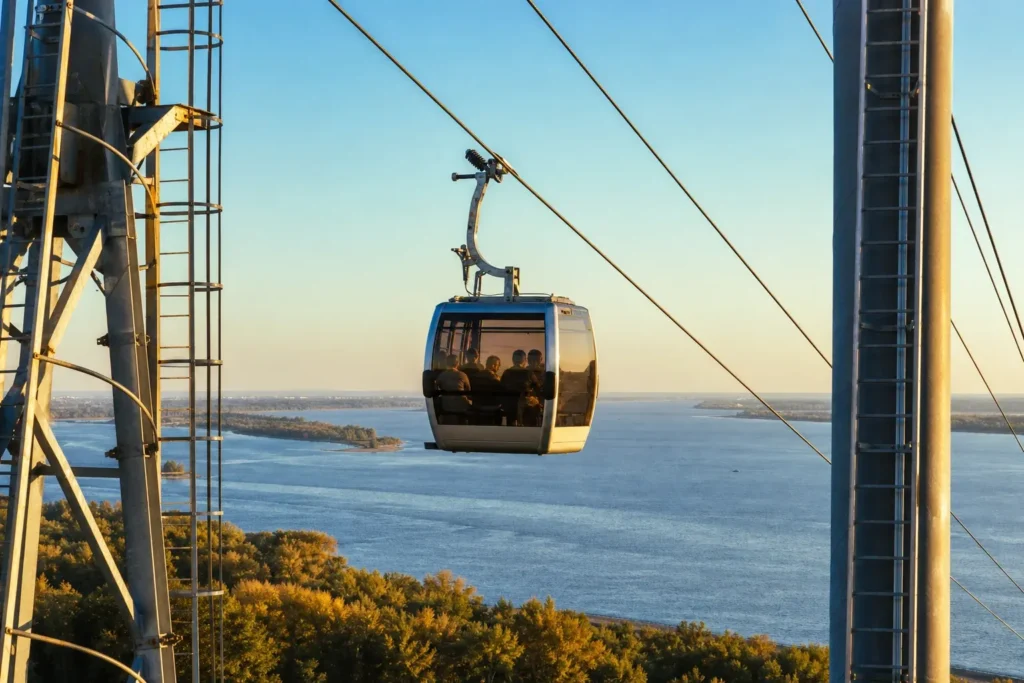
The Nizhny Novgorod Cableway is Russia’s only urban transit gondola, a working alternative transport system that has become one of the city’s most memorable attractions. Built by French engineers from Poma and opened in February 2012, it spans the Volga River with an unsupported cable stretch of 861 metres—one of Europe’s longest over water.
The cable car operates from Kazanskaya Embankment on the Nizhny Novgorod side and reaches Bor on the opposite bank. Originally designed to ease congestion on bridge crossings (cutting a 27-kilometre highway detour to just 3.6 kilometres), it has transformed into a popular tourist experience, offering a unique bird’s-eye perspective on the river, the city skyline and the surrounding natural landscape.
Quick Facts
| Russian name | Нижегородская канатная дорога |
|---|---|
| Built / opened | 2012 |
| Architect(s) | Poma |
| Address | Казанская набережная, 8A, Нижний Новгород OpenStreetMap · Google Maps |
| District | Nizhny Novgorod |
| Metro | Chkalovskaya (Line 1, From the station, walk north towards the Verkhnevolzhskaya Embankment and descend to Kazanskaya Embankment, about 10–15 minutes) |
| Opening hours | Mon-Sat 06:45-22:00; Sun 09:00-22:00; technical break Mon & Thu 10:45-13:00 |
| Admission | ₽ |
| Best time to visit | Spring and autumn offer comfortable temperatures and good light without extreme heat or cold. Summer weekends bring large crowds and queues; visit on weekday mornings for a quieter experience. Winter (January to March) offers the unique sight of ice fishermen on the frozen Volga, but trips are shorter due to reduced daylight. The cable car operates year-round and operates daily with extended evening hours. |
| Recommended duration | 13 minutes one-way ride |
| Website | nnkd.ru |
What Is (and Isn't) Part of a Visit to Nizhny Novgorod Cableway?
| Part | Status | Notes |
|---|---|---|
| Main cable car journey across the Volga | Included in the standard ticket | One-way ticket covers a single crossing from Nizhny Novgorod to Bor or vice versa. |
| Return ticket | Separate ticket or institution | Only one-way tickets are sold. To return, you must purchase a second ticket at the opposite station. |
| Cable car stations and seating | Included in the standard ticket | Access to both stations and cabin seating for the entire 13-minute ride. |
| Guided tours or commentary | Not open to visitors | No audio guide, staff commentary or organized tour packages; the experience is self-guided. |
| Kremlin cable car (separate funicular system) | Outside / not part of it | A different cable car system (People's Unity Square to Kremlin) opened around 2023 and is not part of this Volga cable car. |
| Food, shops or facilities on the cable car | Not open to visitors | No onboard services; the cabin is a transit vehicle with no food, water, restrooms or retail. |
Why Visit Nizhny Novgorod Cableway?
The cable car delivers the most spectacular urban transport experience in Russia. A 13-minute journey suspends you over the Volga at heights up to 80 metres, with views that shift dramatically by season: winter reveals fishermen on frozen ice below; summer shows wetlands, forests and a palette of blues and greens.
The ride is genuinely useful if you need to reach Bor, but most visitors come for the view alone. The gondola carries about 2 million passengers annually, blending commuters with tourists in a genuine public experience. It costs far less than a tourist boat tour and offers more intimate, unobstructed sightlines.
Highlights of Nizhny Novgorod Cableway
The Volga crossing
The cable car's signature feature is its 861-metre unsupported span across the Volga between two 82-metre-high masts. This engineering feat makes it one of Europe's longest uninterrupted cable spans over water. During the crossing, the cabin peaks at over 80 metres above the river. The masts themselves are visible from kilometres away and anchored with massive foundations on both banks. On clear days, the view extends far along the river valley.
Tip: The longest span occurs roughly midway through your journey; sitting on the cabin's right side (facing Bor) gives better light and views.
Winter ice fishing
From January to March, the frozen Volga reveals one of the most surreal sights: tiny figures of ice fishermen dotting the white surface like confetti. They appear almost doll-sized from the cable car, creating an otherworldly contrast between human activity and the scale of the river. The clarity of these views depends on weather and ice stability.
Tip: Morning light reveals details better; bring a camera or binoculars if you want close-up photos of the ice fishermen.
Summer wetlands and forests
From May to September, the river banks transform into lush vegetation. Swampy zones bloom with reeds and water plants; deciduous forest creates dense green walls. On humid days, mist rises off the water, creating impressionistic layers. The Bor side shows industrial zones mixed with nature—an honest reflection of the region's working landscape.
Tip: Visit in late afternoon when slanting light picks out the details in the forest and water. Wetlands are most vibrant in June and July.
The two stations
The Nizhny Novgorod station sits on Kazanskaya Embankment near the riverfront in the city centre. The cabin features capacity for 8–10 people per car, and cabins depart every few minutes. The Bor station on the opposite bank has less infrastructure—it's a smaller terminal where you must purchase your return ticket separately.
Tip: The queue for the outbound cabin from Nizhny Novgorod is typically short except summer weekends and public holidays. Early morning (before 9 a.m.) and weekday afternoons offer minimal waits.
The engineering journey
Mounted on the cabin ceiling are technical information panels explaining the gondola's construction. Built from 2009 to 2012, the project required 10 support towers, 560 tons of steel structures, and the two principal 82-metre masts. The Italian-French technical partnership overcame challenges including wind resistance and river current zones.
Tip: Read the panel before departure to understand the route; it adds narrative to the views below.
Bor's industrial waterfront
As you approach the Bor side, you see factories, warehouses and working docks—the town across the river was historically a timber-processing and chemical manufacturing hub. The contrast between Nizhny Novgorod's preserved historic centre and Bor's industrial character is stark and informative about the region's economic geography.
Tip: Photographers can capture industrial architecture framed by forest on the approach to Bor; the golden hour (late afternoon) offers dramatic side light.
Atmosphere
The cabin experience mixes functionality with quiet drama. You share a small space—typically six to eight people—with local commuters, families and visitors standing shoulder to shoulder. The metal floor, industrial ceiling and cable-overhead create an industrial aesthetic that contrasts with the expansive natural views outside.
The hum of the motor and gentle sway of the cabin is hypnotic rather than alarming; stability is smooth and motion feels natural after the first minute. Passengers fall quiet, absorbed in the views. Summer mornings feel peaceful; summer evenings and weekends bring crowding. Winter rides are eerily silent, with the frozen river creating an almost monochromatic scene interrupted only by figures on the ice.
History of Nizhny Novgorod Cableway
The cableway was conceived as a response to congestion on the Bor Bridge, which by 2010 handled 90-minute crossings for a journey of 27 kilometres by road. In December 2007, the French company Poma presented a cable car proposal to city authorities.
Engineering work began in 2009. Moscow-based StroyArchitecture designed the structure; JSC Energomash managed production. The two main 82-metre masts—each weighing 6 tonnes—were transported overland in November 2009. By 2010, all ten support towers were installed. Construction of the cable anchorages and station buildings occupied 2011.
The system was tested in early 2012 but faced challenges with wind gusts triggering automatic safety stops. On 9 February 2012, the first public test runs began. Full commercial operation commenced later that month. The gondola was Russia’s first—and remains its only—urban transit aerial cable car.
The system carries approximately 2 million passengers annually. It has proven so successful that it inspired discussion of similar systems in other Russian cities, though none have yet been built. The cable car remains a notable symbol of modern engineering applied to the region’s transport infrastructure.
Tickets and Booking for Nizhny Novgorod Cableway
| Ticket | Price | Includes |
|---|---|---|
| Single one-way ticket (adult) | ₽ | One crossing from either station to the opposite bank; valid for one cabin ride only. |
| Single one-way ticket (child, ages 7–12) | ₽ | One crossing; reduced rate applies to children in this age group. |
| Free entry (children under 7) | Free | Children under 7 years old travel free with a paying adult. |
₽ budget · ₽₽ moderate · ₽₽₽ upscale · ₽₽₽₽ splurge. Price levels are estimates compared with typical prices for visitors.
Where to buy: Tickets are sold at booth windows at each station. The Nizhny Novgorod station has a staffed ticket office; the Bor station also has a booth.
Payment: You can pay in cash (roubles) or use a card at the turnstile if you have a Nizhny Novgorod transport card (same as for metro and buses). Contactless payment may also be available.
One-way only: There are no round-trip or return tickets. You must purchase a separate ticket for each journey. If you wish to go to Bor and back, you pay twice.
Same-day tickets: No advance booking is required. Show up and buy a ticket at the booth. During summer weekends and public holidays, expect queues (15–30 minutes possible).
Concessions and rates for Russian citizens differ, and reductions exist for students and pensioners. For all ticket categories and current fares, visit the official website at nnkd.ru.
Plan and Book
Suggested itineraries Nizhny Novgorod Cableway
15 minutes (cable car only)
Walk to Kazanskaya Embankment, buy a ticket at the station booth, ride the cable car to Bor (13 minutes). Disembark, enjoy the Bor waterfront or return immediately.
1 hour (with embankment walk)
Start at Chkalovskaya metro station. Walk north through the city center to reach Kazanskaya Embankment (10–15 minutes). Visit the cable car station, ride to Bor (13 minutes), return with a second ticket, then walk back along the Verkhnevolzhskaya Embankment towards the Kremlin.
2 hours (with Bor exploration)
Take the cable car to Bor. Walk around the Bor waterfront and town centre to see its industrial heritage and local life (45 minutes–1 hour). Return on the cable car. Optional: combine with a visit to nearby Kazanskaya Embankment parks or cafés on the Nizhny Novgorod side.
How to Get to Nizhny Novgorod Cableway
By metro: Exit Chkalovskaya station (Line 1, Avtozavodskaya line). At street level, turn right and head north along the main road (Myasnitskaya Street initially, then it curves). Follow signs for the embankment or turn left towards the river. Walking time: 10–15 minutes, downhill towards the water.
On foot from Kremlin: From the Kremlin walls (Kremlyovskaya Street side), walk north and slightly east to descend via the Chkalovskaya Stairs (near Chkalovskaya metro) or Verkhnevolzhskaya Embankment. Follow the embankment east (downriver) to reach Kazanskaya Embankment.
By bus: Several buses service the embankment area (routes vary). Ask locals or check the transport app for ‘Kazanskaya Embankment.’
By taxi/ride-share: Provide the address ‘Kazanskaya embankment 8A’ to your driver. Parking near the station is limited.
Accessibility
Wheelchair users may face challenges: the station has a ticket booth but access to the cabin itself is limited. Stairs and boarding steps to the cabin are present; transfer from a wheelchair to a cabin seat is difficult. No official accessible information is published by the operator. Contact the station directly (+7 831 411-10-09) to discuss accessibility options before your visit.
Food Nearby
Cafés and small restaurants line Kazanskaya Embankment and nearby streets. Popular options include casual Russian cuisine venues. The Verkhnevolzhskaya Embankment area (10 minutes' walk) has more established restaurants. Convenience stores near Chkalovskaya metro sell snacks and drinks.
What to Bring
Comfortable walking shoes (embankment access involves slopes and stairs). Bring water and sun protection (hat, sunscreen) in summer. In winter, dress warmly for the wind-exposed cabin and outdoor waiting areas. Photography equipment is useful for capturing views. The cabin holds few belongings; keep bags small.
Best Views and Photo Spots of Nizhny Novgorod Cableway
Cabin window at mid-crossing (Volga span)
The most dramatic perspective: suspended directly above the wide Volga with the distant tree-lined banks framing the water. In winter, fishermen dots appear below. The 861-metre unsupported span is most obvious here.
Best time: Late afternoon for warm light; any clear day for visibility.
Station platform before boarding (Nizhny Novgorod side)
Views upstream along Kazanskaya Embankment and the city's historic riverfront, including glimpses of the Kremlin walls and Chkalovskaya stairs in the distance.
Best time: Morning light illuminates the embankment and architecture without harsh shadows.
Bor station arrival
Industrial waterfront with factories and cranes; the contrast between Bor's working landscape and Nizhny Novgorod's historic side is striking.
Best time: Afternoon light picks out the industrial structures and forest texture.
Photography Rules
Photography is permitted throughout the ride and at stations. No drones, tripods or flash photography. The best views for photos occur during the main Volga crossing; position yourself on the right-side seating (facing Bor) for better light during daytime. Evening rides offer dramatic sunset light but require faster camera settings.
Family Suitability
The cable car is suitable for all ages, including young children and infants. The ride is smooth, stable and short (13 minutes). However, very young children may find the height or motion slightly unsettling; reassurance from an adult helps. Strollers can be brought to the station but may be awkward in the small cabin; folding or carrying is practical. The waiting queue areas have little shelter or seating; bring snacks and entertainment for waits. Supervision is essential, as the cabin is a moving transport vehicle with windows (safe but requiring attention).
Russia Vibes Tips
- Visit early in the morning (7–9 a.m. on weekdays) to experience the cable car with mostly commuters. The queues are minimal, and the light is often clearer before midday haze builds.
- Don't expect a tourist attraction with museums, shops or food. The cable car is a working transport system. Bring entertainment if you dislike long walks or waits.
- Winter trips (January–March) are memorable for the ice fishermen below, but the frozen landscape is monochromatic. Summer offers vibrant colour and life at the cost of bigger crowds.
- The technical break (Monday and Thursday, 10:45–13:00) closes the cable car. Avoid these times or plan an alternative activity.
- Bring small notes or coins if paying cash; the ticket booth may not have change for large bills.
- The right side of the cabin (facing Bor) has better natural light for photography and views. Request seating on this side if possible, or board early to claim a spot.
Explore Nearby Nizhny Novgorod Cableway
Related guides
 Chkalov Staircase: Russia’s Longest Monument, Hours and What to ExpectOpen 24 hours
Main image: AI-generated illustration. It may not show the place exactly as it looks.
 Nizhny Novgorod Kremlin: Medieval Fortress and River ViewsOpen daily 06:00–22:00
Main image: AI-generated illustration. It may not show the place exactly as it looks.
Browse more: More in Nizhny Novgorod · All Nizhny Novgorod · All Sightseeing · All Sightseeing in Nizhny Novgorod · All Viewpoints
FAQ: Nizhny Novgorod Cableway
How long is the cable car ride?
The crossing takes 13 minutes one-way from either station to the opposite bank. The entire experience (including queuing, ticket purchase and boarding) typically takes 30–45 minutes depending on crowd levels.
Can I buy a round-trip ticket?
No. The operator sells only one-way tickets. If you want to return, you must purchase a second ticket at the opposite station. No discounted multi-trip passes or round-trip fares are offered.
Is the cable car safe? Does it stop or sway?
Yes, it is safe. The system is engineered to European standards and has been operating continuously since 2012. The cabin is stable and sways minimally in normal conditions. Automatic safety systems stop the cable in wind gusts exceeding safe thresholds (this is rare).
What is there to do in Bor after arriving?
Bor is a working industrial town without major tourist attractions. You can walk the waterfront, see the industrial landscape, grab a local café meal, or simply return. Most visitors cross, admire the views and return on the same day.
Is there a guide or audio commentary?
No. The cable car is a pure transit experience with no guide, commentary or information service. Panels at the station provide basic technical details.
Can I bring luggage, a bicycle or pets?
Small luggage and backpacks fit in the cabin. Bicycles are typically not permitted. Pets are not mentioned in public sources; contact the operator (+7 831 411-10-09) to confirm their policy.
Does the cable car run in winter?
Yes, year-round. However, extreme cold or high winds may trigger temporary closures. The operator may also reduce service during harsh weather. Check the official website or call ahead if you plan to visit during winter storms.
Is there a difference between the Volga cable car and the 'Kremlin cable car' I've heard about?
Yes. The Volga cable car (this one) crosses the river between Nizhny Novgorod and Bor since 2012. A separate, newer funicular-style cable car opened around 2023 between People's Unity Square and the Kremlin (a short hill climb). They are two distinct systems.
Russia Vibes is a one-person project. A coffee keeps it going
How we research and update our guides
About this guide: AI assistance and accuracy
This guide is created with the help of AI and is based on official sources where available. Mistakes can still happen. Opening hours, prices, rules and other details are given to the best of our knowledge as of the date shown and can change without notice. It offers general recommendations only, not professional, legal or travel advice. Please confirm important details with the official source before you travel; you are responsible for your own plans and decisions.

Take this guide with you
Get a free PDF of this guide to print or read offline: key facts, tips and a map link on a few clean pages.
Report an issue on this page
Paying for your trip: please read
International sanctions affect payments between Russia and many other countries. In practice, cards issued in the EU, the UK, the US and several other countries often do not work in Russia, Russian cards usually do not work abroad, and some booking platforms, airlines and payment providers limit or suspend their services for Russia. The situation changes frequently.
We do not give legal or financial advice, and this site does not encourage anyone to break or circumvent sanctions. Whatever you plan, you are responsible for following the laws and regulations that apply to you, including those of your country of residence and citizenship.
Many travelers still organise their stay lawfully. It is worth asking your bank or payment provider what is currently permitted, contacting hotels, tour operators and carriers directly about the payment methods they accept, and checking which services are open to customers from your country. Clarify payment, cancellation and refund terms before you commit to a booking, and keep your plans flexible.
Partner links on this site may not be available in every country, and prices, availability and rules in our guides can differ from what you see when you book.