
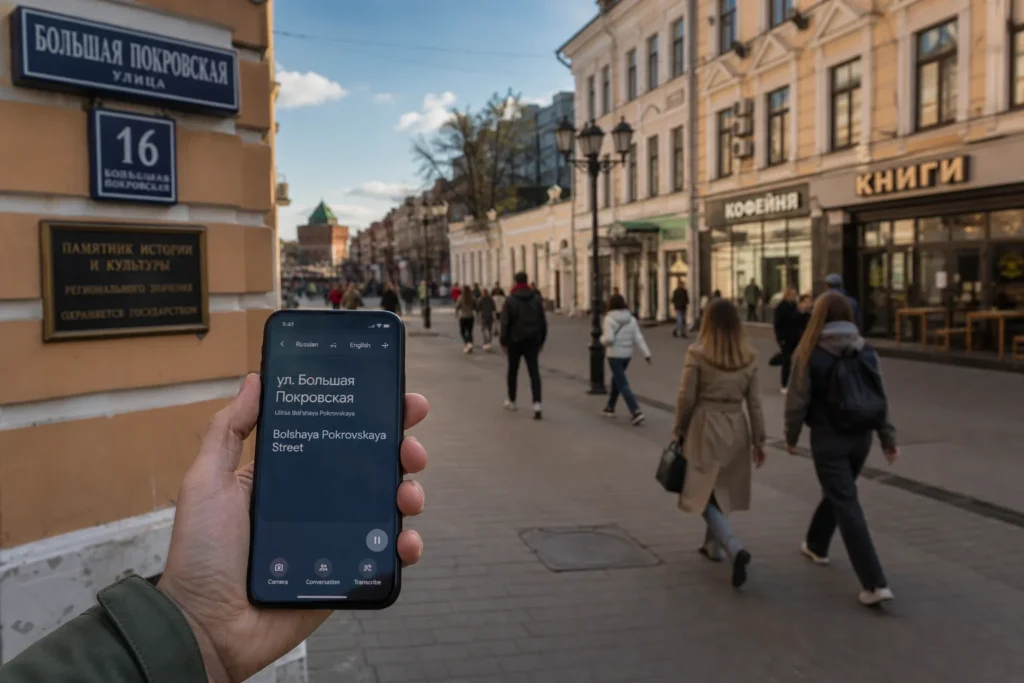
Nizhny Novgorod welcomes visitors but speaks primarily Russian. Unlike Moscow or Saint Petersburg, this city of 1.2 million offers fewer English speakers outside the centre and major attractions. Knowing how to navigate language barriers—using apps, learning basic phrases, and recognizing Cyrillic signs—makes the difference between a smooth trip and frustration.
This guide shows you the practical ways to communicate, understand your surroundings, and ask for help when language fails. The recommended approach combines offline preparation with real-time translation tools, plus a few survival phrases you can memorise before you arrive.
Quick answer: Install offline translation and metro apps before arrival. Use your phone to translate signs and menus by camera. Learn five to ten essential Russian phrases. Carry a notebook and sketches. Ask hotels or tourist information for written directions. Most restaurants and hotels staff speak some English; museums often provide guides in multiple languages.
At a Glance
| Total time | Ongoing; preparation 30–45 minutes before arrival; use during your visit as needed |
|---|---|
| Typical cost | Free (apps are free; phrasebooks available free online) |
What You Need Before You Start
- Smartphone with internet access (or pre-downloaded offline translation)
- Google Translate, Yandex Translate, or similar installed
- Offline Cyrillic-to-Latin converter or transliteration guide
- Nizhny Novgorod metro map (available online before you visit)
- Notebook and pen for drawings and simple written requests
- Patience and a smile—people appreciate the effort
- Backup translation phrasebook (written or printed)
Compare Your Options
| Option | Duration | Price | Notes |
|---|---|---|---|
| Combine phone translation and phrasebook (recommended) | Ongoing | Free | Use Yandex Translate or Google Translate, learn five phrases, carry notebook and pen. Works everywhere. Locals appreciate the effort. No need for expensive translation services or guides unless you want deep cultural insights. |
| Hire a private guide or translator for the day | 4–8 hours per day | ₽₽₽ | Removes all language stress. Useful for understanding history, culture, and nuance. Many hotels can arrange this. Book in advance. Best for history buffs or those with accessibility needs. |
| Use tour groups with English-speaking guides | 2–4 hours per tour | ₽₽ | Covers major sites (Kremlin, cable car, embankment). Guides explain in English. Less flexibility. Book through hotel or nn-tourist.ru. Good for first-time visitors on a schedule. |
| Rely on written phrasebook only (no smartphone) | Ongoing | Free | Printed or handwritten. Slower than apps but works for basic needs. Carry clear phrases for 'hotel', 'food', 'ticket', 'thank you'. Less reliable for unexpected problems or detailed questions. |
| Ask hotel staff to pre-arrange your entire itinerary in writing | 30–60 minutes on arrival | Free | Staff writes directions, provides maps with highlighted routes, books tickets. Most reliable for non-confident travellers. Removes the need to communicate on the spot. Takes time on day one. |
₽ budget · ₽₽ moderate · ₽₽₽ upscale · ₽₽₽₽ splurge. Price levels are estimates compared with typical prices for visitors.
Step-by-Step Instructions
Step 1: Download translation and navigation apps before you leave
Install Google Translate, Yandex Translate (the Russian market leader), and Citymapper or a metro map app. Set them to work offline if possible so you don't rely on mobile data. Download the Nizhny Novgorod metro map from metronn.ru. Test each app on your home device so you know how to use it quickly when you need it. Many apps allow you to photograph text with your camera and translate it instantly.
Tip: Yandex Translate often handles Russian Cyrillic better than Google in this region, and Yandex Maps works well offline for navigation.
Step 2: Learn five to ten essential Russian phrases before arrival
Memorise greetings (Привет/Privet = Hello, Спасибо/Spasibo = Thank you), basic requests (Помогите/Pomogite = Help me, Говорите по-английски? = Do you speak English?), and navigation phrases (Где метро?/Gde metro? = Where is the metro?, Ванная комната/Vannaya komnata = Bathroom). Write them down phonetically if Cyrillic is unfamiliar. Russian speakers often appreciate even clumsy attempts; a smile softens any mispronunciation.
Tip: Practise pronunciation online on YouTube before you arrive so you can be understood, not just understood by your app.
Step 3: Carry a small notebook and pen at all times
Use it to draw simple pictures—a fork and plate for food, a bed for accommodation, a question mark for directions. Sketch the metro line you need or your hotel name. Many older residents and shop staff appreciate this non-verbal approach and will respond by pointing, drawing back, or fetching someone who speaks English. A picture is faster than fumbling with a phone.
Tip: Tear a page from your hotel's business card or write your hotel name and address on paper to show locals when you are lost.
Step 4: Use your phone camera to translate signs, menus, and directions
Point your camera at shop signs, restaurant menus, street signs, and metro announcements. Google Translate's camera feature and Yandex Translate both convert Cyrillic to English in real time. Metro signs often display station names in both Cyrillic and Latin letters, but the camera translation helps with announcement boards and notices you may not recognise.
Tip: If text is too small to read or the camera struggles, take a photo and use the app's 'Gallery' option to translate it offline later.
Step 5: Use Yandex Maps or Google Maps offline for navigation
Download the Nizhny Novgorod map area onto your phone before you lose signal. Nizhny's streets are not always signed clearly in English, and street names are shown in Cyrillic. Tap a destination and follow the blue line. Both apps show metro stations, buses, and walking routes. The metro stations themselves display names in both scripts on most platforms, but a map prevents getting lost between transitions.
Tip: Save your hotel's address in Cyrillic (ask reception to write it or screenshot it) so you can show it to a taxi driver or enter it in maps without typing.
Step 6: Ask your hotel or information centre for written directions
On arrival, request staff at your hotel or a tourist information office to write directions to major attractions in Cyrillic, or to draw a simple route on a map. Major attractions like the Kremlin, Chkalov Staircase, and Bolshaya Pokrovskaya are well-known to locals; written descriptions help you explain where you want to go. The Nizhny Novgorod regional tourism website (nn-tourist.ru) has English-language information and can be consulted before your visit.
Tip: Screenshot directions or save them as PDF on your phone so you have them even if your internet drops.
Step 7: Speak slowly and use simple words at tourist-facing businesses
Staff at hotels, museums, major restaurants, and metro information booths have often been trained in English or can fetch someone who speaks it. Speak in short sentences without idioms. Use words like 'Kremlin', 'metro', 'ticket', 'help', 'food', 'water'. Avoid slang and ask yes-or-no questions rather than open-ended ones. If someone does not understand, try writing it down or drawing it.
Tip: Museums and large attractions often offer free maps in English; ask at the ticket desk even if the guide is not available.
Step 8: Use translation for food ordering in small restaurants
Photograph the menu with Google Translate camera or Yandex Translate. Point to dishes or ask what is popular (Что это/Chto eto? = What is this?). Most small cafes and street food stalls do not require spoken orders; photos and pointing work fine. If no menu is visible, sketch a plate, cup, or bread to indicate the type of food you want.
Tip: Restaurant workers are used to tourists pointing at pictures; do not be shy about it. If vegetarian, learn 'Без мяса/Bez myasa' (without meat) or carry a card stating your dietary needs.
Step 9: Download the Nizhny Novgorod metro system diagram and learn key stations
The metro has two lines: Line 1 (Avtozavodskaya line, 11 stations) and Line 2 (Sormovsko-Meshcherskaya line, 6 stations). Key stations for tourists include Moskovskaya (near the railway station), Chkalovskaya (near Chkalov Staircase and central embankment), and Leninskaya (closer to the historic centre). Station names appear in Cyrillic; the map shows you which line and direction to travel. Transfer at Strelka.
Tip: Take a photo of your destination on the metro map and show it to staff if you are uncertain about the direction; they will point you to the correct platform.
Step 10: Ask for help from police, security, or younger people if lost
Police (in blue uniforms) speak little English but are trained to help tourists and will not be offended if you approach them lost or confused. Younger Russians (under 35) are more likely to speak English than older generations; approach people on the street in central areas like Bolshaya Pokrovskaya. Never be afraid to ask. Have your hotel address written in Cyrillic or a saved photo of it ready to show.
Tip: Smile first, gesture apologetically, and say 'Помогите' (pomogite = help) before trying to explain your problem.
Common Mistakes to Avoid
- Assuming English is widely understood: Outside tourist zones, many people speak only Russian. Hotel and restaurant staff help, but street vendors, bus drivers, and shop assistants may not. Always have a backup communication method ready.
- Forgetting that metro station names are in Cyrillic: Station signs show Russian script first. Carry the metro map or use your app to identify stations by position, not by reading Cyrillic alone. Look for icons or the next station announced.
- Not learning how to read basic Cyrillic letters: You do not need to speak Russian, but recognising key letters (М for metro, Ж for women's restroom, Ч for men's) and numbers helps enormously. Spend 20 minutes learning the alphabet before you arrive.
- Relying only on your phone without a backup: Download offline maps and save key phrases on paper. If your battery dies or you lose signal, you are stuck. Hotels, police, and landmarks are your fallback; knowing them reduces panic.
- Being impatient or rude when locals do not understand: Russian hospitality relies on respect. A smile, a polite phrase, and patience get you further than frustration. If someone is trying to help, acknowledge their effort even if you do not fully understand.
- Ordering food or boarding transport without confirming: Always show a picture, sketch, or written direction to confirm. A nod from a staff member is not always a 'yes'; they may be being polite. A taxi driver may take a different route unless you show the address or map.
Tickets, Payment and Booking
Translation apps are your main tool and are free to download.
- Google Translate: Available worldwide, works offline, camera feature is reliable. Download the Russian language pack before you leave.
- Yandex Translate: Russian company, often preferred locally, works offline, understands Russian idioms well.
- Offline options: Some apps require no internet (e.g., Microsoft Translator offline). Test before arrival.
Maps and metro: Download Nizhny Novgorod metro map from metronn.ru or save a screenshot. Google Maps and Yandex Maps both work offline if you download the area before arrival.
Hotel staff: Speak English in major hotels. Ask them to write or draw directions for free. Tourist information at nn-tourist.ru has an English-language section.
Avoid paid translation scams: Do not pay for translation services from street vendors or unofficial guides unless reputable hotels or tour operators have arranged them. Your phone does the job free and better.
Russia Vibes Tips
- Download Nizhny Novgorod's street map with restaurant and metro overlays from OpenStreetMap or Google Maps before you leave home, even if you have data abroad. This removes dependency on real-time connectivity and lets you spot where you are without asking.
- Carry small denomination rubles in cash. Many small shops, street food vendors, and cafes do not have card readers or take foreign cards. You cannot communicate via card; cash avoids confusion and haggling.
- Ask your hotel to write your destination in Russian in a text message or on a card you can show to a taxi driver or passerby. Cyrillic script is instantly recognisable locally and more reliable than trying to spell an English version aloud.
- Visit Bolshaya Pokrovskaya (main pedestrian street) and the Kremlin area first—the most English speakers congregate here, and signs are clearer. Smaller neighbourhoods require more Russian or visual communication.
- Younger people (under 30) in Nizhny, especially students and tech workers, are far more likely to speak English than older residents. If an older person cannot help, asking a younger passerby often works better.
- Tourist information and museum guides: The regional tourism website (nn-tourist.ru) and major museums like the Nizhny Novgorod Panorama Museum provide English guides and printed materials. Ask for them on arrival; they are free or cheap.
Explore Nearby Navigate Language Barriers in Nizhny Novgorod
Sights near Navigate Language Barriers in Nizhny Novgorod
 Nizhny Novgorod Kremlin · typical visit: 2–3 hoursOpen daily 06:00–22:00
Main image: AI-generated illustration. It may not show the place exactly as it looks.
 Chkalov Staircase, Nizhny Novgorod · typical visit: 45 minutes to 1.5 hoursOpen 24 hours
Main image: AI-generated illustration. It may not show the place exactly as it looks.
 Bolshaya Pokrovskaya Street, Nizhny Novgorod · typical visit: 1.5–2 hoursOpen 24 hours
Main image: AI-generated illustration. It may not show the place exactly as it looks.
Browse more: All Etiquette and Safety · All How-To · All How-To in Nizhny Novgorod · All Nizhny Novgorod
FAQ
Can I get by in Nizhny Novgorod without speaking Russian at all?
Yes, with preparation. Download translation apps, learn five phrases, and use your phone camera to translate signs. Hotels, restaurants, and tourist attractions have English speakers. Outside these areas, you will need non-verbal communication (drawing, pointing, written directions). It is possible but slower than speaking Russian; prepare accordingly.
Which translation app is best for Russian in Nizhny Novgorod?
Yandex Translate is often better for Russian than Google Translate because it understands regional idioms and context. Google Translate's camera feature is excellent. Use both; they are free. Download offline language packs before you arrive so you do not depend on mobile signal.
Are metro signs in English?
Metro station names appear in Cyrillic on signs, but most platforms also show Latin letters or station numbers. Station announcements are in Russian only. Carry the metro map or a screenshot and use the app to show the station name to staff. Do not rely on reading signs alone.
Is there a cost to using translation apps or calling translation services?
Google Translate, Yandex Translate, and most other translation apps are free. Paid translation services from hotels or tour companies are optional and cost extra. Your phone is sufficient; professional translation services are useful only for complex matters (visa issues, legal documents).
What if my phone battery dies or I lose internet connection?
Download offline maps and a written phrasebook (or photos of key phrases) before you leave. Know your hotel's address in Cyrillic. Ask staff to write directions. Use landmarks and taxi driver numbers from your hotel. Avoid being entirely dependent on your phone.
Can I order food in restaurants without Russian?
Yes. Use your phone camera to translate the menu in real time, or point to pictures and photos on the menu. Sketch a plate or cup if no menu is visible. Most restaurants tolerate this approach; staff are used to tourists doing so. Carry a note of your dietary restrictions in Russian.
Are younger or older people more likely to speak English?
Younger people (under 35) are more likely to speak English, especially in the city centre and in tech or service roles. Older residents often speak little English. In smaller towns and neighbourhoods outside Nizhny, English is even less common. When stuck, ask young people first.
Do I need to hire a guide to avoid language problems?
No, but a guide is useful if you want detailed historical or cultural information or if you are uncomfortable navigating alone. For basic sightseeing and transport, translation apps and phrasebooks are enough. Tours and guides are available through hotels or nn-tourist.ru if you prefer company.
Russia Vibes is a one-person project. A coffee keeps it going
How we research and update our guides
About this guide: AI assistance and accuracy
This guide is created with the help of AI and is based on official sources where available. Mistakes can still happen. Opening hours, prices, rules and other details are given to the best of our knowledge as of the date shown and can change without notice. It offers general recommendations only, not professional, legal or travel advice. Please confirm important details with the official source before you travel; you are responsible for your own plans and decisions.

Take this guide with you
Get a free PDF of this guide to print or read offline: key facts, tips and a map link on a few clean pages.
Report an issue on this page
Paying for your trip: please read
International sanctions affect payments between Russia and many other countries. In practice, cards issued in the EU, the UK, the US and several other countries often do not work in Russia, Russian cards usually do not work abroad, and some booking platforms, airlines and payment providers limit or suspend their services for Russia. The situation changes frequently.
We do not give legal or financial advice, and this site does not encourage anyone to break or circumvent sanctions. Whatever you plan, you are responsible for following the laws and regulations that apply to you, including those of your country of residence and citizenship.
Many travelers still organise their stay lawfully. It is worth asking your bank or payment provider what is currently permitted, contacting hotels, tour operators and carriers directly about the payment methods they accept, and checking which services are open to customers from your country. Clarify payment, cancellation and refund terms before you commit to a booking, and keep your plans flexible.
Partner links on this site may not be available in every country, and prices, availability and rules in our guides can differ from what you see when you book.