
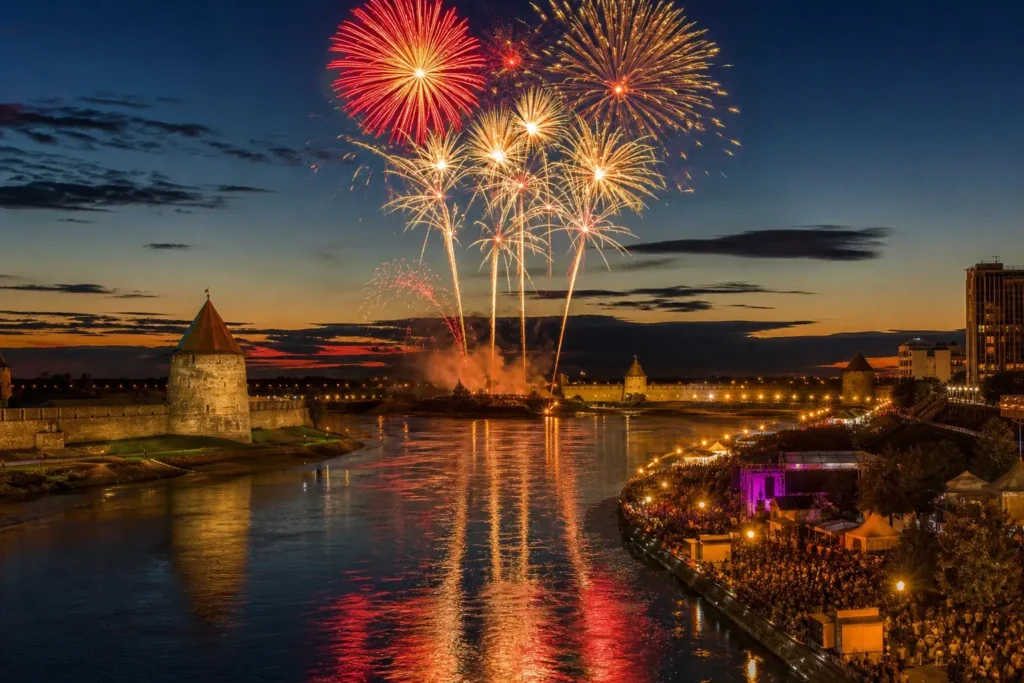
City Day, Nizhny Novgorod is the city’s main annual celebration, held each year on the third Saturday in August. The date commemorates the city’s founding in 1221 by Vladimir princes as a fortress outpost on the Volga and Oka rivers. What began as a single event has evolved into a multi-day festival that transforms the city into an open-air celebration.
Since 2019, the holiday has been reimagined around a broader cultural programme. Rather than a single central event, City Day now features 10 interconnected themed festivals running simultaneously across key venues: the Nizhne-Volzhskaya embankment (the main waterfront promenade), the Strelka area where the Volga and Oka meet, and the Grebnoy channel. This distributed approach brings celebration throughout the city’s heart.
Quick Facts
| Russian name | День города Нижнего Новгорода |
|---|---|
| Type | Holiday / observance |
| When | Every year on the third Saturday in August |
| Typical duration | Typically 2–3 days |
| Public holiday | No, an observance (regular working day) |
| District | Nizhny Novgorod Oblast |
| Best time to visit | Mid-to-late August. The third Saturday of August is the official City Day. Arrive a day early if possible to explore the city without festival crowds and secure good viewing spots for fireworks. The weather in August is typically warm (18–24°C / 64–75°F) with occasional rain, so bring a light jacket for evenings. Afternoon and early evening are the most comfortable times to walk the crowded embankment. |
| Website | admgor.nnov.ru |
Dates, programs and prices change from year to year. Always check the official website for the current edition.
Why Visit City Day, Nizhny Novgorod?
City Day offers a rare window into Nizhny Novgorod life at its most animated and open. The festival programme sprawls across multiple days, so you can explore at your own pace rather than following a packed itinerary. The embankment festivities—concerts, food markets, and river activities—let you experience both local culture and the city’s geographical drama where two major rivers meet. Fireworks over the water end each evening. Street performances, historical reenactments, and interactive installations give you reasons to explore neighborhoods and side streets you might otherwise miss.
How City Day, Nizhny Novgorod Is Celebrated
City Day unfolds as a loose constellation of themed mini-festivals rather than a single main event. The programme typically includes music performances ranging from rock to classical, beach sports competitions on the riverbanks, city dance festivals, historical reconstructions and quests, food markets showcasing local cuisine, fireworks displays over the water, and performances by street theater groups. Many events are free and happen outdoors along the embankment and in central squares.
The atmosphere shifts by district and time of day: daytime brings family activities and sports; evenings feature live music and larger crowds; nights culminate with fireworks. The focal point is typically the Strelka (the promontory where the two rivers meet), but celebrations spread across multiple zones so you can move between different moods and crowds. Interactive elements—participate-as-you-go rather than sit-and-watch—are now central to the design.
Highlights of City Day, Nizhny Novgorod
Strelka Fireworks Festival
The culmination of City Day, the fireworks display lights up the water at the meeting point of the Volga and Oka rivers. This is the most dramatic evening event, drawing crowds to the embankment and riverbanks. Arrive early to secure a viewing spot; the best positions fill an hour or more before sunset.
Tip: Find a spot on the western bank of the Strelka before dusk; you'll have clear sightlines to the water and won't be pressed against barriers.
Nizhne-Volzhskaya Embankment Events
The main waterfront promenade hosts the majority of daytime and evening entertainment: concert stages, food stalls, craft vendors, and interactive installations. This is where you experience the city's river character and street life at full intensity.
Tip: Visit in the late afternoon to scout what's on, grab food, and settle in before the evening crowds arrive in full force.
Historical Quests and Reconstructions
Living history events and guided quests take place across the old city, often centered around the Kremlin and Minin and Pozharsky Square. These immersive experiences connect you to Nizhny's medieval fortress origins and 17th-century role as a merchant stronghold.
Tip: Wear comfortable walking shoes; quests involve moving between multiple sites across uneven historic streets and cobblestones.
Beach Sports Festival
Volleyball, paddleboarding, swimming races, and other water-based competitions take place on the sandy areas along the riverbanks. This reflects the city's life on and around the Volga, and the events are free to watch.
Tip: The water is coolest early in the celebration; later in August it warms but the embankment becomes more crowded.
City Fishing Festival
A themed festival celebrating the Volga's fishing heritage. Local fishermen demonstrate traditional techniques, and the event includes competitions and exhibits related to river ecology and history.
Tip: This event tends to be quieter and less crowded than the main embankment stages, making it a good retreat if you need breathing room.
City Food Markets
Temporary markets showcase local and regional food: pelmeni (dumplings), kvass (fermented drink), pastries, and Volga fish dishes. Food stalls cluster along the embankment and in squares, offering casual eating as part of the festival experience.
Tip: Prices are higher than normal cafés but portions are generous; come hungry and budget for multiple tastings.
Street Theater and Performance Workshops
Roaming performers, improv theater groups, and interactive workshops fill the embankment. Some are participatory (you can join a dance lesson or try making a craft), others are observation-based.
Tip: Follow the crowds to unexpected performances; street theater schedules are fluid and move between zones throughout the day.
What It Means for Your Visit
City Day brings temporary but noticeable changes to the city. The Nizhne-Volzhskaya embankment and surrounding public spaces are closed to traffic and filled with stages, food stalls, and crowds. Metro stations near the embankment and Kremlin become busier during afternoon and evening hours. Some streets near Minin and Pozharsky Square experience temporary closures for parades or processions.
Restaurants and cafés along the embankment are packed; queues at food stalls can be 15–30 minutes. Hotels fill with visitors celebrating the holiday, and transport to the city in the days before and after City Day can be busier than usual. Most shops and museums stay open, though some adjust hours. The busiest hours are typically late afternoon through the fireworks (usually starting around 21:00–22:00). If you prefer to avoid crowds, visit early morning or skip the main embankment on the final evening when fireworks occur.
Atmosphere
City Day transforms the embankment from a walk-through space into a living celebration. The mood is festive but not frantic; because events spread across three days and multiple zones, you can move at your own pace rather than getting swept up in a single massive crowd. Daytime brings families, couples, and groups of friends; you’ll see mix of ages and hear Russian mixed with other languages as tourists join in.
The waterfront fills with the sounds of live music (sometimes competing), river sounds, laughter, and the clinking of food stalls. In the early evening, the energy peaks as outdoor stages amplify performances and food markets bustle. By late evening, the crowds funnel toward viewing areas for fireworks, which happens relatively quickly (usually 15–20 minutes) and then disperses. The overall tone is communal rather than party-like—this is the city celebrating itself to itself and to visitors, not a high-energy nightclub atmosphere.
History of City Day, Nizhny Novgorod
Nizhny Novgorod was founded in 1221 by Vladimir princes as a fortress outpost against the Mordvinians and Volga Bulgars. Its strategic location at the confluence of two major rivers—the Volga and the Oka—made it a natural hub for trade and defense. Within a century, it had grown into one of the Grand Duchy of Moscow’s key strongholds.
By the 17th century, Nizhny had become a vital merchant center and the staging ground for Kuzma Minin and Dmitry Pozharsky’s famous militia that liberated Moscow from Polish occupation in 1612. The city’s merchant class prospered, and the Nizhny Novgorod Fair (established as a permanent market in the 19th century) became one of the largest trade fairs in the Russian Empire. This heritage shaped the city’s identity as a place of commerce, resilience, and civic pride.
The tradition of celebrating City Day reflects this history. For decades, the holiday was a standard Soviet-era observance. In 2019, as the city approached its 800th anniversary (August 19, 2021), city officials reimagined City Day as a distributed cultural festival rather than a single focal event. The date shifted from June 12 to the third Saturday in August to align more closely with the founding date and to create a larger umbrella for 10 interconnected themed festivals. This modernized approach emphasized community participation, public space, and cultural programming rather than top-down celebration.
Tickets and Booking for City Day, Nizhny Novgorod
City Day is a free public celebration; most events on the embankment and in central squares are free to attend and require no advance tickets. Some activities—specialized tours, workshops, or performances in specific venues—may charge modest fees, but the core festival experience is open to everyone.
Details change year to year, including exact dates of specific mini-festivals, stage schedules, and program timing. Fireworks dates and times are usually announced a few weeks before the event. Check the official city website (admgor.nnov.ru) closer to the holiday for the current programme, schedule, and any temporary street closures. Advance booking is not needed unless you plan to join a specialized historical quest or guided tour.
How to Get to City Day, Nizhny Novgorod
Most City Day events center on the Nizhne-Volzhskaya embankment and the Strelka area. To reach the embankment by metro, use the Nizhny Novgorod Metro system. The nearest station is Komsomolskaya (Red Line, exit toward the embankment), a 10-minute walk downhill to the waterfront. Alternatively, Kanavinskaya (Red Line) is 12 minutes’ walk away. From either station, head toward the sound of music and the crowds; the embankment is hard to miss once you’re on the right side of the Volga.
If you prefer, local buses run along the embankment routes; ask your hotel concierge for the nearest stop. Taxis and ride-sharing apps work normally but may experience traffic delays near the embankment during peak evening hours. Street parking becomes impossible; use metro or ride-share rather than driving yourself.
Accessibility
The Nizhne-Volzhskaya embankment is largely flat and paved, making it wheelchair-accessible. Some temporary stages and food stalls have accessibility gaps; routes may shift based on setup. The embankment has scattered benches and rest areas. Accessible public restrooms are available at nearby museums and cafés. Metro stations near the event have elevators and ramps; ask staff at the station for assistance. No specific accessible parking is reserved for the festival, but accessible parking exists in the city center a short ride away.
Food Nearby
During City Day, temporary food stalls line the embankment, serving pelmeni, khachapuri (flatbread), grilled fish, kvass, and pastries. Prices are moderate to upscale compared to regular cafés. Beyond the festival, the embankment has permanent cafés and restaurants: Crooked Rooster (Russian comfort food), Starry Sky (upscale views), and Shokoladnitsa (chain coffee shop) are all within walking distance. The Kremlin area has cafés around Minin and Pozharsky Square. For a more relaxed meal after crowds, head a few blocks inland from the embankment.
What to Bring
Comfortable walking shoes (the embankment is paved but you'll cover several kilometers over the day). A light jacket for evening temperature drops. Sunscreen and sunglasses for daytime. A reusable water bottle (tap water is drinkable). Cash and card both work at stalls and cafés, but some small vendors take cash only. If you plan to watch fireworks, arrive early with a blanket or cushion for sitting on the grass or embankment edge. Bags are not restricted, but crowded areas may make a backpack cumbersome; a cross-body bag works better.
Best Views and Photo Spots of City Day, Nizhny Novgorod
Strelka at sunset
The promontory where the Oka and Volga merge offers an unobstructed view of both river valleys. At sunset (around 20:00–20:30 in mid-August), the light turns golden and reflects off the water. The city skyline—Kremlin towers, Alexander Nevsky Cathedral dome, residential buildings—frames the water. This is the single most photogenic vantage point for the festival, especially an hour before fireworks.
Best time: One hour before sunset (roughly 19:00–19:30 in mid-August). Fireworks begin around 21:00–22:00, so arriving by 20:30 ensures you have space and light.
Embankment from the Chkalov Stairs
The Chkalov Stairs descend steeply from Kremlin heights to the embankment. From the top, you see the expanse of the embankment stretching left and right, the river beyond, and crowds moving between stages. The view captures both the scale of the festival and its relation to the city's geography. Good for wide-angle shots showing the full scene.
Best time: Late afternoon (17:00–19:00) before the biggest crowds; light is warm and long shadows add depth to photos.
Kremlin towers framed by embankment crowds
Standing on the embankment facing the Kremlin across the water, the fortress towers rise above the festival crowds. The juxtaposition of medieval fortification and modern celebration is visually striking. Particularly effective with a telephoto lens to compress the perspective.
Best time: Golden hour (an hour before sunset), when the Kremlin stones glow warm orange-red against a darker sky.
Fireworks over water
On the final evening, fireworks reflect off the Strelka water. To capture them, position yourself on the embankment with an unobstructed view of the water. A wide-angle lens captures the arc of the display; a fast lens helps with low-light conditions.
Best time: Fireworks typically begin around 21:00–22:00. Scout your position 30–45 minutes before; bring a tripod if you plan long exposures.
Food stalls and street performers
Close-up details of the celebration: vendors in colorful stalls, performers in character, people eating and laughing. These intimate shots capture the mood and human-scale activity that the wider city views miss. Good for documentary-style photography.
Best time: Late afternoon (17:00–19:00) when light is warm but people are not yet packed shoulder-to-shoulder. Performers often have more breathing room.
Photography Rules
Photography is unrestricted throughout the embankment and festival areas. Drones are not permitted over the embankment or Strelka due to crowd size and security; check current regulations with local police if you plan to use one elsewhere in the city. Tripods are allowed but are cumbersome in crowded areas and may block other visitors' views; handheld photography works better. Flash photography indoors is subject to venue rules if you enter museums or theaters.
Family Suitability
City Day is highly family-friendly. Most events are free and outdoors; children move between stages, performances, and food stalls at their own pace. The embankment is flat and safe for strollers, though crowds during evening hours may make pushing a stroller difficult. Daytime (10:00–16:00) is best for families with small children; the embankment is less crowded and the sun is overhead rather than in eyes. Older children and teens enjoy street performances, interactive workshops, and food vendors. The beach sports and swimming-adjacent activities appeal to school-age children. The final fireworks typically start around 21:00, which is late for young children but not unusually so for a festival. Restrooms are available at nearby cafés and museums; changing facilities may be limited in temporary festival areas.
Russia Vibes Tips
- The embankment fills most densely on the final two evenings (especially the night of fireworks). If you want to experience the festival without being crushed by crowds, visit on the first day (afternoon) or on non-final-evening days.
- Food stall queues are longest around 18:00–19:30. Eat lunch before the festival, or arrive for dinner after 20:00 when lines shorten (though selection dwindles).
- Bring cash. Many small food stalls and craft vendors accept only rubles in notes; card payment is less reliable at temporary vendors, though larger stages and established cafés accept cards.
- Fireworks begin after dark, usually around 21:00–22:00. Arrive at your viewing spot no later than 20:30. The best free viewing is on the embankment itself; some restaurants charge for premium seating with a view, but the embankment views are just as good and free.
- Metro exits can be confusing in crowds. Ask staff which exit goes directly toward the embankment; you want the river-side exit, not the city-center exit, or you'll waste 10 minutes reorienting yourself.
Explore Nearby City Day, Nizhny Novgorod
Sights near City Day, Nizhny Novgorod
 Nizhny Novgorod Kremlin · typical visit: 2–3 hoursOpen daily 06:00–22:00
Main image: AI-generated illustration. It may not show the place exactly as it looks.
 Chkalov Staircase, Nizhny Novgorod · typical visit: 45 minutes to 1.5 hoursOpen 24 hours
Main image: AI-generated illustration. It may not show the place exactly as it looks.
Browse more: More in Nizhny Novgorod Oblast · All Events & Holidays · All Events & Holidays in Nizhny Novgorod · All Holiday · All Nizhny Novgorod
FAQ: City Day, Nizhny Novgorod
When exactly is City Day in Nizhny Novgorod?
City Day is held on the third Saturday of August each year. In 2026, it falls on August 15. The festival typically runs for two or three days, with the main events and fireworks concentrated on the final evening. Check the official city website (admgor.nnov.ru) a few weeks before the holiday for the exact schedule.
Is City Day free to attend?
Yes, most of City Day is free. The embankment events, stages, and festivals are open to the public at no cost. Some specialized activities—historical tours or paid workshops—may charge a fee, but the core celebration requires no ticket.
What is the best place to watch the fireworks?
The Strelka (the promontory where the Oka and Volga rivers meet) and the Nizhne-Volzhskaya embankment both offer clear views. Arrive 45 minutes to an hour before the display begins (typically around 21:00–22:00) to secure a spot. The western embankment has the best sight lines and less crowding than directly at the Strelka tip.
How long does City Day last?
The festival typically spans two to three days, with the main events concentrated toward the end of the period and the climactic fireworks on the final evening. You can visit for just one day and see a significant portion of the celebration, or spread your visit across the full festival if you prefer a more relaxed pace.
Is there parking near the embankment?
Parking is limited and fills quickly during the festival. Use the metro or ride-sharing apps instead. Metro stations Komsomolskaya and Kanavinskaya are the closest; it's a 10–12 minute walk to the embankment from either.
What if there's rain during City Day?
Most events are outdoors and continue in light rain; stage performances usually go on. Bring a lightweight jacket or rain poncho. The embankment can become slippery; wear non-slip shoes. Some indoor venues (museums, cafés nearby) offer shelter if you need a break from wet weather.
Can I bring food and drinks into the festival area?
Outside food and drinks are typically not restricted on the open embankment. However, the temporary food stalls and established cafés are designed to serve the crowds, so you'll have plenty of affordable options on-site. Bringing your own water is practical; alcoholic drinks may be restricted in some areas—check signage on the day.
Is the city crowded during City Day, and should I book a hotel in advance?
Yes, the city becomes noticeably busier, especially on the final evening with fireworks. Hotels and transport fill up. If possible, book accommodation a week or two in advance. If you're visiting from nearby and can return to your base, day-trip attendance avoids crowding and accommodation issues.
Russia Vibes is a one-person project. A coffee keeps it going
How we research and update our guides
About this guide: AI assistance and accuracy
This guide is created with the help of AI and is based on official sources where available. Mistakes can still happen. Opening hours, prices, rules and other details are given to the best of our knowledge as of the date shown and can change without notice. It offers general recommendations only, not professional, legal or travel advice. Please confirm important details with the official source before you travel; you are responsible for your own plans and decisions.

Take this guide with you
Get a free PDF of this guide to print or read offline: key facts, tips and a map link on a few clean pages.
Report an issue on this page
Paying for your trip: please read
International sanctions affect payments between Russia and many other countries. In practice, cards issued in the EU, the UK, the US and several other countries often do not work in Russia, Russian cards usually do not work abroad, and some booking platforms, airlines and payment providers limit or suspend their services for Russia. The situation changes frequently.
We do not give legal or financial advice, and this site does not encourage anyone to break or circumvent sanctions. Whatever you plan, you are responsible for following the laws and regulations that apply to you, including those of your country of residence and citizenship.
Many travelers still organise their stay lawfully. It is worth asking your bank or payment provider what is currently permitted, contacting hotels, tour operators and carriers directly about the payment methods they accept, and checking which services are open to customers from your country. Clarify payment, cancellation and refund terms before you commit to a booking, and keep your plans flexible.
Partner links on this site may not be available in every country, and prices, availability and rules in our guides can differ from what you see when you book.