
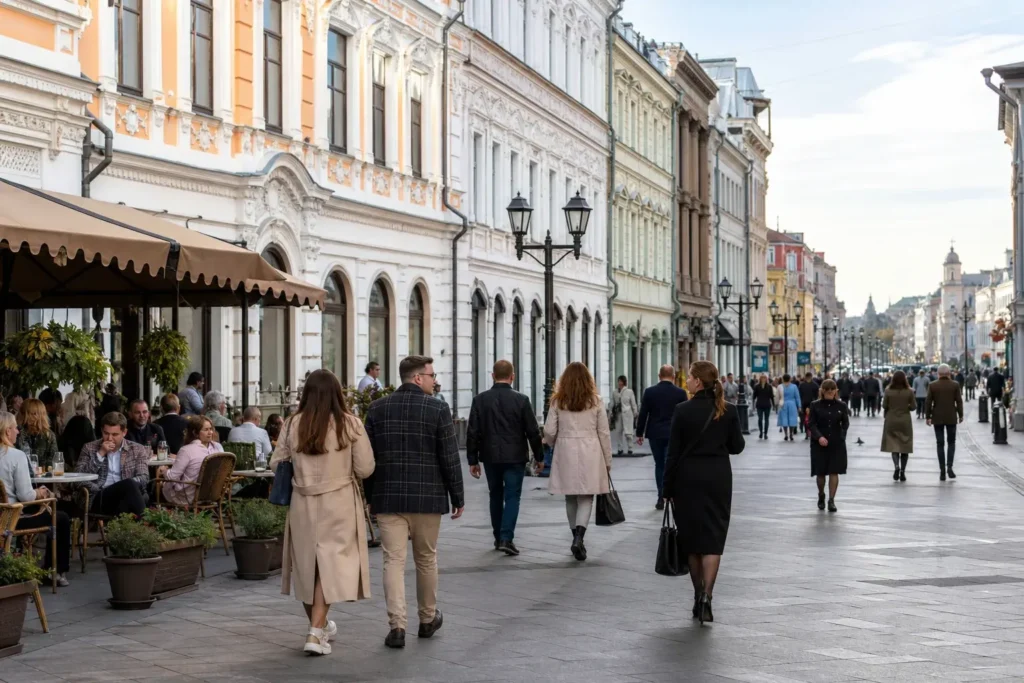
If you’re visiting Nizhny Novgorod, understanding Russian etiquette and customs will help you connect with locals and navigate social situations with confidence. Russians have formal, codified social expectations that differ from Western informal norms, and visitors who respect these customs will find doors opening and conversations flowing more naturally.
This guide covers the key behaviors that matter: how to greet people, what to expect in homes and restaurants, how to dress, religious site protocols, and common pitfalls to avoid. You’ll learn the practical rules that determine whether locals see you as respectful or thoughtless—and why a firm handshake, a gift brought on time, and the right words matter more than you might expect.
Quick answer: Master Russian etiquette by learning six core practices: maintain eye contact and firm handshakes when meeting, dress neatly (avoid sports shoes in restaurants), bring small gifts when invited home (odd-numbered flowers, chocolates), leave 10–15% tips in restaurants, dress modestly in churches, and avoid criticizing Russia in casual conversation. Most can be applied immediately; deeper cultural understanding develops over your stay.
At a Glance
| Total time | Ongoing throughout your stay (best learned before first encounters) |
|---|---|
| Typical cost | Free (gift-giving optional but culturally valued) |
What You Need Before You Start
- Clean socks or indoor slippers (for home visits)
- An odd number of flowers or chocolates (if invited to someone's home)
- Neat, non-athletic shoes suitable for restaurants
- Cash for tips (though card-based tipping now available at some venues)
- Modest clothing with covered shoulders and knees (for church visits)
- Awareness that formal address and respect for authority figures is expected
- Understanding that smiling at strangers is not a social norm
Compare Your Options
| Option | Duration | Price | Notes |
|---|---|---|---|
| Full cultural immersion: learn key phrases and attend cultural events | Ongoing throughout your stay | ₽₽₽ | Taking a Russian cooking class, attending a theater performance, or joining a guided cultural tour deepens understanding of customs. Learning simple phrases (greetings, 'thank you,' 'excuse me') shows respect and often elicits warmer responses from locals. Most effective for travelers staying a week or longer. |
| Social observation: watch locals and mirror behavior | Passive, throughout your stay | Free | Spend time in cafés, on public transport, and in public spaces observing how Russians interact. Note dress codes, greeting styles, and dining practices. This low-pressure method works well for solo travelers or those uncomfortable with direct cultural study. You will naturally absorb norms through observation. |
| Home visit or homestay: experience Russian hospitality firsthand | A few hours to overnight | ₽₽₽₽ | Homestays or arranged home visits with local families offer direct, immersive learning of dining etiquette, gift protocols, and personal interactions. This is the most effective way to understand Russian hospitality and social warmth. Best for travelers who feel confident in less structured settings. |
| Business or formal events: practice in structured settings | Event-dependent | Free | Conferences, business meetings, or formal dinners require and reinforce formal etiquette. If you have access to such events through work or contacts, they provide real-world practice with handshakes, toasts, and professional conversation. High-stakes but highly effective. |
| Restaurant dining: learn tipping and dining customs in low-pressure environment | 1–2 hours per meal | ₽₽₽₽ | Dining in restaurants allows you to practice greeting staff politely, observe other diners, and understand tipping conventions without the pressure of a home visit. Start with casual cafés and progress to nicer restaurants as confidence grows. Best for learning incrementally. |
₽ budget · ₽₽ moderate · ₽₽₽ upscale · ₽₽₽₽ splurge. Price levels are estimates compared with typical prices for visitors.
Step-by-Step Instructions
Step 1: Start with greetings: firm handshake and eye contact
When meeting someone for the first time, offer a firm handshake and maintain steady eye contact throughout the exchange. In Russian culture, looking away or avoiding eye contact suggests disrespect or dishonesty. Women may receive a lighter handshake than men, but should always initiate with their hand extended first. Close friends and family may hug instead. Avoid shaking hands across a threshold, as this is considered bad luck.
Tip: Even if you're nervous, commit to the handshake. Russians notice hesitation and may interpret it as lack of confidence or respect.
Step 2: Use formal address until invited to use first names
Address people by title (Mr./Ms.) plus surname unless they explicitly invite you to use their first name. With older people or in formal settings, using a patronymic (the middle name derived from the father's name) shows particular respect. This formality is not coldness—it is a sign that you take the relationship seriously. Only after several interactions or when invited should you drop to first-name basis.
Tip: If unsure of someone's name structure, ask politely. Russians expect foreigners to make this effort and will not find the question rude.
Step 3: Dress neatly; avoid casual athletic wear in public spaces
Russians pay attention to appearance and respect those who dress well. Wear neat, tidy clothing in public; jeans are acceptable, but avoid overly casual or revealing attire, especially in cities. Do not wear athletic or sports shoes (trainers, sneakers) to restaurants, bars, or formal venues—you may be refused entry. Dressing better than you normally would at home signals respect for the place and the people you'll meet.
Tip: Pack one or two dressier outfits for restaurants and cultural venues. You'll blend in better and feel more confident.
Step 4: If invited to a home: bring a gift and remove your shoes
Never arrive at a Russian home empty-handed. Bring flowers (always an odd number, as even numbers are reserved for funerals), a box of chocolates, or a bottle of wine. Avoid yellow flowers, which symbolize separation or betrayal. Red roses carry romantic meaning and should not be given to hosts or colleagues. Upon entering, offer to remove your shoes—the host will likely provide slippers (tapochki). Russian homes are kept scrupulously clean, and removing outdoor shoes is non-negotiable.
Tip: If you forget a gift, acknowledge it honestly and apologize. It's better to admit the oversight than to pretend you didn't know the custom.
Step 5: At the table: eat everything offered, give toasts standing, keep elbows on table between courses
Accept and eat everything offered (unless there is a medical reason to refuse); rejecting food is seen as disrespect to the host. Russian tables are generous, and hosts become upset if guests refuse dishes. Leave a small amount on your plate at the end to signal you have eaten well; finishing everything can imply you are still hungry and the host will refill your plate. Toasts are given standing, glass raised, with eye contact to each guest. The first toast typically goes to the host. Between courses, rest your elbows on the table—contrary to Western practice, keeping hands under the table appears evasive.
Tip: If you truly cannot eat something, eat a small portion rather than refuse entirely. This shows respect even if you are genuinely unable to finish.
Step 6: In restaurants: tip 10–15%, call waitstaff politely, linger over meals
Tipping of 10–15% is customary in mid-range and high-end restaurants, preferably in cash left directly with the server or in a tip box on the counter. Do not snap fingers or whistle for service; instead, make polite eye contact or say 'Девушка' (young lady) or 'Молодой человек' (young man) with a discreet gesture. Waiters will not rush to clear plates—lingering over a meal is normal and valued. Pace yourself; refusing food can seem impolite, but over-eating is also not admired.
Tip: Some restaurants now offer QR-code tipping via mobile payment. Either method is acceptable; ask the waiter if uncertain.
Step 7: In churches and monasteries: dress modestly and remain quiet
Women must wear skirts below the knee, clothing covering the shoulders, and headscarves (often available at the entrance). Men should remove hats and avoid shorts. Inside, maintain silence to avoid disturbing worshippers. Do not turn your back to the iconostasis (the screen that frames the altar). Photography may be restricted; look for signs or ask permission. Respect these spaces as living places of worship, not tourist attractions.
Tip: If you forget a headscarf, ask at the entrance—one will almost always be provided. Many churches and monasteries have a small donation box; leaving a modest contribution is appropriate.
Step 8: In public: offer your seat, mind personal space, respect queues
Offer your seat on public transport to elderly people, pregnant women, or women with small children. Do not keep your hands in your pockets while speaking—this is considered rude. Personal space is tighter than in many Western countries, and casual contact in crowds is normal. Russians may start boarding a bus or train before those inside have exited; this is not rudeness but cultural norm. However, respect formal queues when they exist—inform the person ahead if you are in line so they can note your spot if you step away temporarily.
Tip: Physical pushing in crowded places is not a conflict; it is simply how Russian crowds function. Stay calm and move with the flow.
Step 9: Avoid certain topics; stick to history, literature, and neutral current events
Avoid overly critical comments about Russia or its government, especially with people you have just met. Sensitive political subjects are best left to conversations with people you know well and who initiate such discussions. Instead, engage with topics like Russian history, literature, architecture, and achievements. Personal questions about family and work are common and show genuine interest—respond openly to demonstrate respect for the friendship being formed.
Tip: If someone asks a personal question, answer it. Deflecting suggests you don't value the connection. Russians build relationships through openness.
Step 10: Before leaving after a visit: sit briefly near the door
If you need to return to a Russian home after leaving (having forgotten something), sit for a moment before heading out again. This tradition is believed to bring safe travels. Similarly, before any trip, Russians take a brief pause to silently reflect and recall whether they have everything—the 'sitting for the road.' These practices may seem unusual to outsiders but honoring them shows cultural respect.
Tip: Accept this ritual gracefully even if you do not fully understand it. The gesture is a blessing, and acknowledging it matters more than explaining it.
Step 11: Understand that Russian smiling is reserved and genuine
Unlike many Western cultures, Russians do not typically smile at strangers in public. A smile is reserved for genuine warmth or amusement among people who know each other. Do not mistake a serious expression for unfriendliness or rudeness; it is simply cultural norm. When someone does smile at you, it usually means they are genuinely pleased to see you or find something amusing. Your serious demeanor will be read as professional and respectful, not hostile.
Tip: Adapt your expression to match the setting. A serious face in formal or professional contexts shows you take things seriously; a warm smile with friends is genuine welcome.
Step 12: Show respect to older people and authority figures
Always show heightened respect to those older than you. Adopt a more formal demeanor in their presence. In Russian culture, age confers authority and wisdom. Use formal address (title + surname or patronymic), listen more than you speak, and accept their advice or opinions gracefully even if you disagree privately. This respect is foundational to Russian social order and is noticed and appreciated.
Tip: If an older person offers a suggestion or criticism, receive it as kindness, not judgment. They are acting in a mentoring role that Russians value highly.
Common Mistakes to Avoid
- Refusing food at a home or restaurant. This is interpreted as rejection of the host's generosity and is deeply offensive. Even if you are not hungry, accept a small portion and eat it. If you have genuine dietary restrictions, communicate this in advance.
- Giving an even number of flowers. Flowers given in even numbers are for funerals. Always bring an odd number (3, 5, 7, etc.). This is a non-negotiable rule that every Russian will notice if broken.
- Smiling excessively at strangers. Western-style friendliness and constant smiling can be misread as insincere or superficial. Reserve your warmth for people you know; a calm, serious demeanor shows respect in formal settings.
- Wearing athletic shoes to restaurants or bars. Sports shoes mark you immediately as a tourist and may result in being refused entry. Keep casual but neat shoes for dining and cultural venues.
- Criticizing Russia or comparing it unfavorably to your home country. Even casual criticism of Russian politics, history, or culture can offend people you have just met. Save political discussions for close friends and only if they initiate them.
- Avoiding eye contact or appearing evasive. Looking away too much or failing to maintain steady eye contact in conversation signals disrespect, dishonesty, or lack of interest. Commit to the eye contact; it is crucial to Russian communication.
- Forgetting to remove shoes when entering a home. This is non-negotiable and will produce immediate correction from your host. Always offer to remove your shoes; asking is unnecessary—it is expected.
Tickets, Payment and Booking
Russian etiquette has no ‘booking’ in the traditional sense, but you can prepare by:
- Reading in advance: Purchase or borrow cultural guides or etiquette books before your trip. Many online resources offer free primers on Russian customs.
- Taking online courses: Some cultural organizations offer short video courses on Russian etiquette, often free or low-cost. Search for ‘Russian culture basics for travelers.’
- Consulting with your hotel or host: Upon arrival, ask staff or your accommodation provider about local customs specific to Nizhny Novgorod. They can offer region-specific guidance.
- Learning basic Russian phrases: Apps like Duolingo or Memrise offer free lessons. Knowing ‘hello,’ ‘thank you,’ ‘excuse me,’ and ‘how are you?’ shows genuine effort and earns respect.
- Watching Russian films or documentaries: Visual learning of behavior and social norms often sticks better than reading. Search for films set in contemporary Russian settings.
Helpful Links
Compare hotel pricesSearch flights
Advertisement: these are partner links. If you book or buy through them, we may earn a commission at no extra cost to you.
Russia Vibes Tips
- Arrive exactly on time or no more than 15 minutes late to formal events and invitations. Punctuality shows respect. For very casual social gatherings, 15–30 minutes late is often acceptable, but ask ahead if unsure.
- If you must return to a Russian home after leaving (having forgotten something), sit for a moment before departing again—this tradition, called 'sitting for the road,' is believed to ensure safe travel and is appreciated even if you don't fully believe it.
- When toasting, always raise your glass and look each person in the eye. A rushed or half-hearted toast is worse than no toast at all. Short, sincere toasts beat long improvised speeches every time.
- Hand objects directly to the recipient (money, items, documents) rather than placing them on a table. Passing hand-to-hand shows respect; leaving things on surfaces can seem dismissive.
- Pay attention to how people address each other and mirror their formality level. If someone uses your first name, you may follow suit. If they use your title and surname, match that formality. Jumping to informality too quickly is rude.
- In crowded situations (public transport, queues, markets), expect physical contact and close proximity. This is not aggression—respond calmly, move with the flow, and do not take offense. Russians are direct and physical in crowds but not hostile.
Explore Nearby Understand Russian Etiquette and Customs, Nizhny Novgorod
Sights near Understand Russian Etiquette and Customs, Nizhny Novgorod
 Nizhny Novgorod Kremlin · typical visit: 2–3 hoursOpen daily 06:00–22:00
Main image: AI-generated illustration. It may not show the place exactly as it looks.
Browse more: All Etiquette and Safety · All How-To · All How-To in Nizhny Novgorod · All Nizhny Novgorod
FAQ
Is tipping mandatory in Russia?
No, tipping is not mandatory but is appreciated for good service. In restaurants, 10–15% is customary at mid-range and high-end establishments. In casual cafés, rounding up or leaving small change is common. Tipping is optional; not tipping will not cause offense, but it is a polite gesture if service was good.
What should I bring if invited to a Russian home?
Never arrive empty-handed. Bring flowers (always an odd number), chocolates, or wine. Avoid yellow flowers (separation/betrayal) and red roses (romantic meaning). If bringing wine or spirits, choose a good bottle. Chocolates are a safe alternative if you are unsure about flowers.
Can I refuse food at a Russian table?
You should avoid refusing food unless you have a genuine medical or religious reason. The Russian table is generous, and refusing dishes is seen as disrespect to the host. If you cannot eat something, eat a small portion. Not eating reads as rejection of hospitality.
What should I wear to visit a church or monastery?
Women must wear a skirt below the knee, cover shoulders, and wear a headscarf (provided at most entrances). Men must remove hats and avoid shorts. These rules are enforced, and breaking them may result in being asked to leave.
Is it rude to disagree with a Russian in conversation?
Disagreement is fine in established relationships, but with new acquaintances, it is safer to listen more and speak less. Avoid criticizing Russia, its government, or culture when you have just met someone. Political or sensitive discussions should only happen with people you know well and who initiate them.
Why do Russians not smile at strangers?
Smiling at strangers is not typical in Russian culture. A smile is reserved for genuine warmth among people who know each other. A serious expression is not unfriendliness; it is cultural norm. When someone does smile at you, they likely mean it sincerely.
Should I learn Russian to visit Nizhny Novgorod?
While English is spoken in tourist areas and by younger people, learning a few basic phrases (hello, thank you, excuse me) shows respect and effort. English alone is often sufficient in hotels, restaurants, and attractions, but speaking even basic Russian earns goodwill from locals.
What is a patronymic and why does it matter?
A patronymic is a middle name formed from the father's name (e.g., Ivanovich = son of Ivan). Using someone's title, first name, and patronymic in formal settings shows deep respect, especially with older people. In casual settings, first name + surname is sufficient unless invited to use first name alone.
Russia Vibes is a one-person project. A coffee keeps it going
How we research and update our guides
About this guide: AI assistance and accuracy
This guide is created with the help of AI and is based on official sources where available. Mistakes can still happen. Opening hours, prices, rules and other details are given to the best of our knowledge as of the date shown and can change without notice. It offers general recommendations only, not professional, legal or travel advice. Please confirm important details with the official source before you travel; you are responsible for your own plans and decisions.

Take this guide with you
Get a free PDF of this guide to print or read offline: key facts, tips and a map link on a few clean pages.
Report an issue on this page
Paying for your trip: please read
International sanctions affect payments between Russia and many other countries. In practice, cards issued in the EU, the UK, the US and several other countries often do not work in Russia, Russian cards usually do not work abroad, and some booking platforms, airlines and payment providers limit or suspend their services for Russia. The situation changes frequently.
We do not give legal or financial advice, and this site does not encourage anyone to break or circumvent sanctions. Whatever you plan, you are responsible for following the laws and regulations that apply to you, including those of your country of residence and citizenship.
Many travelers still organise their stay lawfully. It is worth asking your bank or payment provider what is currently permitted, contacting hotels, tour operators and carriers directly about the payment methods they accept, and checking which services are open to customers from your country. Clarify payment, cancellation and refund terms before you commit to a booking, and keep your plans flexible.
Partner links on this site may not be available in every country, and prices, availability and rules in our guides can differ from what you see when you book.