
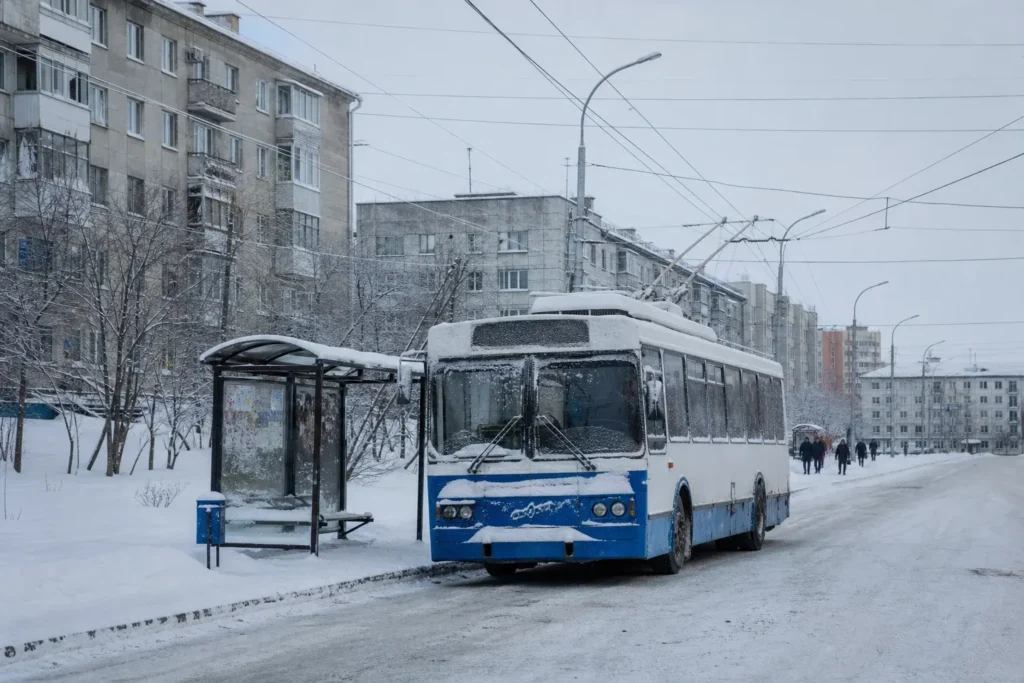
This guide is for visitors who want to move around Murmansk on city buses, trolleybuses and minibuses without a taxi or rental car. You will learn where to board, how to pay, which vehicle serves which area, and how to avoid the most common mistakes that first-time riders make.
The recommended option is to use the trolleybus system for main routes across the city center. Most journeys take 15–30 minutes. For areas outside the trolleybus network or for faster travel, minibuses fill the gaps.
Quick answer: Buy a single ticket or use cash to board trolleybuses and buses. Most routes run from early morning (around 5 am) to late evening (around 11 pm). A typical journey across the central area takes 15–30 minutes depending on the route and time of day.
At a Glance
| Total time | 15–45 minutes depending on route and destination |
|---|---|
| Typical cost | ₽ |
What You Need Before You Start
- Cash in rubles (payments are primarily cash-based; card payments may not work for foreign visitors)
- Comfortable walking shoes for getting to stops
- Route number or destination name
- Knowledge that trolleybuses run primarily on north–south routes; east–west journeys require minibuses
Compare Your Options
| Option | Duration | Price | Notes |
|---|---|---|---|
| Trolleybus | 15–30 minutes across main routes | ₽ | Runs on fixed routes along major streets (mainly north–south). Main routes (1, 2, 3, 4, 6, 10) operate from approximately 5 am to 11 pm. Frequent and reliable for getting around the city center and main attractions. |
| Minibus (marshrutka) | 10–25 minutes | ₽ | Smaller vehicles serving residential areas and east–west routes. Faster than trolleybuses but less frequent. Departs when full rather than on a fixed schedule. Best for neighborhoods outside the trolleybus network. |
| Bus | 20–40 minutes | ₽ | Long-distance routes within the region and connections to nearby towns. Routes like 106 connect to the airport. Less frequent than trolleybuses in the city center. |
| Taxi or ride-app (Yandex Go) | 5–15 minutes depending on destination | ₽₽ | Fastest option but more expensive than public transport. Recommended for late night, bad weather, or when carrying luggage. Pay the driver in cash or use the app if you have a Russian phone number. |
₽ budget · ₽₽ moderate · ₽₽₽ upscale · ₽₽₽₽ splurge. Price levels are estimates compared with typical prices for visitors.
Step-by-Step Instructions
Step 1: Locate the nearest stop for your route
Trolleybus stops are marked with overhead wires and shelter signs. Bus and minibus stops display route numbers on poles. Ask your hotel or a local to point you to the stop heading in your direction. Main stops are clearly marked; minor stops may have only a pole. Note that trolleybuses run mainly on major north–south streets (Lenin Prospekt, Kirov Avenue), while minibuses serve residential areas and east–west directions.
Tip: Use the real-time tracking app Busti.me (Russian-language) to see live locations of trolleybuses on the main routes.
Step 2: Check the route number and destination
For trolleybuses, the main routes are 1, 2, 3, 4, 6, and 10. Route numbers are displayed on the front of the vehicle and inside. For buses and minibuses, routes number 5, 7, 10, 11, 18, 19, 24, 25, 27, 29, 30, 31, 33 and others serve different areas. Before boarding, confirm the route goes to your destination or near it.
Tip: Trolleybus route 3 and 6 connect the city center with the shipping museum and other central sights. Route 4 runs across most of the city from Leninsky to Oktyabrsky district.
Step 3: Prepare cash in small denominations
Most drivers accept payment in rubles only. Have coins or small bills ready. Foreign bank cards do not work on public transport in Murmansk; drivers will not accept card payments. Some sources mention that bank cards can be used for payment as of recent updates, but cash remains the safest method for foreign visitors.
Tip: Carry at least a few small bills; drivers may not have change for large notes.
Step 4: Board at the front and pay the driver
Enter through the front door. Pay the driver by placing money in the collection box or handing it to them. Ask 'skolko?' (how much?) if you are unsure of the fare. The driver may give you a paper ticket or just wave you through. Do not board through the rear doors.
Tip: Observe how other passengers pay and follow their lead if uncertain.
Step 5: Stand or sit and hold on during the journey
Find a handrail or seat. Trolleybuses and buses can be crowded during rush hours (7–9 am, 5–7 pm) and may stop suddenly. Elderly passengers and people with disabilities have priority seating; offer your seat if the vehicle is full.
Tip: Expect delays during rush hour and winter weather.
Step 6: Exit at your stop
Listen for the driver to announce stops (usually in Russian, but major stops may be announced in English on some routes). Many stops are only marked on the vehicle; note nearby landmarks to recognize your destination. Press the button inside the trolleybus or say 'sleduyushchaya' (next stop) to signal the driver to stop.
Tip: The driver will open both doors; exit from whichever side is safe and convenient.
Common Mistakes to Avoid
- Assuming trolleybuses go east–west: Trolleybuses run primarily north–south on main streets. To travel east or uphill, use minibuses instead. Many visitors waste time waiting for the wrong route.
- Boarding from the rear: Always enter at the front door. The rear doors are for exiting only and may be locked or monitored.
- Not having small change: Drivers rarely carry change for large bills or foreign currency. Always carry coins and small bills.
- Traveling during rush hour without holding on: Trolleybuses and buses brake suddenly and can be crowded. Hold the handrail and brace yourself.
- Missing your stop: Route announcements are in Russian and may be hard to hear. Watch for major landmarks or ask other passengers to alert you when your stop approaches.
- Paying by foreign card: Western credit and debit cards do not work on public transport. Always pay with cash in rubles.
Tickets, Payment and Booking
Tickets are purchased directly from the driver when you board. There is no advance booking or ticket office for city buses and trolleybuses.
- Payment methods: Cash in rubles only. Foreign credit cards, debit cards and mobile payments do not work.
- Ticket types: Single journey tickets are the norm for visitors. Monthly passes and student discounts exist for residents.
- Where to pay: Board through the front door and pay the driver directly into the collection box or by handing cash to them.
- Apps: The route planner and real-time tracker Busti.me shows live locations of trolleybuses and buses (Russian-language interface only).
- Official information: Routes and timetables are available on local transport sites and the operator’s website (OAO Elektrotransport).
Helpful Links
Compare hotel pricesSearch flights
Advertisement: these are partner links. If you book or buy through them, we may earn a commission at no extra cost to you.
Russia Vibes Tips
- Trolleybus routes 3 and 6 pass close to the Shipping History Museum (Volodarskogo). Route 2, 3, and 4 serve the Alyosha Statue stop (Gagarina). Route 6 heading south reaches the Orthodox Monastery on Kolsky Prospekt. Plan your stop carefully by confirming the route before boarding.
- Winter delays are common due to snow and ice. Allow extra travel time between November and March. Some routes may be suspended during severe blizzards, though this is rare.
- The city center is compact. Walking between Ploshchad Pyat Uglov (Five Corners Square) and the Lenin Prospekt is often faster than waiting for a bus, especially if you miss one by a few minutes.
- Minibuses depart from fixed stops but only when they are full (usually 10–15 passengers). If the minibus is nearly empty, you may wait several minutes. Trolleybuses run on fixed schedules and are more predictable.
- Rush hour (7–9 am and 5–7 pm) means crowded vehicles and longer journey times due to traffic. Avoid these times if your schedule allows. Travel mid-morning or mid-afternoon for shorter waits and more space.
- The trolleybus is the world's northernmost trolleybus system; locals are proud of it. Many tourists ride it simply for the experience of this unique infrastructure.
Explore Nearby Use Public Transport in Murmansk
Browse more: All How-To · All How-To in Murmansk · All Metro and Trains · All Murmansk
FAQ
Can I use a transport card instead of paying per journey?
Yes, regular transport cards (bilety) can be purchased from some kiosks and used across buses, trolleybuses, and minibuses. However, most visitors buy single cash tickets directly from the driver. Cards are primarily for residents with monthly or weekly subscriptions. Ask your hotel concierge where to buy a card if you plan to stay longer than a few days.
How often do trolleybuses run?
Trolleybuses run frequently during the day, often every 5–10 minutes on main routes during peak hours. Off-peak and evening frequency decreases. Exact schedules vary by route; check Busti.me or ask your hotel for the specific route's timetable.
What time do buses and trolleybuses stop running?
Most trolleybuses and buses run from approximately 5–6 am to 11 pm. Some routes may end earlier or start later. Night transport is very limited. Plan your evening activities accordingly or book a taxi for late-night returns to your hotel.
Is there a metro or train system in the city?
No. Murmansk has no metro or urban tram system. Public transport consists of trolleybuses, buses, and minibuses only. The railway station is served by long-distance trains to Moscow and Saint Petersburg, not city transit.
Can children ride for free?
Young children (usually under 5) may ride free; slightly older children may have reduced fares. Rates for children are not standardized across all routes. Ask the driver or your hotel when boarding. Bring rubles in small denominations for payment.
What if I get on the wrong trolleybus?
Inform the driver immediately, and ask where to exit to catch the correct route back. The driver will advise you. You cannot get a refund for a single-journey ticket, but getting off and boarding a different vehicle is straightforward. Do not panic; trolleybuses serve well-known routes and locals are usually helpful.
Are there lifts or ramps for wheelchairs?
Older trolleybuses and buses do not have lifts or wheelchair access. Newer vehicles (especially minibuses on some routes) may have low-floor designs or steps that are easier to navigate. Call your hotel in advance or ask your hotel staff to arrange accessible transport if you have mobility needs.
Can I use the public transport to reach Murmansk Airport?
Yes. Bus 106 connects the central bus station (next to the railway station) to the airport approximately 40 km away. The journey takes about 60–70 minutes and buses run regularly throughout the day at intervals of 20–40 minutes. This is the most budget-friendly option, though taxis or ride-apps are faster.
Russia Vibes is a one-person project. A coffee keeps it going
How we research and update our guides
About this guide: AI assistance and accuracy
This guide is created with the help of AI and is based on official sources where available. Mistakes can still happen. Opening hours, prices, rules and other details are given to the best of our knowledge as of the date shown and can change without notice. It offers general recommendations only, not professional, legal or travel advice. Please confirm important details with the official source before you travel; you are responsible for your own plans and decisions.

Take this guide with you
Get a free PDF of this guide to print or read offline: key facts, tips and a map link on a few clean pages.
Report an issue on this page
Paying for your trip: please read
International sanctions affect payments between Russia and many other countries. In practice, cards issued in the EU, the UK, the US and several other countries often do not work in Russia, Russian cards usually do not work abroad, and some booking platforms, airlines and payment providers limit or suspend their services for Russia. The situation changes frequently.
We do not give legal or financial advice, and this site does not encourage anyone to break or circumvent sanctions. Whatever you plan, you are responsible for following the laws and regulations that apply to you, including those of your country of residence and citizenship.
Many travelers still organise their stay lawfully. It is worth asking your bank or payment provider what is currently permitted, contacting hotels, tour operators and carriers directly about the payment methods they accept, and checking which services are open to customers from your country. Clarify payment, cancellation and refund terms before you commit to a booking, and keep your plans flexible.
Partner links on this site may not be available in every country, and prices, availability and rules in our guides can differ from what you see when you book.