

The Ushkany Islands are a small, remote archipelago floating in the middle of Lake Baikal, approximately 7 kilometres northwest of Svyatoy Nos Peninsula. Consisting of one large island and three smaller islets, this protected site is where thousands of Baikal seals – the world’s only freshwater seal – gather to rest on warm rocks.
The archipelago sits at the northern tip of the underwater Academician Ridge, which separates Baikal’s northern and southern basins. Visitors must arrive by boat and require special permission from the national park to land on the islands, measures designed to protect the seals and their habitat from human disturbance.
Current access notice: As of October 2026: Landing on Ushkany Islands requires special permission from Zabaikalsky National Park. Access is typically restricted to summer months (May through September) when seals are most active and water conditions are safest. Winter access by hovercraft may be available but is seasonal and weather-dependent.
Quick Facts
| Russian name | Ушканьи острова |
|---|---|
| Address | Zabaykalsky National Park, Republic of Buryatia, Russia Google MapsApple MapsYandex Maps2GIS |
| District | Republic of Buryatia |
| Admission | Permit required from Zabaikalsky National Park; see booking info |
| Best time to visit | Late May through August. Peak seal numbers occur in May–June when they bask on warm rocks after winter. Summer weather is most stable, with clearer skies for photography. September is possible but seals become less active and depart for deeper water. Winter access by hovercraft (February–March, when the lake is frozen) is possible but limited to specialized operators and weather-dependent. Spring (April) and autumn (September–October) involve risk of sudden storms and fewer seals visible. Weekday visits tend to be quieter than weekends. |
| Recommended duration | Half day to full day |
| Website | zapovednoe-podlemorye.ru |
What Is (and Isn't) Part of a Visit to Ushkany Islands, Lake Baikal?
| Part | Status | Notes |
|---|---|---|
| Big Ushkan Island | Included in the standard ticket | The largest island; main site for seal viewing and hiking. |
| Long, Thin, and Round Ushkan Islets | Included in the standard ticket | The three smaller islands; typically viewed from the boat, sometimes landed depending on permit conditions. |
| Seal rookery and viewing screens | Included in the standard ticket | Part of the permitted visit; special trails and screens protect the seals. |
| Guided hikes through the archipelago | Included in the standard ticket | Usually included in organized tours; independent exploration not permitted without special arrangements. |
| Overnight accommodation on the islands | Separate ticket or institution | Some tour operators offer multi-day trips with lodging; this requires a separate booking and specialized permit. |
| Svyatoy Nos Peninsula | Outside / not part of it | A nearby location 7 kilometres away, not part of the islands visit but sometimes included in regional tours. |
| Hot springs at Chivyrkuisky Bay | Outside / not part of it | Often visited on the same day trip but requires separate boat transportation and different access conditions. |
Why Visit Ushkany Islands, Lake Baikal?
See the Baikal seal in its natural habitat. In summer, hundreds or even thousands of seals bask on the rocks around the islands, a sight found nowhere else on Earth.
Witness unusual geology. The islands are composed of marble and limestone with caves containing evidence of Neolithic human habitation.
Experience remoteness. At the geographical centre of Baikal, these islands feel truly isolated despite the lake being a major travel destination, offering a sense of wilderness exploration.
How Ushkany Islands, Lake Baikal Is Laid Out
The archipelago consists of four islands arranged in a loose arc. Big Ushkan Island is the largest, rising 216 metres above the lake surface and stretching 5 kilometres from west to east. The three smaller islets – Long, Thin, and Round – reach only 17 to 22 metres above the surface. Boats typically land on the eastern side of Big Ushkan Island. From here, visitors cross the island on a 320-metre path towards the western rocks where seals congregate.
Highlights of Ushkany Islands, Lake Baikal
Seal Rookery on Big Ushkan Island
The western rocks of Big Ushkan Island are the central haul-out site for Baikal seals. During summer months, hundreds gather here to rest, with numbers occasionally reaching 3,000. The seals are most active in late afternoon when they return from fishing. A designated trail with viewing screens protects the seals from disturbance. Visitors must remain quiet – loud noise causes seals to panic and dive into the water.
Tip: Visit in late May or June for peak seal numbers. Approach slowly and stay behind the screens; use binoculars or a telephoto lens rather than walking closer.
Marble and Limestone Cliffs
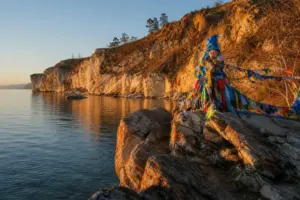
The islands' rocky shores display striking marble and limestone formations in various hues. These ancient pre-Cambrian rocks form the peaks of the submerged Academician Ridge. The colour variation and layering tell the geological story of Baikal's formation as a deep rift valley.
Tip: Photograph the cliffs from the boat as you approach the islands; the contrast between rock and water is most striking in afternoon light.
Neolithic Caves
Small caves embedded in the island rocks contain archaeological evidence of human habitation dating to the Neolithic age, thousands of years old. These caves suggest that humans have been drawn to Baikal's islands since prehistoric times, though they now serve mainly as shelter for birds and small animals.
Tip: Ask your boat guide to point out the cave entrances; they are not always obvious from a distance.
Endemic Larch and Birch Forest
Big Ushkan Island is covered with larch forest, but the trees here exhibit unusual traits found nowhere else on Earth. The larches display characteristic thickening at the base, and the birches have distinctively black bark and flag-like crowns shaped by wind. These endemic varieties are unique to this isolated location.
Tip: Walk the interior trail slowly to spot the distinctive tree forms against the sky and surrounding rocks.
Exceptional Ant Colonies
The islands are home to an unusually high density of ant hills, with some estimates of 18 to 20 ant hills per hectare on Big Ushkan Island – far exceeding typical densities elsewhere. Scientists and nature enthusiasts visit partly to study this phenomenon.
Tip: Look for the large, conical ant hills, especially in the forested areas away from the rocks where seals rest.
Long Ushkan Islet
This crescent-shaped islet stretches approximately 1.25 kilometres and rises only slightly above the water. It is a secondary gathering place for seals and offers different perspectives of the archipelago from the boat.
Tip: Boat tours often pass close to Long Ushkan for photography without requiring landing permission.
Atmosphere
The islands evoke a sense of pristine remoteness, despite their accessibility. The silence on the rocks is profound – punctuated only by the occasional splash of a seal diving or the cry of gulls. On a clear summer day, the islands feel like an intimate window into untouched nature. The weathered marble and limestone cliffs glow pale against dark water. If seals are present, you see heads bobbing silently in the shallows or bodies sprawled on rocks, some basking in the sun, others partially submerged. Early morning and late afternoon are the calmest times. The atmosphere is contemplative rather than busy, as most visitors move quietly and observe from a distance.
History of Ushkany Islands, Lake Baikal
The Ushkany Islands have held human interest for centuries. Local Buryat peoples knew of them long before Russian contact, though permanent settlement never developed on the remote islands. The name ‘Ushkan’ likely derives from the Pomor (White Sea) term for seals, ‘sea hares’, adopted by Russian fur traders and explorers who encountered Baikal in the 17th and 18th centuries. Russian hunters and traders would have observed the seal colonies, which were already well established.
Archaeological evidence from caves on the islands documents human presence during the Neolithic age, suggesting the islands have been known and visited by people for thousands of years. However, the harsh central lake environment and seal protection eventually discouraged permanent habitation.
In the Soviet era, the islands remained relatively isolated. Modern nature conservation efforts began after Baikal’s ecological crisis became apparent in the 1960s and 1970s. The islands were incorporated into Zabaikalsky National Park when it was established in 1986. Special permit requirements for landing were implemented to protect the endemic seal population and the islands’ unique ecosystems from excessive human impact. Today, access remains carefully controlled, with guided boat tours operating mainly in summer when seals are most active.
Legends and Myths about Ushkany Islands, Lake Baikal
The Origin of the Name 'Ushkan'
Disputed by historians. In Siberian languages, 'ushkan' means 'hare'. Local historians long believed the islands were named for abundant hares, but archaeological and historical evidence suggests a different origin. Northern Russian fur traders and explorers called seals 'sea hares' (a term used by Pomors of the White Sea). When Russians first saw Baikal's seals, they applied this nickname. Settlers from the north, unfamiliar with freshwater seals, named the islands 'Ushkan' after the animals they encountered, not after hares at all – though the etymology created lasting confusion.
Mirages and Optical Phenomena
Legend – historically unreliable. Visitors and local guides report that during fogs and on hazy days near the Ushkany Islands, mirages sometimes appear on the water's surface. Some accounts describe entire scenes or even a fairy-tale city with golden domes. Scientists attribute these to temperature inversions and atmospheric refraction over the cold lake water, but the phenomenon has become part of Baikal's mystique.
Tickets and Booking for Ushkany Islands, Lake Baikal
| Ticket | Price | Includes |
|---|---|---|
| National Park permit and boat tour (standard) | ₽₽ | Landing permit, boat transportation from Svyatoy Nos Peninsula or Irkutsk area, access to seal viewing areas and hiking trails on Big Ushkan Island, guide services |
| Boat viewing cruise (no landing) | ₽ | Cruise around the islands by boat, seal viewing from water, photography opportunities; does not include landing or hiking |
₽ budget · ₽₽ moderate · ₽₽₽ upscale · ₽₽₽₽ splurge. Price levels are estimates compared with typical prices for visitors.
To visit the Ushkany Islands, book through licensed tour operators in Irkutsk or settlements on Lake Baikal’s eastern shore such as Ust-Barguzin. Tour operators handle the national park permit application and logistics. Most departures operate from May to September when weather is stable and seals are present.
Booking timeline: Book at least 7–14 days in advance. The national park processes permits for groups; last-minute private visits may not be available. If a date is marked as unavailable online, it typically means permit slots are full for that day.
How to book: Contact tour operators directly via their websites or email. Several operators offer standard 1-day and multi-day packages. Payment usually proceeds in two stages: a deposit to confirm the booking, then final payment 7–10 days before departure.
Same-day options: Limited same-day spaces occasionally open, but these are rare. Do not count on walk-up availability.
Important notes: Rates for Russian citizens differ from international visitor rates. Discounts for children and concessions may apply. Weather can delay or cancel departures; operators will reschedule or offer refunds. Check the national park’s official website at http://zapovednoe-podlemorye.ru/ for current access conditions and permit details.
Plan and Book
Suggested itineraries Ushkany Islands, Lake Baikal
Half day (morning or afternoon departure)
Depart from the eastern shore settlement (Ust-Barguzin or Severobaikal'sk) by boat for approximately 1–2 hours. Arrive at Big Ushkan Island, land with guide, walk the designated trail to the western rocks (about 40 minutes round-trip). Observe seals from the viewing screens for 1–2 hours. Return to boat and depart. Total time: 4–5 hours door-to-door.
Full day
Depart early morning. Travel 2–3 hours to the Ushkany Islands with scenic stops along the eastern shore. Land on Big Ushkan Island, hike to the seal viewpoint. Spend 2–3 hours observing and photographing seals. Optional: visit a second islet or cruise closer to other islands. Picnic lunch on the boat or island. Return journey includes stops at nearby bays or the hot springs of Chivyrkuisky Bay. Return to base by late evening.
Multi-day expedition (2–3 days)
Overnight accommodation on Big Ushkan Island or nearby lodge. Day 1: arrive, settle, sunset viewing. Day 2: early morning seal observation (peak activity), afternoon hike through endemic forest, evening exploration of Chivyrkuisky Bay and thermal springs. Day 3: final seal viewing, breakfast, return journey to mainland. Offers the best chances for seal photography and a deeper sense of the islands' remoteness.
How to Get to Ushkany Islands, Lake Baikal
From Irkutsk: Fly or take a train to Irkutsk, then arrange a transfer to the boarding point. Most tours depart from settlements on Lake Baikal’s eastern shore – primarily Ust-Barguzin (approximately 8 hours by road from Irkutsk) or Severobaikal’sk.
Nearest towns and boarding points:
- Ust-Barguzin: Most common departure point. Reached by marshrutka (shared minibus) or private car from Irkutsk along the M56 highway. The drive takes 8–10 hours.
- Severobaikal’sk: An alternative boarding point further north, reached by a different route but offering scenic journey through Siberian taiga.
By boat: All access to the islands is by motorboat or hovercraft. Tour operators arrange transportation from the boarding point (usually a pier or harbour). Boat rides typically last 1–3 hours depending on the departure location and route.
Accessibility note: The boat journey involves open water and can be rough in poor weather. There are no intermediate stops and no facilities once you leave shore, so be prepared for 1–3 hours at sea.
Accessibility
The boat journey requires good mobility; boarding involves climbing a ramp and stepping across potentially unstable surfaces. Once on the island, a 320-metre trail leads to the seal viewing area – the path is generally flat but uneven and rocky in places. No wheelchair access on the islands. Viewing screens allow observation from a seated position. There are no toilets, water, or shelter on the islands; bring supplies. The boat has basic facilities. Visitors with mobility limitations should inform their tour operator in advance; some specialized tours can accommodate specific needs. Seals are easily disturbed; visually impaired visitors can still enjoy the experience through sound and guidance, but the prime activity is observation.
Food Nearby
No food services operate on the islands. Bring sufficient water and snacks (energy bars, sandwiches, fruit) for the duration of your visit. Tour operators typically include a picnic lunch on full-day tours. The boat may have tea or coffee. Nearby settlements such as Ust-Barguzin have basic shops and cafes where you can purchase supplies before departure.
What to Bring
Waterproof jacket and windproof layers (lake winds can be strong even in summer). Good hiking boots with grip (rocks are slippery). Hat and sunscreen (sun reflects off water and rock). Binoculars or telephoto lens for seal photography. Insect repellent (summer mosquitoes). Seasickness medication if prone (1–3 hours on open water). Trash bag (leave no trace). Camera with extra batteries. Snacks and 1–2 litres of water per person. Small first-aid kit. Bag check: national park rules prohibit drones and tripods on the islands.
Best Views and Photo Spots of Ushkany Islands, Lake Baikal
Western rocks of Big Ushkan Island (seal rookery viewpoint)
Seals resting on pale marble rocks with dark water in the background. Multiple angles available from behind the viewing screens. Telephoto lens captures detail of individual seals. Wide-angle lens shows the scale of the colony and surrounding rocky landscape.
Best time: Late afternoon (4–6 PM) when seals return from fishing and are most active. Clear days offer sharp detail; overcast skies reduce glare from white rock.
Approach from the boat (all four islands visible together)
Panoramic view of the entire archipelago with Big Ushkan Island dominating the composition and the three smaller islets visible in context. Marble and limestone cliffs show colour variation and geological layering.
Best time: Mid-morning or early afternoon when light is high. Overcast days reduce harsh shadows on the rock faces.
Endemic larch trees on Big Ushkan Island interior
Close-up detail of the unusual tree forms – larches with thickened bases and birches with black bark and wind-flagged crowns. Trees stand against sky or frame the rocky landscape.
Best time: Sunny days emphasize the distinctive bark colours and tree silhouettes. Early morning light creates subtle contrast.
Neolithic cave entrances (consult guide for location)
Small cave openings embedded in pale limestone, framed by surrounding rock formations. Atmospheric shot evoking prehistoric habitation and geological timescale.
Best time: Mid-day light penetrates cave entrances. Overcast days reduce unwanted shadows inside the caves.
Lake Baikal shoreline from the boat during approach or departure
Wide vistas of the lake's water, distant mainland mountains or shores, and the islands receding into the distance. Captures the sense of remoteness and the geographical scale of Baikal.
Best time: Early morning or late afternoon when low-angle light emphasizes texture and depth. Clear visibility required for distant mountain views.
Photography Rules
Photography is permitted and encouraged. Drones are not allowed on the islands. Tripods are restricted – check with your tour operator. Flash photography near seals should be avoided; use natural light or high ISO. Binoculars and telephoto lenses (200mm+) are ideal for respectful seal portraits without disturbance. Photographs of the marble cliffs and endemic trees are excellent in afternoon light. Take photos from behind the designated viewing screens to avoid disturbing the animals.
Family Suitability
The Ushkany Islands are suitable for families with children aged 10 and older who can walk uneven rocky terrain and follow quiet observation rules. Younger children may struggle with the boat ride (1–3 hours) and the need to stay silent near seals. Strollers are not practical on the islands – hiking involves rocky, uneven paths. The seal viewing itself is engaging for children – seeing hundreds of real animals in their natural habitat is memorable. Boat tours cater to families and often include educational narration about Baikal's ecosystem. Supervision is essential near water and steep rocks. No specific children's facilities exist on the islands. Check with your tour operator about child-appropriate schedules and pacing.
Russia Vibes Tips
- Book a multi-day tour if possible. A single afternoon visit compresses the experience into a few hours. An overnight stay allows early-morning and sunset seal viewing, when light and animal activity are optimal. The islands feel more immersive when you have time to sit and observe, not rush.
- Arrive at the viewing screens early in the morning or stay until late afternoon. Most seals are actively resting and basking during these times. Midday visits coincide with many seals diving into the water to fish, reducing visual impact.
- Bring a telephoto lens (200mm or longer) if you have one. It allows close photography without walking closer to the seals, reducing disturbance and capturing better detail. Smartphone cameras are too limited for respectful wildlife photography here.
- Do not expect to find Long, Thin, or Round islets easy to explore. These smaller islands have limited landing areas and fragile ecology. Most tours focus on Big Ushkan Island. Ask your guide in advance if time and conditions allow visiting other islands.
- Pack all your own supplies. There are no shops, restaurants, or water sources on the islands. Tour operators may provide basic meals on full-day trips, but bringing extra snacks ensures you stay comfortable during long seal observation sessions.
- Prepare for wind and cold. Even in July, lake winds can be strong and temperatures drop noticeably when out on the water. Layered clothing is essential – shed layers as needed, but always have a windproof jacket accessible.
Explore Nearby Ushkany Islands, Lake Baikal
Sights near Ushkany Islands, Lake Baikal
 Olkhon Island, Lake Baikalabout 114.4 km away · typical visit: 2–3 days
Main image: AI-generated illustration. It may not show the place exactly as it looks.
 Shamanka Rock, Lake Baikal – about 112.1 km away · typical visit: 30–45 minutesOpen 24 hours
Main image: AI-generated illustration. It may not show the place exactly as it looks.
 Cape Khoboy, Lake Baikalabout 74.6 km away · typical visit: 3–4 hours
Main image: AI-generated illustration. It may not show the place exactly as it looks.
Related guides
 Chivyrkuisky Bay: Lake Baikal’s Warm Waters and Hidden Granite Coves
Main image: AI-generated illustration. It may not show the place exactly as it looks.
Browse more: More in Republic of Buryatia · All Lake Baikal · All Landmarks · All Sightseeing · All Sightseeing in Lake Baikal
FAQ: Ushkany Islands, Lake Baikal
Do I need special permission to visit the Ushkany Islands?
Yes. The islands are part of Zabaikalsky National Park, and landing requires a permit issued by the park administration. Tour operators handle the permit application as part of their booking package. Independent visitors cannot simply arrive and land – all access must be through authorized tours.
What is the best time to see seals?
Late May through June offers peak seal numbers – sometimes 2,000–3,000 animals gather on the rocks. July and August are still good, though numbers decline as seals disperse deeper into the lake. September is possible but less reliable. Winter seal viewing (February–March on frozen ice) is available through specialized hovercraft tours but is weather-dependent.
Can I visit the islands independently, or do I need a guide?
All visits must be through licensed tour operators or authorized guides. You cannot visit independently. Operators arrange permits, transportation, and on-site guidance. This policy protects both the seals and the fragile ecosystem.
How long does a visit usually take?
A half-day visit (morning or afternoon) takes 4–5 hours total, including 1–2 hours on the islands. A full-day tour takes 8–10 hours with more island exploration and scenic stops. Multi-day tours (2–3 days) include overnight stays on or near the islands.
Is the boat ride rough? Could it be unsafe?
The journey takes 1–3 hours on open water and can be choppy in poor weather. Tours are cancelled or rescheduled if conditions are unsafe. If prone to seasickness, take preventive medication before boarding. All boats meet safety standards and operate only in appropriate weather.
How close can I get to the seals?
Designated viewing screens on Big Ushkan Island allow observation from a safe distance (typically 10–30 metres from the nearest seals). You cannot walk freely around the rocks. This distance is necessary to prevent panicking the seals, which can be fatal if they flee into cold water suddenly.
Are there facilities on the islands (toilets, food, shelter)?
No. The islands have no shops, restaurants, toilets, or shelter. Bring all supplies (water, snacks, sun protection). Tour operators may provide meals on full-day trips, but basic amenities are limited. Multi-day tours include accommodation in a lodge on or near the islands, but on-island facilities are minimal.
What makes the Baikal seal unique?
The Baikal seal is the world's only freshwater seal species and lives only in Lake Baikal. Its origin is debated – some scientists believe seals migrated from the Arctic Ocean via rivers during the Ice Age. Today, approximately 75,000–100,000 seals live in Baikal, with the largest population on the Ushkany Islands.
Russia Vibes is a one-person project. A coffee keeps it going
How we research and update our guides
About this guide: AI assistance and accuracy
This guide is created with the help of AI and is based on official sources where available. Mistakes can still happen. Opening hours, prices, rules and other details are given to the best of our knowledge as of the date shown and can change without notice. It offers general recommendations only, not professional, legal or travel advice. Please confirm important details with the official source before you travel; you are responsible for your own plans and decisions.
Packing for this trip
* Affiliate link: as an Amazon Associate we earn from qualifying purchases at no extra cost to you.

Take this guide with you
Get a free PDF of this guide to print or read offline: key facts, tips and a map link on a few clean pages.
Report an issue on this page
Paying for your trip: please read
International sanctions affect payments between Russia and many other countries. In practice, cards issued in the EU, the UK, the US and several other countries often do not work in Russia, Russian cards usually do not work abroad, and some booking platforms, airlines and payment providers limit or suspend their services for Russia. The situation changes frequently.
We do not give legal or financial advice, and this site does not encourage anyone to break or circumvent sanctions. Whatever you plan, you are responsible for following the laws and regulations that apply to you, including those of your country of residence and citizenship.
Many travelers still organise their stay lawfully. It is worth asking your bank or payment provider what is currently permitted, contacting hotels, tour operators and carriers directly about the payment methods they accept, and checking which services are open to customers from your country. Clarify payment, cancellation and refund terms before you commit to a booking, and keep your plans flexible.
Partner links on this site may not be available in every country, and prices, availability and rules in our guides can differ from what you see when you book.