
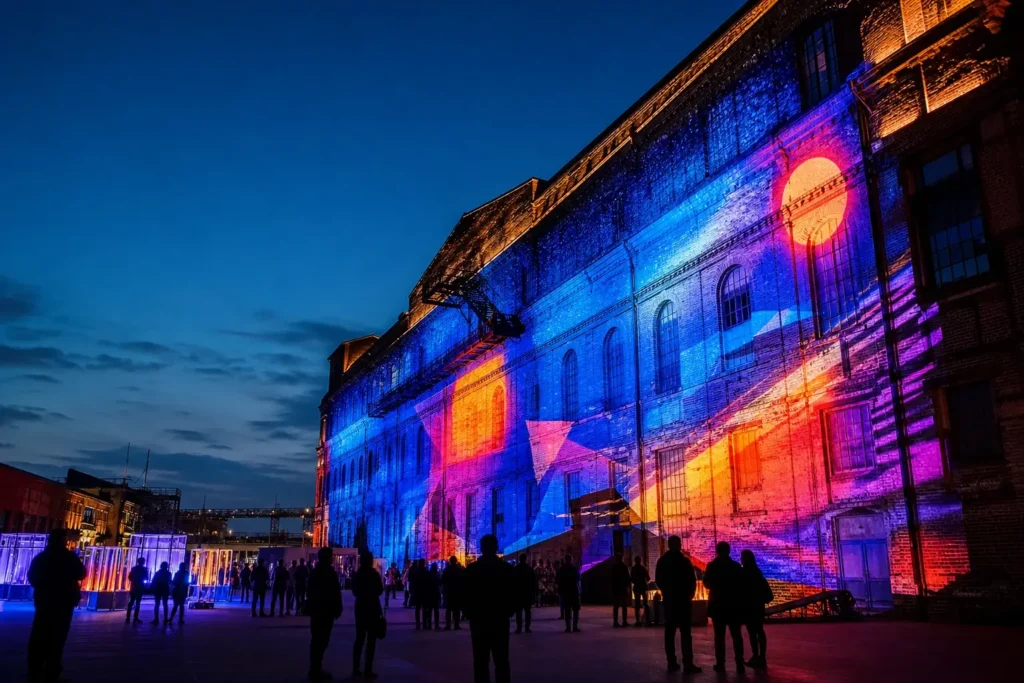
The Intervals Media Art Festival is Russia’s largest international multimedia art festival, held annually in Nizhny Novgorod since 2017. Organized by the company dreamlaser, the festival spans four to five days in late April and turns the entire city into an open-air art exhibition, blending media installations, live music, and educational programs.
What sets Intervals apart is its city-wide scope: rather than confining art to a single venue, the festival uses Nizhny Novgorod’s diverse architecture—historic buildings, industrial spaces, riverside embankments, and contemporary galleries—as canvases for multimedia works by contemporary artists from across Russia, Europe, Asia, and beyond.
Quick Facts
| Russian name | Фестиваль мультимедийного искусства INTERVALS |
|---|---|
| Type | Recurring event |
| When | Every year in late April |
| Typical duration | 4–5 days |
| District | Nizhny Novgorod |
| Admission | Free |
| Best time to visit | Late April is the scheduled time every year. Spring weather in Nizhny Novgorod is variable—expect temperatures around 10–15°C (50–59°F) with possible rain, so pack layers and waterproof clothing. April days are long and daylight extends well into evening, which is ideal for viewing evening installations. Daytime and early evening (before 18:00) tend to be less crowded than peak hours (20:00–23:00), when concert and performance crowds gather. If you prefer intimate viewing of installations and educational programs, visit during daytime hours; if you seek the festive, social energy, come for evening performances. Because the festival is free to explore and runs for four to five consecutive days, you can plan multiple visits during different times of day to experience different aspects. |
| Website | intervalsfest.com |
Dates, programs and prices change from year to year. Always check the official website for the current edition.
Why Visit Intervals Media Art Festival, Nizhny Novgorod?
The festival makes contemporary media art genuinely accessible: the entire media exhibition is free. You’ll see large-scale multimedia installations, digital projections, and interactive artworks integrated into the urban landscape in unexpected ways, from historic city squares to abandoned industrial sites. The 2025 edition attracted over 450,000 visitors, indicating the scale and energy of the event.
Beyond the visual exhibition, the festival pairs cutting-edge technology with live sound: expect AV performances, concert programming featuring established and emerging musicians, and educational talks that explore the intersection of art, technology, and the built environment. The festival’s theme changes yearly—2026 focused on ‘Signs and Symbols’—offering fresh conceptual frameworks for understanding how media art shapes perception.
What to Expect at Intervals Media Art Festival, Nizhny Novgorod
The festival unfolds as a four-to-five-day immersive experience across the city. An opening concert on the first evening launches the program with large-scale musical and choreographic performances, often featuring prominent musicians and dancers. Over the following days, the city’s streets, embankments, and cultural spaces host a continuous program: multimedia installations remain on public view around the clock, audiovisual performances and concerts happen during evening hours, and daytime sessions feature educational lectures, artist talks, and workshops.
Visitors move through the city following a festival map or their own route, discovering works at historical landmarks, former factories, riverside parks, and dedicated exhibition spaces. The night program intensifies the experience with special lighting and immersive installations. Educational sessions demystify the creation and meaning of media art, drawing international and local specialists. The closing day typically features a final concert or performance that anchors the closing of the festival cycle.
Highlights of Intervals Media Art Festival, Nizhny Novgorod
Urban Media Exhibition Across the City
The festival transforms Nizhny Novgorod into a gallery without walls. Large-scale multimedia installations, LED projections, and interactive digital works are scattered across the city's most interesting architectural locations—from the restored Nizhny Novgorod Fair (a 19th-century trading complex) to the Strelka (the arrow-shaped confluence point of two rivers), from contemporary art spaces to Soviet-era industrial warehouses. Each location hosts artworks that interact with the specific character and history of that place, creating conversations between old and new architecture, tradition and innovation. The exhibition route covers roughly 23 distinct venues, making it genuinely city-wide.
Tip: Pick up a festival map from venue partners or check the official website for the complete list and opening times of each location; some venues have specific hours while outdoor installations are visible 24 hours.
Opening Concert and AV Performances
The festival opens with a large-scale concert-performance that sets the tone for the entire event. The 2026 opening, for example, featured a multimedia space where live choruses intertwined with choreography and dynamic lighting. During the subsequent days, audiovisual performances by digital artists and musicians create immersive 30–60 minute experiences, typically held in larger venues or outdoor spaces designed to accommodate crowds. These performances blend projected imagery, live music, dance, and sometimes architectural projection mapping onto building façades.
Tip: AV performances and concerts require advance tickets; check the program schedule on the official website well ahead, as popular evening performances sell out quickly.
International and Russian Contemporary Artists
The festival's lineup rotates annually but consistently features established names alongside emerging talent. Past editions have showcased artists from Italy (Quayola, who merges classical art with digital technology; mammasONica), Spain (Josep Poblet, exploring light and space), China, Saudi Arabia, Germany, and beyond, alongside prominent Russian media studios and individual artists. The festival also runs open calls, selecting new talent from emerging artists—allowing unknown names to show alongside recognized figures and democratizing access to the festival platform.
Tip: Follow the festival's social media or sign up for the mailing list to learn about the 2027 lineup early, as the festival typically announces major participants two to three months before the event.
Educational Program and Artist Talks
Parallel to the visual and musical programs, the festival hosts daytime lectures, panel discussions, and workshops by festival curators, artists, and industry specialists. These sessions explore themes like 'How do we create with multimedia?' and 'What technologies are shaping contemporary art?' They are valuable for serious art enthusiasts, students, and anyone curious about the creative process behind large-scale digital installations. Sessions are typically delivered in Russian and English.
Tip: Educational programs are free; arrive early for popular talks, as seating in smaller lecture spaces can fill up during peak hours.
Night Program with Special Installations
The festival's night program activates the city after dark with installations specifically designed to shine under evening light, extended DJ sets, additional AV performances, and interactive works. Some of the most striking visual moments happen in darkness—LED installations, projection mapping on historic buildings, and illuminated sculptures transform familiar urban landmarks. The nighttime atmosphere is energetic, with crowds gathering at major venues and a palpable sense of shared discovery.
Tip: Streets can be crowded during peak evening hours (20:00–23:00); if you prefer a more intimate experience, explore lesser-known venue locations or visit daytime performances.
Nizhny Novgorod Fair and Industrial Heritage Venues
Historic and industrial spaces form the backbone of the festival's spatial story. The Nizhny Novgorod Fair—a sprawling 19th-century trading complex with pavilions and courtyards—hosts major installations and serves as a central hub. Former print shops, warehouses, and Soviet-era cultural centers like ЦЕХ (The Workshop) are revitalized as temporary art venues. This reuse of historical architecture underscores the festival's mission: connecting cutting-edge technology with the city's layered past.
Tip: The Fair and industrial venues can be far from city center metro; wear comfortable walking shoes and budget extra time for travel between distant locations.
Riverside and Embankment Installations
The Nizhny Volga (Lower Volga) embankment and the Strelka—the iconic point where the Oka and Volga rivers meet—become focal points for outdoor installations, concert venues, and gathering spaces during the festival. These riverside locations offer open-air settings ideal for large crowds and are aesthetically powerful: historic buildings frame the river views, and the scale of public space allows massive projection mapping and LED installations to have maximum visual impact. The river itself becomes part of the artistic composition.
Tip: Riverside venues are weather-dependent; check the forecast before visiting in late April, and bring layers as spring weather in Nizhny Novgorod can be variable.
Contemporary Artists and Emerging Talent Platform
The festival's commitment to supporting emerging media artists is evident in its open call processes. Winners of artist competitions exhibit alongside established international names. This democratic approach means discovering unknown tomorrow's important artists is part of the experience. Many festival installations exist nowhere else—they are created specifically for this event and for these Nizhny Novgorod locations, making each year's festival genuinely unique.
Tip: If you're interested in following emerging artists, collect business cards and contact information from artists you meet during the festival; many use the Intervals platform as a springboard for international careers.
What It Means for Your Visit
When the Intervals Festival takes place (usually late April), it significantly affects how visitors experience Nizhny Novgorod’s city center. Major urban areas become busier and more festive; restaurants, cafés, and hotels near major venues report higher occupancy; and some street-level pedestrian traffic patterns change as crowds move between installation sites.
Most major museums, galleries, and cultural institutions remain open during the festival, though some may adjust hours to accommodate increased foot traffic. The festival itself is completely free to enter, though concerts and some specialized programs require advance ticket purchase (typically budget to moderate price levels). Educational programs are also free.
Public transport usage increases notably, particularly around the metro stations serving major venues like the Nizhny Novgorod Fair. The festival provides a map and directions, and route planning on the official website helps visitors navigate the distributed venues. Streets near riverfront installations and the Fair can be congested during evening peak hours (19:00–23:00).
April weather in Nizhny Novgorod is unpredictable—spring can bring mild sunshine or cold rain—so plan for variable conditions. Comfortable walking shoes are essential, as the festival’s geographic spread means visiting multiple venues requires moving through the city on foot or via public transport throughout the day.
Atmosphere
The atmosphere is one of creative energy and collective discovery. Unlike conventional museums or concert halls, the festival unfolds across the entire urban landscape, so the experience is unpredictable and social—you move through the city with other art enthusiasts, stumbling upon installations, gathering for performances, debating meaning over coffee. By day, the tone is contemplative and educational: small clusters of visitors study a projection-mapped façade or attend an artist talk. By evening, the energy becomes festive and social, with crowds gathering for concerts and performances, street food vendors appearing, and the whole city feeling alive to art in a way that everyday life does not.
The festival attracts a mix of serious contemporary art audiences, local families, international travelers, students, and casual visitors drawn by the free admission and lively atmosphere. The makeup is notably younger and more diverse than traditional art institutions, and there is a palpable sense that the city itself—not a single institution—is the venue. Spring weather in Nizhny Novgorod (late April) is mild but changeable; some installations are indoors in galleries and converted industrial spaces, while others are fully exposed to the elements, so the festival has both intimate interior moments and grand outdoor spectacle.
History of Intervals Media Art Festival, Nizhny Novgorod
The Intervals Festival was founded in 2017 by the creative company dreamlaser, emerging from a vision to create a platform for media art that was genuinely accessible and deeply rooted in a specific city’s identity. The festival’s name reflects its original mission: to celebrate the creative dialogue and intervals between different artistic mediums and between artists and audiences. Rather than positioning media art as a niche specialty confined to elite institutions, the founders chose to transform an entire city into the gallery.
Nizhny Novgorod was selected deliberately. As one of Russia’s oldest and most architecturally diverse cities—with medieval Kremlin walls, 19th-century trading complexes, Soviet-era factories, and contemporary cultural developments—it offered the festival a rich urban palimpsest. The city had recently undergone significant urban renewal and public space improvements, creating new opportunities and visible change that aligned with the festival’s mission to explore how media art can reshape perception of the built environment.
The festival grew rapidly. The 2022 edition, marking its 5th anniversary, attracted over 100,000 visitors. By 2025, attendance had climbed to over 450,000 people, making it one of the most-visited contemporary art events in Russia. Growth came from expanding the program (adding more venues and artists each year), deepening educational offerings, and building partnerships with cultural institutions and corporations. The festival organizers also deliberately sought international partnerships and artists, transforming what began as a regional initiative into a genuinely international platform.
Each edition carries a thematic focus. The 2026 festival centered on ‘Signs and Symbols,’ exploring how visual codes and symbols shape collective perception and memory in urban environments. This conceptual approach—pairing artworks with explicit ideas rather than purely aesthetic curation—became a signature of the festival’s intellectual approach. The festival views the city not as a neutral backdrop but as an active network of meanings and symbols that media artworks can intervene in and redirect.
The festival’s trajectory has also reflected broader shifts in the art world: increased use of digital and immersive technologies, growing interest in public and site-specific art, and the rise of interdisciplinary projects that blur boundaries between visual art, music, technology, and architecture. Intervals exemplifies these trends while maintaining grounding in a single place, resisting the pattern of traveling festival franchises by remaining anchored to Nizhny Novgorod’s specific identity and renewal.
Tickets and Booking for Intervals Media Art Festival, Nizhny Novgorod
Entry to the media exhibition—the core of the festival—is always free. You may walk through all outdoor installations and visit most venues without tickets. However, concerts, AV performances, and some specialized events require advance ticket purchase; these are typically sold through the official festival website (intervalsfest.com) and sometimes through partner ticketing platforms.
Educational programs and lectures are free, though seating is limited and first-come, first-served. The festival website publishes the full program schedule and venue map roughly six to eight weeks before the event. Once the program launches online, individual events’ tickets open according to the schedule shown—typically concert tickets become available four to six weeks in advance. If a date or event does not yet show available tickets, it is not yet on sale; check back as the event date approaches. Advance booking is strongly recommended for all paid events, as popular concerts and AV performances sell out.
Entry, venues, and most programming details are specified on the official website intervalsfest.com. The festival organizers also provide information through social media (Telegram, Instagram, Facebook). All programs and ticket categories are listed on the official site; check there for the most current information and any special offers or group discounts, as details and pricing vary by year.
Get Tickets for Intervals Media Art Festival, Nizhny Novgorod
How to Get to Intervals Media Art Festival, Nizhny Novgorod
The Intervals Festival uses multiple venues across Nizhny Novgorod, so there is no single ‘entrance.’ Major venues are served by different metro stations. The Nizhny Novgorod Metro operates two lines; key festival locations near metro stops include:
- Nizhny Novgorod Fair (central hub for many installations): Served by stations on the Sovetskaya Line; check the festival map for the closest station to your venue of interest.
- Strelka (river confluence, major outdoor venue): Accessible by walking 10–15 minutes from central metro stations or by direct bus routes along the embankment.
- ЦЕХ and other central cultural venues: Walking distance from Kremlevskaya metro station (Sovetskaya Line).
Plan routes using Yandex Maps or Google Maps with the festival venue address; public transport cards (valid for metro and buses) are available at metro stations. Most major venues are within 15–20 minutes’ walk of a metro station, though the distributed nature of the festival means expect significant walking between sites. A comfortable pair of shoes is essential. Local taxis and ride-share apps (Yandex Taxi, Uber, Gett) are reliable if you need transport between distant venues or if weather becomes prohibitive.
Accessibility
Detailed accessibility information is not published on the official website. Because the festival spans the entire city using historic buildings, industrial warehouses, outdoor riverfront spaces, and contemporary galleries, accessibility varies significantly by venue. Some indoor venues may have elevator access, while others in older historic buildings may not. Outdoor installations have no barriers but involve walking on uneven riverside or historic plaza surfaces. Visitors with mobility concerns should contact the festival organizers directly (hello@intervalsfest.com) with specific venue information to confirm accessibility for their needs.
Food Nearby
Nizhny Novgorod has abundant restaurants, cafés, and street food options. The central areas near major festival venues—particularly around the Kremlin, Nizhny Novgorod Fair, and Nizhne-Volzskaya Embankment—feature casual eateries, traditional Russian restaurants, and international cuisine. During the festival, temporary food vendors and pop-up stands often appear near major gathering points and concert venues. Street food options include pancakes (blini), pastries, and local specialties. The Kremlin area and central Nizhny Novgorod have established restaurants ranging from budget to upscale.
What to Bring
Comfortable walking shoes are essential, as you will move between scattered venues across the city. Bring layers and a light waterproof jacket, as April weather is unpredictable. A portable phone charger is helpful for navigation and checking the festival program. A camera or smartphone for photography is recommended, though note that some indoor venues may have photography restrictions. Cash or a card (as not all vendors accept both) is useful for food and small purchases at festival stalls.
Best Views and Photo Spots of Intervals Media Art Festival, Nizhny Novgorod
Nizhne-Volzskaya Embankment at Strelka
The Strelka offers expansive views of both rivers meeting with the city skyline in the background, and during the festival, this space hosts outdoor installations and large-scale projections that transform the embankment after dark. The riverfront perspective captures both the historic architecture on the far bank and the scale of contemporary media art installations.
Best time: Golden hour at sunset (around 20:00 in late April) and into early evening, when installations are fully illuminated and the sky still holds color; also striking during the night program when LED installations and projection mapping are most visible.
Nizhny Novgorod Fair Main Courtyard
The Fair's historic 19th-century arcade buildings surround a large central courtyard that becomes a focal point for installations. The contrast between centuries-old brick and iron architecture and cutting-edge multimedia art creates compelling compositional layers, particularly when projections map onto the historic façades.
Best time: Dusk to night (19:00–22:00) when projection mapping and LED installations are in full effect and the scale of the historic space is dramatic against the dark sky.
Kremlevskaya Street leading to the Kremlin
This pedestrian thoroughfare is central to Nizhny Novgorod's walkable core and often hosts installations. Walking the street toward the medieval Kremlin walls while viewing contemporary media art installations creates a narrative arc from present technology backward through history.
Best time: Late afternoon through early evening (17:00–21:00) when street lighting and installation lighting coexist and pedestrian traffic is moderate.
ЦЕХ (The Workshop) Cultural Center Exterior and Surroundings
A converted industrial print shop that now houses gallery and performance spaces, ЦЕХ's architecture—with large windows and industrial details—becomes an excellent backdrop for photographing installations both inside and in the surrounding area. The contrast between raw industrial materiality and digital projection is visually striking.
Best time: Evening when interior installations glow through large windows and exterior projections activate the industrial façade.
Chkalov Stairs Overlook
Nizhny Novgorod's famous Chkalov Stairs (a 560-step monumental staircase descending to the Volga) occasionally host festival installations or serve as a vantage point for viewing river-based artworks. The elevated perspective captures the entire sweep of the river valley.
Best time: Clear late afternoon or early evening when visibility across the river valley is best and festival installations on the embankment below are visible.
Industrial Warehouse Venues (Нижполиграф, Pakhgauzy)
Former Soviet-era printing factories and warehouse complexes, converted to temporary exhibition spaces, become sculptural themselves when lit by festival installations. Their scale and raw materiality provide dramatic settings for contemporary digital art.
Best time: Night hours (20:00–23:00) when the contrast between dark industrial exteriors and illuminated installations is most dramatic.
Photography Rules
Photography rules vary by venue. Outdoor installations and public spaces allow personal photography and video without restrictions. Some indoor galleries and cultural institutions may prohibit flash photography or commercial photography; check signage at each venue. Drones, tripods, and professional filming equipment require advance permission from venue management and the festival organizers. Amateur photography for personal use is generally welcomed; sharing festival images on social media with festival hashtags is encouraged.
Family Suitability
The festival is generally family-friendly because outdoor installations are free to view and accessible to all ages. Children can wander through the city experiencing multimedia art in an open, non-institutional setting. However, several factors affect suitability: the festival's geographic spread means significant walking and using public transit, which can tire young children; late evening performances and night program events run until 23:00 or later, so only older children and families with flexible schedules will comfortably experience the peak energy; some concerts and specialized events may not appeal to children. The city's historic cobblestone streets and riverbank walking paths can be uneven, making strollers challenging in some areas. Spring weather is cool and changeable. Families with young children should plan daytime visits to central venues, shorter walking routes, and early evenings rather than attempting to experience the entire festival.
Russia Vibes Tips
- Download the festival map and program before arriving or get a printed copy at any major venue. The city-wide distribution means it's easy to become disoriented; knowing which venues interest you and their metro connections saves time and energy. The festival website also offers suggested walking routes between clusters of venues.
- The opening concert (April 23) and major evening performances draw the largest crowds; if you prefer a more intimate experience with shorter queues, focus on daytime activities, educational programs, and indoor galleries, where you can encounter artworks thoughtfully. Leave major outdoor venues for evening when the installations' lighting design is fully realized.
- Nizhny Novgorod's metro is straightforward but small compared to Moscow or Saint Petersburg; plan journeys carefully and allow extra time. Not all venues are near metro stations; some require short bus rides or 10–15 minute walks. A physical metro map and public transit pass simplify navigation.
- The Nizhny Novgorod Fair is the festival's de facto hub and houses many major installations; starting there and using it as a reference point before branching to other venues helps orient your day. Many visitors find that focusing on 3–5 venues per day rather than attempting all 23 in one visit provides a richer, less exhausting experience.
- Festival concert and performance tickets sell out weeks in advance; if you've identified specific events (especially evening AV performances or named musicians), purchase tickets immediately when they go on sale. Waiting until a few days before the event often means limited availability.
- The festival emphasizes the viewing experience of media art in public and industrial spaces—not in white cubes. This means installations are weather-dependent and can feel different depending on time of day, lighting, and crowds. Revisiting a venue at different times (morning, golden hour, full night) can reveal entirely different aspects of the same work.
Explore Nearby Intervals Media Art Festival, Nizhny Novgorod
Related guides
 Bolshaya Pokrovskaya: Nizhny Novgorod’s Historic Pedestrian Street
Main image: AI-generated illustration. It may not show the place exactly as it looks.
 Unity Day Celebrations in Nizhny Novgorod: History and Observance
Main image: AI-generated illustration. It may not show the place exactly as it looks.
 Andrey Sakharov Festival: Classical Music and Human Rights in Nizhny Novgorod
Main image: AI-generated illustration. It may not show the place exactly as it looks.
 Gorky Fest: Russian Cinema Festival in Nizhny Novgorod
Main image: AI-generated illustration. It may not show the place exactly as it looks.
 AZIMUT Hotel Nizhny Novgorod: Central Location on the Strelka
Main image: AI-generated illustration. It may not show the place exactly as it looks.
Browse more: More in Nizhny Novgorod · All Events & Holidays · All Events & Holidays in Nizhny Novgorod · All Festivals · All Nizhny Novgorod
FAQ: Intervals Media Art Festival, Nizhny Novgorod
Is the Intervals Festival really free?
The media exhibition (the main festival component) is completely free. All outdoor installations and most venue spaces are open to anyone at no cost. However, concerts, AV performances, and some specialized programs require advance ticket purchase. Educational programs and artist talks are free but have limited seating. Think of it as: the city-wide art is free; special ticketed performances are extra.
Do I need to buy a ticket to see the installations?
No. The multimedia installations across the city are freely accessible. You can walk through Nizhny Novgorod during the festival and experience artworks without purchasing anything. Tickets are only needed for concerts, some evening performances, and certain indoor exhibitions; most venues show what is free vs. ticketed at the entrance.
How long should I spend at the festival?
This depends on your interest level. You could spend 2–3 hours seeing a few central venues and getting a sense of the festival's character, or a full day (or multiple days) exploring the 23 venues, attending talks, and experiencing evening performances. Most visitors find that visiting 4–6 major venues over a full day, including an evening performance, provides a satisfying experience.
Can I visit if I don't speak Russian?
Yes. The media art installations are visual and do not require language. Educational talks are offered in both Russian and English. The festival website and map are available in English. Signage at venues is typically bilingual. Using Google Translate or a translation app on your phone helps with written signage or talking to venue staff.
Is the festival crowded, and when is the best time to visit?
Daytime hours (10:00–17:00) are less crowded and ideal for viewing installations and attending educational talks. Evening peak hours (20:00–23:00) see significant crowds around concert and major performance venues. If you want the festive, energetic atmosphere, go at night; if you prefer to contemplate artworks more quietly, visit during the day.
What if I can't go to the festival during the scheduled dates?
The festival runs for only 4–5 consecutive days in late April each year (typically April 23–26). It is not an ongoing event, so you need to plan your visit for those specific dates. The exact dates are announced months in advance on the official website, so you can plan travel accordingly.
Are the festival venues all in one place or spread around the city?
The festival is deliberately spread across Nizhny Novgorod—approximately 23 different venues including the historic Fair, riverside embankments, industrial warehouses, and contemporary galleries. This is intentional; the city itself is the canvas. You will need to move between venues using the metro, buses, or on foot, typically covering several kilometers over the festival days.
Can I bring a camera, or are there photography restrictions?
Personal photography is generally allowed and encouraged at outdoor installations and public spaces. Some indoor venues may prohibit flash or commercial photography; check signage. Professional equipment (drones, tripods) requires advance permission. Festival organizers welcome visitors sharing photos on social media with festival hashtags.
Russia Vibes is a one-person project. A coffee keeps it going
How we research and update our guides
About this guide: AI assistance and accuracy
This guide is created with the help of AI and is based on official sources where available. Mistakes can still happen. Opening hours, prices, rules and other details are given to the best of our knowledge as of the date shown and can change without notice. It offers general recommendations only, not professional, legal or travel advice. Please confirm important details with the official source before you travel; you are responsible for your own plans and decisions.

Take this guide with you
Get a free PDF of this guide to print or read offline: key facts, tips and a map link on a few clean pages.
Report an issue on this page
Paying for your trip: please read
International sanctions affect payments between Russia and many other countries. In practice, cards issued in the EU, the UK, the US and several other countries often do not work in Russia, Russian cards usually do not work abroad, and some booking platforms, airlines and payment providers limit or suspend their services for Russia. The situation changes frequently.
We do not give legal or financial advice, and this site does not encourage anyone to break or circumvent sanctions. Whatever you plan, you are responsible for following the laws and regulations that apply to you, including those of your country of residence and citizenship.
Many travelers still organise their stay lawfully. It is worth asking your bank or payment provider what is currently permitted, contacting hotels, tour operators and carriers directly about the payment methods they accept, and checking which services are open to customers from your country. Clarify payment, cancellation and refund terms before you commit to a booking, and keep your plans flexible.
Partner links on this site may not be available in every country, and prices, availability and rules in our guides can differ from what you see when you book.