
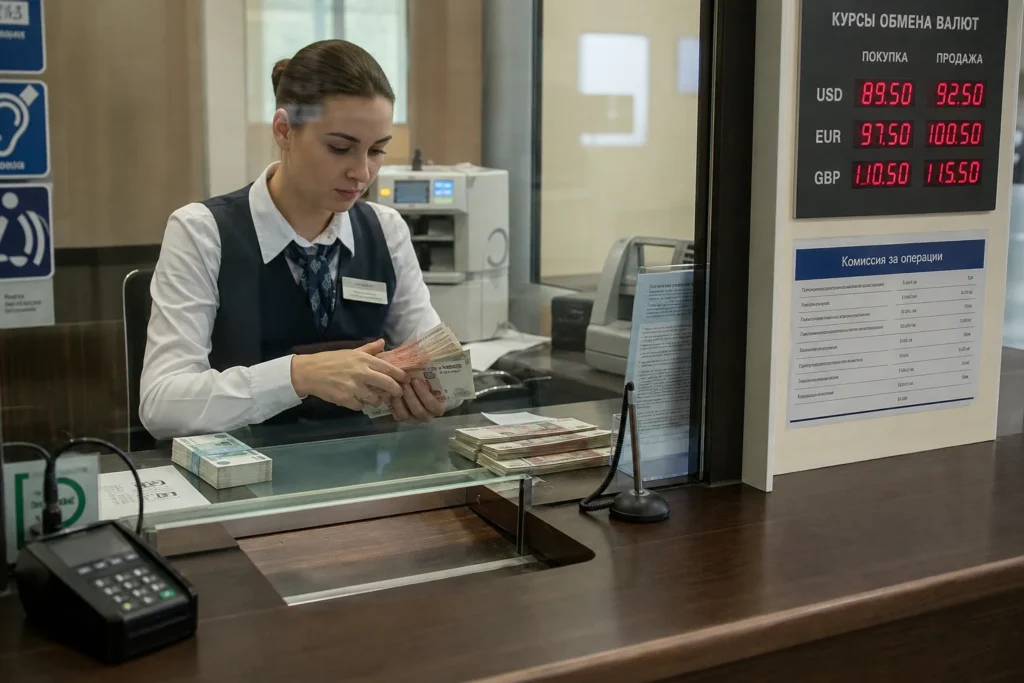
Exchanging foreign currency for rubles is straightforward in Murmansk, but it matters where and how you do it. This guide shows you the best places to exchange cash—banks, dedicated exchange offices, and ATMs—and what to expect at each. You’ll learn which banks offer the best rates, what documents you need, and how to avoid the worst rates (usually at airports and hotels).
The recommended approach is to find a major bank branch in the city centre with an exchange desk. Banks offer fair rates and secure transactions, though opening hours are standard business hours only.
Quick answer: Exchange cash at a bank branch or dedicated exchange office (обменник). Most transactions take 10–15 minutes and cost ₽₽ (moderate fees). Avoid airport counters and hotel exchanges, which charge higher fees.
At a Glance
| Total time | 10–15 minutes |
|---|---|
| Typical cost | ₽₽ |
What You Need Before You Start
- Foreign cash (USD or EUR preferred)
- Your passport or travel document (for transactions above the threshold)
- Access to a bank during business hours, or visit an exchange office that may have longer hours
Compare Your Options
| Option | Duration | Price | Notes |
|---|---|---|---|
| Bank branch exchange desk (recommended) | 10–15 minutes | ₽₽ | Available Monday–Friday, usually 09:00–17:00, some Saturdays until 13:00. Secure, fair rates, reliable. Sberbank and VTB are the largest networks with multiple branches. |
| Dedicated exchange office (обменник) | 5–10 minutes | ₽₽ | Often open longer than banks (some until 20:00 or later). Rates vary widely; compare before handing over cash. Found on main streets and shopping areas. |
| Hotel currency exchange (if available) | 5–10 minutes | ₽₽₽ | Convenient but charges higher fees than banks. Use only if other options are closed. Not all hotels offer this service. |
| Airport exchange counter | 5–10 minutes | ₽₽₽ | Available 24/7 but has the worst rates of any option. Use only for emergency small amounts. Avoid if possible. |
| ATM cash withdrawal with UnionPay or Mir card | 5 minutes | ₽ | Lowest cost if your card is UnionPay or Mir. Not available for Visa/Mastercard. Many ATMs throughout the city (Sberbank, VTB). |
₽ budget · ₽₽ moderate · ₽₽₽ upscale · ₽₽₽₽ splurge. Price levels are estimates compared with typical prices for visitors.
Step-by-Step Instructions
Step 1: Locate a bank branch in central Murmansk
Major Russian banks with exchange services include Sberbank, VTB, Alfa-Bank, and Raiffeisen Bank. Look for branches on Lenin Prospect (Prospekt Lenina) or near central public spaces. City hotel staff and metro information points can direct you to the nearest branch. Banks are typically open Monday to Friday, 09:00–17:00, with limited Saturday hours.
Tip: Avoid exchange counters at Murmansk Airport; their rates are noticeably worse. If you arrive at the airport with little cash, withdraw a small amount from an ATM first, then exchange at a city branch later.
Step 2: Enter the bank and find the exchange desk
Walk into the bank lobby and look for a sign marked 'Обмен валют' (currency exchange) or 'Обменник'. In most banks, the exchange desk is a separate window from regular customer service. If unsure, ask staff 'Где обмен валют?' (Where is the exchange desk?).
Tip: Smaller branches may not have dedicated exchange desks. Call ahead or visit a main branch in the city centre.
Step 3: Prepare your cash and documents
Have your foreign cash ready (crisp, undamaged notes only; banks reject torn or marked notes). If exchanging more than roughly 40,000 rubles' worth, bring your passport or travel document as identification. Staff will check it before proceeding.
Tip: Check that notes are clean and in good condition before you go. Carry your passport anyway, even for smaller amounts; rules can vary.
Step 4: Confirm the exchange rate
Ask the teller 'Какой курс?' (What's the rate?) or look for the rate display on the counter. The rate is usually shown as how many rubles per USD or EUR. Banks update rates throughout the day; rates are typically updated hourly or more frequently.
Tip: Compare rates between two or three branches if possible. Differences are usually small but worth checking. Main branches generally offer better rates than satellite offices.
Step 5: Hand over your cash and complete the transaction
Give your cash to the teller, who will count it carefully and record the amount. They will enter the transaction into the system and display the ruble amount you will receive. Review the receipt (квитанция) to verify the amount before accepting the ruble notes.
Tip: Always count the rubles you receive before leaving the desk. Banks are reliable, but verifying on the spot avoids later disputes.
Step 6: Collect your rubles and receipt
The teller will count out your rubles and pass them through the payment window, usually with your receipt. Store the receipt safely; most banks allow returns or corrections for a short period if there is an error. Place your rubles in a safe pocket or bag.
Tip: Keep the receipt for at least 24 hours. If you spot a discrepancy, return to the bank with the receipt and the rubles.
Common Mistakes to Avoid
- Exchanging at the airport: Rates are significantly higher than in the city. If you arrive with no rubles, withdraw a small amount from an airport ATM and exchange the rest at a bank later.
- Handing over cash without confirming the rate: Always ask for the current rate and verify the amount you'll receive before giving your money to the teller.
- Trying to exchange with foreign Visa/Mastercard: These cards cannot withdraw cash in Russia. Only UnionPay and Mir cards work at ATMs. Exchange cash instead.
- Presenting damaged or marked notes: Banks reject torn, written-on, or stained notes. Check your notes before you go. If rejected, the teller will explain why and return the note.
- Not bringing your passport for large amounts: Transactions above roughly 40,000 rubles require identification. Carry your passport even if you don't think you'll need it.
- Leaving without checking your cash: Count the rubles before you leave the desk and keep your receipt until you're sure the amount is correct.
Tickets, Payment and Booking
Where to exchange: Banks (Sberbank, VTB, Alfa-Bank, Raiffeisen) have dedicated exchange desks and offer the fairest rates. Dedicated exchange offices (обменник) are faster but rates vary. Hotels and airports offer convenience but at a cost.
Payment and ID: Bring foreign cash (USD, EUR preferred). For transactions above approximately 40,000 rubles, bring your passport or travel document. No ticket or pre-booking is needed; walk in during business hours.
Card restrictions (important): Foreign Visa and Mastercard cannot be used to withdraw cash in Russia. If you have only a Visa/Mastercard, exchange cash at home before arrival or use a UnionPay/Mir card if available. Cashless exchange of foreign currency from these cards to rubles is also not possible.
Official rates: The Central Bank of Russia sets official daily rates. Banks use rates close to official; exchange offices may offer slightly worse rates in exchange for convenience or longer hours. Shop around if time allows.
Helpful Links
Compare hotel pricesSearch flights
Advertisement: these are partner links. If you book or buy through them, we may earn a commission at no extra cost to you.
Russia Vibes Tips
- Exchange what you think you'll need for your stay at a bank, where rates are fair. If you run short, smaller exchange offices are faster but charge more. Plan your cash needs to avoid multiple exchanges.
- Visit banks on weekday mornings (09:00–11:00) when queues are shortest. Avoid Friday afternoons and Saturdays when lines can be long.
- The ruble weakens and strengthens against major currencies throughout the year. If you're flexible on timing, check the rate in advance and exchange when the rate is favorable. But for a short trip, this may not matter much.
- Keep a small emergency stash of rubles separate from your main cash. If your main money is lost or stolen, you'll have enough for immediate needs until you can exchange more.
- Many shops, restaurants, and hotels in central Murmansk accept card payments. If you have a UnionPay or Mir card from your home country or can get a Russian Mir card, you may need less cash than you think.
Explore Nearby Exchange Money in Murmansk
Browse more: All How-To · All How-To in Murmansk · All Money and Cards · All Murmansk
FAQ
Can I exchange money at Murmansk Airport?
Yes, but rates are significantly worse than in the city. If you arrive with no rubles, withdraw a small amount from an ATM at the airport, then exchange the rest at a bank branch in central Murmansk for better rates.
Do I need my passport to exchange money?
For small exchanges (under roughly 40,000 rubles), no. For larger amounts, yes—bring your passport or travel document. It's always safer to carry it anyway.
Can I use my foreign credit card to withdraw rubles?
No. Visa and Mastercard issued outside Russia do not work at ATMs. Only UnionPay and Mir cards (or Russian bank cards) can withdraw cash. Exchange foreign cash instead.
Which currencies are easiest to exchange?
USD and EUR are the most widely accepted. Other currencies (GBP, CHF, SEK) can be exchanged at larger banks but may take longer or have fewer options. Check with the bank in advance for less common currencies.
What happens if a bank rejects my cash?
Banks reject torn, heavily marked, or stained notes. The teller will return the note and explain why. If you have mostly damaged notes, bring a mix or visit a different bank—standards can vary slightly.
Is the rate better at banks or exchange offices?
Banks typically offer rates closer to the official Central Bank rate. Exchange offices are faster and have longer hours but usually charge higher spreads (worse rates). Compare if time allows.
How much cash should I exchange at once?
Exchange what you'll need for your stay. If you stay longer than expected or find you need more, it's easier to exchange again than carry excess rubles home. Rubles are hard to exchange outside Russia at good rates.
Can I exchange rubles back to my home currency when I leave?
Yes, at banks and exchange offices in Murmansk. However, rates are usually worse for returning cash than for buying it. Keep your receipt from the original exchange. It's better to spend or give away leftover rubles than to exchange back.
Russia Vibes is a one-person project. A coffee keeps it going
Not legal advice. This is general information for visitors. Rules on visas, entry, registration, customs and similar matters change often and can depend on your nationality. Check the official source and, if in doubt, ask your embassy or a qualified adviser.
How we research and update our guides
About this guide: AI assistance and accuracy
This guide is created with the help of AI and is based on official sources where available. Mistakes can still happen. Opening hours, prices, rules and other details are given to the best of our knowledge as of the date shown and can change without notice. It offers general recommendations only, not professional, legal or travel advice. Please confirm important details with the official source before you travel; you are responsible for your own plans and decisions.

Take this guide with you
Get a free PDF of this guide to print or read offline: key facts, tips and a map link on a few clean pages.
Report an issue on this page
Paying for your trip: please read
International sanctions affect payments between Russia and many other countries. In practice, cards issued in the EU, the UK, the US and several other countries often do not work in Russia, Russian cards usually do not work abroad, and some booking platforms, airlines and payment providers limit or suspend their services for Russia. The situation changes frequently.
We do not give legal or financial advice, and this site does not encourage anyone to break or circumvent sanctions. Whatever you plan, you are responsible for following the laws and regulations that apply to you, including those of your country of residence and citizenship.
Many travelers still organise their stay lawfully. It is worth asking your bank or payment provider what is currently permitted, contacting hotels, tour operators and carriers directly about the payment methods they accept, and checking which services are open to customers from your country. Clarify payment, cancellation and refund terms before you commit to a booking, and keep your plans flexible.
Partner links on this site may not be available in every country, and prices, availability and rules in our guides can differ from what you see when you book.