
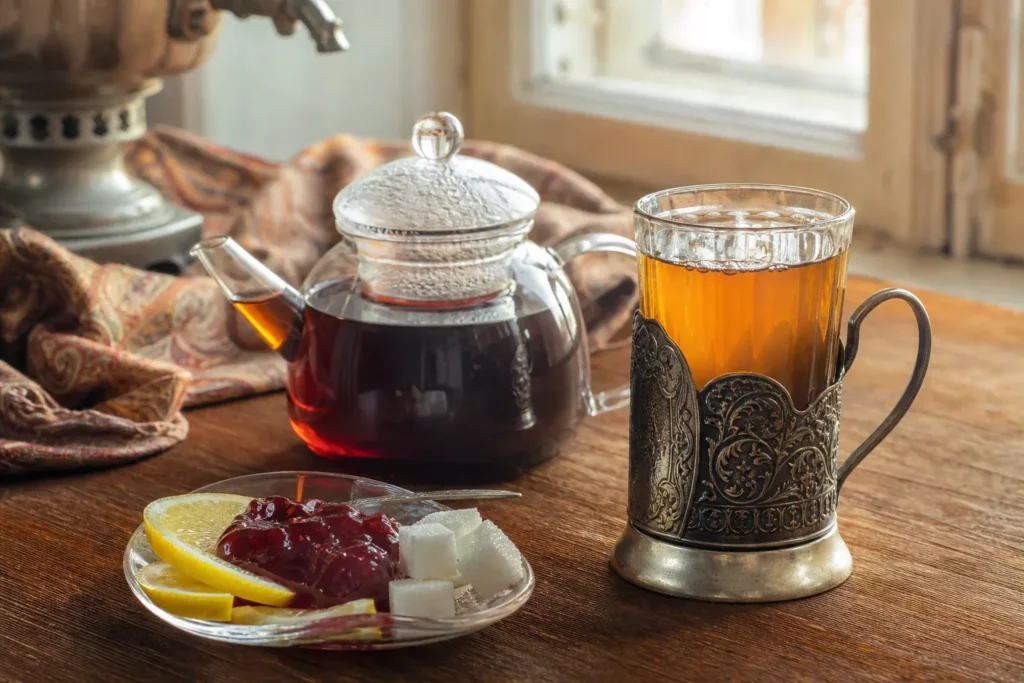
When you’re invited for tea in Russia, you’re not just getting a cup of tea—you’re joining a social tradition that goes back centuries. This guide explains how traditional Russian tea works, what to expect, and how to brew it yourself.
The Russian way is different from Western tea customs. Visitors often assume they’re ordering regular tea and are surprised by the strong concentrate that arrives. Understanding the zavarka method helps you enjoy it properly and accept it like a local.
Quick answer: Traditional Russian tea uses the zavarka method: brew loose black tea to make a strong concentrate, then pour a small amount into a cup and top it with hot water. You control the strength. Total time: about 20 minutes.
At a Glance
| Type | Drinks |
|---|---|
| Local name | Чай (Zavarka method) |
| Origin | Tea became popular in Russia starting in 1638 when a Mongolian ruler gave approximately 70 kilograms of tea to Tsar Michael I. By the 18th century, the city of Tula became the heart of samovar production, where expert metalworkers turned the large metal container into both a household essential and a work of art. The tea that arrived in Russia had been exposed to campfire smoke during the caravan journey, and Russians loved this smoky flavor so much that tea began to be roasted over beds of pine thereafter. |
| Servings | 2–4 servings |
| Total time | 20 minutes |
| Difficulty | Easy |
History and Story of Tea, Nizhny Novgorod
Russian tea culture began as a result of a gift of tea to a Russian Tsar in the mid-1600s. The samovar, which was an adaptation of the Tibetan hot pot, served both as heater and source of boiling water with which to brew the tea. A notable feature of Russian tea culture is the two-step brewing process, where tea concentrate called zavarka is prepared in a small teapot, and each person pours some quantity of this concentrate into their cup and mixes it with hot and cold water to adjust strength and heat to taste. Russians have always preferred a strong, dark brew which is sweetened with sugar, jam or honey.
Ingredients
- 200ml loose black tea leaves (about 4–5 teaspoons per small pot)
- 1 litre fresh water for boiling
- A small teapot (porcelain or glass)
- A kettle or way to boil water
- Sugar, jam, honey or lemon (optional, for serving)
How Tea, Nizhny Novgorod Is Made
Step 1: Boil water
Fill a kettle with fresh cold water and bring it to a rolling boil. Use more water than you think you need—you'll need some for the concentrate and some for diluting.
Tip: Hard water can affect the flavor; if possible use filtered water.
Step 2: Prepare the teapot
Take a small teapot (about 300–400ml capacity) and place 4–5 teaspoons of loose black tea leaves into it. The amount depends on how strong you like your concentrate and how many people you're serving.
Tip: Use loose leaves, not tea bags. Russians prefer the fuller flavor and tradition of loose tea.
Step 3: Brew the zavarka
Pour boiling water over the tea leaves into the small teapot until it's about half full. Stir gently, cover the pot tightly, and let it steep for at least 5–10 minutes. The longer it steeps, the darker and stronger it becomes. You're making a concentrate, not a regular cup of tea.
Tip: Wrapping the pot in a cloth or tea cozy keeps it hot and helps the leaves settle.
Step 4: Fill your cup
Pour about one-quarter to one-third of a cup with the dark zavarka concentrate. This strong tea is the base. Do not fill the cup.
Tip: If you like very weak tea, use even less concentrate. If you want it stronger, use more.
Step 5: Add hot water
Top the cup with hot boiling water from the kettle or samovar, leaving about 1cm at the top. Stir. The water will dilute the concentrate to your preferred strength and heat level.
Tip: Adjust the ratio of concentrate to water until you get the strength and temperature you like.
Step 6: Add sweetener if desired
Traditionally, Russians let a spoonful of sugar or jam dissolve in their mouths just before drinking. You can instead stir sugar, honey, lemon or jam into the cup. Some people sip it neat, black and strong.
Tip: A classic Russian pairing is tea with fruit jam—add jam to the cup or keep it on the side for sipping between drinks.
Variants
- Tea with lemon instead of sugar—common in Russia and provides brightness to cut the strength
- Tea with berry jam (particularly raspberry or currant)—a classic Russian pairing where jam is stirred into the tea or eaten between sips
- Herbal tea (mint, chamomile, or fireweed) mixed with black tea
- Tea with honey and spices (cinnamon, cloves) added for warmth
Common Mistakes to Avoid
- Treating zavarka like regular tea. It's not meant to be drunk as-is—it's too strong. Always dilute it with hot water first.
- Using tea bags instead of loose leaves. Russians traditionally use loose leaf tea for better flavor and a more authentic experience. Tea bags are available but less preferred.
- Not keeping the concentrate pot hot. The zavarka can be kept simmering gently throughout a tea session, with more hot water added to the big pot to refresh it.
- Pouring boiling water directly into a cold cup. The temperature shock can crack glass or ceramic. Either preheat the cup with hot water first, or use thermal glass.
- Expecting one strong cup. Russian tea is a ritual meant to be sipped slowly over conversation. One pot of zavarka is meant to serve multiple people multiple cups over time.
- Forgetting the tea concentrate can be topped up. Keep the small teapot hot on the samovar or near the kettle, and continue topping up the main water source. One batch of zavarka typically lasts for several rounds of tea.
How to Order and Eat It
Merchants drinking from chinaware started the fashion of drinking tea from a saucer—a solution for tea that was too hot when boiling water from the samovar was combined with the zavarka. However, although this is often seen in historical depictions of Russian tea drinking, it is considered socially poor practice today. In modern Russia, tea is drunk from a cup or glass. Sip slowly. Russian tea is part of extended social time, not rushed refreshment. Tea is often accompanied by pastries, biscuits, or bread, and served after meals rather than before.
To order: Чай с сахаром, пожалуйста [Chai s sakharom, pozhaluysta – Tea with sugar, please]
Russia Vibes Tips
- If served tea in a glass with a metal holder (called podstakanniki), this is authentic and traditional—the holder is meant to protect your hand from the hot glass. It's not a decoration.
- When invited for tea at a Russian home, expect to stay for at least an hour. Tea is a social event, not a quick beverage. Conversation, sweets and multiple cups are all part of the ritual.
- The strength of the zavakia varies by household and region. Don't assume all Russian tea tastes the same. Ask if you're unsure how strong to make yours.
- In cafes and restaurants, tea may be served already prepared in a cup, not as a concentrate. Ask for zavarka if you want the traditional method.
- Tea is drunk year-round in Russia, hot even in summer. Cold tea is less common than in Western countries, though iced tea exists.
Where to Find Tea, Nizhny Novgorod in Russia
Related guides
 Best Restaurants for Traditional Russian Cuisine, Nizhny Novgorod: Where to Eat Local
 Best Coffee Shops & Cafes, Nizhny Novgorod: Specialty Venues and Breakfast Spots
 Bolshaya Pokrovskaya Street: A Walking Tour of Nizhny Novgorod’s Historic HeartOpen 24 hours
Browse more: All Food & Drink · All Food & Drink in Nizhny Novgorod · All Nizhny Novgorod · All Other
FAQ
Is Russian tea the same as English tea?
No. English tea is typically brewed once at full strength in a cup or pot. Russian tea uses the zavarka method: a strong concentrate is made separately, then each person dilutes it to their taste with hot water. This allows everyone at the table to adjust strength and temperature individually.
Do I need a samovar to make Russian tea?
You do not need a samovar to make Russian tea. Any small teapot made of porcelain or glass and any kettle to boil water will work. A samovar is traditional and keeps water hot for hours, but a regular electric kettle works fine.
What kind of tea should I use?
Black tea is the most common tea consumed in Russia. Traditionally, Russian people favored a black unflavored tea grown in India or Sri Lanka, but now teas from any country might be used. Russian Caravan (a smoky blend) is a classic choice, but any quality loose black tea works.
What's the right proportion of concentrate to water?
Each cup consists of about one quarter to one third of the concentrate, diluted with hot water from the samovar itself. Start with less concentrate and add more if you want it stronger, or add more water if you want it weaker.
Should I drink the leaves at the bottom?
No. The leaves settle at the bottom of the pot and should not be drunk. Pour carefully to leave them behind, or use a strainer. Loose leaf particles in your cup are unpleasant to drink.
When is tea typically served in Russia?
Tea is served throughout the day, especially in the afternoon and after meals. It's less common as a morning drink (coffee is more typical for breakfast) but can be drunk at any time. An afternoon tea gathering with pastries is a longstanding tradition.
What's typically served with tea in Russia?
Tea is almost always accompanied by something sweet: pastries, biscuits, cakes, bread, jam, or sugar. It may also be served with savory items like bread or cheese. Tea without food is less common.
Can I ask for tea in a cafe in Russia?
Yes, tea is widely available in cafes, restaurants and hotels throughout Russia. However, it may come already prepared in a cup rather than as a concentrate. Ask for "zavarka" if you want the traditional method, or accept what's offered.
Russia Vibes is a one-person project. A coffee keeps it going
How we research and update our guides
About this guide: AI assistance and accuracy
This guide is created with the help of AI and is based on official sources where available. Mistakes can still happen. Opening hours, prices, rules and other details are given to the best of our knowledge as of the date shown and can change without notice. It offers general recommendations only, not professional, legal or travel advice. Please confirm important details with the official source before you travel; you are responsible for your own plans and decisions.

Take this guide with you
Get a free PDF of this guide to print or read offline: key facts, tips and a map link on a few clean pages.
Report an issue on this page
Paying for your trip: please read
International sanctions affect payments between Russia and many other countries. In practice, cards issued in the EU, the UK, the US and several other countries often do not work in Russia, Russian cards usually do not work abroad, and some booking platforms, airlines and payment providers limit or suspend their services for Russia. The situation changes frequently.
We do not give legal or financial advice, and this site does not encourage anyone to break or circumvent sanctions. Whatever you plan, you are responsible for following the laws and regulations that apply to you, including those of your country of residence and citizenship.
Many travelers still organise their stay lawfully. It is worth asking your bank or payment provider what is currently permitted, contacting hotels, tour operators and carriers directly about the payment methods they accept, and checking which services are open to customers from your country. Clarify payment, cancellation and refund terms before you commit to a booking, and keep your plans flexible.
Partner links on this site may not be available in every country, and prices, availability and rules in our guides can differ from what you see when you book.