
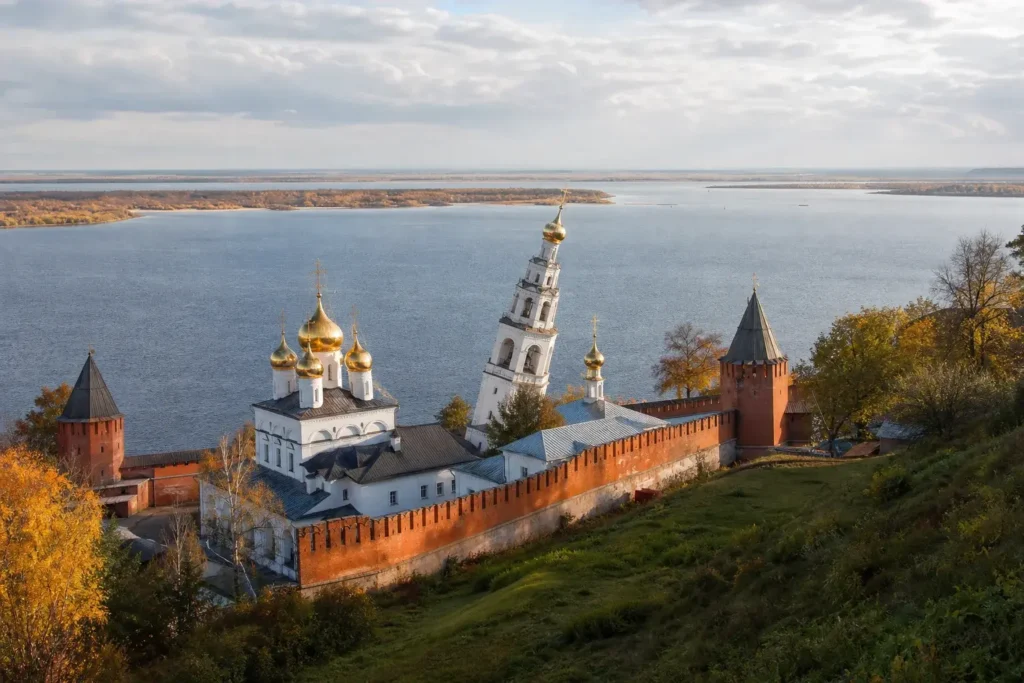
Founded around 1328–1330 by St. Dionysius, who came from Kiev Pechersk Lavra with other monks and dug a cave on the steep Volga shore, the Pechersky Ascension Monastery is one of Nizhny Novgorod‘s most historically significant religious sites. The monastery spreads across the steep right bank of the Volga, about three kilometres downstream from the Kremlin, with its location on the slope offering breathtaking views of the river and a peaceful atmosphere detached from the city bustle.
Although there are no caves in the modern monastery, the name Pechersky—meaning caves—has been preserved, linking it to the old Kiev cloister. Closed by the NKVD in 1924, it reopened in 1994 and today functions as an active Orthodox monastery with multiple churches, an archaeological museum, and a bookshop.
Quick Facts
| Russian name | Печёрский Вознесенский монастырь |
|---|---|
| Built / opened | 1328 |
| Address | ул. Приволжская Слобода, 108 OpenStreetMap · Google Maps |
| District | Nizhegorodsky |
| Admission | Free entry to monastery grounds; separate charges for museum |
| Best time to visit | Spring (May–early June) and autumn (September–early October) offer mild weather, clear skies for photography, and comfortable temperatures for walking the grounds. Avoid the coldest winter months (December–February) unless you enjoy stark landscapes; summer (July–August) brings heat and peak tourist traffic. Weekday mornings are quieter than weekends and religious holidays, which attract larger pilgrim groups. Afternoon light (3–5 pm) illuminates the white churches and golden domes most dramatically. |
| Recommended duration | 1–2 hours |
| Website | pecherskiy.nne.ru |
What Is (and Isn't) Part of a Visit to Pechersky Ascension Monastery, Nizhny Novgorod?
| Part | Status | Notes |
|---|---|---|
| Monastery grounds and exterior | Included in the standard ticket | Open to visitors; no restrictions on movement around the main courtyard, outer walls, and viewing external architecture. |
| Churches and chapels (interior) | Included in the standard ticket | Open during visiting hours; standard Orthodox dress codes apply (women cover head, men remove hat, no bare shoulders or legs). |
| Archaeological Museum | Separate ticket or institution | Located in the cell building; requires separate ticket; documents the monastery's history from 14th-century foundations through 1597 relocation. |
| Monastic cells and economic buildings | Not open to visitors | Accessible only with prior permission; off-limits to casual visitors. |
| Church bookshop and tea service | Included in the standard ticket | Shop and simple refreshments available; church shop sells icons, candles, liturgical texts, and souvenirs; traditional monastery tea and cakes served at entrance. |
| Nizhny Novgorod Kremlin | Outside / not part of it | Separate site approximately 2.5 km to the northwest; separate ticket required; not part of the monastery complex. |
| Cable car (Kantnaya doroga) | Outside / not part of it | Located nearby, approximately 500 m away; separate transport facility; independent operator; not part of the monastery. |
Why Visit Pechersky Ascension Monastery, Nizhny Novgorod?
The monastery offers a compelling blend of medieval history and Orthodox spirituality on a dramatic Volga hillside. The site bears the name of the Kiev Pechersk Lavra, evoking the cave-dwelling monastic tradition from which it descended. The complex includes the Ascension Cathedral with its distinctive bell tower, the Assumption Church, the Gate Church of Euthymius of Suzdal, and several smaller chapels. The setting itself—elevated above the river with panoramic views—creates a contemplative atmosphere that appeals equally to pilgrims and visitors interested in Russian ecclesiastical architecture and history.
How Pechersky Ascension Monastery, Nizhny Novgorod Is Laid Out
The monastery perimeter is surrounded by fortress walls stretching almost one kilometre with four towers; visitors enter through the western gate into a spacious territory featuring an alley of busts of Russian rulers, a chapel, and an old bell. The main compound arranges several churches around a central courtyard. Principal buildings include the Ascension Cathedral, the Assumption Church, the Church of St. Euthymius, the Church of St. Sergius of Radonezh, and the Church of Peter and Paul. A cell building houses the church-archaeological museum and church shop. There are no restrictions on moving around the territory and visiting temples, but economic buildings and cells are accessible only with permission.
Highlights of Pechersky Ascension Monastery, Nizhny Novgorod
Ascension Cathedral
Built in 1630–1632, the cathedral features a distinctive leaning belfry that also serves as a clock tower and has been out of plumb almost since its original construction. The white-stone cathedral with its golden cupola dominates the monastery compound and is visible from the river. The tilted bell tower creates an unusual architectural character and makes the cathedral instantly recognizable from a distance.
Tip: Approach from the western entrance to see the full silhouette of the cathedral and its leaning tower against the Volga.
Church of the Dormition of Our Lady
Completed in 1648, this church dates from the monastery's rebuilding period following the 1597 landslide. Part of the active monastic complex, it showcases 17th-century Orthodox ecclesiastical architecture and maintains an important role in the monastery's daily liturgical life.
Tip: Photography from inside the church requires respectful positioning; the interior lighting is often atmospheric in morning hours.
Church of Saint Euthymius of Suzdal
Built in 1645, this gate church stands above the monastery's main entrance and was dedicated to the venerable ascetic Euthymius. Its position over the entrance creates a distinctive feature where worship space and functional gateway architecture combine.
Tip: Look up as you pass through the western gate to see the church positioned above the archway.
Fortress Walls and Towers
The perimeter walls measure almost one kilometre in length and feature four towers, designed to protect the monastery complex from external threats. The red-painted walls and towers give the complex a fortified appearance that distinguishes it from typical monasteries and reflects its historical defensive importance.
Tip: Walk the full perimeter path to appreciate the scale of the fortifications and enjoy continuous Volga views.
Icons and Relics Chamber
The monastery houses the "Made-by-Hands" Icon of the Mother of God, brought by the monastery's founder Saint Dionysius from the Kyiv-Pechersk Lavra. This venerable icon remains a major draw for pilgrims and represents the direct spiritual connection between the two monastery traditions.
Tip: Ask at the church shop about the location and viewing hours of special relics; some are displayed only during specific services.
Archaeological Museum
Located in the cell building, the church-archaeological museum documents the monastery's history and material culture. The museum explores the site's 14th-century foundations and the transition from the original cave settlement to the current plateau location after 1597.
Tip: Purchase museum tickets separately at the cell building entrance; guided tours can be arranged by advance request.
Alley of Russian Rulers
An alley of busts depicting Russian rulers lines the main monastery courtyard, creating a distinctive secular monument within the sacred space. A bust honouring the 400th anniversary of the Romanov dynasty was installed near the Ascension Cathedral in May 2013, marking significant historical commemorations.
Tip: The busts provide good photo opportunities; visit in afternoon light when shadows enhance the sculptural details.
Atmosphere
The monastery radiates a sense of contemplative solitude despite its proximity to the city. Located halfway up the hillside, it creates an atmosphere of peace and detachment from urban bustle while offering panoramic Volga vistas. Early morning brings mist over the river and muted light; midday sun illuminates the white stone and golden domes dramatically. The grounds maintain evident active monastic life—visitors may encounter monks in black habits and encounter the rhythms of liturgical services, particularly during Orthodox feast days. The combination of fortress-like outer walls, peaceful inner courtyards, and riverside setting produces a distinct atmosphere that bridges defensive architecture with spiritual sanctuary. Weekday mornings are quieter; weekends and religious holidays draw larger groups of pilgrims.
History of Pechersky Ascension Monastery, Nizhny Novgorod
Saint Dionysius, arriving from Kiev Pechersk Lavra around 1328–1330 with other monks, dug a cave on the steep Volga shore and later founded a monastery with a church dedicated to the Resurrection of the Lord. The name Pechersky derives from the Russian word for caves; the founder and first monks initially settled in caves dug into the mountain slope. The original monastery thrived as a spiritual centre and became influential in regional Orthodox life.
On June 18, 1597, a landslide destroyed the original site; the same year the monastery was rebuilt about one kilometre upstream, where no caves exist, yet the name Pechersky was retained, preserving the link to the Kiev tradition. Patriarch Filaret, father of the first Romanov tsar, oversaw the rebuilding on the present plateau; the Ascension Cathedral, refectory church, and bell tower date from the 1630s and 1640s.
The Church of Dormition of Our Lady dates from 1648 and the Church of Saint Euthymius of Suzdal from 1645; other buildings originated in the 17th and 18th centuries. Through the eighteenth and nineteenth centuries, it served as the senior monastery of the Nizhny Novgorod eparchy, playing a central role in regional ecclesiastical administration.
The monastery was closed by the NKVD in 1924 during the Soviet suppression of religious institutions. It reopened in 1994 following the restoration of religious freedom in post-Soviet Russia. Today it remains the principal monastery of the Nizhny Novgorod Eparchy and the seat of the Bishop of Nizhny Novgorod and Arzamas, resuming its historical ecclesiastical role.
Legends and Myths about Pechersky Ascension Monastery, Nizhny Novgorod
Saint Dionysius and the Cave Monastery
Legend – historically unreliable. The tradition holds that St. Dionysius dug a cave on the steep Volga shore, evoking monastic cave-dwelling practices from the Kiev Pechersk Lavra. Local Orthodox tradition venerates this act of ascetic self-denial, locating spiritual authority in the voluntary embrace of hardship and isolation. Though the cave settlement was later abandoned and eventually destroyed by the 1597 landslide, the memory of these original cave-cells shaped the monastery's identity and spiritual significance.
The Leaning Belfry's Ancient Tilt
Disputed by historians. The belfry of the Ascension Cathedral has been noticeably out of plumb, leaning almost since the time it was originally constructed. The persistent lean, whether originally intentional or accidental, has become inseparable from the structure's identity. Local accounts attribute the tilt to various causes—shifting soil, hasty construction, or divine will—but the belfry has weathered centuries while maintaining its distinctive list.
Tickets and Booking for Pechersky Ascension Monastery, Nizhny Novgorod
| Ticket | Price | Includes |
|---|---|---|
| Monastery grounds and churches | Free | Entry to monastery grounds, all churches and chapels, viewing of reliquaries and icons, access to shop and tea service, use of facilities. |
| Archaeological Museum | ₽ | Entry to museum in cell building with exhibits on monastery's 14th-century foundations, 1597 relocation, architectural history, and religious artefacts. |
₽ budget · ₽₽ moderate · ₽₽₽ upscale · ₽₽₽₽ splurge. Price levels are estimates compared with typical prices for visitors.
The monastery is open to visitors without advance reservation for the main grounds and churches. Entrance is free. The archaeological museum requires a small ticket purchased at the cell building. Guided group tours and specialist visits can be arranged by contacting the monastery in advance via phone (+7 831 432-66-50) or the official website (www.pecherskiy.nne.ru). Standard Orthodox church etiquette applies: remove shoes if requested, cover shoulders and knees, women cover the head, men remove hats. Photography is generally permitted in outdoor areas and many churches, though some inner sanctums may restrict cameras during services. Ticket rates for Russian citizens and pilgrims may differ from visitor rates; check the official website for current categories and concessions. Visiting during non-liturgical hours (typically morning to mid-afternoon) allows free movement; services are held at various times and may restrict visitor access to certain areas.
Plan and Book
Suggested itineraries Pechersky Ascension Monastery, Nizhny Novgorod
1–1.5 hours
Enter through the western gate and stroll the main courtyard. Photograph the Ascension Cathedral and its distinctive leaning belfry. Visit the Church of the Dormition of Our Lady and Church of Saint Euthymius. Pause to view the alley of Russian rulers' busts. If time permits, browse the church bookshop and enjoy refreshments.
2 hours
Complete the shorter itinerary. Walk the full perimeter of the fortress walls to appreciate the surrounding Volga views. Enter the archaeological museum in the cell building to learn the monastery's history from its 1328 founding through the 1597 relocation. Spend final minutes in quiet contemplation in a chapel or the courtyard.
2.5–3 hours
Begin with the full fortress perimeter walk. Spend focused time in the Ascension Cathedral studying its 1630s architecture and tilted bell tower. Visit the archaeological museum. Return to the courtyard for tea and cakes. End with a leisurely walk along any riverside paths or viewpoints accessible from the monastery grounds to absorb the Volga landscape.
How to Get to Pechersky Ascension Monastery, Nizhny Novgorod
By Metro & Marshrutka: There is no direct metro station at the monastery. From central Nizhny Novgorod, take a marshrutka (minibus) or local bus heading towards Privolzhskaya Sloboda or Sennaya area from Minin and Pozharsky Square (Ploshchad Minina i Pozharskogo). Ask the driver for Privolzhskaya Sloboda, 108. The journey takes 15–25 minutes depending on traffic.
By Cable Car & Walking: The monastery is located about 500 metres east of the cable-car base station. The Nizhny Novgorod cable car (Kantnaya doroga) descends to Sennaya Square; from there, follow signs or ask directions to Privolzhskaya Sloboda heading uphill and southeast. The 500 m walk takes approximately 8–10 minutes through residential streets with moderate elevation gain.
By Taxi or Ride-Share: A taxi from the city centre (Kremlin area) takes 10–20 minutes depending on traffic. Yandex Taxi and other ride-share apps operate in Nizhny Novgorod. Provide the address: Privolzhskaya Sloboda, 108, Nizhny Novgorod, 603093.
Accessibility
The monastery occupies hilly terrain with slopes and steps connecting different levels. No formal wheelchair-accessible routes are documented. The main western entrance and courtyard are navigable on relatively flat ground. Churches require climbing multiple interior steps. Uneven stone surfaces and outdoor staircases limit access for visitors with mobility challenges or using walkers. Bench seating exists in the courtyard. Visitors with access requirements should contact the monastery (+7 831 432-66-50) in advance to discuss specific needs and possible alternative arrangements.
Food Nearby
Limited food options exist immediately at the monastery. Tea and cakes are sold at the entrance, made on-site. For fuller meals, the Sennaya area (Sennaya Square, approximately 1 km away by road) contains cafés and small restaurants. The cable car base station vicinity also has a few food kiosks. For dining diversity, return to central Nizhny Novgorod (Kremlin area, approximately 2.5 km) where numerous restaurants and cafés serve Russian and international cuisine.
What to Bring
Comfortable walking shoes with good grip for hillside terrain and stone surfaces. Sun protection (hat, sunscreen) in spring and summer. A headscarf or shawl for women entering churches (strict dress codes apply). Water bottle for the ascent and hillside walk. Camera or phone for photography. In winter, warm clothing and non-slip footwear as paths may be icy. Pack respectfully—no bare shoulders, knees, or flashy clothing inside churches; bag and security checks are standard at entry.
Best Views and Photo Spots of Pechersky Ascension Monastery, Nizhny Novgorod
Western gateway entrance
Framed view of the Ascension Cathedral and its tilted belfry rising behind the monastery gate; the fortress walls and towers flank both sides, creating a theatrical composition with depth and enclosure.
Best time: Late afternoon when the white stone catches warm light and shadows define the gate arch; aim for early September or May for crisp clarity.
Riverside vantage above the Volga
Panoramic view of the entire monastery silhouette—churches, walls, and towers—set against the river and far bank; captures the hillside perch and isolation of the complex.
Best time: Sunset (summer, 20:00–21:00) for golden light across the Volga; autumn offers low-angled morning light and clearer air.
Ascension Cathedral belfry framing
Close-up of the distinctive tilted bell tower and its architectural details; the gold cupola and white stone contrast sharply, especially when framed against sky or darker church structures.
Best time: Midday (11:00–14:00) for bright side-lighting that emphasizes the tower's lean and architectural ornament.
Alley of rulers' busts courtyard
Linear perspective down the alley of busts with the Ascension Cathedral or another major church as focal point; creates depth and documentary character highlighting the blend of secular and sacred.
Best time: Afternoon when shadows between busts add sculptural definition and courtyard activity is moderate.
Fortress walls and towers perimeter
Red-painted walls and fortification towers with the river and far bank visible beyond; emphasizes the monastery's defensive architecture and commanding hillside position.
Best time: Golden hour (early morning or late afternoon) when the red walls glow and shadows of towers create dramatic diagonal patterns.
Photography Rules
Photography is generally permitted in the outdoor courtyard, around the churches, and on monastery grounds. Interior photography in some temples may be restricted, particularly during services; standard rules apply: remove hats for men, cover the head for women, no flashy attire. No drones permitted. Tripods are not encouraged in crowded areas; ask permission before setting one up. Avoid photographing inside certain chambers or during active liturgical services.
Family Suitability
The monastery appeals to families with older children and adults interested in history and Orthodox culture. The hillside terrain with stairs and uneven surfaces can be challenging for very young children and those in strollers; plan accordingly. The peaceful atmosphere and outdoor courtyard allow children to move around and explore safely under supervision. Churches require quiet behaviour and respectful dress; explain expectations beforehand. The archaeological museum is educational for school-age children but may lack interactive elements for very young visitors. Allow adequate time for tea and refreshments at the entrance. The 1–2 hour visit suits most family attention spans; extend to 2–3 hours only if children are particularly engaged. Avoid peak pilgrim times (major Orthodox holidays) when crowds may overwhelm small children.
Russia Vibes Tips
- Visit on a weekday morning before 11:00 to avoid pilgrim groups and enjoy a quieter, more contemplative atmosphere in the churches and courtyard.
- Wear comfortable hiking-grade shoes: the monastery sits on a slope with stone steps and uneven surfaces throughout. Casual footwear may be slippery or uncomfortable.
- Bring a headscarf or small shawl in your bag if you're unsure about the dress code for women; Orthodox church protocol strictly requires head covering, and borrowing is not always available.
- Do not assume the museum or shops are open during all advertised hours. Call ahead (+7 831 432-66-50) if you specifically want to visit the archaeological museum; some days it may have limited hours or be closed for maintenance.
- The cable car (Kantnaya doroga) nearby offers a scenic descent or ascent of the Volga Bank; combining a cable car ride with a monastery visit creates a full half-day itinerary that showcases the region's geography.
- Photography from the Volga embankment (accessible via public riverside paths) offers panoramic silhouettes of the monastery against the water; scout these views from a distance before or after your visit.
Explore Nearby Pechersky Ascension Monastery, Nizhny Novgorod
Sights near Pechersky Ascension Monastery, Nizhny Novgorod
 Nizhny Novgorod Kremlin – about 3.0 km away · typical visit: 2–3 hoursOpen daily 06:00–22:00
Main image: AI-generated illustration. It may not show the place exactly as it looks.
 Chkalov Staircase, Nizhny Novgorod – about 2.6 km away · typical visit: 45 minutes to 1.5 hoursOpen 24 hours
Main image: AI-generated illustration. It may not show the place exactly as it looks.
 Nizhny Novgorod State Art Museumabout 2.8 km away · typical visit: 2–3 hours
Main image: AI-generated illustration. It may not show the place exactly as it looks.
Hotels near Pechersky Ascension Monastery, Nizhny Novgorod
 Hampton By Hilton Nizhny Novgorod, Nizhny Novgorodabout 1.3 km away (~21 min walk)
Main image: AI-generated illustration. It may not show the place exactly as it looks.
 Kulibin Parkhotel & SPA, Nizhny Novgorodabout 2.9 km away
Main image: AI-generated illustration. It may not show the place exactly as it looks.
 Mercure Nizhny Novgorod Center, Nizhny Novgorodabout 2.9 km away
Main image: AI-generated illustration. It may not show the place exactly as it looks.
Related guides
 Sennaya Square Area, Saint Petersburg: Dostoevsky’s Streets
Main image: AI-generated illustration. It may not show the place exactly as it looks.
 Khachapuriya: Georgian Khachapuri and Khinkali in Nizhny Novgorod
Main image: AI-generated illustration. It may not show the place exactly as it looks.
 Pelmennaya Lepi Testo: Authentic Dumplings at Budget PricesOpen daily 08:00–21:30
Main image: AI-generated illustration. It may not show the place exactly as it looks.
Browse more: More in Nizhegorodsky · All Churches · All Nizhny Novgorod · All Sightseeing · All Sightseeing in Nizhny Novgorod
FAQ: Pechersky Ascension Monastery, Nizhny Novgorod
Is the Pechersky Ascension Monastery an active place of worship or purely a museum?
The monastery is fully active. It serves as the principal monastery of the Nizhny Novgorod Diocese and the seat of the Bishop of Nizhny Novgorod and Arzamas. Liturgical services occur regularly, and monks live and work on site. Visitors are welcome to observe and participate respectfully; the complex also includes a museum and bookshop.
Is there a metro station directly at the monastery?
No. The monastery is not served by metro. From central Nizhny Novgorod, take a marshrutka (minibus) from Minin and Pozharsky Square to Privolzhskaya Sloboda (15–25 minutes), or use the cable car and walk 500 metres uphill from Sennaya Square.
What are the dress code requirements for entering the churches?
Standard Orthodox dress codes apply. Women must cover their heads (with a headscarf or shawl), avoid bare shoulders and knees, and dress modestly. Men must remove hats and avoid tank tops or shorts. Respectful attire demonstrates consideration for active worship.
Is entry to the monastery grounds free?
Yes, entry to the monastery grounds, courtyard, and churches is free. A separate small ticket is required for the archaeological museum. The church bookshop and tea service are optional add-ons.
How is the Pechersky Monastery different from the Nizhny Novgorod Kremlin?
They are distinct sites. The Kremlin (approximately 2.5 km away) is a medieval fortress with walls, towers, and contained museums. The Pechersky Monastery is a religious complex on a hillside with working churches, a cemetery, and a different spiritual character. Each requires a separate visit.
When was the monastery built, and why did it move locations?
Founded around 1328–1330 on the Volga shoreline by St. Dionysius, the original site was destroyed by a massive landslide on June 18, 1597. The monastery was immediately rebuilt about 1 kilometre upstream on higher, more stable ground where it stands today. The 1630s–1640s reconstruction established the Ascension Cathedral and other principal buildings.
Can I take photographs inside the churches?
Photography is generally permitted in the courtyard and exterior areas. Inside churches, photography is allowed in most public spaces, though certain inner chambers or active liturgical areas may restrict cameras. Always ask respect-fully if unsure, and avoid photographing during services.
How long should I plan for a visit?
A brief visit to the grounds and one or two churches takes 1–1.5 hours. A more thorough exploration including the archaeological museum and fortress perimeter walk takes 2–3 hours. Allow extra time if you wish to attend a service or have a quieter contemplative experience.
Russia Vibes is a one-person project. A coffee keeps it going
How we research and update our guides
About this guide: AI assistance and accuracy
This guide is created with the help of AI and is based on official sources where available. Mistakes can still happen. Opening hours, prices, rules and other details are given to the best of our knowledge as of the date shown and can change without notice. It offers general recommendations only, not professional, legal or travel advice. Please confirm important details with the official source before you travel; you are responsible for your own plans and decisions.

Take this guide with you
Get a free PDF of this guide to print or read offline: key facts, tips and a map link on a few clean pages.
Report an issue on this page
Paying for your trip: please read
International sanctions affect payments between Russia and many other countries. In practice, cards issued in the EU, the UK, the US and several other countries often do not work in Russia, Russian cards usually do not work abroad, and some booking platforms, airlines and payment providers limit or suspend their services for Russia. The situation changes frequently.
We do not give legal or financial advice, and this site does not encourage anyone to break or circumvent sanctions. Whatever you plan, you are responsible for following the laws and regulations that apply to you, including those of your country of residence and citizenship.
Many travelers still organise their stay lawfully. It is worth asking your bank or payment provider what is currently permitted, contacting hotels, tour operators and carriers directly about the payment methods they accept, and checking which services are open to customers from your country. Clarify payment, cancellation and refund terms before you commit to a booking, and keep your plans flexible.
Partner links on this site may not be available in every country, and prices, availability and rules in our guides can differ from what you see when you book.