
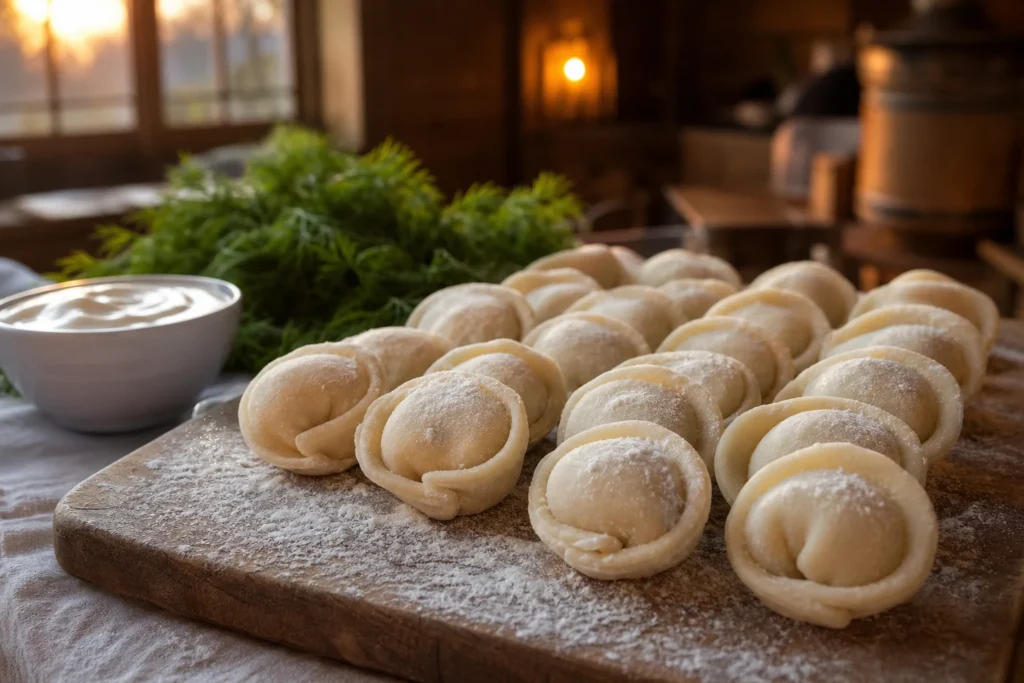
Pelmeni are small meat-filled dumplings that have become a staple of Russian cuisine. Whether you eat them in a restaurant in Nizhny Novgorod or prepare them in your own kitchen, these tender parcels wrapped in thin dough deliver juicy, herb-flaked meat with every bite. This guide will walk you through how to make pelmeni at home in approximately 2–3 hours, depending on your pace and whether you freeze them for later.
The process is straightforward and meditative: mix a simple dough, prepare a seasoned meat filling, shape each dumpling by hand or with a mold, and boil them until they float. The recommended option is to freeze shaped pelmeni overnight, then cook them directly from the freezer, which gives you a reliable result and the flexibility to serve them whenever you choose.
Quick answer: Mix a soft dough with flour, eggs, water and salt; let it rest. Combine ground beef and pork with diced onion, salt and pepper. Roll dough thin, cut circles, fill each with a teaspoon of meat, fold in half and pinch the ends together to seal. Freeze for at least 30 minutes, then boil in salted water until they float and cook 3–5 minutes longer. Total time: 2–3 hours (or just 15 minutes if cooking frozen pelmeni you've made ahead).
At a Glance
| Type | Dishes |
|---|---|
| Local name | Пельмени |
| Origin | Pelmeni originated in the Urals and Siberia, where they became a staple food in the 19th century. The name comes from the Permian words 'pel' (ear) and 'nyan' (bread), referring to their ear-like shape when pinched at the corners. |
| Servings | 2–4 servings |
| Total time | 2–3 hours (or 15 minutes if cooking frozen pre-made pelmeni) |
| Difficulty | Easy |
History and Story of Pelmeni, Nizhny Novgorod
Pelmeni remained a Ural-Siberian regional specialty for centuries, originating from the Finno-Ugric peoples of the region. The name derives from the Permian words for ‘ear’ and ‘bread.’ Pelmeni were first mentioned in Russian cookbooks in the 1820s–1830s, when they were still considered an exotic, regional dish unfamiliar to most educated Russians. By the mid-19th century, they had become associated with Russian national cuisine and are now found throughout the country in restaurants, cafes, and home kitchens.
Ingredients
- 350 g all-purpose flour
- 1 egg
- 200 ml water
- 1 teaspoon salt (plus extra for boiling)
- 300 g ground beef
- 300 g ground pork
- 1 medium onion
- Black pepper to taste
- Optional: 1 tablespoon oil or butter
How Pelmeni, Nizhny Novgorod Is Made
Step 1: Make the dough
In a large bowl, combine flour and salt. Make a well in the center, crack the egg into it, and begin stirring with a fork. Add water a little at a time while mixing with your hands until a shaggy dough forms. Transfer to a lightly floured surface and knead for 8–10 minutes until smooth and elastic. The dough should be firm but not sticky; adjust with extra flour or water as needed. Cover the dough and let it rest for at least 30 minutes at room temperature.
Tip: A well-rested dough is easier to roll thin without tearing.
Step 2: Prepare the filling
In a bowl, combine the ground beef, ground pork, finely diced onion, salt, and black pepper. Mix thoroughly by hand until evenly combined. To check the seasoning, cook a small teaspoon of the mixture in boiling water for 1 minute, taste it, and adjust salt and pepper if needed. Refrigerate the filling until you're ready to shape the dumplings.
Tip: A test-cook helps you avoid under-seasoned pelmeni.
Step 3: Roll and cut the dough
On a lightly floured surface, divide the rested dough into 4 equal pieces. Roll one piece out to roughly 1/8 inch (2–3 mm) thick. Using a 2.5–3 inch round cutter (a glass works well), cut circles from the dough. Place the cut circles on a floured board and keep the remaining dough covered to prevent it from drying out. Gather scraps, re-roll, and cut more circles until dough is used up.
Tip: Don't flour the surface too heavily or the edges won't seal properly when pinched.
Step 4: Fill and shape each pelmeni
Place about 1 teaspoon of meat filling in the center of each dough circle. Fold the circle in half to form a half-moon and press the edges firmly to seal. Pinch the two ends together and fold them around so the dumpling forms a small, curved shape resembling an ear. Make sure the seams are fully sealed or the meat will leak out during cooking. Repeat until all circles are filled.
Tip: Avoid overfilling, which makes sealing difficult and can cause the dumpling to burst while boiling.
Step 5: Freeze the pelmeni
Arrange the shaped pelmeni on a floured cutting board or baking sheet in a single layer without touching each other. Place uncovered in the freezer for at least 30 minutes, or until completely hard. Once frozen solid, transfer them to a freezer bag or container, sprinkle lightly with flour, and store for up to 3 months.
Tip: Freezing makes the dumplings easier to handle and improves texture. You can cook them straight from the freezer without thawing.
Step 6: Boil the pelmeni
Bring a large pot of salted water to a rolling boil (add about 1 tablespoon salt per 2 liters of water). Carefully drop the pelmeni into the water and stir gently with a wooden spoon to prevent them from sticking to the bottom. They will sink initially. Once they float to the surface (after 2–3 minutes), let them continue boiling for another 3–5 minutes until cooked through.
Tip: Avoid crowding the pot; cook in batches if necessary to ensure even cooking.
Step 7: Serve
Remove the cooked pelmeni with a slotted spoon and place in a warm bowl. Toss gently with a tablespoon of butter or sour cream to coat. Serve hot, topped with fresh dill, more sour cream, melted butter, or vinegar according to your preference. Many Russians also enjoy them with a simple broth spooned over the top.
Tip: Have all your toppings ready before serving; pelmeni are best eaten immediately while still warm.
Variants
- Siberian pelmeni: traditionally made with a mix of beef and pork
- Lamb or game pelmeni: popular in southern Russia and among hunters
- Chicken pelmeni: a lighter modern variant
- Fish pelmeni: made with minced salmon or other white fish
- Mushroom pelmeni: a vegetarian option using finely chopped mushrooms
- Mixed-meat pelmeni: using beef, pork, and lamb together for deeper flavor
Common Mistakes to Avoid
- Overfilling the dough circles—a teaspoon is enough. Too much filling prevents proper sealing and causes bursting.
- Not sealing the edges firmly—pelmeni must be pinched and folded so no seams are open, or meat will float out into the water.
- Cooking without freezing—freshly made pelmeni that haven't been chilled can fall apart in boiling water. Always freeze for at least 30 minutes.
- Adding the filling while the dough is still warm—warm dough won't hold its shape as well. Always let dough rest and cool.
- Skipping the test-cook of the filling—under-seasoned or bland filling is a common disappointment. Taste a small sample first.
- Overcrowding the pot—pelmeni need room to move and cook evenly; cook in batches if necessary.
How to Order and Eat It
Pelmeni are traditionally served hot, either in a bowl by themselves or in a light broth, topped with one or more of the following: sour cream, melted butter, fresh dill, vinegar, or a sprinkle of paprika. Some eat them with their hands as a quick snack, holding one by a corner and dipping it into sour cream. In restaurants, they come as a main course, often alongside a simple salad. The dough should be tender and slightly chewy, the meat juicy and well-seasoned. Bite into the dumpling to release the warm filling.
To order: Пельмени, пожалуйста [Pelmeni, pozhaluysta]
Diet and Allergens
- Contains gluten
- Contains eggs
- Contains pork
- Contains beef
Russia Vibes Tips
- Make pelmeni in bulk and freeze them. Shaping 100 dumplings takes time, but once frozen, you have instant meals ready to boil in 10 minutes.
- If you don't own a pelmeni mold, a glass or cookie cutter and your hands are all you need. Hand-shaping is slower but produces equally good results.
- Add a bay leaf, a few black peppercorns, or a small onion to the boiling water for extra flavor in the cooking liquid.
- Save the cooking broth—it's silky and flavorful. Serve pelmeni in a small bowl with a ladle of broth poured over them, Russian-style.
- If a pelmeni splits open while boiling, it's usually because the seal wasn't tight enough or it was overfilled. Your filling will still taste good; just fish out the loose pieces.
- In winter, many Russians store pelmeni in a cloth bag in a freezing garage or outside rather than in the freezer, as they stay frozen and save space.
Where to Find Pelmeni, Nizhny Novgorod in Russia
Related guides
 Nizhny Novgorod Kremlin: Medieval Fortress and River ViewsOpen daily 06:00–22:00
 Bolshaya Pokrovskaya Street: A Walking Tour of Nizhny Novgorod’s Historic HeartOpen 24 hours
Browse more: All Food & Drink · All Food & Drink in Nizhny Novgorod · All Nizhny Novgorod · All Other
FAQ
What is the difference between pelmeni and vareniki?
Pelmeni are always filled with meat (or occasionally mushrooms), while vareniki are dumplings filled with sweet or savory ingredients such as potato, cheese, berries, or cabbage. Vareniki are typically served with sour cream or fried onions, while pelmeni are often served in broth or with butter and sour cream.
Can I use only beef or only pork?
Yes, you can use either meat alone, though the traditional Siberian version combines beef and pork for richer flavor. Chicken also works well for a lighter version. Avoid very lean meat, as pelmeni filling benefits from some fat to keep them juicy.
Can pelmeni be made ahead?
Absolutely. Freeze shaped pelmeni for up to 3 months and cook them directly from the freezer—they actually cook better when frozen. Store them in a freezer bag with a light dusting of flour so they don't stick together.
How long does it take to cook frozen pelmeni?
About 8–10 minutes total: they sink, then float after 2–3 minutes, then simmer for another 5–7 minutes until cooked through. Fresh (unfrozen) pelmeni cook in about 5–7 minutes.
What if my pelmeni split open while cooking?
This usually means the seal wasn't tight enough or the filling was too generous. The dumpling will leak some filling into the broth, but it's still edible. For next time, pinch the edges more firmly and use exactly 1 teaspoon of filling per dumpling.
Do I need a special pelmeni mold to make them?
No. A 2.5–3 inch round cutter (or glass) and your hands are sufficient. A mold speeds up production and makes uniform shapes, but hand-shaping works perfectly well.
Can pelmeni be baked or pan-fried instead of boiled?
Traditionally they are boiled, but they can be pan-fried after boiling for crispier edges, or baked. Boiling is the simplest and most reliable method for a tender dumpling.
Is gluten-free flour suitable for pelmeni?
Gluten-free flour does not produce the same tender, slightly chewy texture. All-purpose wheat flour is traditional and gives the best result.
Russia Vibes is a one-person project. A coffee keeps it going
How we research and update our guides
About this guide: AI assistance and accuracy
This guide is created with the help of AI and is based on official sources where available. Mistakes can still happen. Opening hours, prices, rules and other details are given to the best of our knowledge as of the date shown and can change without notice. It offers general recommendations only, not professional, legal or travel advice. Please confirm important details with the official source before you travel; you are responsible for your own plans and decisions.

Take this guide with you
Get a free PDF of this guide to print or read offline: key facts, tips and a map link on a few clean pages.
Report an issue on this page
Paying for your trip: please read
International sanctions affect payments between Russia and many other countries. In practice, cards issued in the EU, the UK, the US and several other countries often do not work in Russia, Russian cards usually do not work abroad, and some booking platforms, airlines and payment providers limit or suspend their services for Russia. The situation changes frequently.
We do not give legal or financial advice, and this site does not encourage anyone to break or circumvent sanctions. Whatever you plan, you are responsible for following the laws and regulations that apply to you, including those of your country of residence and citizenship.
Many travelers still organise their stay lawfully. It is worth asking your bank or payment provider what is currently permitted, contacting hotels, tour operators and carriers directly about the payment methods they accept, and checking which services are open to customers from your country. Clarify payment, cancellation and refund terms before you commit to a booking, and keep your plans flexible.
Partner links on this site may not be available in every country, and prices, availability and rules in our guides can differ from what you see when you book.