
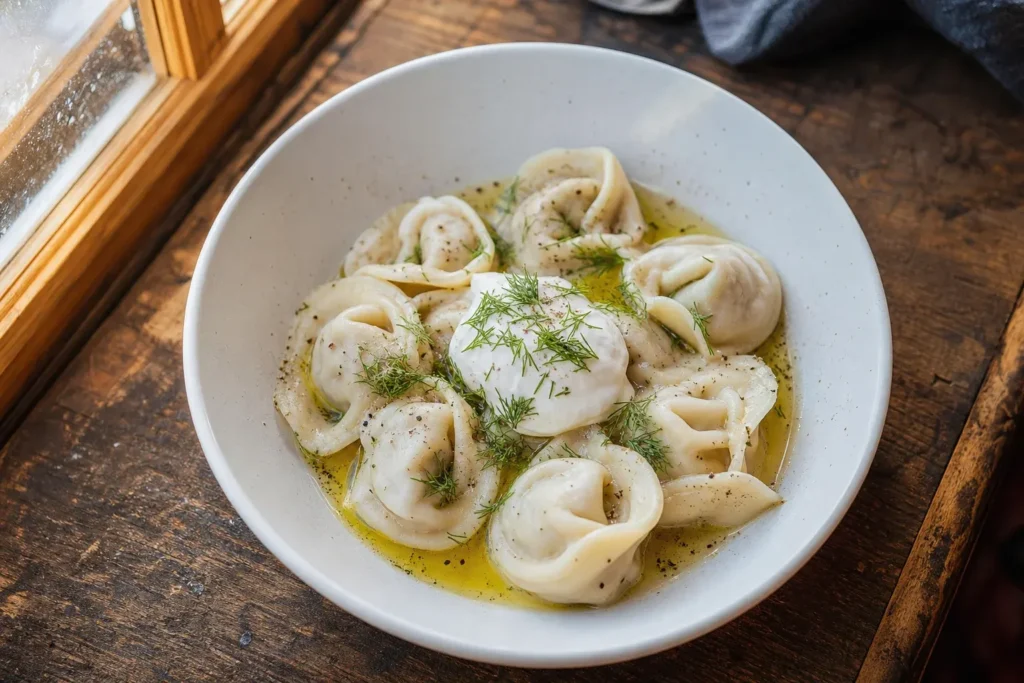
Pelmeni are small meat-filled dumplings that have been part of Russian cuisine for centuries, with deep roots in Siberia and the Ural Mountains. If you’re learning how to make pelmeni at home, you’ll be joining a tradition of home cooks and families who prepare these in bulk and freeze them for winter—a practice that goes back generations.
This guide teaches you the fundamentals: a simple unleavened dough wrapped around seasoned ground meat and onion, boiled until they float, then finished with sour cream, butter, or vinegar. The whole process takes about an hour and yields enough for a satisfying meal or a freezer supply. The recommended method uses equal parts beef and pork for authentic Siberian flavor.
Quick answer: Make a basic dough from flour, water, eggs and salt. Mix ground meat with finely chopped onion and seasoning. Roll dough thin, cut circles, fill and seal into ear-shaped dumplings. Boil in salted water until they float, then cook 5 minutes more. Total time: about 1 hour. Serve with sour cream, butter or vinegar.
At a Glance
| Type | Dishes |
|---|---|
| Local name | пельмени |
| Origin | Pelmeni originated among indigenous Siberian people and were probably named by the Komi, a people indigenous to the Urals. The term derives from "pel'n'an'" meaning "ear bread" and refers to the shape of the dumplings. Pelmeni were a practical way to preserve meat during the six months of Siberian winter; families made thousands in November when temperatures dropped below freezing. |
| Servings | 2–4 servings (about 40–50 dumplings) |
| Total time | 50–60 minutes |
| Difficulty | Medium |
History and Story of Pelmeni, Irkutsk
Pelmeni became a staple of Russian cuisine during the period of Russian expansion into the Ural Mountains and Siberia, with deep roots in the traditions of Komi and Udmurt regions. The concept probably originated with early Mongols who borrowed it from the Chinese and carried it to the Urals and Eastern Europe. In Siberia, with winters lasting six months and temperatures as low as −47°F, pelmeni provided a way to preserve meat; households had natural refrigeration in unheated barns and could harvest livestock before the freeze, eliminating the cost to feed animals through the long winter. The name “pelmeni” became widespread only in the 19th century, after the abolition of serfdom and development of the road network allowed people to travel more and mix cultural traditions between regions.
Ingredients
- 300 g all-purpose flour
- 1 egg
- 150 ml water
- 1 teaspoon salt
- 250 g ground beef
- 250 g ground pork
- 1 medium onion
- Black pepper to taste
How Pelmeni, Irkutsk Is Made
Step 1: Make the dough
Combine flour and salt in a bowl. Add the egg and half the water, mixing with a wooden spoon or your hands until the flour is wet. Gradually add the remaining water until a soft dough forms. Knead on a lightly floured surface for about 5 minutes until smooth. The dough should be soft but not sticky. Cover and let rest at room temperature for 20–30 minutes to relax the gluten and make rolling easier.
Tip: Traditional Siberian dough sometimes includes a small amount of sour cream to relax the gluten further, creating an ultra-thin shell.
Step 2: Prepare the filling
In a large bowl, combine the ground beef and pork with finely chopped onion, salt and black pepper. Mix thoroughly with your hands until well combined. The mixture should be moist; use fatty cuts of meat (about 20% fat) rather than lean cuts, as lean meat shrinks during cooking and produces dry, tough dumplings. If the meat seems dry, add a tablespoon of very cold water and mix gently.
Tip: Finely mince the onion so pieces are very small—these dumplings are tiny and large onion chunks are unpleasant to eat. Some cooks sauté the onion first to mellow its sharp flavor.
Step 3: Roll and cut the dough
Divide the rested dough into 4 equal portions. On a lightly floured surface, roll each portion as thin as possible—about 1/8 inch (2–3 mm). Using a small glass or jar (about 2.5 inches in diameter), cut out circles of dough. Place a small teaspoon of filling (about 1/2 teaspoon) in the center of each circle. Work quickly so the dough does not dry out; cover unused dough with a damp towel.
Tip: Thin dough is essential—it should be nearly translucent. If circles dry out while you work, cover them with a towel and come back to them.
Step 4: Seal the dumplings
Fold each circle in half to form a semicircle and press the edges tightly to seal. Then bring the two corners of the semicircle together and press firmly to seal, forming the characteristic ear shape. Place finished dumplings on a floured baking sheet to prevent sticking. Work steadily but without rushing; properly sealed edges are crucial to keep the filling inside during cooking.
Tip: If edges are not sealed tightly, the filling leaks out during boiling and the dumplings fall apart.
Step 5: Boil the pelmeni
Bring a large pot of salted water to a rolling boil. Add a bay leaf and a few peppercorns for flavor. Carefully drop pelmeni into the boiling water, a small batch at a time (don't overcrowd the pot). Stir gently with a spoon along the bottom and sides to prevent sticking. Once the pelmeni float to the surface, cook for 5 more minutes. Remove with a slotted spoon.
Tip: Do not defrost frozen pelmeni before cooking—add them directly to boiling water. They will take longer to float (about 5–7 minutes) but cook the same way.
Variants
- Fish pelmeni: made with white fish filling (pike or pikeperch), common in regions near rivers and lakes, especially along the Volga
- Mushroom pelmeni: filling of cooked mushrooms mixed with onion, popular during fasting periods in Orthodox tradition
- Mixed-meat pelmeni: beef and pork combined with lamb or venison (venison particularly traditional in colder regions)
- Fried pelmeni: boiled pelmeni pan-fried until golden, more common in southwestern Russia closer to Moldova and Poland
Common Mistakes to Avoid
- Using lean meat or ground chicken: these shrink during cooking and produce tough, dry dumplings. Choose fattier cuts—short rib beef mixed with pork is traditional and ideal.
- Sealing edges poorly: if not pressed firmly, filling leaks out into the water during boiling and dumplings fall apart. Press edges hard and check the seal.
- Rolling dough too thick: thick dough is chewy and tough, not the light, delicate shell that makes pelmeni appealing. Aim for tissue-thin; it should be nearly translucent.
- Letting dough dry out: uncovered dough dries and becomes impossible to seal. Always cover unused portions with a damp towel while working.
- Cooking pelmeni in too small a pot or in too large a batch: they stick together and to the pot bottom. Use a large pot and cook in small batches, stirring immediately after dropping them in.
- Overcooking or letting finished pelmeni sit: they become soggy and the dough loses its slight chew. Serve immediately after cooking, dressed while still hot.
How to Order and Eat It
The traditional way to eat pelmeni is to dress them with vinegar and sour cream, typically served undressed so individual diners add whatever they want. Pelmeni are traditionally either served with butter and sour cream, or swimming in homemade broth and black pepper. Vinegar and mustard define the Siberian style—a sharper dressing that cuts the richness of the meat—while broth turns pelmeni into a soup course, sometimes floating in rich meat stock in Moscow-style traditions. Pelmeni are eaten with a fork, often one at a time with a dab of topping. In canteen-style restaurants they are ordered by weight or portion and considered a normal meal at any hour. They are almost never rinsed after boiling and are served immediately while the dough still has its slight chew; leftovers are deliberately anointed with butter so they keep until the next day.
To order: пельмени [pel-MYEN-ee]
Diet and Allergens
- Contains eggs
- Contains gluten
- Contains pork
- Contains beef
Where to Try Pelmeni, Irkutsk
Irkutsk
 Taiga, Irkutsk Siberian cuisine with game, smoked dishes and local products
Main image: AI-generated illustration. It may not show the place exactly as it looks.
Russia Vibes Tips
- Make pelmeni in bulk and freeze them: lay finished dumplings on a baking sheet, freeze completely, then transfer to a freezer bag. They keep for up to three months and can be cooked directly from frozen without thawing—just add 5–7 minutes to the boiling time. This is how traditional Siberian families preserved food through winter.
- Keep a bowl of cold water nearby while sealing: damp fingertips help press edges together more firmly and prevent them from drying out as you work.
- Toast or pan-fry the cooked pelmeni for a different texture: after boiling, transfer to a hot buttered skillet and fry until golden and crispy on the edges. Serve with sour cream and fresh dill. This is more common in southwestern Russia.
- Make your own broth to boil pelmeni in: bone broth or meat stock adds richness. You can serve pelmeni in the cooking liquid itself, seasoned with salt, pepper and fresh dill—this is a complete meal on its own.
- For company, set out small bowls of sour cream, melted butter, vinegar, mustard and fresh dill so guests can dress their own pelmeni to taste. This is the traditional Siberian way: pelmeni arrive plain and hot, and each person customizes them.
- Don't discard the cooking water: it's gelatinous and full of flavor from the pelmeni. Strain it and use as a light broth, or pour over the finished dumplings for a lighter soup-like course.
Where to Find Pelmeni, Irkutsk in Russia
More chains in Russia
 Bird Cherry Cake, Yekaterinburg
 Blini, Nizhny Novgorod
 Borsch, Nizhny Novgorod
 Buuzy, Irkutsk
 Crab Belyash, Murmansk
 Kvass, Nizhny Novgorod
Related guides
 Local Food & Market Walk, Yekaterinburg: Central Market, Pelmeni and Street Eats
 Best Restaurants by Budget, Yekaterinburg: Where to Eat at Every Price Level
 Stolovaya Maslenitsa: A Transit Traveler’s Honest Canteen
 Pelmennaya Lepi Testo: Authentic Dumplings at Budget PricesOpen daily 08:00–21:30
Browse more: All Food & Drink · All Food & Drink in Irkutsk · All Irkutsk · All Other
FAQ
What's the difference between pelmeni and other dumplings like Chinese dumplings or Italian ravioli?
Chinese pot-stickers and Italian ravioli are cousins to pelmeni. Pelmeni are typically smaller, ear-shaped, and use a thinner unleavened dough with a meat-and-onion filling. They're boiled and served in a simple, savory way rather than steamed or pan-fried.
Can I use just one type of meat instead of beef and pork?
Although any kind of ground meat can be used—beef, pork, lamb, chicken, turkey or a mix—traditional Siberian pelmeni are made with half-and-half beef and pork. Pork or beef alone works, but beef is often too lean; lean meats tend to lose moisture and shrivel during cooking, producing noticeably inferior pelmeni.
How long can I store uncooked pelmeni?
Uncooked pelmeni are best cooked immediately or frozen. If left at room temperature, they become soggy and the dough sticks. Refrigerate for no more than a few hours if necessary. Frozen pelmeni keep for up to three months.
Do I need a special pelmeni mold to make them?
No. A pelmeni mold speeds up the process, but you can make them by hand using a small glass or jar to cut circles, then folding and sealing each one. Hand-made pelmeni take longer but taste just as good.
What does the name 'pelmeni' mean?
The term "pelmeni" derives from the word "pel'n'an'" from Finno-Ugric-Komi and Udmurt languages, meaning "ear bread" and referring to the particular shape of the dumplings.
Can pelmeni be made vegetarian?
The filling can be minced meat or mushrooms, or a combination of the two. Vegetarian pelmeni with mushroom filling are traditional in Orthodox Christian regions during fasting periods.
How do I know when pelmeni are done cooking?
Pelmeni are cooked when they float to the surface of the boiling water. Cook for 5 more minutes after they float, then remove with a slotted spoon. If you're using frozen pelmeni, wait until they float (this takes longer, 5–7 minutes), then cook 5 minutes more.
Should I rinse pelmeni after boiling?
Pelmeni are almost never rinsed after boiling and are served immediately while the dough still has its slight chew—letting them sit is considered a small domestic tragedy, and leftovers are deliberately anointed with butter so they keep until the next day.
Russia Vibes is a one-person project. A coffee keeps it going
How we research and update our guides
About this guide: AI assistance and accuracy
This guide is created with the help of AI and is based on official sources where available. Mistakes can still happen. Opening hours, prices, rules and other details are given to the best of our knowledge as of the date shown and can change without notice. It offers general recommendations only, not professional, legal or travel advice. Please confirm important details with the official source before you travel; you are responsible for your own plans and decisions.

Take this guide with you
Get a free PDF of this guide to print or read offline: key facts, tips and a map link on a few clean pages.
Report an issue on this page
Paying for your trip: please read
International sanctions affect payments between Russia and many other countries. In practice, cards issued in the EU, the UK, the US and several other countries often do not work in Russia, Russian cards usually do not work abroad, and some booking platforms, airlines and payment providers limit or suspend their services for Russia. The situation changes frequently.
We do not give legal or financial advice, and this site does not encourage anyone to break or circumvent sanctions. Whatever you plan, you are responsible for following the laws and regulations that apply to you, including those of your country of residence and citizenship.
Many travelers still organise their stay lawfully. It is worth asking your bank or payment provider what is currently permitted, contacting hotels, tour operators and carriers directly about the payment methods they accept, and checking which services are open to customers from your country. Clarify payment, cancellation and refund terms before you commit to a booking, and keep your plans flexible.
Partner links on this site may not be available in every country, and prices, availability and rules in our guides can differ from what you see when you book.