
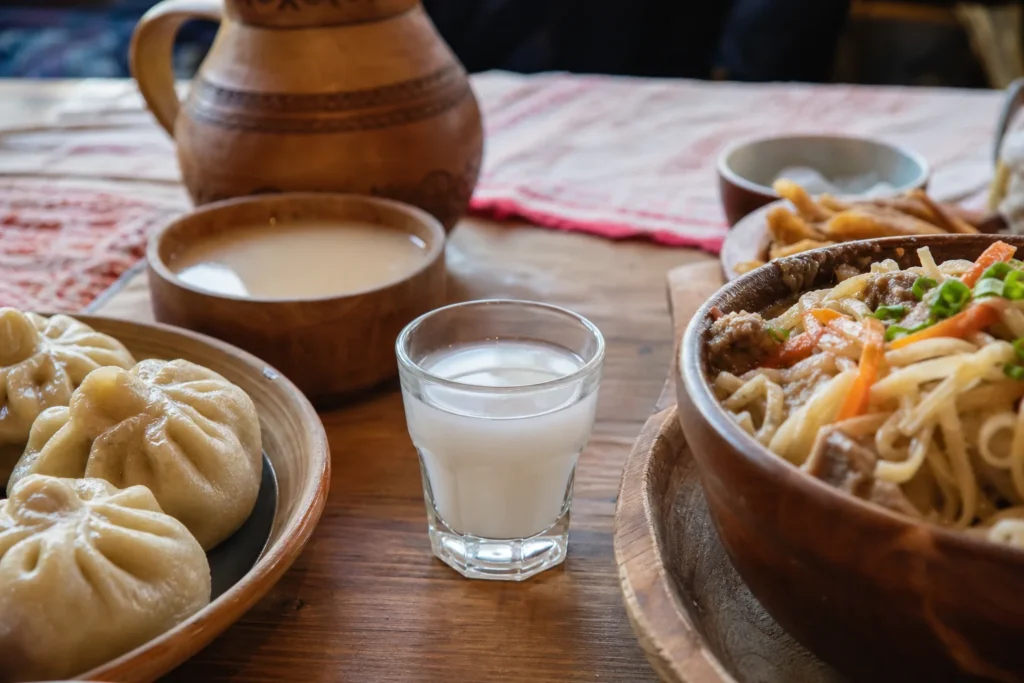
Tarasun appears in Irkutsk not as a restaurant menu item but as a test of hospitality. This traditional Buryat spirit, distilled from fermented mare’s milk, is central to how locals mark celebrations, from weddings to ordinary family meals. How to make tarasun drink is less a question visitors ask than a mystery they encounter when offered a small glass at a local table.
This article explains what tarasun actually is, how it is made, where to find it, and what to expect when you taste it. The drink has no commercial production, so you will not buy it in a shop; you will meet it through invitation, at markets, or in Buryat restaurants. The recommended way is to try it first in a restaurant setting before seeking it elsewhere, so you know what to anticipate.
Quick answer: Tarasun is prepared by distillation and fermentation of mare's milk, yielding a highly alcoholic spirit. Approximately 1 litre of tarasun with an alcohol content of around 10–11% is produced from 10 litres of fermented milk (khuremge). Total preparation takes 2–3 weeks, including fermentation (7–10 days) and distillation. The process requires no special equipment beyond a home still, making it accessible to home producers but illegal or restricted in many jurisdictions.
At a Glance
| Type | Alcoholic drinks |
|---|---|
| Local name | Тарасун |
| Origin | Archival research shows deep historical roots of darasun dating back to the 13th–14th centuries in the period of the Mongol Empire. Traditionally, Western Buryats—like their Eastern kin—had distilled their own liquor (tarasun) from milk, or occasionally grain. It is the national drink of Buryatia, where Buryat people live in Southern Siberia, including the Irkutsk region. |
| Servings | 2–4 servings per distillation batch (approximately 1 litre yields 8–16 shots) |
| Total time | 14–21 days (including fermentation and distillation) |
| Difficulty | Medium |
History and Story of Tarasun, Irkutsk
Archival research shows deep historical roots of darasun dating back to the 13th–14th centuries in the period of the Mongol Empire. Tarasun is an alcoholic beverage drunk by the Mongol Buryats of Siberia. Apart from being the national drink of Buryatia, it is also used by the Buryats in their religious ceremonies. Traditionally, Western Buryats—like their Eastern kin—had distilled their own liquor (tarasun) from milk, or occasionally grain. Irkutsk excise officials banned domestic tarasun production to encourage consumption of taxable commercial vodka. No family celebration in Irkutsk is held without tarasun, not to mention weddings where locals can drink gallons of this beverage. Tarasun production is still not produced commercially and it is not possible to buy this drink in stores. To get it you will need to visit a local market.
Ingredients
- 10 litres mare's milk (or cattle milk, though traditionally mare's milk is preferred)
- Fermentation starter (lactobacillus culture and yeast)
- Salt (small amount, to taste)
- A clean glass or ceramic fermentation vessel
- Cheesecloth or fine strainer
- A distillation apparatus (home still)
- Clean bottles for storage
How Tarasun, Irkutsk Is Made
Step 1: Prepare fermentation starter
Add a lactobacillus culture and yeast starter to create the fermentation base. This symbiotic culture of bacteria and yeast is essential for converting milk sugars into alcohol. Allow the starter to activate according to the culture packet instructions, typically 2–4 hours at room temperature.
Tip: Use a proven tarasun starter strain if available; modern fermentation uses specific lactobacillus species and wild yeasts to replicate traditional results.
Step 2: Create khuremge (fermented milk)
Pour mare's milk (or cattle milk) into a large glass or ceramic fermentation vessel. Add the activated starter. Stir well to distribute the culture evenly. Cover loosely with a cloth to allow gases to escape while protecting from contamination. Keep at warm room temperature (18–24°C).
Tip: Traditional preparation used the milk solids and whey together; separate the whey by straining through cheesecloth if you prefer a clearer final product.
Step 3: Ferment for 7–10 days
Allow the milk to ferment undisturbed. The mixture will become cloudy, separate slightly, and develop a sour aroma. After 7–10 days, the fermented milk (khuremge) will have a faint vinegary smell and a cloudy greenish-white appearance. Take fat milk, separate the whey from the cream, into which the starter is added. The strength of the finished brew is only 1–3 degrees.
Tip: Do not stir during fermentation. The longer fermentation, the more sour the flavour and the higher the initial alcohol content will be.
Step 4: Strain the fermented milk
Pour the fermented khuremge through cheesecloth or a fine strainer into a clean vessel, pressing gently to extract as much liquid as possible. Discard the solids. The strained liquid is now ready for distillation.
Tip: Keep the liquid at a cool temperature (below 15°C) if you cannot distill immediately; cover it to prevent oxidation.
Step 5: Set up the distillation apparatus
Pour the strained fermented milk into the distillation flask of your home still. Assemble the apparatus according to its instructions, ensuring all connections are tight and the condenser is properly cooled with running water or ice. Household distillation of khurenge is performed without temperature control, though slow, even heating produces better results.
Tip: Never leave a still unattended. Ensure good ventilation and have a fire extinguisher nearby, as distillation produces flammable vapours.
Step 6: Distill slowly over 2–4 hours
Typically, household distillation of khurenge yields approximately 1 L of darasun with an alcohol content of around 10–11% from 10 L of khurenge. Heat the fermented milk gently. The first vapours (heads) may be harsh; collect and discard the first 10–15 ml. Then collect the main body (hearts) into a clean bottle. When the liquid becomes cloudy or the aroma changes, stop collecting.
Tip: Separate heads, hearts, and tails to improve flavour. The heart fraction should be clear to slightly cloudy and smell of sour milk with alcohol.
Step 7: Store in sealed bottles
Pour the collected tarasun into clean glass bottles and seal tightly. Store in a cool, dark place. Tarasun improves slightly with age over weeks but should be consumed within a few months. Keep away from direct sunlight and heat.
Tip: The drink develops a stronger aroma and smoother taste after 2–4 weeks of storage. Some producers distil a second time to increase strength; in 20th-century Mongolia, five stages of distillation were documented: arkhi, arza, khorzo, sharza, and dun, with alcohol content rising from approximately 9–11% to 50%.
Variants
- Khuremge: the first fermentation stage, containing 1–3% alcohol, cloudy and lightly sour. Often drunk on its own as a probiotic beverage.
- Single-distillation tarasun: approximately 10–11% alcohol, the most common form. Clear to slightly cloudy, with strong sour-milk aroma.
- Arza (second distillation): approximately 40–45% alcohol. More refined and less aromatic than first-distillation tarasun.
- Khorzo (third distillation): approximately 75–77% alcohol. Extremely potent; rarely encountered and more like a concentrated spirit.
- Tarasun laced with vodka: modern variant where commercial vodka is mixed with traditional tarasun to increase shelf-life or alcohol strength. Not preferred by traditionalists.
Common Mistakes to Avoid
- Using only low-fat or skim milk instead of full-fat milk: tarasun requires high-fat milk to ferment and distill properly. The fat content provides the characteristic creamy mouthfeel and determines flavour.
- Contaminating the fermentation vessel: any unwanted mould or bacteria will spoil the batch. Always use sterilised equipment and cover the vessel with a clean cloth to prevent dust and insects.
- Fermenting at temperatures below 15°C or above 25°C: fermentation slows or stalls in cold, and undesirable bacteria thrive in excessive heat. Room temperature (18–22°C) is ideal.
- Discarding the first distillation liquid (heads): some home producers discard too much at the start, wasting product. Separate heads, hearts, and tails carefully to retain the best portion.
- Attempting to distil in unsuitable vessels or without proper cooling: home stills must have an effective condenser or ice bath. Poor cooling leads to low yield and danger.
- Assuming the fermented milk has finished fermenting before 7 days: early distillation yields weak, unpleasant spirits. Wait until the aroma is distinctly sour and the liquid has settled.
- Storing the finished tarasun in direct sunlight or warm places: the spirit deteriorates, oxidises, and can develop off-flavours. Keep bottles sealed and cool.
How to Order and Eat It
Tarasun is best served cold with Buryat buuz (large dumplings) or tsuivan (a Mongolian noodle dish popular in Irkutsk). Traditionally, it is offered as a shot in small glasses at the beginning of celebrations, meals, and ceremonies. It is served neat, ice-cold, and always in small quantities—it is a spirit of ceremony and hospitality, not a casual drink. Sip slowly; the flavour is acquired. The taste of tarasun leaves no one indifferent – you will either love it, or perhaps it will take you some time to appreciate. Some say that milk vodka reminds them of fortified milk whey, while others taste a hint of cow dung in it. Drink it alongside fatty meat or heavy food to balance the sourness.
To order: Тарасун, пожалуйста [Tarasun, pozhaluysta]
Diet and Allergens
- contains alcohol
- dairy-based
Contains alcohol. Please drink responsibly and follow local rules.
Russia Vibes Tips
- Tarasun is almost never sold in shops in Irkutsk. If you encounter bottles labeled 'tarasun' in supermarkets, they are commercial imitations or industrial spirits, not traditional tarasun. Authentic tarasun is homemade or served only in restaurants specializing in Buryat cuisine.
- The smell is part of the experience. Visitors often remark that tarasun smells like sour milk, fermented whey, or—more bluntly—dairy funk. This is not a flaw; it is a signature. Approach the first taste with an open mind and expectation of sourness, not sweetness.
- Markets in Irkutsk, particularly Rusinovsky market, sometimes have locals selling tarasun in small bottles or jars, but availability is unpredictable and depends on the season and vendors present that day. Go early in the morning and ask vendors directly; tarasun is rarely displayed prominently.
- If invited to a Buryat home and offered tarasun, it is a gesture of trust and hospitality. Accept a small taste, even if you are uncertain. You may refuse a second glass politely, but rejecting the first offer is considered rude. The offer itself matters more than consumption.
- Tarasun ferments best in late spring through early autumn, when room temperatures are naturally warm. Winter production is possible but slower. If you are making it, time your fermentation for warmer months.
- Do not confuse tarasun (made from milk) with kumis (fermented mare's milk, non-distilled, much lower in alcohol). Kumis is sweeter and milder; tarasun is sour and potent. Both are Buryat traditions, but they are very different drinks.
Explore Nearby Tarasun, Irkutsk
Browse more: All Food & Drink · All Food & Drink in Irkutsk · All Irkutsk · All Other
FAQ
Is tarasun the same as kumis?
No. Kumis is fermented mare's milk (non-distilled) with about 1–3% alcohol and a slightly sweet, creamy taste. Tarasun is distilled from fermented milk and contains 10–11% alcohol (or higher if distilled multiple times). Tarasun is sour and potent; kumis is milder and is sometimes drunk for health.
Can visitors buy tarasun commercially in Irkutsk?
Tarasun production is still not produced commercially and it is not possible to buy this drink in stores. However, you can look for tarasun at Rusinovsky market in Irkutsk and in private cafeterias that offer national Buryat cuisine. The most reliable way is to order it in a restaurant serving Buryat food or to accept an invitation from a local.
What does tarasun taste like?
Tarasun tastes sour and alcoholic, with a flavour reminiscent of sour milk, fermented whey, or vinegar. Some detect hints of dairy funk or cow products. It is not sweet or smooth; it is an acquired taste. Opinions are sharply divided: many Buryats love it; others dislike it intensely.
How strong is tarasun?
Tarasun has an impressive alcohol content of around 11%, earning it the nickname 'milk whisky'. Some home distillations reach 15–20%; commercial tarasun sold in markets may vary. It is stronger than wine but weaker than vodka in its standard form, though it can be distilled again to reach 40–77% alcohol.
Is it legal to make tarasun at home?
In Russia, home distillation is generally illegal without a license, though enforcement in remote Buryat communities is minimal. In Irkutsk and urban areas, the rule is technically strict. Visitors should not attempt to make or transport tarasun without understanding local laws. Taste it in restaurants or at private invitations only.
Can I buy tarasun online or bring it back to my country?
No. Tarasun is not commercially produced and is not sold online. Attempting to export it is illegal in most countries due to customs and alcohol import restrictions. Enjoy it only during your visit to Irkutsk or Buryatia.
What does tarasun pair with when eating?
Tarasun is best served cold with Buryat buuz (large dumplings) or tsuivan (a Mongolian noodle dish). It pairs well with fatty meat, hearty stews, and savoury food. Drink it slowly in small shots; never drink it like water or regular vodka.
Why is tarasun important in Buryat culture?
Tarasun is considered to be the 'Soma' of the Buryats. Offerings of tarasun are made in almost all Buryat festivals and ceremonies including marriages and childbirth. It is not merely a drink but a sacred element of hospitality and spiritual practice among Buryats.
Russia Vibes is a one-person project. A coffee keeps it going
How we research and update our guides
About this guide: AI assistance and accuracy
This guide is created with the help of AI and is based on official sources where available. Mistakes can still happen. Opening hours, prices, rules and other details are given to the best of our knowledge as of the date shown and can change without notice. It offers general recommendations only, not professional, legal or travel advice. Please confirm important details with the official source before you travel; you are responsible for your own plans and decisions.

Take this guide with you
Get a free PDF of this guide to print or read offline: key facts, tips and a map link on a few clean pages.
Report an issue on this page
Paying for your trip: please read
International sanctions affect payments between Russia and many other countries. In practice, cards issued in the EU, the UK, the US and several other countries often do not work in Russia, Russian cards usually do not work abroad, and some booking platforms, airlines and payment providers limit or suspend their services for Russia. The situation changes frequently.
We do not give legal or financial advice, and this site does not encourage anyone to break or circumvent sanctions. Whatever you plan, you are responsible for following the laws and regulations that apply to you, including those of your country of residence and citizenship.
Many travelers still organise their stay lawfully. It is worth asking your bank or payment provider what is currently permitted, contacting hotels, tour operators and carriers directly about the payment methods they accept, and checking which services are open to customers from your country. Clarify payment, cancellation and refund terms before you commit to a booking, and keep your plans flexible.
Partner links on this site may not be available in every country, and prices, availability and rules in our guides can differ from what you see when you book.