
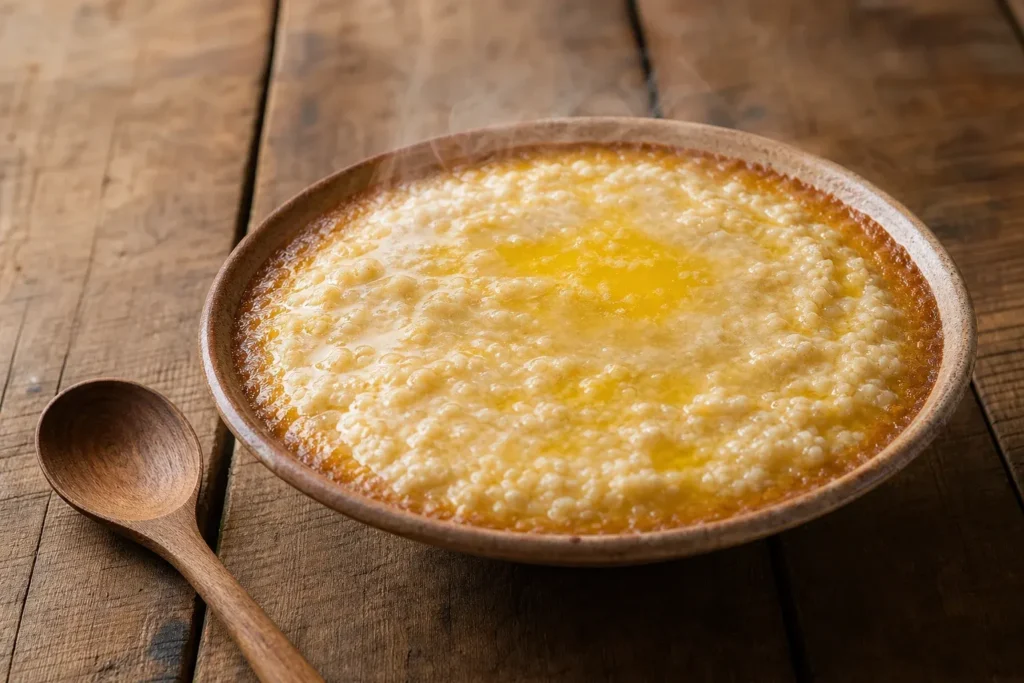
Salamat is a rich, creamy dairy dish central to Irkutsk‘s food culture and Buryat tradition. If you’re curious about how locals make this ceremonial comfort food at home, this guide walks you through the simple but time-intensive technique that creates its signature golden crust and buttery texture. The dish dates back centuries and remains a marker of authentic Siberian hospitality.
Salamat is easy to prepare but requires patience and constant stirring. Most home cooks allow 30–45 minutes of active cooking time to achieve the correct consistency and appearance. It is typically served hot in bowls as a starter before main courses.
Quick answer: Heat sour cream in a cast-iron pan over low heat, gradually stir in rye flour and salt while stirring constantly for 30–45 minutes until butter separates and forms a golden crust on the surface. Serve immediately while hot.
At a Glance
| Type | Dishes |
|---|---|
| Local name | Саламат |
| Origin | Buryatia and Siberia; documented since the 16th century in Russian monastery records. |
| Servings | 2–4 servings |
| Total time | 30–45 minutes |
| Difficulty | Easy |
History and Story of Salamat, Irkutsk
Salamat has roots stretching back at least to the 16th century, when it was mentioned in monastery dining records. Among the Buryats and Yakuts of Siberia, the dish held ceremonial significance, offered to deities during rituals and served at weddings and festivals as a mark of hospitality and abundance. In Irkutsk, where Russian and Buryat cultures intersect, salamat became embedded in the local food identity. Historically prepared by simmering fatty homemade sour cream with flour over open flames or in cast-iron cookware, the recipe has remained largely unchanged. A 19th-century Russian academic called it ‘a divine dish, the best food to please one’s tongue and stomach,’ reflecting its esteemed place in Siberian food culture.
Ingredients
- 300–400 g sour cream (30% fat or higher)
- 50–75 g rye flour
- Salt to taste
- Cast-iron cookware or heavy-bottomed pan
- Wooden spoon or spatula for stirring
How Salamat, Irkutsk Is Made
Step 1: Heat the sour cream
Pour sour cream into a cast-iron pan or heavy-bottomed saucepan. Place the pan over low heat and warm the sour cream gently until it is very hot but not boiling. The residual heat and the fat content will do most of the work; high heat risks burning the bottom. Stir occasionally to ensure even heating.
Tip: Using cast iron as the traditional cookware helps distribute heat evenly and develops the characteristic golden crust that forms on the surface later.
Step 2: Sift the flour
While the sour cream heats, sift the rye flour through a fine sieve into a separate bowl. Sifting removes lumps and helps the flour incorporate smoothly into the sour cream without creating clumps when stirred.
Tip: Some cooks add a pinch of salt to the flour before sifting.
Step 3: Add flour gradually while stirring
Once the sour cream is hot, reduce heat to minimum. Begin adding the flour in small portions—roughly a tablespoon at a time—while stirring constantly with a wooden spoon. Stir vigorously after each addition to prevent lumps from forming. Add salt to taste. Continue until all flour is incorporated.
Tip: The constant stirring breaks down lumps and distributes heat evenly throughout the mixture. Do not stop stirring or the bottom will stick and burn.
Step 4: Stir constantly and watch for separation
Maintain low heat and continue stirring continuously. After several minutes, you will notice butter beginning to separate and float to the surface. This is a sign the dish is developing correctly. Keep stirring; the mixture will thicken gradually and take on a creamy, porridge-like texture.
Tip: This stage typically takes 15–25 minutes. The separation of fat is the key indicator that the cooking is progressing properly.
Step 5: Check for the golden crust
As you continue stirring over low heat, look for a golden crust to form around the edges of the pan and a thin layer of separated butter on the surface. The mixture should become glossy and rich-looking, with a consistency similar to thick gravy. When the crust is clearly visible and the butter coats the top, the dish is ready.
Tip: This final stage may take another 10–15 minutes. Do not rush it; the texture depends on sufficient time and constant movement.
Step 6: Serve hot
Spoon the salamat into bowls or wide shallow plates while it is still hot. Pour a small amount of the separated butter from the surface over the top of each portion. Serve immediately as an appetizer before the main course, in keeping with Siberian tradition.
Tip: Salamat thickens as it cools, so eat it while it is warm for the best texture. If it becomes too thick, you can warm it again briefly and add a splash of hot milk or cream to loosen it.
Variants
- With herbs and mushrooms: some modern versions add finely chopped wild mushrooms and fresh herbs for complexity.
- With lingonberries: a sweet-savory variant where tart lingonberries are folded in or served alongside, popular in winter celebrations.
- With added meat: in some Buryat regions, small pieces of beef or mutton are added to make it heartier.
- With butter instead of sour cream: a lighter, more buttery version made primarily with butter and flour rather than sour cream, common among some Yakut families.
Common Mistakes to Avoid
- Adding all the flour at once instead of gradually will create lumps that are difficult to break down and ruin the smooth texture.
- Using heat that is too high will cause the bottom to burn and the dish to develop a bitter taste. Keep the flame minimal throughout.
- Stopping or slowing your stirring will allow the mixture to stick to the pan and burn. Constant motion is essential.
- Using sour cream with too low a fat content (under 20%) will not separate properly and the dish will never achieve its characteristic appearance and richness.
- Not allowing enough cooking time means the flour will not fully incorporate and the butter separation will be incomplete. The full 30–45 minutes is not excessive.
- Cooking it in a thin or non-stick pan instead of cast iron distributes heat unevenly and makes it harder to develop the traditional golden crust.
How to Order and Eat It
Salamat is eaten hot and directly from the bowl using a spoon. In Irkutsk and Buryat tradition, it is consumed as an appetizer before hot entrées, not as a main course. The creamy, slightly salty taste and rich texture coat the mouth and prepare the palate for the heartier dishes that follow. Some diners pour a few drops of hot cream or melted butter over the top before eating. It is always consumed fresh and hot; reheating or eating it cold is not traditional.
To order: Саламат, пожалуйста [Salamat, pozhaluysta]
Russia Vibes Tips
- Use the highest-quality sour cream you can find—preferably 30% fat or higher. In Russia, shop for 'сметана' (smetana) at traditional markets or dairy sections; mass-market supermarket brands often have too low fat content and will not separate properly.
- Rye flour is traditional and gives the dish its characteristic earthy color and slightly deeper flavor. Wheat flour makes a paler, milder version; mixing the two is also common.
- The wooden spoon or spatula should have a flat edge so you can scrape the bottom of the pan continuously and prevent sticking. Metal spoons work but wood is gentler on both the pan and the mixture.
- If you are cooking in Irkutsk or visiting a Buryat family, they may offer you salamat with lingonberry jam on the side or swirled through. Accept this addition—it is a genuine modern variation, not a mistake.
- Salamat is traditionally served in small, wide bowls or on shallow plates rather than in deep soup bowls. This allows the separated butter on the surface to be visible and the dish to cool slightly more evenly.
Explore Nearby Salamat, Irkutsk
Browse more: All Food & Drink · All Food & Drink in Irkutsk · All Irkutsk · All Other
FAQ
Is salamat the same as porridge?
Salamat is sometimes called a porridge but it is quite different. Unlike oat or grain porridges, salamat has no grains—only flour suspended in sour cream and fat. The texture is more like a thick, creamy sauce or gravy than a breakfast cereal. It is also savory and served as an appetizer, not a main grain dish.
Can I make salamat without sour cream?
Traditional salamat relies on sour cream for its flavor and richness. Some regional variants use butter alone, but the result is different. Butter-only versions are lighter but lack the tangy, complex taste that sour cream provides. Kefir can replace sour cream in some emergency situations, but the texture and flavor will not be authentic.
Why does my salamat not separate properly?
Separation depends on fat content. If your sour cream is too low in fat, butter will not separate visibly. Use sour cream labeled 30% fat or higher. Also, the heat must be low enough that you do not see vigorous bubbling—gentle warmth allows the fat to rise naturally. Insufficient cooking time also prevents separation; allow the full 30–45 minutes.
How long does salamat keep?
Salamat is best eaten immediately while hot and freshly made. If you must store it, refrigerate it in a covered container for up to 2 days. Reheat it gently over low heat with a splash of hot milk or cream, stirring constantly, until it softens and warms through. It will not have the same silky texture after reheating.
Is salamat vegetarian?
Yes, traditional salamat is vegetarian. It contains only sour cream, flour, and salt. Some modern regional variants add meat, but the classic Irkutsk and Buryat recipe is dairy-based with no meat.
What allergens does salamat contain?
Salamat contains gluten from rye or wheat flour and dairy from sour cream. It does not typically contain nuts, sesame, or soy unless variants with added ingredients are served. If you have a gluten allergy or dairy sensitivity, inform your host; some adaptations exist but are uncommon in traditional preparations.
Can I add other flavors to salamat?
Traditional salamat is mildly salted and does not contain spices or strong flavorings. Garlic, onions, or lard can be added during cooking in some Siberian and Buryat homes, but these are not the core recipe. Lingonberries or jam are served on the side rather than mixed in.
Is salamat popular in all parts of Russia?
Salamat is primarily a Siberian and Buryat specialty. It is most deeply rooted in Irkutsk, the Buryat Republic, and Yakutia. In central and western Russia it is less common, though the basic milk-and-flour combination appears in various forms across Eastern Slavic regions. Salamat is most authentic and widely available in Irkutsk.
Russia Vibes is a one-person project. A coffee keeps it going
How we research and update our guides
About this guide: AI assistance and accuracy
This guide is created with the help of AI and is based on official sources where available. Mistakes can still happen. Opening hours, prices, rules and other details are given to the best of our knowledge as of the date shown and can change without notice. It offers general recommendations only, not professional, legal or travel advice. Please confirm important details with the official source before you travel; you are responsible for your own plans and decisions.

Take this guide with you
Get a free PDF of this guide to print or read offline: key facts, tips and a map link on a few clean pages.
Report an issue on this page
Paying for your trip: please read
International sanctions affect payments between Russia and many other countries. In practice, cards issued in the EU, the UK, the US and several other countries often do not work in Russia, Russian cards usually do not work abroad, and some booking platforms, airlines and payment providers limit or suspend their services for Russia. The situation changes frequently.
We do not give legal or financial advice, and this site does not encourage anyone to break or circumvent sanctions. Whatever you plan, you are responsible for following the laws and regulations that apply to you, including those of your country of residence and citizenship.
Many travelers still organise their stay lawfully. It is worth asking your bank or payment provider what is currently permitted, contacting hotels, tour operators and carriers directly about the payment methods they accept, and checking which services are open to customers from your country. Clarify payment, cancellation and refund terms before you commit to a booking, and keep your plans flexible.
Partner links on this site may not be available in every country, and prices, availability and rules in our guides can differ from what you see when you book.