
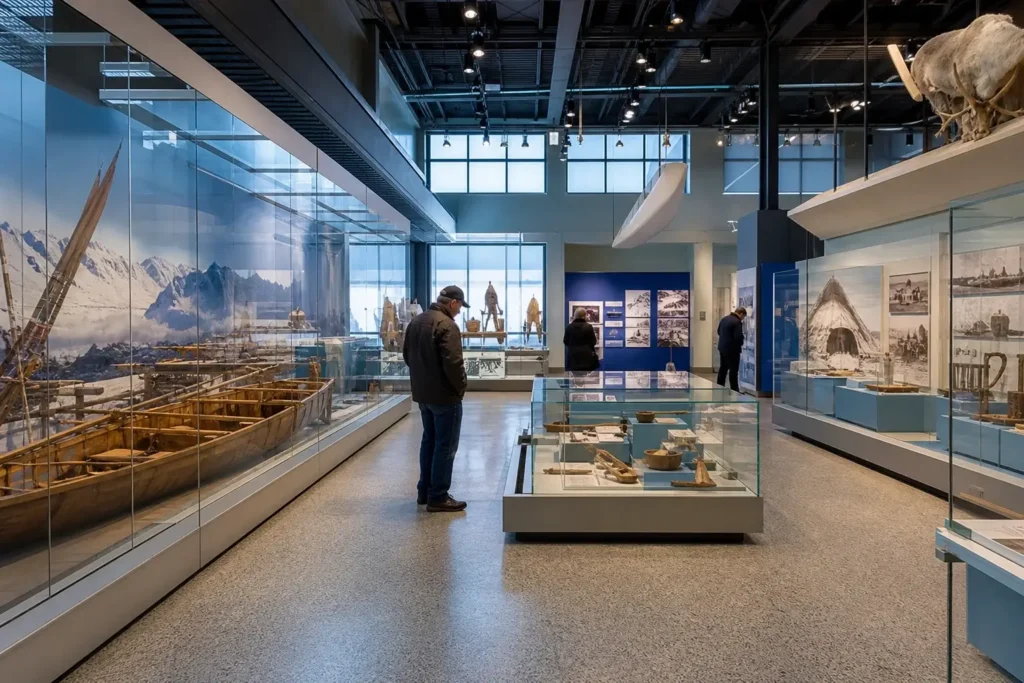
Museums and cultural heritage, Murmansk opens the door to the Arctic region’s unique history and creative spirit. Murmansk, founded only in 1916, has condensed a remarkable past into compelling exhibitions and restored historic buildings that now serve as cultural landmarks. This list covers the city’s primary museums and heritage institutions where visitors can learn about Arctic exploration, indigenous Sami traditions, World War II defense, regional art, and the natural world of the Kola Peninsula.
You will find 9 key places here, ordered by what first-time visitors should see first. Most exhibitions are presented in Russian; hire a guide through the museum if you plan an extended visit and want detailed interpretation. Visit the official websites to check for current exhibitions and opening hours, as programs change seasonally.
Current access notice: The main building with an anchor on Lenin Avenue is under reconstruction, and visitors attend museum events and exhibitions in the house number 1A on Pavlova street. The Murmansk Regional Museum of Local Lore's main historic building is undergoing renovation; the museum has temporarily relocated nearby. Check the official website for any updates on reopening schedules.
At a Glance
| # | Place | Best for | Good to know |
|---|---|---|---|
| 1 | Murmansk Regional Museum of Local Lore | Arctic history and Sami culture | Currently at Pavlova Street 1A (main building on Lenin Avenue under reconstruction); paid; check official website mokm51.ru for hours |
| 2 | Murmansk Regional Art Museum | Russian fine art in the Arctic | Kominterna Street 13, center of city; paid; check artmmuseum.ru for current hours |
| 3 | Regional Palace of Culture and Folk Art named after S.M. Kirov | Soviet cultural heritage site | Central Murmansk location; programs vary; contact for current events and performances |
| 4 | Nuclear Icebreaker Lenin Museum | Arctic engineering and exploration | Marine station (river port area); paid; contact leninexpo@rosatomflot.ru or rosatomflot.ru |
| 5 | Museum of the History of the Kola Sami | Indigenous Sami heritage (branch museum) | Lovozero village, about 100 km south of Murmansk; day trip required; paid; arrange transport in advance |
| 6 | Museum of Culture and Life of the Terek Pomors | Pomor maritime heritage (branch museum) | Umba village, about 150 km east of Murmansk; day trip required; paid; arrange transport in advance |
| 7 | Center for Contemporary Art 21A | Modern art and experimental exhibitions | Sofia Perovskoy Street 3 (within the library complex); paid; check official website for exhibition calendar |
| 8 | Murmansk State Regional Universal Scientific Library with Planetarium | Arctic science education and stargazing | Sofia Perovskoy Street 3; planetarium shows are paid; library access is free; check hours online |
| 9 | Museum of the History of OAO MMP | Soviet Arctic port operations | Port district area; limited hours and advance booking often required; contact port authority for access |
How We Chose
Entries have been verified as currently operating through official sources and tourism websites. The selection prioritizes institutions with permanent collections and regular access, excludes temporary popup galleries, and focuses on places where international visitors can meaningfully engage with Murmansk’s heritage. Branch museums of the Regional Museum of Local Lore (in Lovozero and Umba) are noted but not listed separately, as they require day trips beyond the city. Opening hours and ticket policies are subject to change; always verify at the official website or contact the museum before visiting.
1. Murmansk Regional Museum of Local Lore – Arctic history and Sami culture
The oldest museum in the region, founded in 1926, with over 170,000 items spanning Arctic exploration, indigenous Sami and Pomor traditions, World War II Arctic defense, and Kola Peninsula geology. The permanent exhibitions occupy 17 halls displaying traditional household interiors, archaeological artifacts, samples from the Kola Superdeep Borehole, and historical documents. A dedicated exhibition explores the region's crucial defense role during 1941–1945. The museum organizes over 100 temporary exhibitions annually, so collections on view rotate.
Good to know: Currently at Pavlova Street 1A (main building on Lenin Avenue under reconstruction); paid; check official website mokm51.ru for hours
Tip: Rent an English-speaking guide through the museum for deep historical context; exhibitions are labeled in Russian. Budget 2–3 hours for the main collections.
2. Murmansk Regional Art Museum – Russian fine art in the Arctic
The youngest art museum in Russia and the only one in the Arctic. Located in the historical center of Murmansk on Kominterna Street in one of the oldest stone buildings of the city. The permanent exhibition "Russian Fine Art of the 18th–20th Centuries" features paintings, graphics, sculpture and decorative arts with emphasis on northern landscapes and Murmansk artists. Collections include works emphasizing the beauty and harsh conditions of Arctic regions, as well as graphic works by Moscow and Leningrad-era artists. Temporary exhibitions rotate frequently, showcasing both regional and international contemporary art.
Good to know: Kominterna Street 13, center of city; paid; check artmmuseum.ru for current hours
Tip: The building itself, completed in 1927, is historically significant as Murmansk's first stone structure. Viewing the permanent collection takes about 1.5 hours.
3. Regional Palace of Culture and Folk Art named after S.M. Kirov – Soviet cultural heritage site
The first cultural and educational institution of the Kola Peninsula is currently an object of regional cultural heritage. The Palace implements socially significant projects and develops new forms of social and cultural projects using new information technologies. Originally established as a hub for performing arts and public cultural programming, the Palace functions as a restored Soviet-era institution that reflects early Arctic settlement priorities.
Good to know: Central Murmansk location; programs vary; contact for current events and performances
Tip: Check ahead for evening performances and cultural events, which are the best way to experience the venue's original function.
4. Nuclear Icebreaker Lenin Museum – Arctic engineering and exploration
The icebreaker "Lenin" worked for 30 years and was decommissioned in 1989 and put into permanent parking in Murmansk. Today, the Nuclear icebreaker "Lenin" is a museum and the only object of cultural heritage of federal significance in the city of Murmansk. The vessel is moored at the Marine Station and operates as an exhibition center exploring Arctic shipping history, nuclear icebreaker technology, and the opening of the Northern Sea Route. Visitors can board and explore the working spaces.
Good to know: Marine station (river port area); paid; contact leninexpo@rosatomflot.ru or rosatomflot.ru
Tip: Wear sturdy shoes; narrow passages and metal stairs require caution. Allow at least 1.5 hours for a thorough exploration of all accessible decks.
5. Museum of the History of the Kola Sami – Indigenous Sami heritage (branch museum)
The museum has 2 territorial departments (the Museum of the History, Culture and Life of the Kola Sami – in the village of Lovozero and the Museum of History, Culture and Life of the Pomors – in the village of Umba). Located in Lovozero, a historic Sami settlement, this branch museum focuses on the indigenous peoples of the Kola Peninsula with displays on traditional crafts, clothing, hunting practices and sacred sites. Every visitor to the Museum would stop at the sacred stone covered with pictures (petroglyphs) which are more than 3,000 years old. The stone was taken from the river Ponoy in 1973, near the Lapp settlement Chalmny-Varre, the Lovozero district.
Good to know: Lovozero village, about 100 km south of Murmansk; day trip required; paid; arrange transport in advance
Tip: Visit as part of an organized excursion or hire local transportation; the museum cannot be easily reached by public transit and is best visited with a guide familiar with the region.
6. Museum of Culture and Life of the Terek Pomors – Pomor maritime heritage (branch museum)
The Museum of History, Culture and Life of the Pomors – in the village of Umba. This branch explores the maritime heritage and everyday life of the Pomors, Russian fishermen and traders who settled the White Sea coast. Displays cover traditional fishing methods, boat-building, commerce and seasonal settlements adapted to Arctic conditions.
Good to know: Umba village, about 150 km east of Murmansk; day trip required; paid; arrange transport in advance
Tip: Best visited as part of a guided tour; local knowledge greatly enhances the experience of understanding Pomor settlements and their adaptation to harsh coastal environments.
7. Center for Contemporary Art 21A – Modern art and experimental exhibitions
In 2020, the Center for Contemporary Art 21A and the information and educational center Planetarium were created on the basis of the library. Located within the Murmansk State Regional Universal Scientific Library, this center presents rotating exhibitions of contemporary visual art, often featuring works by Arctic-based artists and experimental media.
Good to know: Sofia Perovskoy Street 3 (within the library complex); paid; check official website for exhibition calendar
Tip: Hours may vary with library operations; call ahead to confirm exhibitions are on view and learn about artist talks or opening events.
8. Murmansk State Regional Universal Scientific Library with Planetarium – Arctic science education and stargazing
In 2020, the Center for Contemporary Art 21A and the information and educational center Planetarium were created on the basis of the library. The library's planetarium offers shows about Arctic astronomy, the aurora borealis, and celestial phenomena visible from the High North. The library itself houses local history collections and functions as a research institution for regional studies.
Good to know: Sofia Perovskoy Street 3; planetarium shows are paid; library access is free; check hours online
Tip: Planetarium shows are often in Russian; inquire about English-language options or presentations with visual storytelling that transcends language barriers.
9. Museum of the History of OAO MMP – Soviet Arctic port operations
Specialized museum dedicated to the history of the Murmansk Merchant Fleet (OAO MMP), a major Soviet-era institution. Displays focus on the port's role in Arctic trade, Arctic expeditions, maritime commerce, and the development of Arctic infrastructure throughout the Soviet period.
Good to know: Port district area; limited hours and advance booking often required; contact port authority for access
Tip: This museum has restricted public access; contact the Murmansk port authority or tour operators in advance if interested in visiting.
Russia Vibes Tips
- Hire an English-speaking guide through the museums if you plan to spend more than an hour in any single collection. Most permanent exhibitions have labels in Russian only; a guide will unlock the stories behind the artifacts and help you navigate thematic connections across halls.
- Visit the Regional Museum of Local Lore early in your stay to understand Murmansk's context—Arctic exploration, Sami culture, WWII history, and regional geography—before exploring specific sites like the Lenin icebreaker or Alyosha Monument nearby.
- The Regional Art Museum is located at the historic Five Corners intersection in the center of the city; combine your visit with a walk along nearby Lenin Avenue (now often called Prospekt Lenina) to see Soviet-era architecture and monuments.
- Plan branch museum visits to Lovozero or Umba as full-day excursions; these require transport and are remote from the city center. Book tours in advance through your hotel or a local operator; public transport is limited and infrequent.
- Many exhibitions rotate seasonally; check mokm51.ru and artmmuseum.ru before you arrive to see what will be on display during your visit. Special exhibitions often run for only a few weeks.
- Plan for 3–4 hours minimum at the Regional Museum of Local Lore if you want to see the main permanent galleries. The Art Museum takes 1.5–2 hours. The Lenin icebreaker visit requires sturdy shoes and can take 1.5–2 hours depending on your interest level.
Explore Nearby Museums and cultural heritage, Murmansk
Browse more: All Culture Lists · All Guides · All Guides in Murmansk · All Murmansk
FAQ
Which museum should I visit first if I have limited time?
Start with the Murmansk Regional Museum of Local Lore to understand the region's history, Arctic indigenous cultures, and World War II context. This foundation helps you appreciate other sites like the Lenin icebreaker or city monuments. Budget 2–3 hours.
Are museum exhibitions presented in English?
Most exhibitions are labeled in Russian only. You can hire an English-speaking guide through the museum (contact them in advance), use a translation app, or join a city tour that includes museum visits with professional interpretation.
Is the main museum building on Lenin Avenue open?
No. The Murmansk Regional Museum of Local Lore's main historic building is currently under renovation. All exhibitions have relocated to temporary premises at Pavlova Street 1A. Check mokm51.ru for the reopening date.
What is the Regional Art Museum's claim to fame?
It is the only art museum located beyond the Arctic Circle and Russia's youngest art museum, founded in 1990. The building itself, completed in 1927, is Murmansk's first stone structure and was heavily damaged in World War II before restoration in the 1980s.
Can I board the nuclear icebreaker Lenin?
Yes. The Lenin is permanently moored at the Marine Station and operates as a museum with public access to several decks. Wear sturdy shoes; passages are narrow and metal stairs are steep. Contact leninexpo@rosatomflot.ru or check rosatomflot.ru for hours.
How do I visit the branch museums in Lovozero and Umba?
These villages are outside the city center (100+ km away) and require organized transport. Book tours through your hotel, a tour operator, or the main museum. Public transit is limited. Visits are best done as full-day excursions.
What is special about the Kola Superdeep Borehole collection?
The Regional Museum holds geological samples and core material from the deepest borehole ever drilled into the Earth's crust, a Soviet scientific achievement. The collection provides unique geological data and visual documentation of the Kola Peninsula's interior.
When is the best time to visit Murmansk's museums?
Any season works, since museums are indoors. Winter (November–January) offers long dark hours when aurora displays are possible and city lighting makes evening strolls atmospheric. Summer (May–July) provides midnight sun and the most comfortable outdoor exploration between museums.
Russia Vibes is a one-person project. A coffee keeps it going
How we research and update our guides
About this guide: AI assistance and accuracy
This guide is created with the help of AI and is based on official sources where available. Mistakes can still happen. Opening hours, prices, rules and other details are given to the best of our knowledge as of the date shown and can change without notice. It offers general recommendations only, not professional, legal or travel advice. Please confirm important details with the official source before you travel; you are responsible for your own plans and decisions.

Take this guide with you
Get a free PDF of this guide to print or read offline: key facts, tips and a map link on a few clean pages.
Report an issue on this page
Paying for your trip: please read
International sanctions affect payments between Russia and many other countries. In practice, cards issued in the EU, the UK, the US and several other countries often do not work in Russia, Russian cards usually do not work abroad, and some booking platforms, airlines and payment providers limit or suspend their services for Russia. The situation changes frequently.
We do not give legal or financial advice, and this site does not encourage anyone to break or circumvent sanctions. Whatever you plan, you are responsible for following the laws and regulations that apply to you, including those of your country of residence and citizenship.
Many travelers still organise their stay lawfully. It is worth asking your bank or payment provider what is currently permitted, contacting hotels, tour operators and carriers directly about the payment methods they accept, and checking which services are open to customers from your country. Clarify payment, cancellation and refund terms before you commit to a booking, and keep your plans flexible.
Partner links on this site may not be available in every country, and prices, availability and rules in our guides can differ from what you see when you book.