
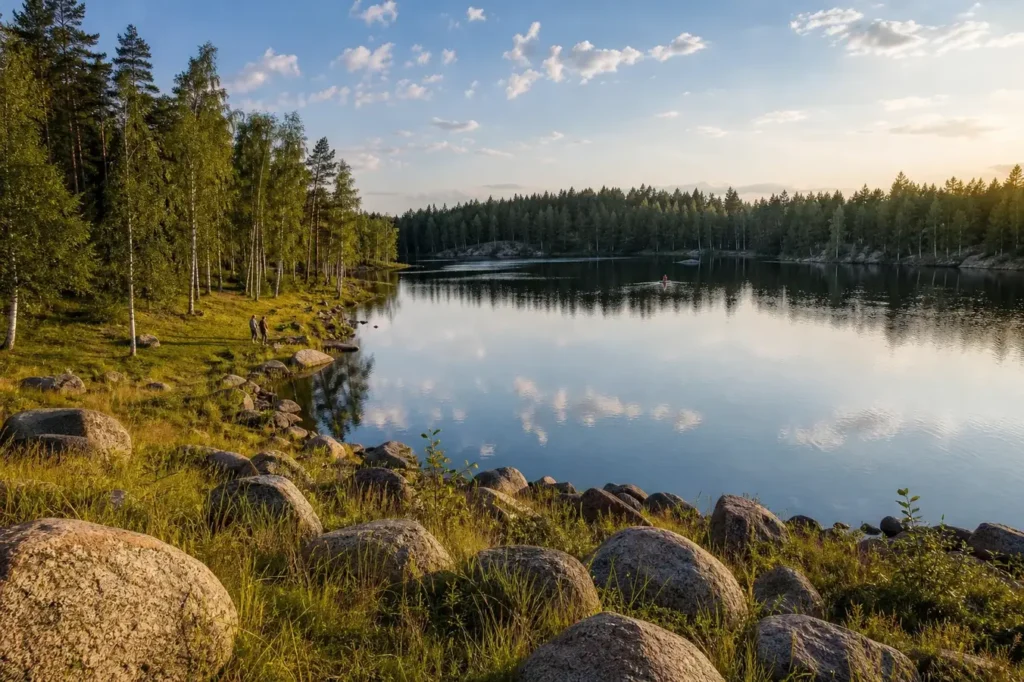
Lake Shartash Yekaterinburg is one of the largest natural water features within the city, fed by a tectonic fault that opened a million years ago. The lake takes its name from Turkic words meaning “yellow stone,” referring to the weathered granite boulders that ring its bean-shaped shore. Today it is the city’s primary recreational destination for locals seeking nature: walkers, cyclists, swimmers and families all use the free-access forest park that surrounds it.
Visitors come for the lake itself, the protected birch and pine forest, the trail system, and the dramatic Stone Tents—ancient granite outcrops sacred to Iron Age shamanistic peoples. Winter brings ice skating and skiing; summer brings water sports and picnics. The lake remains busy yet feels wild, a place where the Urals’ geological history is written in stone.
Quick Facts
| Russian name | Озеро Шарташ |
|---|---|
| Distance from the nearest major city | 1,800 km |
| Travel time from the nearest major city | 26–28 hours by train; 4 hours by flight |
| Address | Kirovsky District, Yekaterinburg, Sverdlovsk Oblast, Russia OpenStreetMap · Google Maps |
| Opening hours | Open 24 hours |
| Admission | Free |
| Best time to visit | Late May through early September is the warmest and most pleasant season. Parks are full, the lake is swimmable (mid-summer warmest), forest trails are dry, and daylight is long. June through August are best for water sports and swimming.Late September through October brings autumn foliage and fewer crowds; water is cool but the forest is beautiful.November through March: the lake freezes solid and becomes a winter recreation area for ice skating and skiing. Daylight is short (plan visits in daylight hours). Winter is quieter and atmospheric but requires warm clothing and caution on ice.Visit on weekdays or early mornings to avoid summer weekend crowds. Late afternoon brings sunset visitors and photographers. Spring (April–early May) is wet and muddy; water is cold. |
| Recommended duration | 2–4 hours |
What Is (and Isn't) Part of a Visit to Lake Shartash, Yekaterinburg?
| Part | Status | Notes |
|---|---|---|
| Lake Shartash itself – swimming, water sports, views | Included in the standard ticket | Free public access year-round to the lake shore and water. No tickets required. |
| Shartash Forest Park – cycling, walking, hiking trails | Included in the standard ticket | Free public access. The 12.5 km path around the lake is open to all. Forest trails connect to the main path. |
| Stone Tents (Kamennyye Palatki) – ancient granite formations | Included in the standard ticket | Free public access. Accessible via forest trail from the main lake area; no separate ticket required. Part of the protected natural complex. |
| Recreation bases and gazebo rentals | Separate ticket or institution | Rental of barbecues, gazebos, and cabins requires advance booking and payment. Separate contact; operators run independent businesses around the shore. |
| Bicycle rentals (available in central Yekaterinburg) | Separate ticket or institution | Not provided at the lake itself. Rental shops in the city centre offer bikes at affordable rates. Bring your own or rent before arrival. |
| Café and food services on site | Separate ticket or institution | Limited or no permanent cafés at the lake. Small kiosks may operate seasonally. Bring snacks and water. Some recreation bases offer catering if you rent their facilities. |
| Shartash Granite Quarry (2.4 km away) | Outside / not part of it | Not part of the lake or park. An active industrial quarry that has operated since the 1960s. Not open to public visits. |
How to Get from the nearest major city to Lake Shartash, Yekaterinburg
| Option | Duration | Price | Notes |
|---|---|---|---|
| Public Bus from Yekaterinburg City Centre | 30–45 minutes | ₽ | Multiple buses serve Shartash Lake from central Yekaterinburg. Bus lines connect the city centre to stops near the lake's eastern shore (near Izoplit village) and southern areas. Buses run frequently during daylight hours and into the evening. Journey time depends on traffic and which section of the lake you aim for. This is the most affordable option. Buy a single ticket on board or use a transport card (available at metro stations and convenience stores). Last return buses run into the early evening. |
| Bicycle from City Centre | 20–40 minutes (depending on district) | ₽ | Cycling is popular and practical for reaching Shartash. Several bike rental shops operate in central Yekaterinburg; rental rates are affordable. Popular city cycle routes lead directly to the lake. This option gives flexibility and combines transport with recreation. Bring a lock and helmet; cycle on designated lanes where available. The route is flat or gently rolling. Return to the city centre at your own pace or use the rental agency's collection service. |
| Taxi or Ride-Share App (Yandex Taxi, Uber or Citymobil) | 20–30 minutes from city centre | ₽₽ | Taxis and ride-share apps are widely available in Yekaterinburg and reach the lake in 20–30 minutes depending on which section and traffic. Drivers know the lake well. Request drop-off at the main beach or picnic area. This option is convenient if you have luggage or limited time. Fares are moderate. Return transport is available by the same method. Apps in Russia: Yandex Taxi is the most reliable; Citymobil and Uber also operate. |
| Private Car or Rental Vehicle | 20–30 minutes from city centre | ₽₽ | Driving to Lake Shartash is straightforward; several parking areas surround the lake. Roads are paved and accessible year-round. Parking is free or inexpensive. This option offers flexibility to explore multiple sections of the lake and take your own pace. Car rental in Yekaterinburg is available from agencies and international chains. Winter driving is possible but requires appropriate tires and caution. Note: some rough forest roads require a higher-clearance vehicle. |
₽ budget · ₽₽ moderate · ₽₽₽ upscale · ₽₽₽₽ splurge. Price levels are estimates compared with typical prices for visitors.
Why Visit Lake Shartash, Yekaterinburg?
Lake Shartash is a natural attraction where visitors see and experience what makes the Urals distinctive: massive granite formations, old-growth forest, and geology on the scale of a million years. The 12 km cycling trail is flat and accessible, making it suitable for all fitness levels. Water sports, from swimming to windsurfing, are available in summer; in winter, the frozen lake becomes a skating rink. The Stone Tents—dramatic granite outcrops—draw photographers and history enthusiasts. Best of all, it costs nothing and requires no bookings, making it ideal for unstructured exploration or a family day out.
Highlights of Lake Shartash, Yekaterinburg
The Bean-Shaped Lake and the Million-Year Tectonic History
Lake Shartash formed roughly 1 million years ago as a result of tectonic movement—a fault in the Earth's crust that subsided and filled with water. The lake is 3.8 km long, 2.8 km wide, and averages 3 metres deep, with a maximum depth of 4.7 metres. Its oval outline is instantly recognizable from above. The lake is one of only two large natural water bodies inside Yekaterinburg's city limits and is of geological and ecological significance. Look for the clear water in spring and early summer; it greens later in the season.
Tip: Arrive early morning in spring to see the water at its clearest before algae blooms turn it greenish in summer.
Stone Tents (Kamennyye Palatki) – Ancient Granite Monuments
Stone Tents are a natural monument: dramatic granite outcrops in the forest near the northern shore, left behind by Ice Age glaciers. Local shamanistic peoples of the Iron Age used these formations for sacred rites; traces of human presence date to the late Neolithic era. The stones create a striking landscape, with massive weathered boulders stacked like tents. The site is free and reachable on foot from the main lake area or via the forest trail. A bicycle tour around the lake includes a stop here.
Tip: Go in the morning or late afternoon for the best light on the granite; the stones photograph dramatically when the sun is low.
The 12.5 km Forest Park Trail for Walking and Cycling
A path circles the entire lake, mostly asphalt with sections of dirt, totalling roughly 12.5 km. It runs through the Shartash Forest Park and passes the village of Izoplit. The route is flat and suitable for all abilities, from families with strollers to serious cyclists. Along the way you pass meadows, forest, picnic areas, and access points to the water. Walkers typically take 2–3 hours for the full circuit at a leisurely pace; cyclists take 1.5–2 hours. The path is busier on weekends and in summer; quieter on weekday mornings.
Tip: Rent a bicycle from agencies in central Yekaterinburg to complete the full circuit; it gives a better sense of the lake's scale than a car or short walk.
Summer Swimming and Beach Access
The lake is swimmable in summer, though water quality varies by area and season. The eastern shore near Izoplit village is the most popular swimming zone and has informal beaches and designated access. Water is warmest in mid-summer (July and August). The lake also hosts kayaking and water sports clubs in the southwestern section. Several recreation bases around the shore rent cabins with barbecues and offer amenities. Always bring a swimsuit and towel if you plan to swim; facilities are basic outside organized rental areas.
Tip: Check current water quality before swimming; spring water is clearest; avoid the lake in mid-summer if algae bloom is visible. Swim in marked zones.
Winter Recreation: Ice Skating, Skiing and Wildlife
When the lake freezes solid (typically October through May), locals use the surface for ice skating and the surrounding forest for cross-country skiing. The frozen lake becomes an extension of the park, opening new routes. The forest around Shartash is home to squirrels and waterfowl; tame ducks and squirrels are common near picnic areas and will approach visitors. Winter visits are rewarding for photographers and for anyone seeking a quiet forest walk in snow.
Tip: Winter visits are safest in daylight; the forest lacks lighting after dark. Bring sturdy boots or ice skates, and layers of warm clothing.
Picnic and Recreation Bases Around the Shore
Multiple recreation complexes and rental bases operate around the lake, offering gazebos, barbecue equipment, and amenities. These are concentrated on the southern and western shores. Some require advance booking, especially in high season (summer weekends). Day-use picnic areas are free and scattered around the public park. Bring your own food and drinks, or use the facilities offered by rental bases. Clean up after yourself; the park is popular but can show wear from visitor use.
Tip: Book a gazebo or barbecue rental in advance if you plan to visit on a summer Saturday or Sunday; walk-in availability may be limited.
Yellow Granite Boulders and the Lake's Name
The lake's name comes from the Turkic words "sar" (yellow) and "tash" (stone). This refers to the numerous granite boulders that ring the shore and weather to a yellowish hue over time. These rocks are a geological legacy of the Ice Age; as glaciers melted and retreated, they left behind massive granite blocks scattered across the landscape. The boulders give the lake's coastline its distinctive northern Ural character. They are safe to explore and photograph.
Tip: Visit the Stone Tents and examine the weathered granite close up to understand the lake's geological history and the origin of its name.
Atmosphere
Lake Shartash feels like a forest lake that happens to be inside a city, not the other way around. The birch and pine forest is dense and quiet, muffling traffic noise from distant roads. In summer, the meadows fill with picnickers, families, and dog walkers, especially on weekends. Birdcalls, wind in the trees, and the sound of bicycle wheels on asphalt are the dominant soundscape. The water itself is calm and reflects the sky. In winter, the frozen lake creates an otherworldly silence; you can hear your footsteps on ice and snow. Early mornings are peaceful; late afternoons bring joggers and sunset seekers. The Stone Tents, rising unexpectedly from the forest, give the place a primal quality.
History of Lake Shartash, Yekaterinburg
Lake Shartash formed approximately 1 million years ago through tectonic subsidence—a shift in the Earth’s crust that created a depression that filled with water over millennia. It is one of the oldest lakes in the Urals. The lake basin lies on a bed of granite, which surfaces as the characteristic yellow-hued boulders and Stone Tents that define the landscape today.
Human presence at the lake dates to the late Neolithic era, with archaeological traces found on the shores. The Stone Tents granite formations held sacred significance for shamanistic peoples of the Iron Age, who used them for ritual purposes. These practices are documented in local archaeological records but are not visible to modern visitors.
In the Soviet era, Shartash was incorporated into the city’s recreational infrastructure as Yekaterinburg (then Sverdlovsk) expanded eastward. The forest park was developed for public use. In the 1960s, a nearby granite quarry began operations; its activities have occasionally affected the lake’s water chemistry, depositing heavy metals in the lake bed, though fish populations remain present.
Today, Lake Shartash is protected as a natural area and public forest park. It remains the only large natural lake within Yekaterinburg’s city limits and is central to locals’ identity of the city as a place where nature remains accessible.
Tickets and Booking for Lake Shartash, Yekaterinburg
Lake Shartash and its forest park are free to access year-round, 24 hours a day. No tickets or advance bookings are required for general lake access, swimming, walking, or cycling. If you wish to rent a recreation base, gazebo, barbecue equipment or cabin, you must book separately with the operator; rates and availability vary. Rental operators are private businesses; contact details are best found through local tourism websites or by phone on arrival.
For facilities and rental services, booking in advance is recommended, especially during summer weekends and holidays. Specific facility hours may vary from the lake’s 24-hour access; check locally or by phone before visiting a particular location.
Rates for Russian citizens and special concessions are not applicable here, as general lake access is free. For detailed rental information and current provider contacts, visit Yekaterinburg’s official tourism website.
Plan and Book
Suggested itineraries Lake Shartash, Yekaterinburg
2 hours
Arrive by bus or taxi. Park and walk the eastern shore near Izoplit (the busiest swimming area) for 1.5 hours. Look for the Stone Tents monument in the nearby forest. Take photos, observe waterfowl and the granite formations. Return to the city by the same transport. Ideal for a morning or afternoon outing.
3–4 hours
Arrive by bike or taxi. Rent a bicycle if you don't have one. Cycle the full 12.5 km loop around the lake at a relaxed pace, stopping to explore the Stone Tents and meadows. Have a picnic or swim (bring a swimsuit). Return to central Yekaterinburg by bike or public transport. This gives a complete sense of the lake's scale.
Half day (4–6 hours)
Cycle the full lake loop. Stop for a picnic at a beach or meadow area. Explore forest trails beyond the main path. Visit and photograph the Stone Tents. If in summer, swim. In winter, skate on the frozen lake if conditions permit. Return to the city in late afternoon or early evening. This pace allows unhurried exploration and relaxation.
Full day with return
Drive or take a taxi to a recreation base and rent a gazebo and barbecue. Arrive in the morning. Spend the day cycling, walking, picnicking, and swimming. Explore different sections of the shore and forest. Sunset views are striking from the western shore. Depart before dusk. This option suits families and groups seeking a comprehensive outdoor day.
How to Get to Lake Shartash, Yekaterinburg
From central Yekaterinburg by public transport: Multiple bus routes serve Lake Shartash. Take bus lines that head toward the eastern or southern lake areas from the city centre. Journey time is 30–45 minutes. Get off at the main beach or picnic area stop. From the bus stop, walk 5–10 minutes to the shore. Ask the driver or other passengers to confirm your stop; locals know the lake well.
From the metro: Yekaterinburg Metro does not reach the lake directly. Use the metro to reach a central bus hub or transport interchange, then take a bus to the lake.
By bicycle: The city has dedicated cycle lanes that extend toward Shartash. Plan a 25–40-minute ride depending on your starting point. Popular routes lead to the eastern shore. Use a map app or ask at bike rental shops for the current best routes.
By taxi or ride-share app: Use Yandex Taxi, Citymobil or Uber to request a journey to Lake Shartash. Journey time from central Yekaterinburg is 20–30 minutes. Request drop-off at the beach or recreation area you aim for.
By car: Parking is available around the lake shore; free or low cost. Roads are paved and accessible year-round.
Accessibility
The main forest path around the lake is mostly asphalt or packed earth, making it accessible for walking and cycling. Sections are flat; some areas have gentle slopes. The path is generally wheelchair-accessible in sections, though not all parts have paved surfaces or designated wheelchair ramps. Accessible parking areas exist near main beach zones.Picnic areas and meadows near the shore are accessible to wheelchairs in places, especially those near parking. Most recreation bases have basic facilities. The Stone Tents require short forest hikes over natural terrain; not wheelchair-accessible.Visitors with limited mobility should stay on the main paved path. Accessible restroom facilities are limited; those at recreation bases may require rental. In winter, snow and ice reduce accessibility; verify conditions before visiting.
Food Nearby
Food options directly at Lake Shartash are limited. No major restaurants or cafés operate permanently on the shore. Small seasonal kiosks may sell snacks and drinks in summer, but availability is inconsistent. Recreation bases with gazebo rentals sometimes offer catering or allow you to use their barbecues for a fee.Bring your own picnic food and water; this is standard practice. Shops and cafés are in nearby Yekaterinburg neighborhoods (Kirovsky District); take public transport if you need supplies before or after your visit.
What to Bring
Sunscreen, hat, and insect repellent (especially in summer and early autumn). A swimsuit and towel if you plan to swim (water is warmest July–August). Snacks and plenty of water; facilities at the lake are minimal. Sturdy walking or cycling shoes. In winter, warm clothing, layers, ice skates or cross-country skis if planning winter activities. A bicycle lock if renting. Bag and rubbish disposal; help keep the park clean. No drones or tripods without prior permission.
Best Views and Photo Spots of Lake Shartash, Yekaterinburg
Stone Tents granite formations, northern forest area
Massive weathered granite blocks stacked against dark forest. The boulders are golden-grey and dramatic, especially in low-angle light. These ancient Ice Age glacial deposits rise unexpectedly from flat ground, creating a landscape that feels primordial.
Best time: Early morning or late afternoon for warm, raking light on the stone. Autumn when forest colors intensify the contrast.
Western shore at sunset
The lake stretches flat and calm, reflecting an orange or pink sky. Dark tree line frames the composition. The opposite shore (east) becomes silhouetted. Water and sky merge in a serene, mirror-like view.
Best time: 30–60 minutes before sunset on clear days. May through September for the longest sunsets; October for clear autumn light.
Eastern beach near Izoplit village
Sandy or pebbly beach with visitors, tame waterfowl, and the calm lake. Forest backdrop. Informal and active atmosphere; good for environmental portraits and candid shots of leisure.
Best time: Summer mornings or late afternoons for softer light and fewer crowds. Weekdays preferred.
Frozen lake surface in winter
Vast white expanse with minimal detail, surrounded by birch trees (white bark) and evergreen forest. Aerial view from a ridge or shore shows the lake's bean shape. Creates stark, minimalist compositions.
Best time: Early winter (January–February) when snow is fresh and uniform. Overcast days reduce harsh shadows. Midday for flat, diffuse light.
Birch forest near the main path
White-barked birch trees with undergrowth and dappled light. Sense of depth and verticality. The forest is dense but navigable; atmospheric and quintessentially Ural.
Best time: Autumn for golden leaves and warm light filtering through canopy. Early morning when mist may be present.
Photography Rules
Photography is permitted freely on the lake shore and forest. Drones and tripods are not explicitly forbidden but should be used responsibly and kept away from other visitors. Professional photography may require contact with the park management. The Stone Tents are an excellent photo subject, especially in early morning or late afternoon light. The frozen lake and forest in winter offer strong compositions. Bring a waterproof bag in rainy season.
Family Suitability
Lake Shartash is very family-friendly. The flat, easy paths suit strollers and small children. Shallow, designated swimming areas are suitable for young swimmers with supervision. Children enjoy the tame ducks and squirrels. Cycling is popular for families; many rent bikes together. Picnic areas and meadows encourage relaxed day outings. In winter, ice skating and sledding are available for older children. The park has no entrance fees or time limits, allowing flexible scheduling. Facilities (restrooms, water, food) are minimal off-season, so plan accordingly. Supervision is essential near water and in forest trails; the park is safe but large and can feel remote in quiet areas.
Russia Vibes Tips
- Arrive early on summer weekends to secure parking and avoid crowds; midweek visits are much quieter and more peaceful.
- Rent a bicycle in central Yekaterinburg before heading to the lake to complete the full 12.5 km loop; it reveals the lake's true scale better than a car ride.
- The Stone Tents are easy to miss if driving; go on foot or by bike to spot them. Ask at recreation bases for directions; many locals know the area well.
- Bring snacks and water from the city; no reliable food vendors operate at the lake itself, even in summer.
- In winter, confirm that the ice is solid enough to walk on before venturing far from shore. Daylight is short; plan visits in daylight hours only for safety.
- Visit in spring (May) or autumn (September) for fewer crowds and perfect temperatures; summer attracts families and can feel busy on weekends.
Explore Nearby Lake Shartash, Yekaterinburg
Browse more: All Day Trips · All Day Trips in Yekaterinburg · All Parks · All Yekaterinburg
FAQ: Lake Shartash, Yekaterinburg
Is there an entrance fee for Lake Shartash?
No. Lake Shartash and its forest park are completely free to access. There are no tickets, no entrance gates, and no advance booking required for general lake access, walking, cycling, swimming, or picnicking. You only pay if you rent a gazebo, barbecue or cabin from a recreation base.
Can I swim in Lake Shartash?
Yes, but with caution. The lake is swimmable in summer (warmest July–August). Water quality varies seasonally; it is clearest in spring and early summer, then greens with algae later in the season. The eastern shore near Izoplit is the most popular designated swimming area. Avoid swimming alone; always use marked zones if available.
Is the lake suitable for families with young children?
Yes. The park has flat, easy paths suitable for strollers. Shallow areas and designated beaches allow supervised swimming. Children enjoy feeding the tame ducks and squirrels. Cycling paths are safe. Picnic areas are abundant. Plan visits on weekdays or mornings to avoid crowds. Bring food and water from the city.
How long does it take to walk around the entire lake?
The full 12.5 km path takes roughly 2–3 hours at a leisurely walking pace, or 1.5–2 hours by bicycle. You can also walk sections of the shore in 1–2 hours without completing the full loop.
What are the Stone Tents, and are they worth seeing?
Stone Tents are ancient granite formations (Kamennyye Palatki)—massive boulders left behind by Ice Age glaciers. They held sacred significance for Iron Age shamanistic peoples and are part of the lake's protected natural complex. They are visually striking and worth the short hike. Access is free and included in general park entry.
Is Lake Shartash frozen solid enough to walk on in winter?
Yes, the lake freezes solid from roughly November through March and locals ice skate and walk on it. Always verify ice conditions locally before venturing far from shore, especially early and late in the season. Daylight is short in winter; plan visits in daylight only. The frozen surface becomes a winter recreation area.
How do I get to Lake Shartash from the city centre?
By bus (30–45 minutes), bicycle (25–40 minutes), taxi or ride-share app (20–30 minutes), or private car (20–30 minutes). Buses are cheapest and frequent. Cycling is practical and enjoyable. Parking is free or inexpensive around the lake. See the Getting There section for detailed transport options.
What is the best time to visit Lake Shartash?
Late May through September for warm weather, swimming, and long daylight. June–August is busiest. September–October is less crowded with pleasant weather and autumn colors. Winter (November–March) is quieter and suitable for ice skating and cross-country skiing, though daylight is limited. Avoid spring (April–early May) as it is wet and muddy.
Russia Vibes is a one-person project. A coffee keeps it going
How we research and update our guides
About this guide: AI assistance and accuracy
This guide is created with the help of AI and is based on official sources where available. Mistakes can still happen. Opening hours, prices, rules and other details are given to the best of our knowledge as of the date shown and can change without notice. It offers general recommendations only, not professional, legal or travel advice. Please confirm important details with the official source before you travel; you are responsible for your own plans and decisions.

Take this guide with you
Get a free PDF of this guide to print or read offline: key facts, tips and a map link on a few clean pages.
Report an issue on this page
Paying for your trip: please read
International sanctions affect payments between Russia and many other countries. In practice, cards issued in the EU, the UK, the US and several other countries often do not work in Russia, Russian cards usually do not work abroad, and some booking platforms, airlines and payment providers limit or suspend their services for Russia. The situation changes frequently.
We do not give legal or financial advice, and this site does not encourage anyone to break or circumvent sanctions. Whatever you plan, you are responsible for following the laws and regulations that apply to you, including those of your country of residence and citizenship.
Many travelers still organise their stay lawfully. It is worth asking your bank or payment provider what is currently permitted, contacting hotels, tour operators and carriers directly about the payment methods they accept, and checking which services are open to customers from your country. Clarify payment, cancellation and refund terms before you commit to a booking, and keep your plans flexible.
Partner links on this site may not be available in every country, and prices, availability and rules in our guides can differ from what you see when you book.