
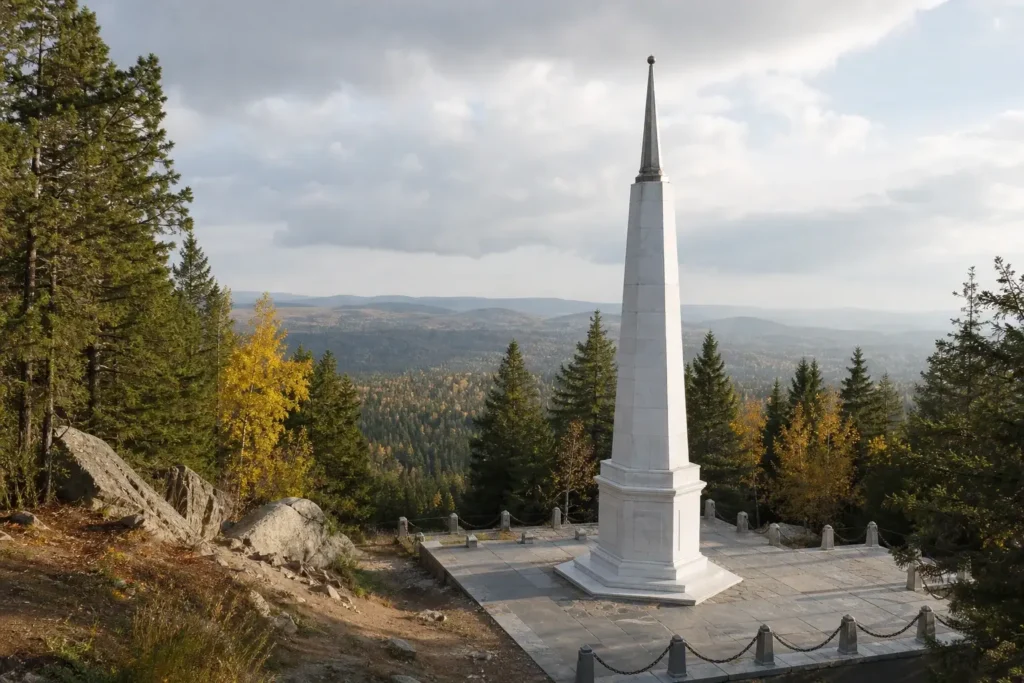
The border between Europe and Asia is one of the features of the Ural area, with Yekaterinburg situated practically on it and the boundary running 17 km from the city. The most practical Europe-Asia border monument for visitors is a marble obelisk at kilometre 17 of the Novomoskovsky tract, already within the city limits.
Tourists love to stand in front of the border marker with one foot in Europe, one foot in Asia for a good photo. The modern monument was installed in August 2004, with two stones at its base symbolizing the union of the two parts of the world: one from the farthest point of Europe—Cape Roca—and the other from the edge of the Asiatic continent—Cape Dezhnev. The site lies on the main highway west toward Perm and Pervouralsk, making it an easy half-hour excursion from central Yekaterinburg.
Quick Facts
| Russian name | Обелиск на границе Европа-Азия |
|---|---|
| Distance from the nearest major city | 1,800 km |
| Travel time from the nearest major city | approximately 26 hours by train via Trans-Siberian Railway; 3.5–4 hours by flight |
| Built / opened | 2004 |
| Address | Московский тракт, 17 км, Yekaterinburg, Sverdlovsk Oblast OpenStreetMap · Google Maps |
| Opening hours | Open year-round, 24 hours (outdoor monument) |
| Admission | free |
| Best time to visit | Late spring through early autumn (May–September) offers the most comfortable weather and daylight for photography. Summer (June–August) is warmest but also busiest with tour groups. Late afternoon (after 4 pm) typically sees fewer visitors than mid-morning. Avoid winter (November–February) due to snow, ice, and extremely short daylight hours. Overcast days are acceptable for visiting but reduce photo quality; clear days are preferable. |
| Recommended duration | 30 minutes to 1 hour |
What Is (and Isn't) Part of a Visit to Europe-Asia Border, Yekaterinburg?
| Part | Status | Notes |
|---|---|---|
| Marble obelisk monument and continental boundary marker | Included in the standard ticket | Main attraction; free to access and photograph. |
| Parking area and walking space around monument | Included in the standard ticket | Small parking lot with rest area; access is free and unrestricted. |
| Small café and gift shop | Separate ticket or institution | Privately operated at the site; optional refreshments and souvenirs available for purchase. |
| Historic 19th-century obelisks near Pervouralsk | Separate ticket or institution | Approximately 35 km away and require separate organized tour or independent transport to visit; not included in a standard day trip to the 17 km monument. |
| Red marble 30-meter stella monument (1 km away) | Separate ticket or institution | Newer large monument installed in 2008; reachable by vehicle from the 17 km site but considered a different destination. |
| Other Yekaterinburg city attractions | Outside / not part of it | Church on the Blood, historical center, and city museums are separate visits in the city center. |
How to Get from the nearest major city to Europe-Asia Border, Yekaterinburg
| Option | Duration | Price | Notes |
|---|---|---|---|
| Taxi or private car from central Yekaterinburg | 45 minutes to 1 hour round trip including visit | ₽₽ | Most convenient and common option for independent travelers. Taxis available at hotels, train station, or via mobile apps. Ask driver to wait or arrange return pickup. Cost depends on negotiated fare and time spent on site. |
| Organized tour from Yekaterinburg | 3 to 4 hours (typically includes city center sights plus monument) | ₽₽ | Many tour operators offer combined city tours with Europe-Asia border stop. Includes transport, guide, and often other Yekaterinburg landmarks. Available daily; book in advance online or through hotels. |
| Bus from central Yekaterinburg | 1.5 to 2 hours round trip including visit | ₽ | Bus route 180 runs from central Yekaterinburg (approximately 14 km); the nearest official stop is about 2 km before the monument. Most economical but requires negotiating with driver for drop-off at the site. |
| Ride-share app (Yandex.Taxi, Uber equivalent) | 45 minutes to 1 hour round trip | ₽₽ | Available from central Yekaterinburg; set destination as Московский тракт, 17 км. Allows flexible pickup and drop-off. Ride cost varies by demand and time of day. |
₽ budget · ₽₽ moderate · ₽₽₽ upscale · ₽₽₽₽ splurge. Price levels are estimates compared with typical prices for visitors.
Why Visit Europe-Asia Border, Yekaterinburg?
Since the beginning of the 18th century, the Urals—an about 2,500 km long mountain range—are considered as the boundary between Europe and Asia. The notion was first proposed by Philip Johan von Strahlenberg, a Swedish army officer, while the founder of Yekaterinburg, Vasily Tatishchev, later declared that the idea had been his. Visiting the monument offers the memorable experience of literally straddling two continents, a uniqueness that few places on earth can claim. The site is particularly meaningful for Trans-Siberian travelers: if you travel from Moscow, you’ll inevitably cross the border of Europe and Asia before entering Yekaterinburg. The outdoor setting provides scenic woods and an uncrowded atmosphere outside peak tourist seasons.
Highlights of Europe-Asia Border, Yekaterinburg
The Marble Obelisk
The marble obelisk features a metal spire reminiscent of the Eiffel Tower, with intertwined letters 'E' and 'A'. At the base rest two symbolic stones: one from Cape Roca, Portugal (the westernmost point of continental Europe), and one from Cape Dezhnev in Chukotka (the easternmost point of Asia). The structure stands prominently at the roadside, visible from the parking area.
Tip: Arrive during daylight hours for clear photographs; the monument is unlit at night.
Standing Between Continents
The main attraction is positioning yourself with one foot on each side of the obelisk to stand simultaneously on two continents. The ground markings clearly show the Europe and Asia sides, making the continental divide obvious and photo-friendly.
Tip: Take photos from multiple angles: side-by-side with companions, the legs-apart stance, and with the obelisk as background.
The Wooded Setting
The monument sits in a natural landscape of Ural forest, with modest parking and a small rest area nearby. The surroundings offer views typical of the region: coniferous trees and the gentle terrain of the mid-Urals. There is a small cafe and gift shop at the site.
Tip: The site can get busy with coach tours mid-morning and early afternoon; visit early morning or late afternoon for fewer crowds.
Historical Context
There is more than one Europe-Asia border marker in the Urals near Yekaterinburg. The closest to the city is the 2004 obelisk at 17 km by the highway to Perm. Two original obelisks from the 19th century are located about 35 km from Yekaterinburg near Pervouralsk, about 5 minutes' walk apart.
Tip: If you have more time, day-trip guides can take you to both the modern monument and the historic 19th-century obelisks for deeper historical context.
Photography Viewpoints
The parking area and immediate surroundings offer several natural photo angles. The monument is positioned to frame well from the road, and the wooded background provides contrast to the white marble structure.
Tip: The best natural light for photographs is mid-morning (around 9–11 am) or late afternoon (4–6 pm), depending on season.
Atmosphere
The site is open air and typically feels spacious despite its popularity with visitors. During peak tourist season (June–August), you may encounter groups arriving by car or on organized tours; during shoulder seasons, it can feel quite peaceful. The atmosphere is informal and celebratory—people naturally gather to pose for photographs, creating an air of playful international spirit.
The natural surroundings are quiet, with sounds of forest and occasional traffic from the nearby highway. Families, couples, and solo travelers of all ages visit. The small café and gift shop add a minor commercial feel without overwhelming the site’s natural character. The monument itself is understated rather than imposing: a white marble structure that seems modest against the vast geography it symbolizes.
History of Europe-Asia Border, Yekaterinburg
Since the beginning of the 18th century, the Urals—an about 2,500 km long mountain range—have been considered the boundary between Europe and Asia. The notion was first proposed by Philip Johan von Strahlenberg, a Swedish army officer of German origin, who as a Russian prisoner of war spent more than 10 years in Western Siberia and had the freedom to study Russian geography.
Vasily Tatishchev, the founder of Yekaterinburg, later declared that the notion of the Ural as continental border had originally been his idea. Obelisks as monuments on the border between Europe and Asia were installed from the beginning of the 19th century, with the first markers looking like wooden monuments with inscriptions ‘Europe’ and ‘Asia’ on four sides.
The historically most interesting of the nearby border monuments is the one 2 km before the town of Pervouralsk, since it had been visited in 1837 by crown prince, later Tsar Alexander II, famously drinking one glass of wine in Europe and one in Asia.
The first obelisk near Yekaterinburg was built 33 km west at the foot of Mount Berezovaya (Birch Tree Hill). In 2008, it was replaced by a grandiose stella of red marble 30 m tall, and the original elegant stella was relocated to the side of the New Moscow track.
In August 2004, a modern symbol of Europe and Asia was installed at the 17 km point on the Moscow highway, with two stones at its base brought from the farthest point of Europe—Cape Roca—and the edge of the Asiatic continent—Cape Dezhnev. In total, the Ural region has more than 20 obelisks marking Europe and Asia.
Tickets and Booking for Europe-Asia Border, Yekaterinburg
Free entry: The Europe-Asia Border Monument is free to visit and photograph year-round. No tickets or reservations are required.
Getting there: Arrange a taxi or private car from your hotel or the railway station (the most straightforward method). Alternatively, book an organized tour through tour operators such as Europe-Asia Tours or Express to Russia, which combine city center sights with the border monument and typically cost a moderate price per person.
Public transport option: Bus route 180 runs toward the site from central Yekaterinburg; however, the official stop is about 2 km before the monument, so you may need to negotiate with the driver for a closer drop-off or walk the final distance.
Timing: Visit during daylight hours for safe walking and good photography. The site is accessible 24 hours as an outdoor monument, but facilities (café, parking attendant) operate during daylight hours only.
Plan and Book
Suggested itineraries Europe-Asia Border, Yekaterinburg
30 minutes on site
Drive to the monument, park, take photographs with one foot on each continent side, view the symbolic stones, and depart. Minimal time for exploration; suitable for travelers with very limited time or those passing through.
1 hour on site
Arrive, walk around the monument from different angles, photograph multiple times, read plaques or interpretive signs if present, visit the small gift shop, have a beverage or snack at the café, and depart. Time to take photos, absorb the continental significance, and enjoy the forest setting.
Half day (3–4 hours total, including 1.5 hours on site)
Depart central Yekaterinburg in the morning by taxi or organized tour. Visit the monument (1–1.5 hours), explore the surrounding wooded area briefly, return to the city center with a guide or independently. Can be combined with other western sights if on an organized tour.
Full day extended excursion
Join a comprehensive tour visiting both the 17 km monument and the historic 19th-century obelisks near Pervouralsk (approximately 35 km, requiring 6–8 hours total). Includes separate visits to multiple border markers and detailed historical context. Typically offered by specialized tour operators.
How to Get to Europe-Asia Border, Yekaterinburg
By taxi or private car (recommended): From central Yekaterinburg or the railway station, request a taxi to Московский тракт, 17 км (Novomoskovsky tract, 17 km). Journey time is 30–45 minutes depending on traffic. Cost is moderate and negotiated by meter or flat rate. The site is clearly signposted on the main Moscow highway heading west.
By organized tour: Many hotels and tour operators in Yekaterinburg offer tours to the Europe-Asia border. Pickup is typically from your hotel or the railway station. Tours range from 3–4 hours and include transport and often a guide.
By public transport: Bus route 180 runs from central Yekaterinburg (approximately 14 km); the nearest official stop is about 2 km before the monument. This is the most economical option but requires walking the final distance or negotiating with the driver.
Exit and return: Arrange for the taxi driver to wait and return you to the city, or book a return trip separately through your app or tour operator. Return journey takes the same time as outbound.
Accessibility
The monument sits in an open parking area on level ground with paved or compacted gravel access. The obelisk itself is approached by a short walk from the parking area. Wheelchair users can access the parking area, but the final approach to the monument may have uneven surfaces. The site has no formal accessibility features such as ramps or accessible facilities. A small café and toilet facilities are present but their accessibility is not documented. It is advisable to check with your tour operator or the site directly if accessibility is a concern.
Food Nearby
A small café operates at the monument site itself, offering light refreshments such as hot beverages, snacks, and basic food items. Quality and menu are modest. For more substantial dining, options are limited in the immediate area. If planning a longer visit or preferred meal, eat before departing Yekaterinburg or bring packed snacks.
What to Bring
Bring water and snacks, especially if visiting by independent transport. Wear comfortable walking shoes suitable for uneven ground. In warm months (May–September), sun protection (hat, sunscreen) is recommended. In cooler months (September–May), warm clothing is essential; the site is outdoors and exposed to Ural weather. A camera is obvious but worthwhile. Bag restrictions are not formally published; small day bags are typical and acceptable.
Best Views and Photo Spots of Europe-Asia Border, Yekaterinburg
The obelisk from the parking area
Wide shot of the monument with forest background, framing the marble structure and metal spire. Shows the scale of the marker and natural setting.
Best time: Mid-morning (9–11 am) for soft directional light; late afternoon for warm golden light and longer shadows.
Ground-level continental divide line
Close-up of the boundary mark on the ground with one foot on each side; captures the personal experience of straddling continents. Most popular photo.
Best time: Any daylight hour; best on clear, bright days for shadow contrast.
The symbolic stones at the monument's base
Detail shot of the Cape Roca and Cape Dezhnev stones, showing the text and the symbolic union. Requires close proximity.
Best time: Midday when light is even, reducing harsh shadows on text.
Forest approach and surrounding Ural landscape
Wider perspective of the monument within its natural forest and mountain setting, capturing the geography of the Urals.
Best time: Late afternoon when golden light filters through trees; early morning for mist if present.
Monument with accompanying people
Group photo with multiple people positioned on either side of the obelisk, emphasizing the continental divide and shared experience.
Best time: Any time with good light; works well with overcast conditions to avoid harsh shadows on faces.
Photography Rules
Photography is freely permitted and encouraged; this is the primary activity for most visitors. No tripods, drones, or commercial filming require permission. Flash photography is not necessary outdoors. Indoor facilities (café) may have posted rules. There are no restricted areas at the outdoor monument.
Family Suitability
The Europe-Asia Border Monument is family-friendly and suitable for children of all ages. The site is open-air, safe, and centered on a straightforward concept—straddling two continents—that children find engaging and memorable. Strollers can navigate the parking area and immediate vicinity, though the final approach to the monument may be uneven. Facilities are minimal (small café only), so plan accordingly. Young children may need help for posed photos. The site is not strenuous and requires no climbing, making it suitable even for very young children or those with limited mobility.
Russia Vibes Tips
- Avoid mid-morning to early afternoon (10 am–2 pm) in summer, when organized tour groups typically arrive in waves. Visit early morning (7–9 am) or late afternoon (4–6 pm) for a more peaceful experience and better photographs with improved light.
- Bring a small bottle of water even if stopping briefly. The site has minimal shade and the café can be crowded or closed unexpectedly. Having water avoids needing to purchase from the café at inflated prices.
- Do not assume the site is only 17 km away by straight-line distance. Road distance is longer (about 20–22 km by the Moscow highway), and actual travel time from the city center is 35–50 minutes depending on traffic and pickup location.
- If visiting as part of an organized tour, verify whether the tour includes time only at the 17 km modern monument or also visits the historic 19th-century obelisks near Pervouralsk. The historic monuments are about 35 km further and require additional time; do not assume they are included in a standard 3-hour tour.
- The symbolic stones (Cape Roca and Cape Dezhnev) at the monument's base are small and easy to miss. Look for them at the base of the obelisk to understand the deeper meaning beyond the simple continental divide photo.
Explore Nearby Europe-Asia Border, Yekaterinburg
Browse more: All Day Trips · All Day Trips in Yekaterinburg · All Landmarks · All Yekaterinburg
FAQ: Europe-Asia Border, Yekaterinburg
Is entry to the Europe-Asia Border Monument free?
Yes, entry and photography are completely free. The monument is an outdoor public landmark with no gates, tickets, or time restrictions. The small café and gift shop are optional.
How far is the monument from Yekaterinburg city center?
The boundary runs 17 km from the city. Road distance is approximately 20–22 km by the Moscow highway. Travel time by taxi from central Yekaterinburg is 35–50 minutes depending on traffic.
What is the best time of day to visit?
Visit during daylight hours for safe walking and clear photographs. Early morning (7–9 am) and late afternoon (4–6 pm) offer better light and fewer crowds than mid-morning and early afternoon when tour groups arrive. The site is open 24 hours but lacks facilities outside daylight hours.
Is this the only Europe-Asia border monument near Yekaterinburg?
There is more than one Europe-Asia border marker in the Urals near Yekaterinburg. The closest to the city, at a distance of 17 km by the highway to Perm, dates from 2004. Two original obelisks from the 19th century are approximately 35 km away near Pervouralsk, about 5 minutes' walk apart.
How long should I plan to spend at the monument?
30 minutes to 1 hour is typical. This includes parking, walking to the obelisk, taking photographs, and viewing the symbolic stones. Add more time if visiting the café or if the site is crowded and you must wait for photo opportunities.
Do I need to book a tour or can I visit independently?
Independent visits by taxi are straightforward and recommended. Simply arrange a taxi to Московский тракт, 17 км and negotiate a round trip or return pickup. Alternatively, book an organized tour through hotels or tour operators for convenience and context.
What are the symbolic stones at the base of the obelisk?
Two stones symbolize the union of the two parts of the world: one was brought from the farthest point of Europe—Cape Roca, Portugal—and the other from the edge of the Asiatic continent—Cape Dezhnev, Chukotka.
Is the site accessible for people with mobility issues?
The parking area is level and accessible. The approach to the monument has uneven surfaces, and no formal accessibility features are present. Visitors with limited mobility can park close but may not be able to reach the obelisk itself. Check with a tour operator beforehand if this is a concern.
Russia Vibes is a one-person project. A coffee keeps it going
How we research and update our guides
About this guide: AI assistance and accuracy
This guide is created with the help of AI and is based on official sources where available. Mistakes can still happen. Opening hours, prices, rules and other details are given to the best of our knowledge as of the date shown and can change without notice. It offers general recommendations only, not professional, legal or travel advice. Please confirm important details with the official source before you travel; you are responsible for your own plans and decisions.

Take this guide with you
Get a free PDF of this guide to print or read offline: key facts, tips and a map link on a few clean pages.
Report an issue on this page
Paying for your trip: please read
International sanctions affect payments between Russia and many other countries. In practice, cards issued in the EU, the UK, the US and several other countries often do not work in Russia, Russian cards usually do not work abroad, and some booking platforms, airlines and payment providers limit or suspend their services for Russia. The situation changes frequently.
We do not give legal or financial advice, and this site does not encourage anyone to break or circumvent sanctions. Whatever you plan, you are responsible for following the laws and regulations that apply to you, including those of your country of residence and citizenship.
Many travelers still organise their stay lawfully. It is worth asking your bank or payment provider what is currently permitted, contacting hotels, tour operators and carriers directly about the payment methods they accept, and checking which services are open to customers from your country. Clarify payment, cancellation and refund terms before you commit to a booking, and keep your plans flexible.
Partner links on this site may not be available in every country, and prices, availability and rules in our guides can differ from what you see when you book.