
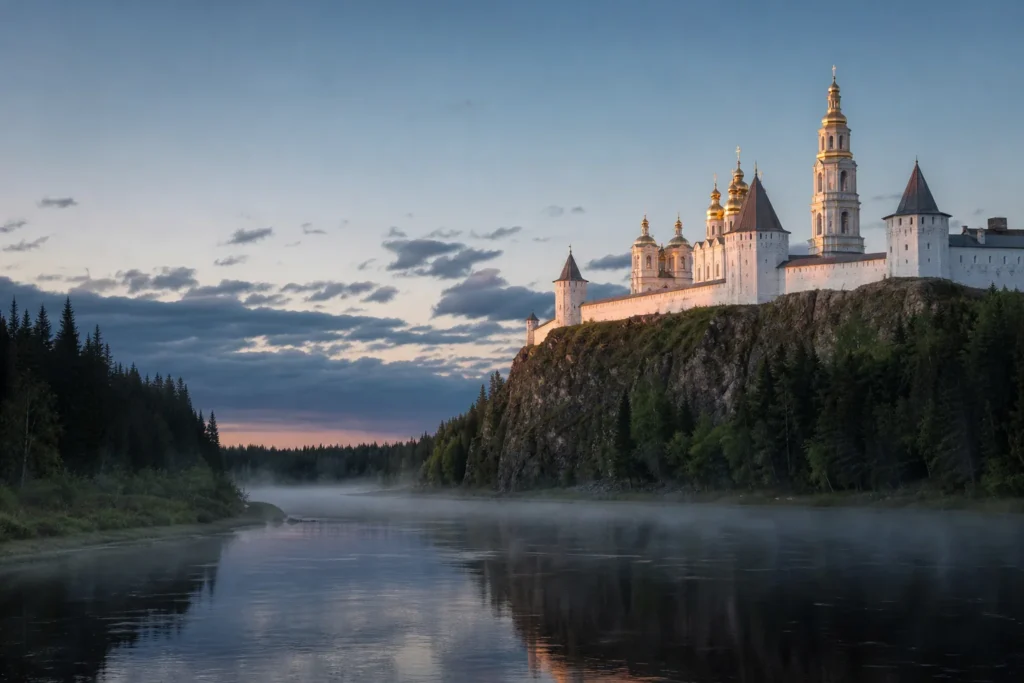
Verkhoturye was founded in 1598 during the campaigns of Yermak’s Cossacks on colonizing Siberia. It was an important transit point on one of the major trading ways that connected European Russia with Siberia. The Verkhoturye historic town is built on high ground overlooking the Tura River, with architecture that has survived industrialization.
Being one of the oldest Russian settlements east of the Urals and with forty churches in the area, Verkhoturye is considered one of the centers of Russian Christianity. The town’s two main architectural anchors—the Kremlin and the St. Nicholas Monastery—define its identity and draw pilgrims and history enthusiasts from across the region.
Quick Facts
| Russian name | Верхотурье |
|---|---|
| Distance from the nearest major city | 1,855 km |
| Travel time from the nearest major city | 20–24 hours |
| Built / opened | 1598 |
| Address | ул. Советская, д. 9, Верхотурье, Свердловская область, Россия OpenStreetMap · Google Maps |
| Opening hours | Kremlin grounds daily 06:00-20:00; Trinity Cathedral and museums have varying hours; check official site for current schedule |
| Admission | ₽ |
| Best time to visit | Visit Verkhoturye in late May through September for the most pleasant weather. Summer is peak pilgrimage season, so expect larger crowds at the monastery during religious holidays. Spring (May) brings fresh greenery and flowing water in the Tura River. Autumn (September–early October) offers the best light for photography, with foliage turning gold and red. Winter is beautiful but cold (down to –15°C) and many visitors are pilgrims observing religious fasts; some facilities close or reduce hours. Weekdays are quieter than weekends. |
| Recommended duration | 4–6 hours |
| Website | adm-verhotury.ru |
What Is (and Isn't) Part of a Visit to Verkhoturye Historic Town, Yekaterinburg?
| Part | Status | Notes |
|---|---|---|
| Verkhotursky Kremlin complex | Included in the standard ticket | Stone fortress with Trinity Cathedral, bell tower, administrative buildings, and museum; included in the town visit; some interiors may require separate payment. |
| Trinity Cathedral interior | Separate ticket or institution | Active Orthodox church; entry is usually free but modest dress required; candlelit winter services available to respectful visitors. |
| Local History Museum | Separate ticket or institution | Housed in the former warehouse building within the Kremlin; modest entrance fee; allows 1–2 hours for a complete visit. |
| St. Nicholas Monastery | Included in the standard ticket | Active male monastery with Cathedral of the Exaltation of the Holy Cross and other churches; grounds are accessible; Cathedral contains the relics of St. Simeon; pilgrims' hotel offers free or low-cost overnight stays. |
| Transfiguration Church | Included in the standard ticket | Located within the monastery grounds; access depends on active services; check schedule at monastery entrance. |
| Female Convent (Verkhoturye Convent) | Separate ticket or institution | Located on the eastern edge of town; contact the Yekaterinburg Eparchy for visiting information and permission. |
| Merkushino village and St. Simeon's hermitage site | Outside / not part of it | Located 65 km east of Verkhoturye; requires a separate day trip; accessible by car or organized tour. |
| Yekaterinburg attractions (Ipatyev House, museums) | Outside / not part of it | Yekaterinburg is 306 km to the south; not part of a single-day Verkhoturye itinerary unless combining destinations. |
How to Get from the nearest major city to Verkhoturye Historic Town, Yekaterinburg
| Option | Duration | Price | Notes |
|---|---|---|---|
| Train from Yekaterinburg | 5–5.5 hours | ₽ | Electric train (Lastochka) departs regularly from Yekaterinburg-Pass station. The Verkhoturye railway station is located 5.5 km from the town center; take a local bus or taxi for final 10–15 minutes. This is the cheapest and most reliable option for visitors without a car. Check the Russian Railways website for current schedules. |
| Bus from Yekaterinburg | 5–6 hours | ₽ | Buses depart from the Yekaterinburg intercity bus station and run nearly every hour. Journey follows the Serovsky Highway northward. Ask the driver to confirm the final stop location in Verkhoturye. |
| Taxi or private car from Yekaterinburg | 4–4.5 hours | ₽₽ | Road distance is approximately 306 km by car. Faster than train or bus but more expensive. Parking is available in the town. If driving, allow extra time for traffic in Yekaterinburg on departure. |
| Shared minibus (marshrutka) | 4–5 hours | ₽ | Minibuses operate from central Yekaterinburg; ask at your hotel for the nearest stop or go to the minibus station. Less frequent than buses but direct service. Confirm the destination with the driver before boarding. |
₽ budget · ₽₽ moderate · ₽₽₽ upscale · ₽₽₽₽ splurge. Price levels are estimates compared with typical prices for visitors.
Why Visit Verkhoturye Historic Town, Yekaterinburg?
The city is also home to the only kremlin in the Urals and its location on the picturesque River Tura make it a perfect tourist destination. The town offers a rare glimpse into 17th–20th-century Russian frontier life, with well-preserved wooden houses lining streets that feel frozen in time.
In contrast to the surrounding mining towns, Verkhoturye has been relatively untouched by industrialization and much of its historic appearance has been preserved. Holy relics of the highly revered Christian Saint Simeon of Verkhoturye, the Miracle Worker of all Siberia are kept there. This spiritual significance makes it a destination for both pilgrims and those seeking to understand Russia’s Orthodox heritage.
Highlights of Verkhoturye Historic Town, Yekaterinburg
Verkhotursky Kremlin
The city is home to the only kremlin in the Urals. The Verkhoturye Kremlin is considered the smallest Kremlin in Russia, with dimensions of only 125 by 194 meters. It is the only Kremlin in the Urals and the last one to be built in the country. The stone fortress sits on a dramatic cliff and contains several buildings within its walls. Look for the brick decoration and towers set against the river backdrop.
Tip: Enter through the main gate from the town side; the kremlin grounds are accessible daily but check the tourist office for which interior buildings are open to visitors.
Trinity Cathedral
The Trinity Cathedral, the main church of the Verkhoturye Kremlin, was consecrated in April 1709. It was built in the style of Moscow Baroque, with a high bell tower, in which a clock was installed in 1777. This church is a striking example of Siberian Baroque, delighting visitors with its grace, rich facade decor, and gilded domes reaching toward the sky. The interior has two separate worship spaces: a cold church for winter and a warm, heated church.
Tip: Climb the bell tower for commanding views of the Tura River and surrounding forests; ask at the entrance if access is currently allowed.
St. Nicholas Monastery and Cathedral of the Exaltation of the Holy Cross
In 1604 – less than a decade after its founding – Verkhoturye gained the first monastery in Russia's Asian territory. Dedicated to St. Nicholas, this monastery became a major point for missionary activity throughout Siberia. The Cathedral of Exaltation of the Holy Cross was built 1905–1913. The Holy Cross Cathedral houses the relics of Saint Simeon of Verkhotursky, the Saint patron of the Ural land. This is an active monastery with a working community.
Tip: Modest dress is required. Early morning visits allow you to observe liturgical services; check the official monastery schedule in advance.
Local History Museum
The local history museum of Verkhoturye is situated in the Kremlin, in the building of the former warehouse. The museum consists of two floors. The main exhibit is on the second floor, the first floor houses administrative offices and temporary exhibits. The museum presents artifacts and documents related to Verkhoturye's role as a frontier customs post and center of Orthodox expansion.
Tip: The museum is small and can be visited quickly; combine it with the kremlin walk. Ask at the entrance for a guided tour if available.
Transfiguration Church
The Transfiguration Church was built in 1821. This church stands within the St. Nicholas Monastery grounds and represents 19th-century Orthodox church architecture. Its simpler lines contrast with the more elaborate baroque structures, showing the evolution of the monastery's architectural style over time.
Tip: This is an active place of worship, so visit respectfully and check if interior visits are permitted on your visit day.
Tura River Viewpoint
The rocky cliff overlooking the Tura River offers one of the town's most atmospheric perspectives. The river winds through forested terrain, and the view shows how Verkhoturye sits strategically on the route connecting European Russia and Siberia. The river remains commercially important and you may see barges or boats passing.
Tip: Visit at dusk for the best light; early morning mist over the water is also striking in autumn.
Atmosphere
Verkhoturye feels like a settlement paused mid-prayer. The streets are quiet outside of pilgrimage seasons, and the rhythm of life follows Orthodox observances rather than commercial traffic. Golden onion domes catch the light, and bells ring several times daily from different churches, creating an overlay of sound that defines the place.
Pilgrims and believers move through the town with purpose, many carrying icons or flowers to leave at shrines. Visitors who are not pilgrims often find themselves the only tourists at a given site, creating moments of solitude in front of 17th-century frescoes or beneath bell towers. The wooden houses have weathered to soft grays and browns, and the few shops and cafés serve mainly locals. The pace is genuinely slow; there is little reason to hurry here.
History of Verkhoturye Historic Town, Yekaterinburg
Verkhoturye was founded in 1598, during the campaigns of Yermak’s Cossacks on colonizing Siberia. The kernel of the town was formed by the Kremlin, founded on a rocky cliff in 1597. The location was strategic: it was an important transit point on one of the major trading ways that connected European Russia with Siberia. Goods flowing east were taxed here, and the customs revenue funded construction.
In 1604 – less than a decade after its founding – Verkhoturye gained the first monastery in Russia’s Asian territory. The St. Nicholas Monastery became not only a spiritual center but also a practical base for Christian missionary work across Siberia. In 1704, there was a solemn transfer of the relics of the righteous Simeon of Verkhoturye from the village of Merkushino to the St. Nicholas Monastery, marking the start of mass pilgrimages. This event transformed the town into a pilgrimage destination.
For the first 100 years of its existence, Verkhoturye consisted of log buildings, but the beginning of the 18th century witnessed the rebuilding in brick of the fortress, located above the Tura River on a massive outcropping named Trinity Rock after the Trinity Church. This central ensemble became a symbol of authority, with brick decoration reminiscent of the Moscow Kremlin. The Trinity Cathedral was consecrated in April 1709. It was seriously devastated by fires of 1674 and 1738.
After the establishment of provinces in Russia it became the chief town of the Tobolsk Province. In the 19th century lines of communication with Siberia moved far to the south, and Verkhoturye lost all its trading significance. The town’s economy collapsed, but its religious role expanded as pilgrims continued to arrive and the monastery remained an important spiritual center.
After the revolutions of 1917 the Bolsheviks first took power in the town, but from September, 1918 till July, 1919 Verkhoturye was under the control of the anti-Soviet White forces of Kolchak. In 1926 Verkhoturye lost the status of a town and regained it only in 1947, in connection with the 350th anniversary since its foundation. Soviet planners left Verkhoturye largely untouched compared to other regional towns, partly because of its remoteness and partly because its religious significance required careful handling. It is the only town of the Sverdlovsk Region registered on the list of Russia’s 115 cities and towns, having the most valuable architecture ensembles and complexes.
Tickets and Booking for Verkhoturye Historic Town, Yekaterinburg
| Ticket | Price | Includes |
|---|---|---|
| Kremlin grounds entry | ₽ | Access to the outer kremlin grounds, fortress walls, and exterior views of all buildings; includes access to bell tower if staffed. |
| Local History Museum | ₽ | Two-floor museum with exhibits on Verkhoturye's history as a trade post and religious center; 1–1.5 hours. |
| St. Nicholas Monastery | Free | Grounds and Cathedral of the Exaltation of the Holy Cross; active church services available; pilgrims may stay overnight free or low-cost. |
| Combined day-trip ticket from Yekaterinburg (if organized tour) | ₽₽ | Round-trip transport, guided tour of kremlin and monastery, and museum; lasting 8–10 hours; book through tour operators in Yekaterinburg. |
₽ budget · ₽₽ moderate · ₽₽₽ upscale · ₽₽₽₽ splurge. Price levels are estimates compared with typical prices for visitors.
Tickets to the Kremlin grounds and museum are purchased on-site at the entrance; no advance booking is required for individual visitors. St. Nicholas Monastery is free and open daily; check the official Yekaterinburg Eparchy website for current liturgical schedules, especially if you wish to attend services.
Transport to Verkhoturye from Yekaterinburg can be booked in advance or purchased same-day. Train tickets are available through Russian Railways (rzd.ru) 60 days in advance; book online or at Yekaterinburg-Pass station. Bus tickets are sold at the Yekaterinburg intercity bus station. Taxi and shared minibus fares can be negotiated on arrival or arranged through your hotel.
Note that ticket prices for Russian citizens and concessions differ from those for international visitors. Pilgrim programs and extended monastery stays have their own pricing. For all current categories, hours, and booking details, visit the Verkhoturye town administration website (adm-verhotury.ru) and the Yekaterinburg Eparchy office.
Plan and Book
Suggested itineraries Verkhoturye Historic Town, Yekaterinburg
Half day (4 hours on site)
Arrive by train or bus mid-morning. Go directly to the Verkhotursky Kremlin, spend 1.5–2 hours exploring the grounds, Trinity Cathedral interior, and climbing the bell tower. Visit the Local History Museum for 45 minutes. Walk through the central streets to observe wooden architecture. Return to Yekaterinburg by late afternoon or evening train/bus.
Full day (8–10 hours total)
Depart Yekaterinburg early. Spend 2–3 hours in the Kremlin complex, museum, and Trinity Cathedral. Have lunch at a local café. Walk to St. Nicholas Monastery and spend 2 hours exploring the Cathedral of the Exaltation of the Holy Cross and grounds. If arriving during liturgical hours (typically 06:00–09:00 morning service, 17:00–19:00 evening service), attend a service for spiritual immersion. Return to Yekaterinburg evening train or bus.
Overnight pilgrimage (24 hours)
Arrive by midday train. Check into pilgrims' hotel at the monastery (inquire at monastery reception) or a guesthouse in town. Explore kremlin and museum in afternoon. Attend evening service at the monastery. Spend evening in prayer or quiet reflection. Wake early for pre-dawn liturgy (typically 06:00). Breakfast, final walk through town and cemetery. Depart by midday or evening train.
How to Get to Verkhoturye Historic Town, Yekaterinburg
By train from Yekaterinburg: Depart from Yekaterinburg-Pass station on the Lastochka electric train; journey takes 5–5.5 hours. The Verkhoturye railway station is 5.5 km from the town center. From the station, take a local bus (inquire which route serves the town center) or a taxi for 10–15 minutes to reach the kremlin or monastery. Train tickets are available through rzd.ru or at the station.
By bus from Yekaterinburg: Buses depart hourly from the Yekaterinburg intercity bus station and take 5–6 hours, following the Serovsky Highway northward. Confirm the final stop with the driver; most buses stop near the town center or close to the monastery. Return buses run regularly throughout the day.
By car from Yekaterinburg: Drive north on the Serovsky Highway for approximately 306 km (4–4.5 hours). Parking is available in the town center and near the kremlin entrance. The road is generally in good condition year-round but can be congested in Yekaterinburg during rush hours.
Accessibility
The Kremlin has gravel paths and some uneven stone surfaces; sturdy shoes are recommended. The bell tower climb involves narrow stairs without handrails. St. Nicholas Monastery grounds are mostly flat. The Local History Museum is on two floors with no elevator; if mobility is limited, focus on the ground floor. Some church entrances require a small step; check with staff for assistance. There is no officially published information on wheelchair access; contact the Yekaterinburg Eparchy or town administration in advance if you have specific needs.
Food Nearby
Verkhoturye has limited formal dining; a few small cafés and bakeries operate near the town center and the monastery. These serve basic Russian fare such as pies, bread, and hot tea. The town's single small shop stocks packaged goods, fresh bread, and drinks. Most visitors bring snacks from Yekaterinburg or eat at their accommodation. During pilgrimage seasons, the monastery may offer simple meals to guests; ask at reception.
What to Bring
Bring comfortable walking shoes suitable for gravel and uneven stone. A light layer and wind-resistant jacket are essential even in summer, as the river valley can be cool and windy. In spring and autumn, warm clothing is necessary. Sun protection (hat, sunscreen) is useful, especially for the exposed bell tower and kremlin walls. Modest clothing is required if entering churches or the monastery; women should bring a scarf for hair covering. A water bottle is practical as the town has few services. In winter, bring heavy outerwear, waterproof boots, and gloves.
Best Views and Photo Spots of Verkhoturye Historic Town, Yekaterinburg
Tura River viewpoint from the Kremlin walls
The rocky cliff drops 26 meters to the river below. Forest-covered banks stretch north and south. In morning light, the water reflects the sky and surrounding landscape. This is the defining view of Verkhoturye and shows the Kremlin's strategic position.
Best time: Early morning (06:00–08:00) for soft light and mist; late afternoon (17:00–18:00 in summer) for golden light. Clearest views are in May or September.
Trinity Cathedral from the Kremlin square
The gilded domes, white bell tower, and intricate brick facade fill the frame. The cathedral's baroque details catch light beautifully. The composition is balanced by the kremlin walls on either side.
Best time: Midday (11:00–14:00) for full illumination of the domes; overcast days provide even lighting without harsh shadows.
Cathedral of the Exaltation of the Holy Cross, St. Nicholas Monastery (south-west view)
The massive early 20th-century cathedral dominates the monastery grounds. Its brick construction and Orthodox crosses create a striking silhouette against the sky. Bell tower visible to the left.
Best time: Late afternoon (16:00–18:00 in summer) when the brick glows warm. Clear skies enhance the architectural detail.
Kremlin fortress gates and tower from the town side
The stone gate and tower emerge from the wooded slope. The kremlin's compact, defensive design is evident. Town buildings and trees frame the structure below the cliff.
Best time: Morning light from the east highlights the stone texture. Spring (with fresh foliage) or autumn (with color) adds depth.
Wooden architecture of central streets
19th-century wooden houses in soft colors (gray, pale green, white) line quiet streets. Carved window frames and eaves show traditional Ural style. The narrow lanes create depth and perspective.
Best time: Soft morning light (07:00–09:00) or late afternoon (17:00–19:00). Avoid midday harsh shadows.
Cemetery and monument near St. Nicholas Monastery
Orthodox crosses and monuments against foliage and sky create a contemplative scene. The monastery buildings are visible in the background. This location captures the spiritual atmosphere.
Best time: Early morning or dusk when light is diffuse and the atmosphere most contemplative.
Photography Rules
Photography is generally permitted in outdoor areas of the Kremlin and monastery grounds. Photography inside churches is usually restricted to respectful, non-flash documentation; ask permission at the entrance. Tripods are not typically allowed in sacred spaces. Drones are not permitted anywhere in the town. Early morning and late afternoon light over the Tura River offer the best conditions for landscape and architectural photography.
Family Suitability
Verkhoturye is suitable for families with children aged 8 and older who enjoy history and religious sites. The Kremlin grounds are safe and compact, though the bell tower climb has steep, narrow stairs and is best for confident children. The museum has exhibits that may interest school-age children but minimal interactive elements. Younger children may find the quiet pace slow; there are no playgrounds or amusement attractions. Strollers can navigate the kremlin, but the monastery grounds and narrow town streets are challenging with wheels. The town lacks family restaurants or modern amenities; plan meals carefully. Walking distances between sites are manageable but the riverside terrain is uneven.
Russia Vibes Tips
- Attend an Orthodox liturgy at dawn (usually 06:00–08:00) if you arrive the evening before or stay overnight. This is the most authentic experience of the town's spiritual character and requires no language skills; you will observe pilgrims and monks at prayer in a candlelit church.
- Ask at the monastery reception about the free or low-cost pilgrims' hotel if you wish to stay overnight. These simple accommodations are clean and allow extended visits to services and sites without rushing back to Yekaterinburg.
- Visit the Kremlin late in the afternoon when most pilgrims have left for the day; the site is much quieter and the light is warm and soft, ideal for photography and contemplation.
- Bring a simple gift (flowers, candles, or a donation) if you enter the monastery; this shows respect and is welcomed by the community. Ask staff what is appropriate.
- Confirm train times before arriving at the station; schedules can vary seasonally and service occasionally is suspended for maintenance. Use the Russian Railways app or website (rzd.ru) to check current schedules.
- Do not assume all buildings inside the Kremlin are open; the museum and some churches have specific hours. Ask at the entrance for a map showing which sites are accessible on your visit day.
Explore Nearby Verkhoturye Historic Town, Yekaterinburg
Browse more: All Day Trips · All Day Trips in Yekaterinburg · All Landmarks · All Yekaterinburg
FAQ: Verkhoturye Historic Town, Yekaterinburg
Is the Verkhotursky Kremlin really the only kremlin in the Urals?
Yes. Verkhoturye's kremlin (1598–1709) is the only stone fortress of its kind in the Urals region. It is also the northernmost kremlin in Russia and the last one built in the country. Its small size and remote location are due to its frontier role.
What is the significance of Saint Simeon of Verkhoturye?
Saint Simeon was a hermit and mystic whose relics are housed in the Cathedral of the Exaltation of the Holy Cross. He is revered as the patron saint of the Urals and fishermen. In 1704, his remains were moved to the St. Nicholas Monastery, triggering mass pilgrimages that transformed Verkhoturye into a religious center.
Can I attend a church service as a visitor?
Yes. Orthodox liturgies are held daily, typically at 06:00–08:00 (morning) and 17:00–19:00 (evening). You are welcome to observe respectfully. Women should wear modest clothing and bring a head covering. Visitors do not participate in the sacraments but may stand quietly at the back of the church.
Is a guide necessary or recommended?
Not essential, but guides offer context about history and architecture. Self-guided visits are possible if you read advance materials. Organized day tours from Yekaterinburg include a bilingual guide and round-trip transport; these are convenient if you prefer structured experiences.
What is the best way to get to Verkhoturye from Yekaterinburg without a car?
Train is the most reliable and cheapest option. The Lastochka electric train takes 5–5.5 hours and departs regularly from Yekaterinburg-Pass station. Buses also run hourly and take 5–6 hours. Both options are affordable and require no advance booking.
How much time do I need to see the main sights?
A 4-hour half-day visit allows time for the Kremlin, museum, and bell tower. A full day (8–10 hours) includes the monastery, churches, a meal, and a walk through the town. Many pilgrims stay overnight to experience liturgy and the spiritual atmosphere.
Are there restaurants in Verkhoturye?
Verkhoturye has very limited formal dining—a few small cafés and a bakery. Expect simple Russian fare such as pies and tea, not cuisine or special diets. Most visitors bring snacks or eat at their hotel. The monastery may offer simple meals to guests during pilgrimage times.
Can women visit the St. Nicholas Monastery, which is a men's monastery?
Yes, women can visit the monastery grounds and churches as guests. The monastery has separate areas for monks and visitors. Modest dress is required. Some areas may be restricted; ask at the gatehouse for current visiting guidelines.
Russia Vibes is a one-person project. A coffee keeps it going
How we research and update our guides
About this guide: AI assistance and accuracy
This guide is created with the help of AI and is based on official sources where available. Mistakes can still happen. Opening hours, prices, rules and other details are given to the best of our knowledge as of the date shown and can change without notice. It offers general recommendations only, not professional, legal or travel advice. Please confirm important details with the official source before you travel; you are responsible for your own plans and decisions.

Take this guide with you
Get a free PDF of this guide to print or read offline: key facts, tips and a map link on a few clean pages.
Report an issue on this page
Paying for your trip: please read
International sanctions affect payments between Russia and many other countries. In practice, cards issued in the EU, the UK, the US and several other countries often do not work in Russia, Russian cards usually do not work abroad, and some booking platforms, airlines and payment providers limit or suspend their services for Russia. The situation changes frequently.
We do not give legal or financial advice, and this site does not encourage anyone to break or circumvent sanctions. Whatever you plan, you are responsible for following the laws and regulations that apply to you, including those of your country of residence and citizenship.
Many travelers still organise their stay lawfully. It is worth asking your bank or payment provider what is currently permitted, contacting hotels, tour operators and carriers directly about the payment methods they accept, and checking which services are open to customers from your country. Clarify payment, cancellation and refund terms before you commit to a booking, and keep your plans flexible.
Partner links on this site may not be available in every country, and prices, availability and rules in our guides can differ from what you see when you book.