
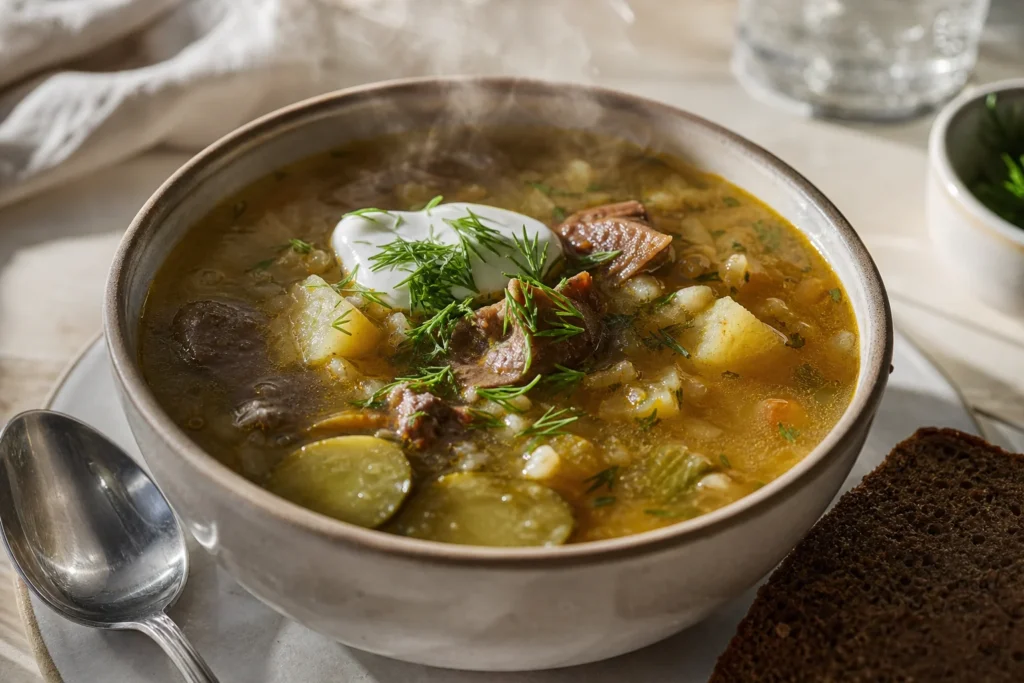
Leningradsky Rassolnik is a hearty pickle soup specific to Saint Petersburg, distinguishing it from the Moscow version. If you’re interested in Leningradsky Rassolnik: how to make pickle soup at home, you’ll discover a warming dish that balances salty, sour and savory flavors through fermented ingredients and beef kidney.
This guide shows you how to make Leningradsky Rassolnik step by step, from preparing the broth to finishing with sour cream. The recommended approach uses chicken broth with beef kidneys, potatoes, carrots and pearl barley—simpler than traditional Moscow rassolnik but deeply satisfying.
Quick answer: Soak pearl barley, make a broth with beef kidneys and aromatics, then combine with sautéed vegetables, pickles and pickle brine. Total time is about 90 minutes. Medium difficulty, moderate cost.
At a Glance
| Type | Dishes |
|---|---|
| Local name | Ленинградский рассольник |
| Origin | During the Soviet period, Leningrad rassolnik became widely popular. The inventor of this soup variation is Nikolai Alexandrovich Kurbatov, who invented multiple dishes during the Soviet period. After the October Revolution, Kurbatov worked as a technologist at NARPIT (association of public cafeterias). At night he and his colleagues worked on their own cookbook. He invented Leningrad rassolnik in 1918–1919. If the old rassolnik was an elegant soup of pickled cucumbers and root vegetables, its Leningrad version made it more filling with pearl barley. |
| Servings | 2–4 servings |
| Total time | 90 minutes |
| Difficulty | Medium |
History and Story of Leningradsky Rassolnik, Saint Petersburg
The dish is known to have existed as far back as the 15th century, when it was called kalya. Rassolnik is considered one of the traditional dishes in Russian cuisine. The origins of rassolnik lie in other soups that consist of fermented ingredients, such as kalya, made with chicken or fish meat, roe, pickled cucumbers, or pickled lemons and lemon brine.
Today in Russian restaurant menus you might come across “Leningrad style” preceding the word rassolnik. But this St. Petersburg soup is just the Soviet version of a Moscow dish. It was created after the 1917 Revolution and reflected food shortages. It was made with pickled cucumbers, potatoes and pearl barley. Leningrad rassolnik is cooked in chicken broth, with beef kidneys added, and the new additions to the recipe were potatoes and carrots, and pearl barley replaced with rice.
Ingredients
- 900 ml beef or chicken stock
- 200 g beef kidneys, cleaned
- 80 g pearl barley, rinsed
- 300 g potatoes
- 120 g carrots
- 100 g onions
- 200 g pickled cucumbers
- 150 ml pickle brine
- 30 ml oil or butter
- 2 bay leaves
- 6–8 black peppercorns
- Salt to taste
- Fresh dill (optional)
How Leningradsky Rassolnik, Saint Petersburg Is Made
Step 1: Soak the barley
Place rinsed pearl barley in a bowl and cover with cold water. Let it soak for at least 30 minutes, or longer if possible. This softens the barley and reduces cooking time. Drain before use.
Tip: Some cooks soak barley overnight for more consistent texture.
Step 2: Prepare the kidneys and broth
Leningrad rassolnik is cooked in chicken broth, with beef kidneys added. Clean the kidneys thoroughly, removing any membrane and tubes. Cut into bite-size pieces. Bring stock to a gentle boil in a large pot. Add kidneys, drained barley, one bay leaf and peppercorns. Reduce heat and simmer for 30 minutes, skimming off any foam that rises to the surface.
Tip: Some recipes use beef broth for deeper flavor; chicken broth creates a lighter version.
Step 3: Prepare the vegetables
While the broth simmers, dice potatoes into small cubes. Cut carrots into thin slices or small dice. Finely chop onion. Dice the pickled cucumbers into bite-size pieces.
Tip: Uniform vegetable sizes help everything cook evenly.
Step 4: Sauté the aromatics
Heat oil or butter in a separate frying pan over medium heat. Add diced onion and cook until softened and beginning to turn golden, about 3–4 minutes. Add sliced or diced carrots and sauté together for another 4–5 minutes until just tender but still holding shape.
Tip: Don't brown the vegetables too deeply; they'll cook further in the soup.
Step 5: Build the soup
Add the sautéed onions and carrots to the pot with the barley and kidneys. Add the diced potatoes. Bring to a simmer and cook for 10–12 minutes until potatoes are tender. Add the diced pickles and pickle brine. Stir in the remaining bay leaf and adjust salt to taste. Simmer gently for 5–7 more minutes to meld the flavors.
Tip: Add pickles and brine toward the end; if added too early, potatoes can remain firm for a long time.
Step 6: Finish and serve
Remove from heat. Taste and adjust seasoning. Ladle into bowls and top each serving with a spoonful of sour cream if desired. Sprinkle fresh dill over the top. Remove bay leaves before eating.
Tip: Sour cream rounds out the acidity and adds richness; it's optional but traditional.
Variants
- Moscow Rassolnik: uses tripe and kidneys with chicken broth, lighter and more traditional with white root vegetables
- Vegetarian Rassolnik: omits meat and kidneys, made during Lent, emphasizing vegetables and pickle brine
- Rice version: some modern recipes substitute rice for pearl barley for a faster-cooking soup
Common Mistakes to Avoid
- Skipping the soaking step for barley: dry barley takes much longer to cook and may never reach the right texture.
- Not cleaning the kidneys properly: membranes and ducts affect taste and texture; wash thoroughly under cold water.
- Adding pickles too early: they soften too much and potatoes stay firm; add them in the final few minutes.
- Using too much pickle brine: the soup becomes overly sour and unbalanced; add gradually and taste as you go.
- Overcooking the vegetables: potatoes and carrots should be tender but still hold their shape, not mushy.
- Forgetting to skim foam: this keeps the broth clear and improves the final appearance and taste.
How to Order and Eat It
Serve hot in a deep bowl. Top with a generous dollop of sour cream before eating, which cools the soup slightly and smooths the sharp flavors. Add fresh dill if available. Eat with black bread, which soaks up the broth. The sour, salty and savory elements balance each other; taste as you eat to appreciate how the flavors change.
To order: Ленинградский рассольник, пожалуйста [Leningradsky rassolnik, pozhaluysta]
Russia Vibes Tips
- The key part of rassolnik is the rassol, a liquid based on the juice of pickled cucumbers with various other seasonings. Use quality fermented pickles (lacto-fermented, not vinegar-pickled) for authentic flavor; grocery store dill pickles work in a pinch but won't have the same depth.
- Don't discard the pickle juice from a jar—it's the soul of the dish. Some home cooks reserve homemade pickle brine specifically for soup season.
- Make a double batch and freeze the broth (without sour cream). It keeps well and makes weeknight dinner faster. Add fresh sour cream and dill when reheating.
- If you cannot find beef kidneys, use lean beef sirloin or brisket instead; the soup will be slightly different but still delicious. Cut the meat small so it cooks in the same time.
- Pearl barley varies in cooking time depending on quality and storage. Taste it after 30 minutes; if still too firm, cook another 10–15 minutes before adding the potatoes.
- The soup is traditionally eaten as a first course before a main, but it's hearty enough for lunch with bread as a light main course.
Explore Nearby Leningradsky Rassolnik, Saint Petersburg
Browse more: All Food & Drink · All Food & Drink in Saint Petersburg · All Other · All Saint Petersburg
FAQ
What is the difference between Leningradsky Rassolnik and Moscow Rassolnik?
The old rassolnik was an elegant soup of pickled cucumbers and root vegetables; the Leningrad version made it more filling with pearl barley. Leningrad rassolnik is cooked in chicken broth, with beef kidneys added, and includes potatoes, carrots, and pearl barley. Moscow rassolnik uses tripe and kidneys with more root vegetables and less grain.
Do I have to use beef kidneys?
Traditionally yes, but many modern cooks substitute lean beef, pork or chicken. The kidneys give authentic flavor but are not essential. If you avoid them entirely, use more meat to keep the soup hearty.
Can I make Leningradsky Rassolnik vegetarian?
A vegetarian variant of rassolnik also exists, usually made during Lent. Omit the kidneys and use vegetable stock. The pickle brine and barley provide enough character and body for a satisfying soup.
What kind of pickles should I use?
Use fermented (lacto-pickled) dill pickles, not vinegar-pickled. Kosher dill pickles from a grocery store work acceptably. Avoid overly sour or spicy varieties, which will overwhelm the broth.
Why is pickle brine important?
The name rassolnik comes from the Russian word rassol, or brine in which pickled cucumbers are kept. The brine gives the soup its characteristic tangy, sour flavor. It's essential, not optional.
How long does it take to make?
About 90 minutes total: 30 minutes soaking barley, 30 minutes simmering the broth with kidneys, 20–30 minutes sautéing vegetables and building the soup, and 5–10 minutes for the final simmer.
Can I use rice instead of barley?
Yes. Rice cooks faster (15–20 minutes instead of 40–50), so add it later in the cooking process. Some Soviet-era recipes use rice, though barley is more traditional for Leningradsky style.
Is sour cream essential?
It's traditional and recommended, but not mandatory. Sour cream balances the sourness of the pickle brine and adds creaminess. You can serve the soup without it, or with a drizzle of oil instead.
Russia Vibes is a one-person project. A coffee keeps it going
How we research and update our guides
About this guide: AI assistance and accuracy
This guide is created with the help of AI and is based on official sources where available. Mistakes can still happen. Opening hours, prices, rules and other details are given to the best of our knowledge as of the date shown and can change without notice. It offers general recommendations only, not professional, legal or travel advice. Please confirm important details with the official source before you travel; you are responsible for your own plans and decisions.

Take this guide with you
Get a free PDF of this guide to print or read offline: key facts, tips and a map link on a few clean pages.
Report an issue on this page
Paying for your trip: please read
International sanctions affect payments between Russia and many other countries. In practice, cards issued in the EU, the UK, the US and several other countries often do not work in Russia, Russian cards usually do not work abroad, and some booking platforms, airlines and payment providers limit or suspend their services for Russia. The situation changes frequently.
We do not give legal or financial advice, and this site does not encourage anyone to break or circumvent sanctions. Whatever you plan, you are responsible for following the laws and regulations that apply to you, including those of your country of residence and citizenship.
Many travelers still organise their stay lawfully. It is worth asking your bank or payment provider what is currently permitted, contacting hotels, tour operators and carriers directly about the payment methods they accept, and checking which services are open to customers from your country. Clarify payment, cancellation and refund terms before you commit to a booking, and keep your plans flexible.
Partner links on this site may not be available in every country, and prices, availability and rules in our guides can differ from what you see when you book.