
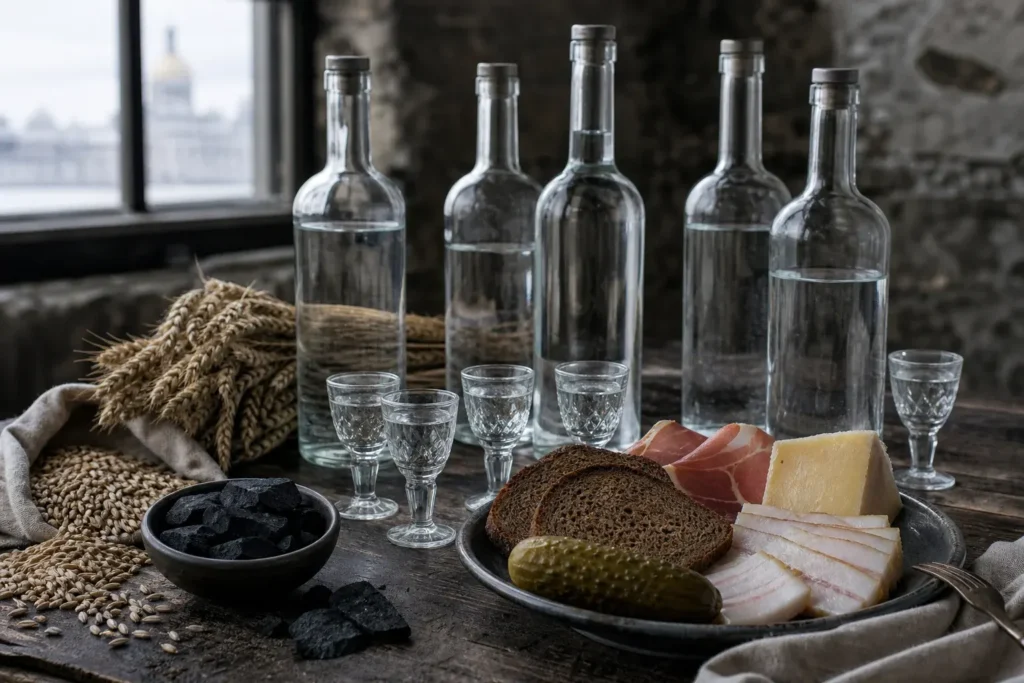
This guide explains how vodka is made in Russia, from selecting grains to the distillation and filtering that define it. Whether you’re visiting Saint Petersburg or interested in the spirit itself, understanding the production process reveals why vodka holds such cultural significance in Russian hospitality and tradition.
The recommended approach is to learn the principles of home distillation and filtering, understanding the key steps that Russian distillers have used for centuries.
Quick answer: Russian vodka begins with fermented grain, is distilled multiple times to reach high alcohol content, then filtered through activated charcoal or other media to remove impurities. The full process takes several days to weeks depending on method and scale.
At a Glance
| Type | Alcoholic drinks |
|---|---|
| Local name | Водка |
| Origin | Russia |
| Servings | 2–4 or as desired |
| Total time | 7–21 days depending on fermentation and distillation method |
| Difficulty | Medium |
History and Story of Vodka, Saint Petersburg
Vodka emerged in Eastern Europe and Russia over centuries, evolving from early grain spirits. By the medieval period, distilled spirits from grain were documented in Russian texts. The name likely derives from ‘voda’ (water) combined with the diminutive ‘-ka,’ suggesting ‘little water.’ Russian vodka culture intensified from the 16th century onward, becoming central to hospitality and tradition. Saint Petersburg, founded in 1703, became a major trading hub where vodka was produced, refined and distributed throughout the empire. The standardization of Russian vodka—neutral flavor, typically 40% ABV—became the model that influenced global vodka production.
Ingredients
- 1 kg grain (rye, wheat or barley) or ready-made neutral spirit
- Water (preferably filtered)
- Yeast (distiller's yeast, 7–10 grams)
- Sugar (if starting from grain, 30–50 grams)
- Activated charcoal or sand for filtering
- Distillation equipment (if distilling at home; check local laws)
- Glass bottles for storage
How Vodka, Saint Petersburg Is Made
Step 1: Prepare the grain base (if starting from scratch)
If beginning with whole grain, clean and crush it slightly. Mix the grain with water and add yeast. Leave in a warm place (18–25°C) for 5–10 days, stirring occasionally. This fermentation converts starches into alcohol. Strain out the solids carefully. Note: many home producers use ready-made neutral alcohol or ethanol to skip this step and focus on filtering and flavoring.
Step 2: Distill (if applicable)
If working with fermented grain liquid, distillation requires specialized equipment and is regulated in most countries—check your local laws first. The goal is to separate alcohol from water and impurities by heating the fermented liquid and collecting the vapor. Professional Russian distilleries perform this in licensed facilities. For home production in most regions, starting with commercial neutral spirit is legal and simpler.
Step 3: Filter through activated charcoal
Pour the spirit through a column of activated charcoal (available in chemical or brewing supply stores) to remove remaining impurities, colors and flavors. Let it drip through slowly. This is the key step that gives Russian vodka its clarity and neutral character. Repeat if desired for extra purity.
Step 4: Add water to reach desired alcohol content
Dilute the filtered spirit with distilled or very clean water to reach the target alcohol level, typically 40% ABV (alcohol by volume) for standard vodka. Mix thoroughly and let rest for 24 hours to allow the mixture to homogenize.
Step 5: Filter again (optional but traditional)
Some Russian producers filter a second time through sand or fine cloth to ensure absolute clarity. This step is optional for home batches but is standard in commercial production.
Step 6: Bottle and store
Pour the finished vodka into clean glass bottles and seal tightly. Store in a cool, dark place. Vodka's high alcohol content makes it shelf-stable for years. Keep bottles upright to prevent cork deterioration.
Variants
- Flavored vodka with herbs, spices or fruit (zubrovka with bison grass, or modern infusions)
- Pepper vodka (pertsovka) steeped with red or black peppers for heat
- Honey vodka (medovukha-style infusions) with local honey
- Grain-based vs. potato-based vodka (though grain is traditional in Russia)
Common Mistakes to Avoid
- Attempting distillation without checking local regulations—home distillation is illegal in many countries including parts of Russia; verify your local laws before starting.
- Using contaminated water—vodka's purity depends entirely on input water quality; use filtered or distilled water only.
- Insufficient filtering—skipping charcoal filtration or reusing old charcoal leaves vodka cloudy and with off-flavors; use fresh, quality activated charcoal.
- Mixing too quickly with water—sudden dilution causes temperature changes and uneven distribution; dilute slowly and let rest.
- Storing in wrong containers—plastic or metal containers can impart flavors; use only glass or food-grade sealed vessels.
- Starting with flavored spirits—vodka's definition is neutrality; begin with a truly neutral base, not flavored alcohol.
How to Order and Eat It
Vodka is traditionally served ice-cold, either neat in small glasses or as part of cocktails. In Russia, it is often consumed in small shots (50–100 ml) accompanied by food—zakuski (appetizers) such as pickles, smoked fish, cured meats, bread and cheese. The practice is to drink quickly and follow with a bite of food rather than sipping slowly. Vodka is rarely consumed on its own without food in traditional Russian hospitality. Modern serving includes mixology—in cocktails with citrus, herbs or other spirits. When visiting Saint Petersburg, you’ll find vodka offered at restaurants, bars and in homes as part of the social ritual.
To order: Водку, пожалуйста [Vodku, pozhaluysta]
Contains alcohol. Please drink responsibly and follow local rules.
Russia Vibes Tips
- Visit distillery museums in Saint Petersburg such as the Vodka Museum (located near Nevsky Prospekt) to understand commercial production and Russian vodka history without attempting home production. They offer tastings and explain why Russian vodka is distinct.
- If you buy vodka in Russia, look for the excise seal on the bottle—it guarantees the product is legal and authentic. Counterfeit vodka is a real problem in some regions.
- Russian vodka is traditionally served at specific moments in meals or toasts, not casually throughout. Learn the custom: a shot is accompanied by a formal gesture or toast (Na zdorovie—to health), then drunk quickly, then followed by food.
- Saint Petersburg's climate (cold winters) is naturally suited to vodka production and storage because low temperatures slow spoilage and allow clear crystallization. Winter is when vodka culture is most vibrant socially.
- Do not attempt home distillation in Russia or most countries without explicit legal permission—it is heavily regulated and often prohibited. Focus on learning about commercially-produced vodka instead through tastings and cultural experiences.
- Water quality is everything in vodka—Russian producers historically used clean spring water or melted snow. If making a home infusion starting with commercial vodka, the quality of any herbs or additions matters more than the base spirit.
Explore Nearby Vodka, Saint Petersburg
Browse more: All Food & Drink · All Food & Drink in Saint Petersburg · All Other · All Saint Petersburg
FAQ
Is vodka actually colorless and flavorless?
True neutral vodka should be colorless and nearly odorless, with minimal flavor. However, this is the result of intensive filtering and distillation—it's not a natural state. Cheaper or less-filtered vodkas may have subtle grain notes or slight cloudiness. Russian producers pride themselves on achieving absolute neutrality.
Can you make vodka at home in Russia?
Home production of spirits is heavily regulated in Russia and most countries. Distillation without a license is illegal. You can infuse or flavor commercial vodka with herbs, but true vodka production (fermentation and distillation) requires legal permission and facilities. Check current regulations before attempting anything.
What's the difference between Russian vodka and vodka from other countries?
Russian vodka traditionally uses rye or wheat as the grain base and emphasizes absolute clarity and neutrality through careful filtering. The cultural tradition of serving it ice-cold with heavy food is distinctly Russian. Legally, 'vodka' can be made anywhere, but Russian vodka carries centuries of refinement and cultural practice.
How much alcohol is in standard Russian vodka?
Standard Russian vodka is typically 40% alcohol by volume (ABV). Some premium varieties may reach 45% or higher. This is a global standard, not unique to Russia, but Russian producers helped establish this norm.
Should vodka be kept in the freezer?
Vodka can be stored in the freezer or refrigerator, but it's not necessary. Its high alcohol content prevents freezing at normal freezer temperatures (−18°C). Cold serving is traditional for taste and texture. Room-temperature storage is fine, as long as bottles are sealed and kept away from sunlight.
What's the best food to eat with vodka?
Russian tradition pairs vodka with hearty, flavorful foods: pickled vegetables (pickles, pickled mushrooms), cured meats, smoked fish, dark bread, and cheese. These strong flavors complement the neutral spirit and balance alcohol absorption. Avoid drinking vodka on an empty stomach.
Is there a Saint Petersburg vodka brand famous outside Russia?
While Saint Petersburg has a rich vodka heritage and distilleries, most famous Russian vodka brands are produced elsewhere or are state-controlled. The city's main cultural legacy is as a historic center of vodka refinement and trade, not as a specific brand origin. Tastings and vodka museums in the city celebrate this heritage.
Can you taste the difference between premium and budget vodka?
If both are truly neutral and properly filtered, the difference is subtle—both should be clear and relatively flavorless. The difference often lies in smoothness (fewer burn sensation), purity (no aftertaste), and production standards rather than obvious flavor. Premium vodka is refined through more distillations and higher-quality filtration media.
Russia Vibes is a one-person project. A coffee keeps it going
How we research and update our guides
About this guide: AI assistance and accuracy
This guide is created with the help of AI and is based on official sources where available. Mistakes can still happen. Opening hours, prices, rules and other details are given to the best of our knowledge as of the date shown and can change without notice. It offers general recommendations only, not professional, legal or travel advice. Please confirm important details with the official source before you travel; you are responsible for your own plans and decisions.

Take this guide with you
Get a free PDF of this guide to print or read offline: key facts, tips and a map link on a few clean pages.
Report an issue on this page
Paying for your trip: please read
International sanctions affect payments between Russia and many other countries. In practice, cards issued in the EU, the UK, the US and several other countries often do not work in Russia, Russian cards usually do not work abroad, and some booking platforms, airlines and payment providers limit or suspend their services for Russia. The situation changes frequently.
We do not give legal or financial advice, and this site does not encourage anyone to break or circumvent sanctions. Whatever you plan, you are responsible for following the laws and regulations that apply to you, including those of your country of residence and citizenship.
Many travelers still organise their stay lawfully. It is worth asking your bank or payment provider what is currently permitted, contacting hotels, tour operators and carriers directly about the payment methods they accept, and checking which services are open to customers from your country. Clarify payment, cancellation and refund terms before you commit to a booking, and keep your plans flexible.
Partner links on this site may not be available in every country, and prices, availability and rules in our guides can differ from what you see when you book.